Tender Offerings
A truly intimate novel alters your pulse. Your blood slows to match the cadence of the sentences, speeds up again with each shift in plot. The feeling is not unlike sleeping next to a loved one, your breath synchronizing at such close range. When the moment is over—the book closed—the feeling lingers. It takes time for your body to return to the usual rhythms.
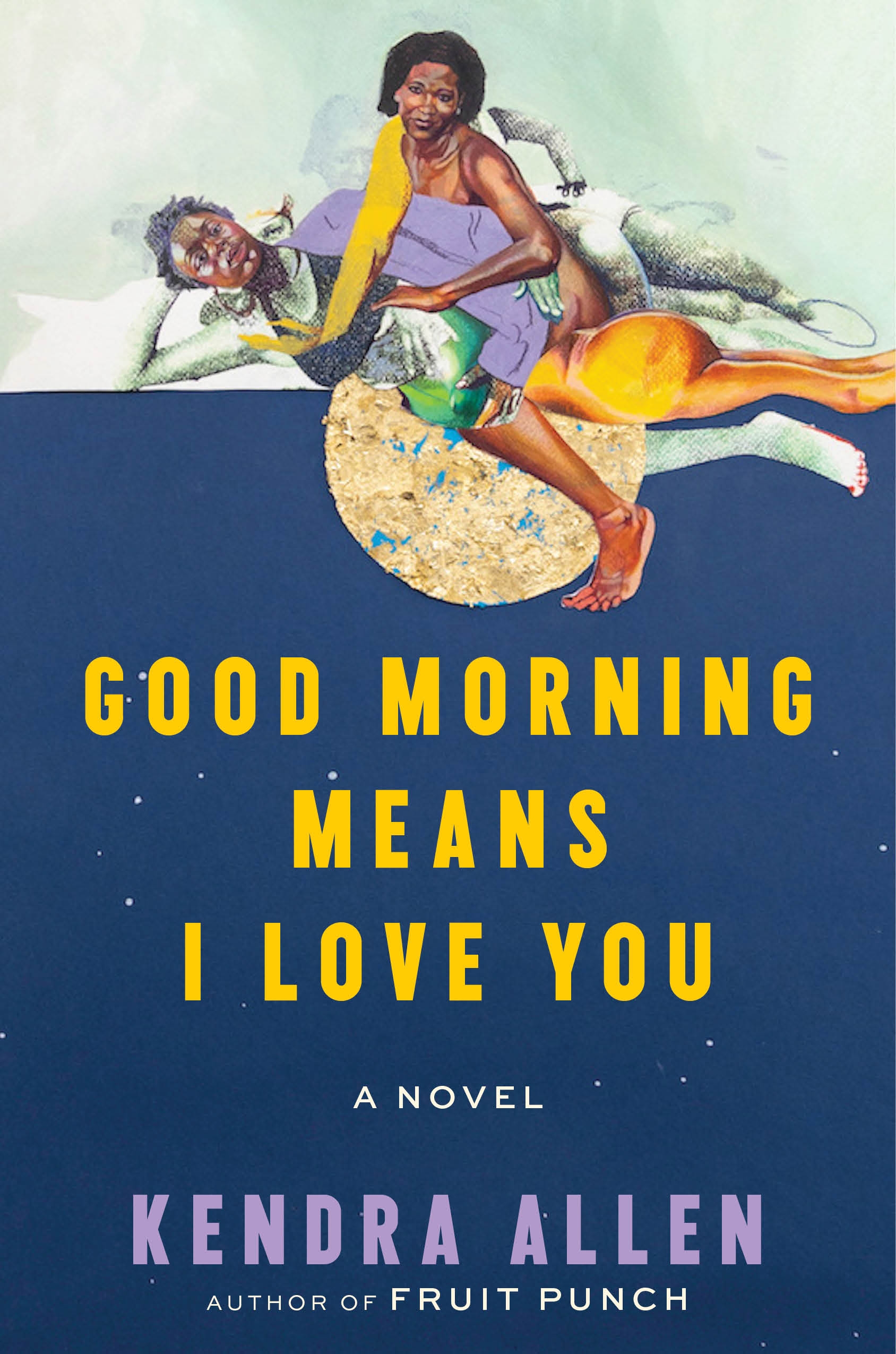
Kendra Allen’s fiction debut, Good Morning Means I Love You (Ecco, 2026), offers such an experience. Put simply, the novel follows Raenell (nicknamed Rae) as she rejoins her family in Texas after a year of self-imposed absence. However, “family” takes on fresh complexity and tenderness in these pages. As one-third of a polyamorous relationship, Rae is coming home to her male partners, Micah and Noon. She is also coming home to their triad’s two sons, Morning (age two) and Night (age one). Other family members round out this homecoming: Dory, Micah’s daughter from a previous relationship; Sin, Rae’s younger sister; and a host of flawed parents who nevertheless show up when needed.
To summarize the novel in a lone paragraph does a disservice to Allen’s masterful pacing, the way she layers backstory within Rae’s contemplative first-person narration. If unsympathetic readers initially judge Rae as a mother—how could she leave them babies behind?—Allen soon reveals one of the reasons Rae needed time to herself: She has experienced a traumatic childbirth and subsequent medical negligence. Similarly, if readers expect the novel to be titillating—the jacket copy lists “sex” first among Rae’s many “stunning” life choices—they soon learn that the novel isn’t preoccupied with amorous love. First and foremost, it explores the characters’ repeated decisions to offer care to each other despite personal turmoil.
Consider an early flashback, which, after several pages, depicts sex between Rae, Micah, and Noon. Allen doesn’t rush acts of physical intimacy, though she eventually writes postpartum intercourse beautifully and heartbreakingly. (“I said please, and when Noon slipped a finger in, a sound fell outta my throat and right into Micah’s mouth. It wasn’t pleasure, but it wasn’t discomfort either.”) Instead, Allen first begins the chapter with Rae and her partners writing a contract, negotiating logistics for the children they will conceive. They discuss last names, schooling options, medical power of attorney, employment obligations. “For us and for them,” Rae clarifies. “Just in case we wake up in two years and decide we don’t like each other.” It is a remarkable narrative moment that doesn’t take childrearing lightly, that is deeply concerned with the well-being of parents and children alike.
Yet despite the considerable thought and planning behind the trio’s arrangement, they are not immune to the trappings of gender. Rather than treating polyamory as an idyllic alternative to two-parent, heterosexual relationships, Allen deftly articulates Rae’s frustrations with motherhood’s ongoing demands. “There wasn’t a second I believed [Micah] nor Noon cared to completely comprehend what me making the decision to mother their children would do to my life,” Rae thinks. “They weren’t the ones who had to be gawked at and questioned and judged. They would simply be adored for being present fathers.”
The novel goes on to explore the postpartum changes to Rae’s body, her partial hysterectomy, the damaged vaginal cuff that causes her to start bleeding when she’s running a simple errand. Indeed, as the plot progresses—parental reconciliations, deaths, Morning and Night’s moving shared birthday party—it ultimately centers Rae’s ongoing need to prioritize her own life, even as she tries to nurture others: “I was so ashamed by my ability to check out on myself for indefinite periods of time.” By the novel’s end, Rae moves closer to figuring out how to remain a whole individual within the family she’s created. When she comes into some money (I’ll avoid saying exactly how, to preserve Allen’s rewarding narrative turns), Rae chooses to build a standalone unit in the backyard, where she might have a bit of privacy when needed. It is a gift she learns to allow herself, even if her family members might sometimes claim that space too.
A series of complex relationships populate Good Morning Means I Love You, though perhaps the most rewarding is the relationship between Rae and thirteen-year-old Dory, Micah’s daughter. Though Rae feels unsteady around Morning and Night after so much time apart from them, she is nevertheless a confident caregiver to Dory, whom she offers the sort of protection she never received. Just before leaving her family in the novel’s backstory, Rae leaves a note for Dory that reads: “If they try to turn you into a mother, call yours.” She is aware that taking time for herself puts Dory at risk in a household of men, who might expect her to take on the emotional and domestic labor so often imposed on women. Later, after Rae returns, she nurtures Dory’s artistic pursuits, takes her on a weekend getaway, listens to Dory’s hopes for her adult life. Ultimately, it is Dory who designs Rae’s private room in the backyard, in one of the novel’s many perfect parallels. Though Rae is only just beginning to offer herself peace and selfhood, she is already passing these down as practices.
The novel’s precise structure matches Allen’s sentence-level work, which is dexterous and astonishing. Passages of dialogue contain the familiar and warm cadences of Black American banter; characters clown each other, then deliver devastatingly vulnerable truths, then turn around again and bite their tongues for fear of causing damage. Other moments are formally inventive and adept at capturing Rae’s unstable interiority; as Rae does her best to resettle into her former life, the text itself ruptures and indents, as if part of Rae is still watching from a distance. For instance, the second chapter ends with Rae tickling Morning, who hums with energy in her presence:
“Uh-huh, uh-uh!” He giggled as if battery operated, shaking his head up and down again, but faster.
He yelped You is us mama
He laughed Us daddy say dat
Many of Allen’s other lines stun with their startling specificity, especially when rendering bodily sensations. When Night bawls, Rae weeps too: “But quietly. So quiet, the cry was almost solely internal.” Later, Rae cups her hands to whisper into Morning’s ear, and he “slip[s] outta the funnel from the unexpected tickle of [her] breath” (my emphasis). The sound of Micah stroking her milk-filled breasts is “like rain dripping from a windowsill.” When Dory laughs, her face has “a lot of colors in it as if she recently woke up or ain’t been to sleep.” Good Morning Means I Love You resounds as firmly in your ears as it does within your spirit.
It would be easy to say that the novel’s syntactical achievements arise from Allen’s talents as a poet. (In addition to her works of nonfiction, Allen also published The Collection Plate, in 2021.) However, the novel’s language always remains filtered through Rae’s unique experiences. In other words, Good Morning Means I Love You never sacrifices the tools of fiction—characterization and plot, to name two—for poetry alone, though poetry abounds. To make full use of several artistic forms is no easy feat.
As I read—slowly, reluctant to surrender each word—it was tempting to imagine a slightly longer version of this novel. Ten extra pages would perhaps give more insight into Rae’s year away from the family. (Allen writes bodies so well that I wondered about Rae’s relationship to her own during her period of independence: What would getting away feel like, when you haven’t yet discovered yourself?) Expansion might also make more room for Dory’s birth mother, who plays a pivotal role in saving Rae’s life in that fraught hospital delivery room. Still, no artistic choice is without consequence, and lengthening the novel might sacrifice its elegance and emotive power. Every included scene strikes with a drumbeat. Every pause, every omission is a reminder of what a character hasn’t yet figured out. In truth, healing doesn’t come easy; showing up for family, despite what can’t be neatly resolved, is the point.
At just over two hundred pages, Good Morning Means I Love You is as compact as a human heart. It contains such full and remarkable chambers. It echoes. Its characters, so alive, such “heavy breathers,” refuse to be relinquished.
Carrie R. Moore is the author of Make Your Way Home, which won the Young Lions Fiction Award and the Anisfield-Wolf Book Award. Her writing has appeared in The Best American Short Stories, Oprah Daily, The Sewanee Review, and One Story, among other publications. She is a National Book Foundation 5 Under 35 honoree.

More Reviews