The Guest List | August Ponthier
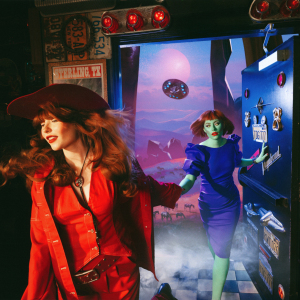
The Guest List is a regular book column that surveys the reading habits of our favorite musicians. In this edition, Hannah Smith talks with Texas singer-songwriter August Ponthier. Their debut album, Everywhere Isn’t Texas, is out now.
Hannah Smith: What are you currently reading?
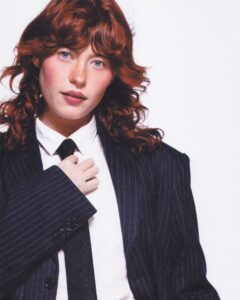 August Ponthier: Right now I’m reading The Chronology of Water by Lidia Yuknavitch. I just saw the adaptation that Kristen Stewart directed, and I knew that there was a lot of interiority there that I wanted to dive in on, so I’ve been devouring that book.
HS: This first track of your new album, “World Famous”—it names genre: horror, sci-fi. Any books that inspired this song?
AP: So, I grew up reading a lot, and then I lost that thing. My love of genre is in campy horror movies, B movies like House on Haunted Hill, and sci-fi movies like Barbarella. So when I fell in love with reading again a couple years ago on tour, the type of books that captured my attention were ones that kind of replicated similar genres that I really loved in film. But the internal element—the thoughts and perceptions that you can’t really get in film very easily—are what made me fall in love with reading and absolutely crush as many books as possible, especially while I’m on the road. So, it started with a book called My Darling Dreadful Thing that a friend recommended to me. It’s a gothic queer novel that uses spirits, ghosts, demons to explain relationships that we choose and don’t choose, our relationships with our self, our relationships with queerness, and then it just kind of blossoms from there.
Most of my early reading was genre, and particularly horror. So I read Tender Is the Flesh. I absolutely loved that book. I read The Last House on Needless Street by Catriona Ward. Genre—which is something I already really, really loved—has been the first step in my falling in love with reading again.
HS: Genre is one of those spaces in which queerness has been historically most represented, and where there are different types of realities that can exist, which is, often, how queerness presents. I think a lot about writers like Ursula K. Le Guin.
AP: Yes, I read Left Hand of Darkness!
HS: I was curious if you’d read it. How do you think about this book or other sci-fi or horror as informing the music you’re making?
AP: Sci-fi and horror, to me, were always an escape, but they always represented things that felt more emotional and felt more human, oddly. I think that my music is very direct singer-songwriter music. I like to talk about identity, but the visuals are very big and very otherworldly, because I think sometimes the easiest and most effective way to explore feelings that feel like you can’t hold them, and like they are monsters in their own way, is through genres that do have monsters, that do have ghosts, that do have things that feel like you can’t hold them in reality. But yes, I did read Left Hand of Darkness—it was a recommendation from a friend, and I read it around the time that I was trying to figure out my own relationship with gender. And for being a book written when it was. . .
HS: 1969!
AP: I’m constantly shocked at how many books, specifically queer books, that feel like they were written yesterday. That book was big for me, and also I read a book, Carmilla, which is a vampire novel written 25 years before Bram Stoker’s Dracula. It’s about an obsessive relationship between two women and it depicts queerness as if it were yesterday. That always shocks me, when I read a book that feels so relevant even though the time [when it was written] was completely different.
HS: You’re mentioning these books that were maybe ahead of their time. How do you think about the kind of tensions between this queer futurism and the nostalgia, the looking back, and the kind of coming-of-age you explore with the album? Do you read in both directions?
AP: I do. I like reading a variety of things. I mean, I do love genre, so that tends to be home, and that tends to be where I go when I’m having a reading slump. But I think reading about queerness in the past makes me feel like it’s something I didn’t invent, in a comforting way. I think feeling like I invented queerness was isolating and lonely, and it felt like a defect before I realized, really, who I was and became proud of that. And so reading about queerness in retrospect. . . it’s just this feeling of “We were always here” that really comforts me. Especially, you know, in my journey now, where I’ve come out as nonbinary and people want to act like nonbinary is something that is new, when the evidence has supported that’s not true.
But also queerness in fantastical spaces, or in a sci-fi future. I think that all of these things: traveling back in time, traveling forward in time, going somewhere completely different. Weirdly, when you change your environment, you learn a lot about how people are just people, and we all kind of value the same things, which are comfort, safety, connection. And in a way, it’s kind of like when I moved to New York. When I moved to New York, I changed everything around me, and the parts that didn’t change—such as my queerness, my ability to want to connect with other people, and that thing in me that always wanted to know more about myself—that was really grounding and showed me a lot of my own character. So, sometimes I think changing something drastically, or creating, like, a really insane space to explore a feeling in, can be grounding or revealing because it’s the thing that sticks out and makes you want to grab on to it. It makes you want to say, “This is kind of the thing I relate to.”
HS: Yeah, it’s interesting because I think some readers lean so hard toward reading into a familiar reality. And other people seek out what you’re describing, this extreme difference in a human or, like, human-esque experience, that makes you recontextualize your own lived experience in a new way.
So do you read anything about Texas? Is that a place you go to in literature?
AP: One of the few nonfiction books that I’ve read over the past year was actually a book called Jesus and John Wayne. It’s about how evangelicals co-opted the image of John Wayne to make a version of Jesus that fit an ideal that was really comforting and also very aggressive. When actually the version of Jesus in the Bible is very sensitive—thoughtful and a pacifist. And so, I tend to read things about texts that say the thing aloud that I had felt as a heaviness growing up, but didn’t have a name for. And that book helped me a lot, because I did kind of grow up in that environment where religion was really important, and that people felt spirituality was a pillar of how they should uphold their lives. But there were things that I didn’t agree with, or I thought were at odds with the teachings that I heard on Sunday.
HS: I love how you go to fiction for this kind of imaginative landscape, and to come to nonfiction as a way to investigate your own life experience and past growing up.
AP: Yeah, I would say now with Chronology of Water, what I love about that book specifically so far—I mean, I’m only halfway through, but I am absolutely loving it—is that the emotional core kind of feels like watching someone go through something fantastical in a negative or hard-to-hold way. But she makes it so easy to understand how people can handle more than seems humanly possible.
HS: I’m interested in the nature of the way you go about songwriting and performing personal narrative, and this interest in interiority. Are there characters in books you’ve read who stick out to you as having a voice that’s informative to your own?
AP: Hmm, that’s a really good question. I think I try to surrender as much as I can to the voice of the protagonist, especially if it’s in first person. But the songs that I personally write tend to be a lot about identity, and I think that’s why I’m so attracted to these kinds of books. I could write a lot of love songs, I could write a lot of songs about crazy situations or wild nights out, but I’m always the most attracted to songs that explore my own relationship with myself, which makes sense. I’m almost 30, and I’m still learning things about myself. I mean, I just changed my name, like, a few months ago. But books I think do that really, really well: I love Open Throat by Henry Hoke. It’s a book about a mountain lion that lives in the Hollywood Hills, and it’s written from the lion’s point of view. So it’s processing all these things that you or I would maybe take for granted or see in a completely different way. Reading about a queer mountain lion that lives in the Hollywood Hills was a beautiful experience that I did not expect would hit me as hard as it did. I’d say that’s a really big one for me.
Another one that was big for me was Annie Bot by Sierra Greer. It’s about an automated sex robot, and the story is told from her perspective. You basically hear her gain consciousness, gain value for herself, want autonomy, and want the will to live. And I’m really attracted to stories that have main characters who don’t feel like they have a voice, who are finding their voice, and that’s one of the best I’ve read.
HS: Do you have any favorite music books or books about music?
AP: I actually don’t read that much about music. I started reading again because I was touring all the time, and I wanted to go somewhere else for a little while. I was on a plane or in a van. But I did read a book of John Prine interviews; it’s called Prine on Prine. I love him, and he’s an amazing example of an incredible storyteller who blends humor and confidence and sentimentality all into one, effortlessly.
Hannah Smith is a poet from Dallas. Her writing has appeared in Best New Poets, Gulf Coast, Ninth Letter, Quarterly West, and elsewhere.
