The Lives That Cotton Made
In 1926 the government of Mexico passed two linked laws: the Law of Irrigation with Federal Waters and the Federal Colonization Law. One could see these as Mexican versions of the Bureau of Reclamation and the Homestead Act: The first created the National Irrigation Commission to build dams and canals around the country, while the other lured settlers to populate the irrigable lands. Together, the laws reshaped northern Mexico.
In the states of Coahuila, Nuevo León, and Tamaulipas, the crop those settlers would grow was cotton. After the US Emancipation Proclamation (1863), cotton had become a major industry in the region. At expansive haciendas, sometimes foreign-owned, peons lived in shacks and received starvation wages for their work sowing, hoeing, and harvesting. The 1910–1920 Mexican Revolution expropriated many of those estates and dared to imagine a country with greater economic equality. The two 1926 laws were part of this transformation toward a land of smallholder agriculturalists, not so dissimilar from Thomas Jefferson’s vision of a nation of yeoman farmers.
As the United States increased deportations in the 1930s, some of the irrigated colonies were laid out specifically for repatriated migrants. “No one had more experience in the care and harvesting of cotton than the Mexican families expelled from the United States,” writes Cristina Rivera Garza in Autobiography of Cotton.
The Tamaulipas-born Rivera Garza is the author of more than nineteen books, among them short story collections, novels, volumes of poetry, and collections of essays. She founded the University of Houston’s Spanish-language PhD in Creative Writing in 2017, received a 2020 MacArthur Fellowship (or “genius grant”), and is a member of Mexico’s prestigious Colegio Nacional. In 2024 her book Liliana’s Invincible Summer, about her sister’s 1990 murder, won the Pulitzer Prize in Memoir/Autobiography.
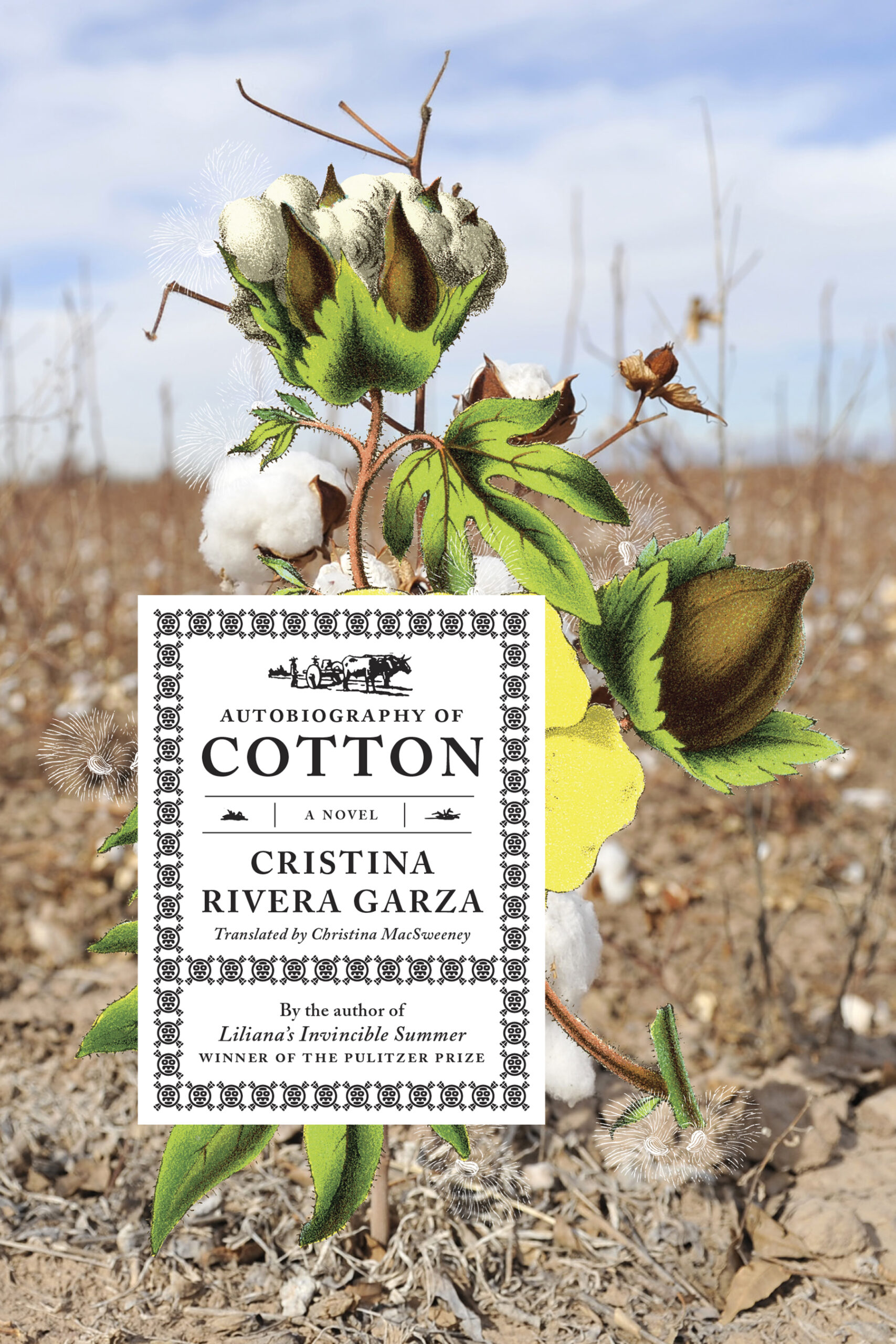
Autobiography of Cotton, first published in Spanish in 2020 and now available in English in Christina MacSweeney’s translation, traces Rivera Garza’s family history as it converged on the borderlands’ “social and agricultural experiment.” Her ancestors arrived in Colonia Anáhuac, Tamaulipas, part of Irrigation District No. 25, from two directions: her paternal grandfather from an Indigenous community in San Luis Potosí—via multiple migrations that brought the deaths of multiple wives and children—and her mestizo maternal side from Houston, Texas, forced out of the United States.
Announcing itself as a novel, Autobiography of Cotton is a speculative history in the mode of Saidiya Hartman, who coined the term “critical fabulation” to designate writing that builds scenes out of a thin or nonexistent historical record. To apply Hartman’s description in Wayward Lives, Beautiful Experiments to Rivera Garza’s work, Autobiography of Cotton has “pressed at the limits of the case file and the document, speculated about what might have been, imagined the things whispered in dark bedrooms, and amplified moments . . . when the vision and dreams of the wayward seemed possible.”
In other words, the archive is full of holes, and Rivera Garza is forced to imagine the history herself. The hacienda where her grandfather was born has been depopulated since the revolution; another of his waypoints was abandoned by drought, then bulldozed for fracking wells. She pulls up to small-town archives only to be told there’s nothing there for her. “How does one write a story about an encounter with nothing?” asks Hartman in Lose Your Mother.
Garza’s answer to that riddle is to deploy a creative research method that she has honed across her historical work: a combination of archival research, literary criticism, and personal narrative. This methodological braid is the basis of Liliana’s Invincible Summer: at the same time as she searched for her sister’s long-lost police file, Rivera Garza made another archive of Liliana’s keepsakes and read her journals, letters to friends, and doodles as literary texts. The 2016 Había mucha neblina o humo o no sé qué (There Was a Lot of Fog or Smoke or I Don’t Know What), similarly uses government archives and road trips to understand Mexican writer Juan Rulfo, arguing that his unique vision of Mexico, simultaneously ethereal and regionally grounded, stemmed from a feeling of ambivalence about the project of modernization in which he was a pencil-pushing foot soldier.
In Autobiography of Cotton, Rivera Garza’s road trips are to the cotton colonies. “Scrub plants, anacahuitas, and pointy rocks,” she writes. “Very white rocks. Farther off: the border. A mirage full of empty water. The wild wind, wind from the north, around our heads.” The threat of violence by organized crime organizations looms, and she is met with the repeated disappointment of histories that have all but disappeared.
Still, drawing on the techniques of fiction, she transforms the bare-bones data she does find—birth registrations, marriage certificates, a border-crossing card—into rich scenes. With descriptions of housewares and chores, she takes particular care to imagine the lives of the story’s women. Describing her grandfather’s first wedding, she turns the lens to his mother-in-law:
In the chair she had been assigned as a witness to the ceremony, Herculana kept her eyes on her daughter. Her child was sixteen, the same as she had been when she married Nicolás sixteen years before, in the same office of the Registro Civil . . . Her daughter looked like a little girl. All thin and straight, like a blade of grass.
Literary criticism enters Autobiography of Cotton with José Revueltas, the leftist writer whose novel El luto humano (Human Mourning) is based on a 1934 workers’ strike at Estación Camarón, one of the settlements in which Rivera Garza’s paternal grandfather lived. Revueltas, a Communist, had come to observe the cotton workers demanding their new, post-revolution rights and “inventing a way of life that he, and those like him, had scarcely heard of.”
Out of his record of the events, he produced a work of art that transcends the leftist politics of its or any individual political moment. El luto humano takes place years after the heyday of the cotton colony, when just a few families remain, all struggling to eke out an existence, on a night when multiple deaths coincide with a shocking flood. Revueltas uses the remaining inhabitants’ recollections of the irrigation district as a window onto—in Rivera Garza’s words—“his endless disquiet about his place on earth and the relationship of other men and women with that earth.” Not only the same infrastructure, but the same questions, animate Autobiography of Cotton.
What the histories covered in Autobiography of Cotton add up to is an understanding that colonization—both as the control of seemingly ungovernable territories and the deracination of Indigenous peoples—was a project that extended well into the twentieth century. Irrigation and commodity crops collaborated as one tool in this effort; ideas of mestizaje and national identity were another.
In the twenty-first century, those tools of state formation continue to shape our lives. Rivera Garza closes Autobiography of Cotton by ruminating on terricide—what she defines as “the damage inflicted on the living surfaces of the earth in the name of profit”—and the connection between agricultural overexploitation and the contemporary atmosphere of insecurity that she experiences on her research trips. “Is there a relationship between the brief period of cotton plenitude and the gory war the Mexican state has waged against its citizens?” she asks. “I argue that the answer is yes.”
It’s only through understanding the historical cycles that shaped her past that Rivera Garza can make sense of the fears and longings that haunt her present. In Autobiography of Cotton, she lays out a method for the rest of us to undertake the same excavation.
Caroline Tracey is a writer whose work focuses on the US Southwest, Mexico, and their borderlands. Her first book, Salt Lakes, is forthcoming in March of 2026 from W.W. Norton.
This review is co-published with The Border Chronicle.

More Reviews