This Cussid Life of Ours
During the middle of the last decade, amid the mania for his epic autofiction series My Struggle, the Norwegian writer Karl Ove Knausgaard made a habit of offering regular shout-outs to his fellow novelist and countryman Thure Erik Lund. During an interview with New York Magazine, Knausgaard called Lund “the greatest prose writer in my generation,” adding, “he’s very wild. His novels start in one place and end up somewhere completely different.” On Tyler Cowen’s podcast, Knausgaard speculated that, had Lund “written in English, he would have been, I guess, on the level of Thomas Pynchon or whoever. He’s that good.” He also mentioned Lund in interviews with The New York Times Book Review and Bookforum.
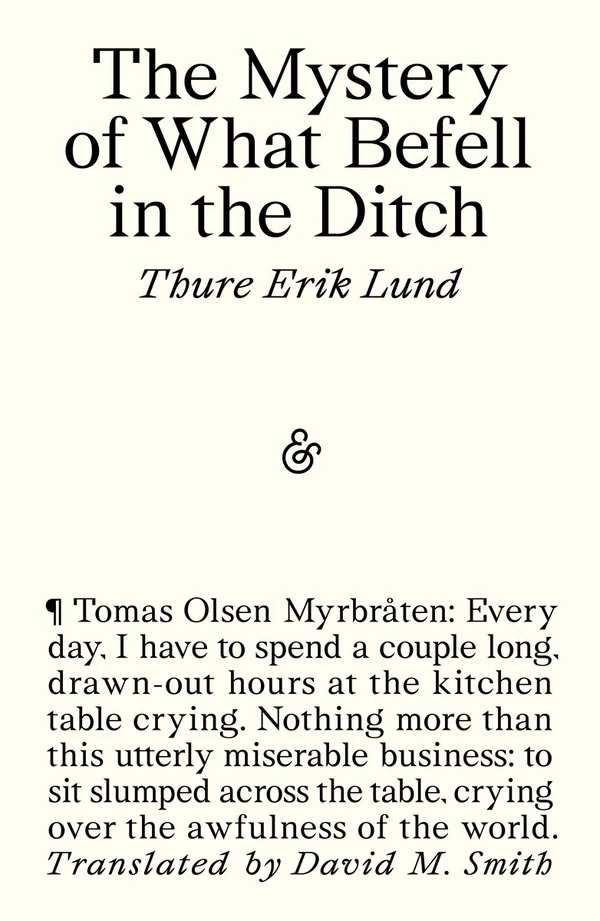
Given the success of My Struggle, the effusiveness of Knausgaard’s praise, and the concurrent explosion in critical and popular interest in translated literature overall, it shouldn’t have taken so long for the first English edition of Lund’s work to appear. One might think that Knausgaard’s tendency to describe Lund as “untranslatable” would have acted as a spur, not a deterrent; surely translators are like a lot of people and are attracted to rather than intimidated by supposedly “impossible” tasks. But, for whatever reason, more than a decade has passed since Knausgaard’s comments, and English readers are only just now getting their first crack at the mysterious Scandinavian master. This fall, And Other Stories is bringing out David M. Smith’s translation of Lund’s novel The Mystery of What Befell in the Ditch, the first work by Lund to be available in English.
Even though the Norwegian version was published in 1999, The Mystery of What Befell in the Ditch has a surprisingly contemporary relevance. The misanthropic narrator and circuitous narration appeal to the current yen for the Austrian monologuist Thomas Bernhard. At one point Lund’s narrator is “canceled,” and his cause is taken up, against his will, by racists and neo-Nazis. The novel raises questions about toxic masculinity, the urban/rural divide, and the effectiveness of cultural institutions; all that’s missing is a riff on artificial intelligence. And yet, nothing here comes close to the gossipy oversharing of My Struggle, and it’s hard to imagine Lund becoming a pop culture sensation on the level of Knausgaard circa 2015. Rather, The Mystery of What Befell in the Ditch is better categorized alongside the dense, hallucinatory prose of Europeans like Jon Fosse and László Krasznahorkai. (Some American readers might be reminded of Faulkner as well.) The novel is shocking, hilarious, and philosophically profound. Lund may not sell as many copies as Knausgaard, but he is a better writer.
The Mystery of What Befell in the Ditch is divided into three parts, each narrated by the book’s protagonist, Tomas Olsen Myrbråten. Tomas is a lonely writer and intellectual, or, as he likes to call himself, a “life-of-the-mind individual.” The novel tracks his long retreat from society, which begins with a commission from the Royal Norwegian Ministry of Culture to write an essay about ancient cultural sites in the country. This assignment supplies the principal plot action of the novel’s first section, although there are plenty of digressions, as Tomas has much to say about contemporary existence and the problems inherent to being a thinking person in a society that has largely left him behind. Tomas’s rants about the “narcoticist,” “Americanized” Norway in which he lives compare with the best of Bernhard’s tirades against post–World War II Austria.
These passages are master classes in bitter, self-annihilating comedy. Tomas observes that “literature is an outmoded, ineffectual contrivance that we permit to live on invisibly as a weirdly anarchic museum piece within the maternal machine of our cultural institutions”—this is not the only one of Lund’s lines that stings because it’s true. Tomas sees himself as allied with pure nature, which has led to him being an outcast. He thinks consumerism is the only vital system of belief left and expresses pity for those of the younger generation, who “barely endure the Norwegian global hell by indulging in rock-n-roll narcoticism and potato chip snarfing as a kind of cheap excuse to call themselves believers.” Tomas pushes the boundary, though, beyond the familiar anti-everything jibes of the typical crank and toward something more sinister: The way he talks about how globalism has run roughshod over traditional Norwegian culture sounds suspiciously like the ethnonationalism emergent today in the right-wing internet. And you can detect a clear note of misogyny in his attacks as well (note the modifier “maternal” in the phrase quoted above, intended to have a negative connotation).
All this comes to a head in the section’s climax, when Tomas presents his essay—which has evolved into an argument about the impossibility of preserving Norwegian cultural sites in the face of “this utterly perverted money-dispersalist mentality”—to his superiors. During the ensuing back-and-forth, he says a “quite unmentionable thing” to the cultural minister, who is a woman; a few pages later he confirms that he has called her the C-word. The incident triggers a steep decline for Tomas. First he attempts to publish the essay, but this effort is unsuccessful. Then Tomas becomes a cause célèbre for people he refers to as representing “the dark side of what it means to be Norwegian” but whom today we would simply call trolls. Tomas rightly calls these characters “lunatics” and avows his opposition to “everything to do with racism and Neo-Naziism,” but he hardly retreats from his reactionary pose. Eventually he ends up out of work, living in a shantytown, and spending his evenings at a dive bar among vagrants, drunks, and other derelicts, which is where the first section ends.
If at this point you’re thinking to yourself, Maybe this guy Tomas isn’t such a good egg, wait till you hear about part 2. In a shift so sudden I had to double-check that this book was in fact a single narrative instead of a collection of longer fictions, we are taken to the not-so-distant future, when Tomas has left the city and returned to the rural farm where he grew up. We notice right away that Tomas has dropped the hyperintellectual voice: Smith, in an admirable if risky decision, has translated these passages, first written by Lund in a dialect from his native region of Modum, into an Southern American idiom of dropped consonants and folksy colloquialisms. Tomas has brought with him Helena, a woman he met at the bar in the city and whom he believes is the ex–cultural minister, having lost her job after the controversy he started (the truth of Helena’s identity remains ambiguous). Also living at the farm is Tomas’s brother Bjørnar, who has a mental disability and is nonverbal; Tomas teases Bjørnar and keeps him on a leash. The house is filthy and filled with a mysterious “slime” that seems to be both a figment of Tomas’s imagination as well as an actual mixture of bodily fluids and mud. The yard is full of ditches that Tomas has dug for reasons he can’t remember. The whole situation is like something out of a backwoods horror movie:
I took to chewing on some cardboard and spit it out. A bit later this gave me enough juice to run up to a door and kick it in. I turned off the television. I said that the slime inside my head was congealing, I can’t fucking think, I blurted. It got quiet. And the day went on. I bent a couple of iron rods straight. Hosed blood off the steps. Ate some potato chips. Watched television. Turned it off, but turned it back on, since Helena lay there all of a sudden and was far away. I lay down next to her. My mouth vented bonfire when I spoke to her. Guess it was in full swing, this cussid life of ours.
Amid this chaos, we get flashbacks to Tomas’s childhood and adolescence. The depiction of his mother, who seems to have saved all her affection for her cows, is especially bizarre and emotionally devastating. We also learn that as a teenager Tomas was some kind of sexual predator, maybe a rapist. The narration veers between the intellectualized tenor of the first section and the down-home vernacular. Things do not work out well for Bjørnar or Helena, and Tomas ends up alone, in nature, which is perhaps where he was headed all along.
Knausgaard wasn’t exaggerating when he said Lund’s novels “start in one place and end up somewhere completely different.” The mostly plotless third section, with its elegiac ruminations on the ideas summoned by the book, reminded me of the end of War and Peace, but with more mud. I can also see Knausgaard’s point about Lund being “untranslatable.” Yet Smith has done a noble job, and the translator’s note included at the end of the book is required reading for what it tells us about his process (specifically, how he came up with the tricky compound nouns in the first section and approached the dialect in the second).
The idea of nature—both in terms of human nature, the purest distillation of our beliefs and behaviors, as well as nature in the sense of the environment outside of human society—plays a crucial role in the book. In the first section, Tomas complains about the “new, synthetic state of nature” and argues that “life-of-the-mind individuals are indeed nothing less than the pure individuals of nature.” He seems to mean that contemporary civilization is a bastardization of what is most natural in humanity. If the return to the farm, then, classifies as going “back to nature,” the question is what to make of all the cruelty, violence, and abuse that happens there. Has Tomas made a colossal misinterpretation, or has he discovered something essential and true about what people really are? In the world of this bewildering, bewitching novel, it’s hard to tell the difference between enlightenment and utter hell.
Wilson McBee lives in Highland Park, Illinois.

More Reviews