I’ve worked as a bookseller for twenty-seven years now, and it’s interesting to see which writers and books—fairly or not—have endured, and which writers and books have faded from memory. Like a lot of weird things I was really into back in the 1990s, the early books of Mark Leyner seem to be fairly unknown to today’s younger readers and the general public. For a writer famous (and interesting) enough to appear on episodes of The Late Show with David Letterman, Late Night with Conan O’Brien, and, most famously, the 1996 episode of Charlie Rose, where he matched wits with Jonathan Franzen and David Foster Wallace (who had once—before this interview, called Leyner “the anti-Christ of American literature”) discussing the state of publishing and books, Leyner now seems like the lost black sheep or odd man out.
Perhaps this goes to prove that when you’re a young, ambitious, wildly original artist with a growing audience who seemingly wanders away from the art form you mastered, people may forget who you are. For fifteen years, Leyner’s writing became less noticed because it was the behind the scenes. He wrote screenplays, created and voiced an audio series, and did some unreleased (censored?) work for MTV. Ironically, he did publish two books during this time that garnered him some of his career’s highest sales numbers. They were the nonfiction books of medical questions and answers: Why Do Men Have Nipples? Hundreds of Questions You’d Only Ask a Doctor after Your Third Martini (2005) and Why Do Men Fall Asleep after Sex? (2006), both cowritten with Dr. Billy Goldberg.
When Leyner made his literary comeback in 2012 with the novel The Sugar Frosted Nutsack, it was a welcome return, though I can imagine Leyner’s new book feeling like the Confused Travolta GIF, looking around and hoping to find the same readers as before, but mostly seeing book buyers with dog-eared copies of Fifty Shades of Grey or the Steve Jobs biography. Attention spans seemed to be diminishing at the same rate as the internet and social media were growing. Personally, it even took me (a Mark Leyner fanatic who sometimes aped the man’s style in my early writing) a little time to process and understand this return. I picked up the book a few times but didn’t read it; maybe I was prudishly annoyed by the goofy title (though every Leyner book has a ridiculous title). The Sugar Frosted Nutsack remains to this day the only Leyner fiction I have not fully read.
It wasn’t until four years later that I was enticed to enter Leyner’s imagination again. His 2016 novel, Gone with the Mind, felt especially rewarding as a reading experience to me (and seemingly to other Leyner fans who have been aging right alongside their favorite “experimental” writer). This new kind of Leyner novel featured a gauzy pall of pathos, with the love of a mother and son being the focal vibe in the comically bittersweet story of a memoirist (named Mark Leyner) giving a reading to zero attendees at the Nonfiction at the Food Court Reading Series at a New Jersey mall. GWTM has all that you’d expect from a Leyner creation: stories within stories, a frenemy-type assistant (in this case, the Imaginary Intern), a full-to-bursting arsenal of pop culture and literary references, absurd self-parody, and a rebellious antagonism. But now . . . with feelings! He recreated himself, and yet was still patently Mark Leyner.
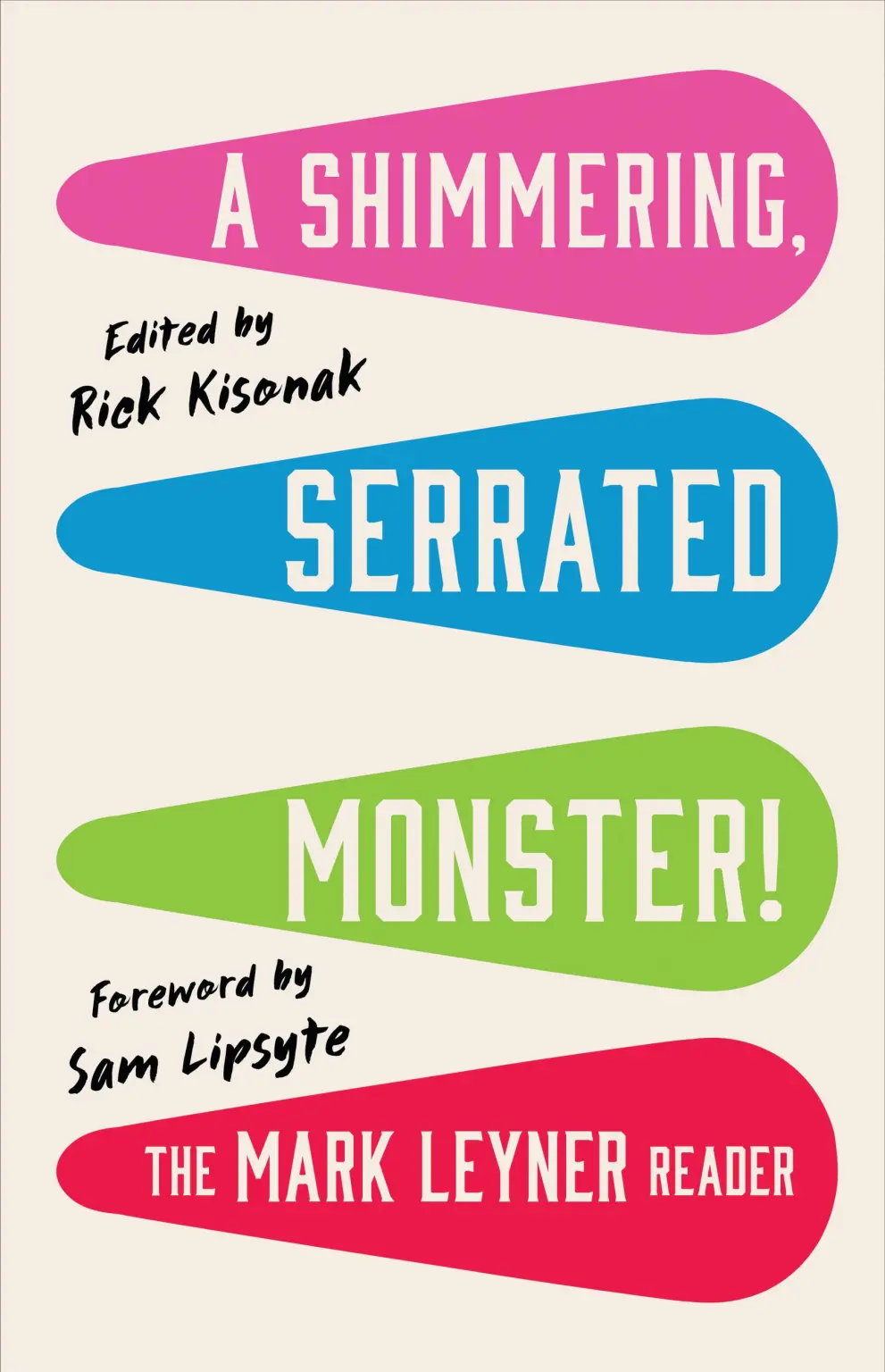
A Shimmering, Serrated Monster! The Mark Leyner Reader (2025) is edited by Rick Kisonak, a media and film critic, and includes a sweet little foreword by the author Sam Lipsyte, where he writes about starting a Mark Leyner cult at Brown University and reading their god’s work out loud to each other. It totally makes sense to me that Lipsyte, another one of my favorite writers, admires Leyner. Lipsyte’s own work is masterful at the sentence level and packed with the sort of Jewish dark comedy that may be too caustic for some. But it’s hard, really, to say that anyone (even Lipsyte) is on the same playing field as Leyner. There are only a handful of fiction writers I’ve encountered—Garielle Lutz, Samuel Beckett, Diane Williams, Haruki Murakami—who I would say have a truly unique style that can’t be successfully copied. Leyner is at the top of that short list, though, with his unrestrainable, almost cartoon-like action-comedy mayhem that blends with his cultural acumen and obscure, unsettling medical references. Leyner’s inimitable style is praised throughout this collection in some of the introductions, interviews, and bonus material that accompany the well-chosen samples. As the author and fan Ben Dolnick says in the introduction to Leyner’s breakthrough 1990 book, My Cousin, My Gastroenterologist: “Recommending Mark Leyner, I feel as if I’m walking up to knots of people at a party and thrusting before them samples of an unspeakably pungent blue cheese. Half . . . will mount a refusal so visceral and emphatic that it will verge on panic. The other half, though, will take a bite, close their eyes, and experience a pleasure so intense and complex that they will, for a few seconds, forget the party completely.”
It boggles my mind that the first published Mark Leyner stories were pre-internet—and especially pre-Google (the World Wide Web became available to the public in April 1993, Google in 1998). Leyner’s mind is itself like a Wikipedia database, even in the glimpses here of his first three books, the short-fiction collections (I hesitate to call them story collections since they’re more like experiences) I Smell Esther Williams (1983) and My Cousin, My Gastroenterologist and the ludicrous ego-fest of a novel, Et Tu, Babe (1992). Perhaps it was his time as a copywriter for Panasonic that contributed to this style, with its shiny technical terms and love of hyperbole. Or maybe the aggressive thrust of his work comes from a need to challenge other media. A quote from Leyner: “The energy in my writing comes from a feeling that writing is dying, or is at least under great threat from other media.” And later, on that same page, more directly describing his mission: “There’s not going to be a single slack verbal moment—no empty transitional phrase or routine expository sentence anywhere. I won’t settle for anything less than maximum, flat-out drug overkill, the misuse of power.”
Surely, the “Leyner-esque” style has caused many editors and publicists to twist their thoughts into pretzels while trying to describe the books. Funny is the easiest descriptor, but it’s an understatement and doesn’t quite fit the muscularity of the paragraphs (some of which last many magically fluid pages). In the realm of funny writers, he’s too literary to compare to goofy authors like Christopher Moore or Tom Robbins, too dark to liken to normie humorists like Dave Barry, too literary to compare to any science-fiction nerds, too profane to mention alongside Nora Ephron, more entertaining than Larry David, and too modern to match with Mark Twain. David Sedaris is kind of close, for pure laughs, but Leyner’s inventiveness and absurdity laps him. Some of Ben Marcus’s books, when they’re so dark they become funny—almost rival Leyner (it was nice to learn that Marcus, another all-time favorite of mine, is also a Leyner fan).
I love the noncomparative armor that Leyner’s writing wears, but it’s possible his signature weirdness could also make readers fear and avoid him. If you tell someone that his 1997 novel, The Tetherballs of Bougainville (which I regard as the funniest book I’ve ever read), is about a thirteen-year-old Mark Leyner who is at his father’s execution when he gets news that he has won a life-changing award for a play he has to write by the next day, and then much of the rest of the book is that play, they might be too perplexed to continue. Or if you told someone that Leyner’s most recent novel, Last Orgy of the Divine Hermit (2021), was simply someone taking a Snellen eye exam at an optometrist’s office that turns out to be a story of a father and daughter meeting at a spoken-word karaoke bar while Chalazian Mafia Factions are creating carnage and violence in the streets outside and the father is trying to find a way to tell his daughter that he is dying but wants to spare her the grief, they might not have the capacity to suspend their disbelief beyond the Snellen eye exam part. And depending on whether you like keeping a dictionary or your Google tab open, the barrage of names—household and non-household (Lizzie McGuire, Kenneth Anger, Marshall McLuhan, Jughead, Mark E. Smith, et al.), pharmaceuticals (Clozaril, Zyprexa, Risperdal, etc.), and historical factoids (like the American POW who blinked his eyes to reveal in Morse code the word torture during a televised press conference in North Vietnam in 1966)—will either be an enlightening sort of Easter egg hunt, or exhausting. In the excellent 1997 Salon interview by Laura Miller that precedes the Tetherballs section in the reader, Leyner says, “The assumption that you are somehow an embodiment, a parallel, of your fiction, or that you take lots of drugs in order to write it—is a little disheartening to me. I think people have little faith in the imagination.”
All in all, A Shimmering, Serrated Monster! is a constant delight that serves as a very fine introduction to the work of one of our most literary madmen and a testament to imagination. Though the collection didn’t sway me into reading The Sugar Frosted Nutsack, I loved revisiting all the other Leyner classics and the interesting array of commentaries. And if you don’t get enough Leyner lore, there’s a QR code in the back that will take you to 226 more pages of “bonus features.” From Et Tu, Babe, the novel that skewered literary celebrity and cast “Mark Leyner” as a power-hungry, virile, completely jacked, bestselling author with a supremely opulent lifestyle, here’s our hero describing his upbringing: “Over the years, I was treated for a slew of psychiatric and behavioral problems. . . . Yet there was a voice within me that said: Someday you will be considered the most intense and, in a certain sense, the most significant young prose writer in America. And I listened.” As a fan, I love the fact that there is now a Mark Leyner reader, and I love that Mark Leyner is very much alive to see it (it doesn’t always happen that way) and that people who may have missed his work the first time around can now discover his brilliance.
Kevin Sampsell is a writer, publisher (Future Tense Books), collage artist, and bookseller living in Portland, Oregon. His latest book is Sean the Stick, a collaboration with Emma Jon-Michael Frank.
