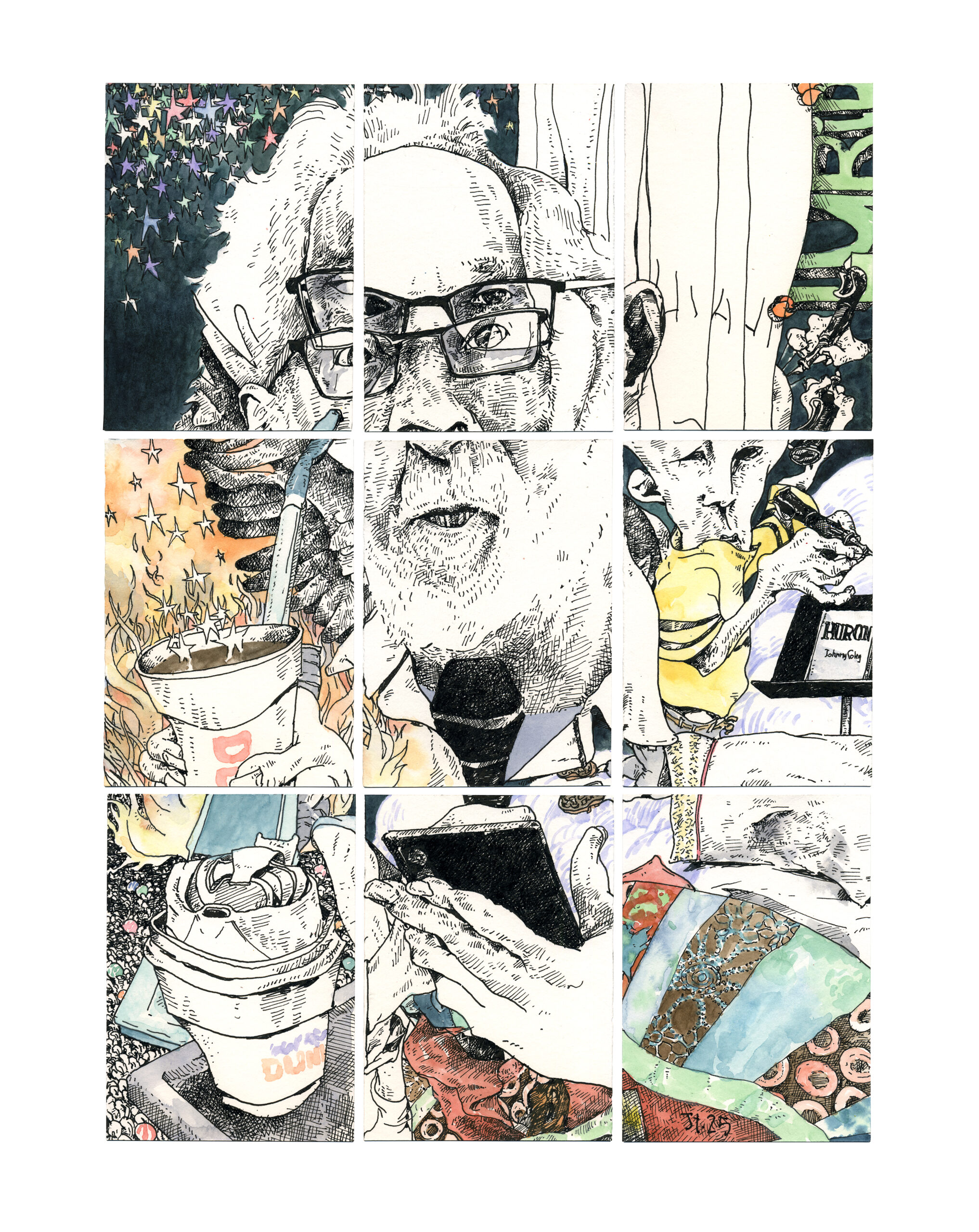
“Somebody told me recently that my voice was ‘lurid,’” Johnny Coley said the first time I called him, responding to my brilliant observation that he sounded on the phone just like he sounded in his music: roguish and sardonic, unquestionably Southern, wonderfully discursive, perhaps a touch ribald. “I mean, really—lurid?” he went on in half-serious protest. “That would describe the type of establishment where half-naked women lean out the door and try to lure you in.”
I had called to see if Coley was amenable for a visit in the Birmingham, Alabama, assisted living facility where he’d been homebound since last year for reasons then unknown to me. He had recently been moved to a much smaller room, he said, but there’d be plenty of space for both of us, provided I didn’t mind sitting on the corner of the bed.
“I told my roommate a woman who was gonna write an article about me was driving down from Chicago to talk to me,” Coley texted me before I left. “My roommate said, ‘You must be famous.’ I said, ‘Well . . .’”
I had come across the seventy-four-year-old poet—who sometimes signs his text messages with “Johnny Coley, Alabama Born and Bred”— in the fall of 2024 through a record he’d released by the name of Mister Sweet Whisper. I’d found myself enchanted by his vaguely supernatural, all-American lounge jazz, which Coley narrates in a meandering drawl that seems to guide the listener through a landscape he’s inventing on the fly. His stories, all completely improvised, unfold along interstate highways, down dark alleyways, in wild strip joints, or at a Chattanooga Dunkin’ Donuts sometime after 2 a.m. Backed by a few young musicians from the local arts collective Sweet Wreath, Coley’s plainspoken lyrics are in turn hilarious, sad, and sublime: beautiful strangers tumble out of nightclubs, long-haul truckers behold surrealist visions, fallen gods walk around in simple human clothes. I wondered if these images are poetic devices or distant recollections, vignettes of decadence from long ago and far away.
It’s raining heavily in Birmingham the Monday I arrive, as it will continue to do until the Thursday when I leave, at which point a flash-flood warning is issued throughout Central Alabama, including, in addition to Birmingham and its surroundings, a list of counties that was pleasing to the ear: Bibb, Blount, Calhoun, Coosa, Talladega, Tallapoosa. There is something sort of lovely about driving very slowly up and down the city’s hilly avenues, which seem to bend in unpredictable, circuitous directions, much the way my conversations with Coley have tended to go. I curve the leafy thoroughfare that slopes through Highland Park, a pretty neighborhood abundant with historic homes, where, in a brick nursing home listed on the National Register of Historic Places, Coley has lived since an incident last summer he cannot quite recall.
It is evident from the guest book in the lobby that I am not Coley’s first visitor of the day, though it is not yet noon. If anything, it would appear he receives more visitors than any other resident of the facility, described online as “one of Birmingham’s best values in senior living.” His myriad young friends—most of whom know Coley from the local art and music scene and consider him as its unofficial poet laureate—stop by regularly for a few hours of conversation or to bring him a large coffee with cream and sugar, his last remaining vice. Since the ’70s, Coley has performed with Davey Williams and LaDonna Smith, two local artists renowned in the world of improvisational music; by association, he says, he became a local hero, too.
“But it’s hard to really think of me as a hero if you know me,” he adds with a soft laugh, propped up at an acute angle in his hospital bed in a double-occupancy room bisected by a curtain. I recognized him from a photo I had seen from maybe forty years before, in which the poet’s hair is darker and handlebar mustache fuller, the soulful eyes more or less the same. And then there is the voice—a deep, hypnotic Alabama drawl whose effect his bandmate, saxophonist Jacquie Cotillard, described as “somewhere between character actor and archetype, [which] speaks to something moving in a surreptitious lived history.” It is a voice whose Southerness might lead someone to draw conclusions, most of which would probably be wrong.
Despite the constant patter of his roommate’s television and the frequent beeps and whines of hospital machinery, Coley has accomplished a great deal of reading since moving here last year, particularly since his cousin helped connect his Kindle to the wifi. Presently he is immersed in Patrick O’Brian’s series of nautical historical novels set during the Napoleonic Wars, starting with 1969’s Master and Commander. “But I just skim through the battles,” he explains, shakily removing the lid from the coffee on his bedside tray. “What I love about it is there’s this wonderful friendship between this guy named Jack, who’s a captain, and Stephen, who’s a doctor and a naturalist and a spy. Their friendship is what I really like, because they stay buddies through all these different events. And in fact, I at first hoped they would be lovers, but they’re not.”
Paradox greases the engine of Coley’s experimental storytelling, which plays out like surrealist Southern front-porch gossip where memories co-mingle with the collective unconscious. In Huron, his epic 2024 novel written entirely on his phone, an aristocratic teacher enters a space-time loophole inhabited by powerful animals and strange, seductive men. In poems, Coley presents the many debasements of modernity as absurdist tragicomedy, though every now and then, abjection functions as an aphrodisiac to send out psychogenic shivers of pure aliveness. There is a transcendental sheen to his droll delivery, and a prurient wink to a song like Mister Sweet Whisper’s “Dancin’ Like an Assassin,” which Coley narrates over manic lounge jazz. “So I needed some money, so this friend of mine told me he could get me a job working as a stripper,” he deadpans. “I said that’s OK / I said I can do that.”
And then there’s the anomaly that Coley himself represents: a gay Southern artist (“Alabama Born and Bred”) whose family history is inextricable from white supremacy; a septuagenarian leftist bearing witness to America’s techno-feudalist dystopian era; a poet whose work, for fifty years, has been contextualized by performance, now permanently confined to a hospital bed. In “Wrong Way Corrigan”—a poem from his fourth book, 2021’s Suggests Nightfall, titled after an aviator who misread his compass and ended up in Ireland instead of California—Coley dreams himself running the wrong way across a football field. “But if I was running in the wrong direction why they keep tackling me?” he writes. “How come I ended up in the hospital? And what was I doing with the ball in a professional football game, all these exquisitely conditioned young giants smearing me into the ground over and over. I’m 67 years old. It seems unfilial.”
“I think it’s sexual,” the poem goes on. “Something about my lithe, slightly crippled, bemused body turns them into crazed abandoned red eyed animals. Déjà vu all over again. All my life.”
I suppose I had some semblance of a journalistic notion to discuss with Coley his life as a queer Southern artist in the latter half of the twentieth century. But I am prone to being swept up by the whims of conversation, and to talk with Coley is to travel down a winding county highway whose many twists and turns divert to unplanned destinations. Minute details of happenings from fifty years ago frequently rise to the surface—a shellfish dinner eaten while abroad in Barcelona, or the way a friend hugged him in the hallway at the University of Alabama at Birmingham—while information in the form of dates and times tends to sink to the bottom. “The thing about me that is most pitiful and sad is that I really have no memory,” Coley tells me several hours into our conversation, during which I mostly perch on the far corner of his bed so as not to block his roommate’s wheelchair path between his own bed and the restroom. “I mean, I have no memory except for the things that just come to me.”
Coley was born in 1950 in Alexander City, the largest city in Tallapoosa County, Alabama, with a population of 14,843 or thereabouts. “My great-grandfather had a big cotton farm worked by enslaved African Americans,” he said in an interview last year. “Because of the Civil War, he was kind of wiped out, but because he was a ferocious capitalist, he made another large amount of money.” Coley’s grandfather inherited a drugstore, which burned down in 1902 when a fire from a machine shop destroyed practically the entire town. His father taught Chaucer at UAB, the local university, while his mother taught history at a nearby high school. “They were kind of upper class because of their family connections, but they didn’t have a whole lot of money,” he tells me, which allowed him a half scholarship to the “Schoolboys Abroad” program he’d discovered as a high school senior prone to hiding in the library to avoid interaction. “The Saturday Review had an ad whose heading was, ‘Spend a year in France!’” he recalls dreamily. “I wished I could just step out of the library onto a plane.”
There is great romance in the way Coley speaks about his time as a French exchange student in 1968, the year that far-left student protests, some regarding American imperialism, shut down the Sorbonne and trade union strikes shuttered the French economy. He is beginning to tell me about the kind French family with whom he lived in Brittany, who allowed him a break from school when he got depressed that spring. “Somehow I have always been able to get people to kinda take care of me and spoil me,” he offers candidly. “I don’t set out to do it—I really don’t—but it just happens.” But then a friendly nurse comes in with a half-dozen pills that Coley must take before lunchtime, and the conversation sails off on a different tack.
“Meaghan came in from Chicago ’cause she likes my poetry. Isn’t that cool? There’s no money involved,” Coley tells the nurse by way of introduction.
“I just found out last week he was a published author,” she says, placing the paper thimble of pills beside the coffee on his tray.
“This is Gabapentin. Aren’t I smart?” Coley says, cupping the anticonvulsant in a trembling palm.
“You knew you were smart a long time ago,” the nurse fires back with a smile. “If you need pain medicine, let me know.”
“That’s good for you,” Coley says, turning to me. “Because when I have pain pills, I’m in a good mood. In fact, you should get one.”
“Well, anyway,” says Coley after she has left the room, washing down the pills with ginger ale, then gesturing to his waist. “I’m paralyzed from here down.” It happened six months ago, he says, or maybe longer, the result of late-onset multiple sclerosis. If there was a certain incident that prompted him to wake up in this bed sometime last year, Coley does not recall it, though he believes his sister might. As for what he does remember: “I had an apartment not far from here, where I smoked pot and cigarettes twenty-four hours a day—I mean, really, I did,” he says. “I got progressively worse in terms of what I considered my back. I had a cane, and then at one point, crutches. At a certain point it got bad, and they put me in here. But I don’t remember it,” he says, staring for a moment out the window at the rain. “You would think I would remember that, though.”
“People say they block out certain moments . . .” I offer uselessly.
“Well, I don’t think it was traumatic,” he demurs. “Though it could be considered traumatic to go from somebody who gets around, maybe with problems, to somebody who can never again get out of their bed.”
Later that evening, on my way to a well-reputed French bistro where the waiters wear white dress shirts and gallant black vests, I put on Coley’s song “Flesh Vehicle.” “So I was kinda turning over on the bed, and it was like rolling across hillsides,” the poet begins as a mystic organ drone transports him to a dream where he is walking—up hills and down valleys, over rivers, into towns. And for a while I’m inside of the dream, too, ambling the unknown country of the imagination, where neither the limits of the body nor the strictures that define America, as much as any bright vision of freedom, can diminish the powers of the sublime, the ribald, and the reckless.
There is a certain decadence to the details that arise in conversation with Coley: breakfast at a hotel he once stayed at in New York; the whorls of black hair upon his college friend’s crossed legs; the name of the ocean liner, the Aurelia, that brought him home from France by way of Barcelona, aboard which he smoked pot for the first time. Coley recalls the day he moved back into the basement of his family’s home with a box of paperbacks by Balzac, Sartre, and Baudelaire. “It was maybe a month before I had sort of a nervous breakdown,” he says. He’d taken up the habit of telling outrageous lies, like that while abroad he had met King Louis XIV, who died in 1715. Through his father’s UAB connections, he was admitted to a clinic that administered a regimen of electroshock treatments for depression. “Up until then, I had been goofy, but it didn’t bother me,” Coley says, shrugging. “But after the shock treatments, I thought I was crazy.” He has no recollection of the treatments, only the sense of displacement when they were done. “I didn’t feel at home,” he says without self-pity. “And I didn’t feel like I would feel at home anywhere else.”
The only benefit from Coley’s time at the clinic was that it helped him avoid conscription to Vietnam. “Steve, my lover for many years, did that drawing,” he says, pointing to an abstract illustration hung above his bed. “I remember telling somebody that I didn’t have to go to Vietnam because of my depression, and Steve got so furious: ‘You think that everybody that went wasn’t depressed?!’” The memory jogs a fit of laughter. “I told you, I have this ability to get people to spoil me,” Coley goes on. “But if you put that in the article, I’ll deny it. I’ll say, ‘I think Meaghan’s very envious of my life, and has to make it look like I was a bad person.’”
In his early twenties, he took on the role of poet as a serious and lifelong identity and daily practice. “I think my strange personality gave more weight to the poems,” he tells me, partly kidding. Then his voice goes wistful: “I had such a wonderful introduction to life as a poet.” A wealthy local entrepreneur had covered the printing costs of Coley’s first two books, Good Luck and No, typeset on letterpress with luxurious paper. The businessman loved Coley’s poetry, he recounts dreamily. “And I think he loved me, too. But I couldn’t understand what he liked about me, and I was terrified I was going to fuck it up.”
Coley worked a handful of day jobs over the years (mowing lawns for a local landscaping company, then later working as a janitor for a gay club downtown), though his stories overrun with self-deprecating humor on the subject of what he calls, in the old-fashioned Southern parlance, his “worthlessness.” “That’s what people that knew me would say, a long time ago,” he says, chuckling. “I mean, I put off reaching for my coffee.” He recounts his favorite anecdote from his short-lived janitor gig, when the industrial vacuum cleaner picked up a book of matches and started a fire. “The guys who owned the club are talking, and I don’t want to interrupt, so I’m just standing there. One of them finally looks over and says, ‘Johnny, what is it?’ And I say, ‘Well, I picked up some matches in the vacuum cleaner downstairs, and it caught on fire and it’s flaming.’ I didn’t know it was a big deal. I was just like, ‘Hmm. The vacuum cleaner’s on fire.’”
Lunch arrives and interrupts us; the facility’s vegetarian offerings leave something to be desired. “This is an example of one of their less glamorous meals,” Coley notes, lifting the cover to reveal a plate of white and beige. “Look at this: rice and a roll. Their idea of feeding a vegetarian is just to remove the meat. But it’s okay,” he adds politely, hoisting himself upright with a pair of handles above his bed. “I get plenty to eat. And sometimes they’ll have okra fried in batter.” He helps himself to a few wary forkfuls, pausing to offer me a can of ginger ale. “It’s really terrible as a Southerner to have what we call company and not have anything to offer,” he apologizes. “Like, I haven’t made cookies, or . . .” He finishes what he can to the drone of commercials on his roommate’s TV: Ask your doctor about Skyrizi, the number-one dermatologist-prescribed biologic for psoriasis. Learn how AbbVie could help you save . . .
It occurs to him it couldn’t have been that he just woke up here one day, considering Medicare had required him to quit smoking cigarettes cold turkey before he was allowed to stay. “I have no money,” Coley announces matter-of-factly. “The only income I have is from Social Security, and because none of the jobs I ever had paid anything, my Social Security is not much.” His younger sister, a teacher in Venice Beach, got him into the facility with the understanding that he couldn’t pay. “I’m here as a Medicare person. If it wasn’t free, I couldn’t have it,” he says. “So I sometimes think they are trying to get rid of me.” As often as the urge to smoke, he gets a hankering to simply hold a cigarette, just as he craves writing by hand in a way that typing on his phone rarely satisfies.
Once, Coley sent out poems to a few of the prestigious literary magazines of the day, but they were quickly rejected and he never tried again. In any case, his poetry lived in a different context: performed in person, sometimes improvised or accompanied by music, usually in Birmingham among fellow artists and friends. “See, I had a life as a poet here,” he says. “I would give a reading and people would come, or I would do these performance things with musicians and people would come. If I ran into somebody I hadn’t seen, they would say, ‘Are you still writing?’” Certain stretches of his life might appear as fallow to an outside observer, but he cannot recall a time when his interest in poetry waned. “That was my role,” he shrugs. “I couldn’t give up my role.”
Coley’s latest visitor arrives midafternoon. Jasper Lee, an artist, musician, and founder of Sweet Wreath, the experimental label and arts collective whose house band put Coley’s words to music on Mister Sweet Whisper, and who published Huron and Suggests Nightfall. The two met at one of Coley’s live improvisations and began recording together at the homes of various friends, though Coley remembers it differently. “I think I have a made-up, wrong idea of Jasper. Like, it wouldn’t surprise me at all if it turned out he had founded the Southeastern Conference in football,” Coley jokes. “He looks like that character in the Dostoevsky novel who organizes groups that are gonna bomb places. In nineteenth-century Russia, there were anarchist groups that set off bombs, though Jasper has not been persuasively linked with any kind of terrorist sectors.” Lee laughs quietly from his seat in the corner on Coley’s motorized wheelchair.
At the insistence of both Coley and his roommate, whose initial gruffness fades when we begin discussing cars—chiefly, that an obscure service light in mine has been flashing now three days—I promise to visit a mechanic before the afternoon’s end. But first, Coley asks if he might read a recent poem. “I can’t go anywhere and read, so I like to read stuff here,” he says. “Though I have to say, people that typically like my poetry have not been so crazy about this one.” He scrolls his phone a while, then begins to read aloud in a patient, lilting drawl. “This is called ‘Maybe It’d Be Fun to Ride in a Motorboat.’”
Regret, sadness,
something that was anger –
hopelessness now.
When I get to where you are
there where we go when we die
you will see a very old man
who just wants to read,
who’s tired of reading.
You’re gonna say,
“why did you live so long Johnny?
There’s hardly anything left of you.
I waited and waited – now look,
there’s hardly anything left of you.”
I’ll kiss you till you lie there next to
me
quiet and I can read.
I’ll read a while.
“What is this bullshit?” I’ll say.
“I don’t wanna read this bullshit.
Why did I live so long?
I lived so long people forgot how
to write
books.”
“It’s not the books boss,” you’re
gonna say.
“And it’s not my lips you’re tired of.
You’re just tired period.
You lived too long.
Maybe you need to go to a dead
people
doctor.”
“I’m not going to a dead people
doctor,”
I’ll say.
“He’ll just say I need to go to a
dead people
football game and cheer for my
side.
I don’t have a side.
It’s just a bunch of dead people
pushing
each other back and forth
up and down
a long field. Dead people
cheering.
If I had a side I wouldn’t need to go
to a
dead people doctor, doctor.” I’lI
say.
“I’d be reading about the new
dead
people quarterback in the dead
people
newspaper.”
“You lived too long,” he’s gonna
say.
“I’m gonna have to send you to a
specialist.
But we don’t have any specialists
here,” he’s
gonna say.
“You’re gonna have to go live
some more.
All the specialists are still alive.”
Then he’s gonna try to kiss me.
Remember? We did all this last
time.”
I do have to admit though.
I do kinda like it when you call me
boss.
I wish I could really be your boss
and
make you do stuff.
You won’t play that though. You
say,
“If I wanted to do it I’d just do it.
You
wouldn’t have to make me. If I
don’t
want to do it I don’t want to do
it so
why would I want you to make
me do
it.”
I say, “You shoulda been a lawyer.”
You say,
“That’s all we need. Another
goddamn
lawyer.
We should be sneaking around at
night
setting fire to law schools.
We’d have to go to law school first
though
of course to learn how to
sneak.
They don’t teach sneaking at law
school.”
I say
“You’re supposed to already know
how to sneak before you go.
Let’s go to the lake.”
Certain themes had been dovetailing lately, tricking me into believing that my work might write itself. Upon discovering Coley’s music last fall, I’d made a big deal of praising its so-called “Lynchian” qualities. The skulking sax and vibraphone of Mister Sweet Whisper reminded me of David Lynch’s experimental jazz side project, Thought Gang, draws from a similar well of American collective imagery, and makes irrelevant the binary of real/unreal. If we live inside a dream that we all dream together, both artists seemed to ask, is the American dream some kind of mass hallucination? Then the director died from emphysema complications while Los Angeles burned, the week before one Lynchian presidency gave way to another at an inauguration headlined by a disco band made up of gay fantasy personas whose biggest song is an entendre about cruising at the gym.
But Coley doesn’t care at all for Lynch’s movies, and he has a personal rule against watching TV, using noise-canceling headphones to block out the sound of his roommate’s when visitors aren’t around. In fact, he recently got into trouble on Facebook for commenting on an old David Lynch interview clip his friend had shared: “In an instant, you know the idea . . . Then the thing is translating that idea to some medium, it could be a film idea or a painting idea . . .” “So I just commented, ‘I hate his voice, and what a dumb thing to say,’” Coley says, showing me the interaction. “He replied, ‘I don’t troll you.’ Maybe he should, if trolling is just disagreeing.” He draws up an example of potential counter-trolling: “He could say, ‘Gilles Deleuze is the most stuck-up asshole—I wouldn’t cross the street to save Gilles Deleuze if he was about to be run over . . .’”
The rain persists the second day I visit Coley, but luck manifests elsewhere: today he has not one but two large cream-and-sugar coffees, delivered by a friend shortly before I arrive. What’s more, lunch is a vast improvement over yesterday’s: black-eyed peas, rice, and greens, plus dessert. “What’s this—is this pie?” Coley marvels, offering me a forkful. “I made a rule, I was never going to eat the cake. But I do eat the pie. Oh, I need to reduce this,” he adds, pressing a remote that lowers his bed to meet the tray. “You know, I don’t think I have dementia, but it’s something like that, where I say the wrong word,” he notes ruefully. “Like, saying just now, ‘I need to reduce this,’ instead of ‘I need to lower this.’ It’s related, but it’s just wrong.” The only logical solution, he figures, is to hire somebody to do his talking for him.
Coley digs happily into the black-eyed peas, and meanwhile I pose a question to which I presume I know the answer, one that will explicate my notion of a certain post-reality American dream state. But as to whether he considers himself an American poet, Coley surprises me with an immediate no. “I mean, I know I am,” he goes on. “But it’s not like, ‘I’ll show those Dutch motherfuckin’ poets!’ What if you were a poet in Dutch? Nobody can read Dutch!” Though surely there is something of an American sensibility, I persist, in stories about buying beer and firecrackers off the highway, or the time his father asked to cut a branch of hydrangeas from a black neighbor’s yard.
“Well, that’s natural—I am an American, and my sensibility is formed in America, though I spent nine months in France and England,” he replies diplomatically. “But I’m always suspicious of people who are from Arkansas and say, ‘I’m just very Arkansas.’ Well, big fuckin’ deal, of course you are!” He cackles, then goes on: “Although some people would say, ‘Well, Alabama is not really a place where you would look for the most contemporary expressions of American culture.’ Except, now you would!” There’s a term that’s popular among local politicians and journalists, Coley tells me: the “Alabamafication” of America. In other words, what seems to the rest of the country as atypically backwards might, in fact, be more like a premonition: as goes Alabama, so goes the USA.
In any case, I like it here in Birmingham, where the prevailing attitude is cool and debonair, or so I discern from a few restaurants where the waiters take my order with a genteel “Certainly.”
“But that’s actually a symptom of a backwards culture—because they have to do that,” Coley says, then doubles back. “Oh, that’s not true. Don’t pay any attention to what I’m saying.”
Shifting the topic to his near-empty plate, he declares brightly: “Black-eyed peas are my favorite food. These do not make you want to call the black-eyed pea society and say, ‘I’ve got something here,’” he allows. “But they’re my favorite food, and here they are!”
A white person Coley’s age in Alabama might spend their life encountering black people strictly in service positions, or so he tells me after lunch, when the gray afternoon light and sound of rain conspire to steer our conversation toward romance. “I think black men are so beautiful and cool,” he sighs. “My last boyfriend was a black guy.” He can’t remember when it was that they first met, but he is certain they broke up sometime last year. “He was much younger than me,” Coley explains, “and really kind of evil, in a way I find amusing. He, um . . . I don’t know how to talk about him.” He scrolls a moment, searching for a photo, despite his pledge to stop using his phone to supplement conversation. “He was so beautiful to me. That’s one reason I can’t see him at all.”
He pulls up a photo of a man who appears to be in his forties, leaning on one elbow and glaring into the camera. “This, to me, is the best picture of him,” Coley says. “Look at his face. See how he looks kind of annoyed?” I cannot dispute the fact that he is terribly good-looking. “So that explains that, right?” Coley sighs. “Though if you were like a god and saw all our interactions, you would realize why he has that look on his face.”
Does he know you’re living here, I wonder? “I don’t think so,” he replies. “If he did, he might just show up and be real mad, because I have refused to see him. This is theoretical, but I think one basic source of his anger towards me was that—and this was before I was crippled—as a white person, I had so many opportunities that I did not take advantage of.” He draws up an example: “Say you were a millionaire, and you live in an apartment and go to eat at cheap little Ukrainian restaurants, and you never go on any trips, and you don’t go to the movies. Some people are gonna think, ‘What’s wrong with that guy?’ I think whiteness seems like that to black people sometimes.” He sighs deeply. “I don’t know, I hate talking about Thomas like that. Because it just makes me want to call him.”
From the hall an hour later, I hear Coley play a song by Otis Redding on his phone:
I’ve been loving you
A little too long
I don’t wanna stop now
Oh-oh, oh
Don’t make me stop now
Oh, baby, I’m down on my knees
Just please, don’t make me stop now
I love you, I love you.
I couldn’t say how long I stood there in the nursing home’s fluorescent light, listening to Redding’s pleads mingle with the feral-sounding sobbing of someone at the far end of the hall. I’d been thinking of a moment from Twin Peaks: The Return, where Monica Bellucci quotes to Lynch from ancient Hindu scriptures. “We are like the dreamer who dreams, and then lives inside the dream,” she says serenely, then grows urgent: “But who is the dreamer?” Coley asks a similar question on the first song of his I’d heard, “They’re Dreaming Me,” in which he wanders a dark side street, wondering if he’s dreaming the people who brush past him at the same time as they dream him. The thought strikes him as plausible, but then he brings the notion back to Earth. “I’ve still got to get where I’m going,” he shrugs. “Even if it’s just the logic of a dream about to turn into another dream / A different dream.”
In his room, dim in the storm, Coley is lost in his own reverie, and I say my goodbyes. Slowly I curve the boulevard to the auto shop, in whose waiting room I skim a gospel tract: “Recognizing Satan’s Tactics in the Light of God’s World.” If America is Alabama—that mass hallucination in which I find myself—then Coley is our de facto poet laureate.
“The bad news is you’re going to need to replace the struts, then cut the wire from the suspension module,” the mechanic drawls somberly.
“Let’s say I don’t, and drive ten hours first thing tomorrow morning,” I ask. “What are the odds I blow up on the highway?”
“You want my advice?” he whispers. “Stick some tape over the service light and drive.”
Meaghan Garvey is a writer from Chicago, currently living on the shores of Lake Michigan. Her work has appeared in the New York Times, County Highway, Pitchfork, and GQ. Her Substack is Scary Cool Sad Goodbye.
Illustration: Jonathan Twingley
