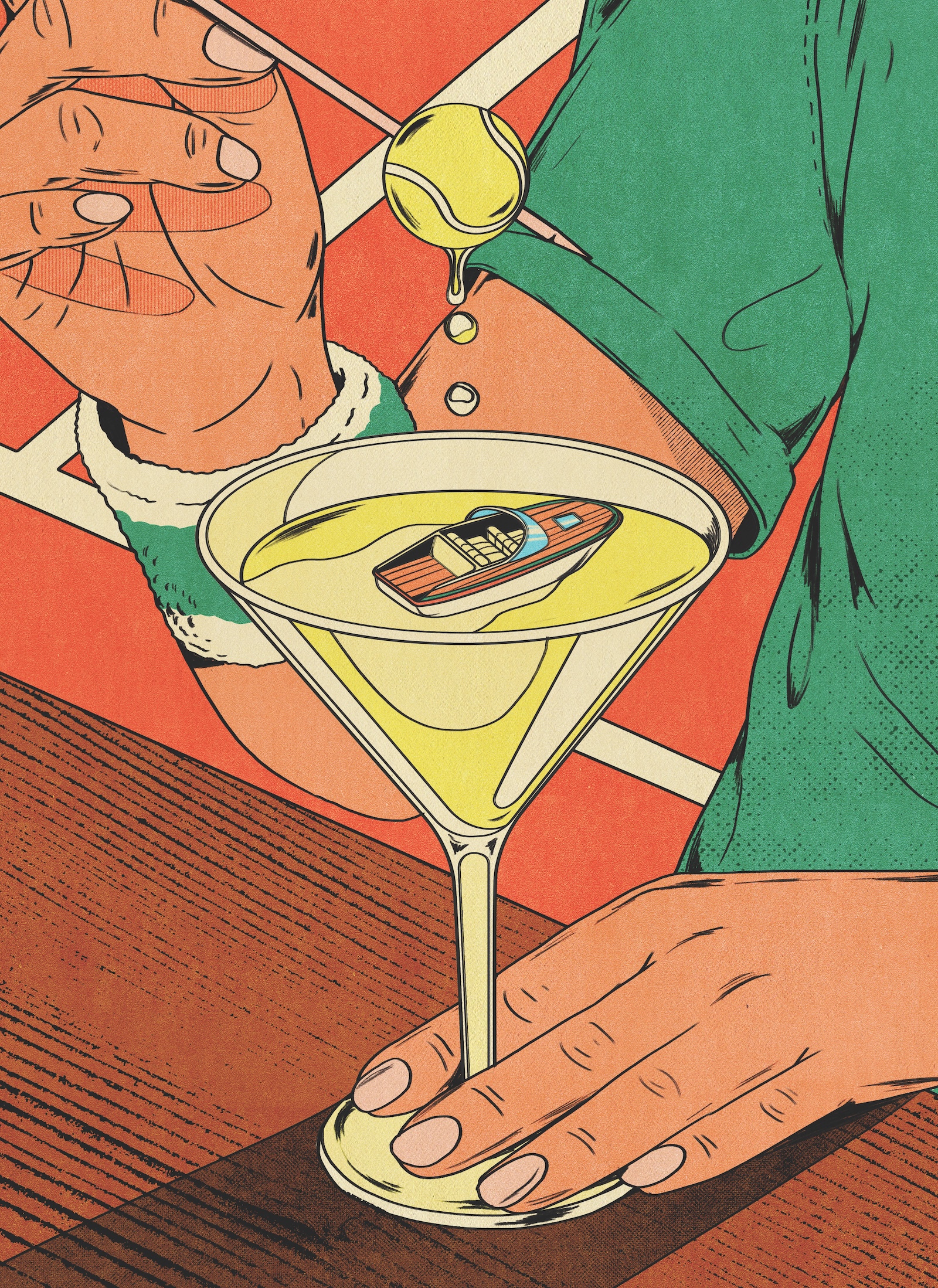
What I learned this past summer as a tennis instructor is that there are depths even to liberal-white credulity. For nearly the entire month of June I had been hired at a rate of fifty dollars an hour to train the fraternal Trevelyan twins at a sport I had a decent grasp of, provided I was a little drunk.
“I can’t help but notice the setup here,” Mrs. Trevelyan said one day as she was picking up the kids from the court.
She was referring to my accoutrement: an old cooler full of ice, a handle of gin, a bottle of cheap blended scotch, something in the Famous Grouse price range. Other items I required for tennis: a folding chair that could support my increasing weight, a jar of olives, lemons, a shaker, a long-handled twirling spoon if you wanted to be fancy about it. I’d picked up the twirling spoon at an estate sale, where I had felt very out of place.
“Well, tennis is more an art than a science. My old Sikh tennis coach insisted on drinking martinis as he supervised our ground strokes,” I said. This was an obvious lie, or should have been. It was not obvious to Mrs. Trevelyan, however. She had afforded me a great deal of latitude on account of her unmoored, really rather unhinged, empathy for my “situation.”
“At the Lankarastan Tennis Club and Polo Grounds?” Mrs. Trevelyan asked delicately.
“Exactly, before the war. Those were days of youthful bliss I won’t soon forget.”
“Well, it must have helped. Since he molded you into a national champion. Sorry, I didn’t mean to pry or interfere. Or, oh God, come off as culturally insensitive!”
“Not at all, madam. Madam, please don’t concern yourself.”
Mrs. Trevelyan laughed timidly and, realizing probably that our brief conversation had cost her dear minutes—the twins had swimming lessons, then piano, then Chinese Mandarin in successive hours—hurried off to her parked SUV, where Marco and Joy were waiting in the air conditioning and eating hummus and carrots.
I had described the Lankarastan Tennis Club and Polo Grounds as a hallowed estate with high marble walls and other bespoke fortifications where I had spent my boyhood, the son of a minor prince, twelfth in line to the throne but no matter, because Lankarastan, like Great Britain, had a largely ceremonial monarchy. Our job as royals was to uphold traditional Lankarian culture, which had been brought across the mountains and down through the desert by the Kashmiri Pandits, where it found purchase with the ancestral and abiding nature worship of the local scheduled tribes, and that this new syncretism blossomed further under the genial Moguls. When the British came, there was a great exchange of culture, and Lankarastan continued to enjoy the privileges of a self-governing, princely state. After Indian independence from Great Britain, Lankarastan was annexed bit by bit into the new republic through a series of armed skirmishes until it was swallowed up whole in 1997, an event overshadowed on the global stage of course by the British handover of Hong Kong. The “treaty,” if you can call it that, which declared the full and final annexation of Lankarastan, was signed at the only sizable building of repute that had survived India’s determined campaign of bombardment: the Lankarastan Tennis Club.
“Which is why most people haven’t even heard of Lankarastan,” I had explained to Mrs. Trevelyan the first time we met.
“That is shameful. I am so embarrassed,” Mrs. Trevelyan replied.
I’d been out walking the dog (Theodore), and as we passed by the park, I noticed a handsome middle-aged white woman struggling to show her children the basics of a forehand. It was as if her elbow had been soldered to the side of her, an unnatural, halting motion that was utterly an affront. An idea came to me suddenly. Much earlier that day, at about two o’clock in the morning, I’d been driven home by an African gentleman—I can’t recall his country of origin; he told me, but I’d been slamming Red Bulls and vodka. But he had been a decorated and respected and widely liked obstetrician in his homeland but was now considered uncredentialed or undercredentialed or whatever the fuck and was currently driving a Lyft. He was making good money and he owned the Lexus he picked me up in outright, but that’s not the point. His situation had stayed with me for the remainder of the day, and had inspired a potentially lucrative idea while watching this inept woman flail along the baseline. I affected an accent based on my favorite uncle.
“Excuse me, madam,” I said. “May I?” I had tied Theodore around the water fountain. I showed Mrs. Trevelyan a proper forehand, then rallied for a while with the twins.
“You’re not looking for an instructor, are you?” I asked. “I played professionally in Lankarastan. I was the national youth championship two years running. Unfortunately, the war interrupted what would have been a promising professional career.”
“Oh my gosh. That would be great! I’m sorry, where is Lankarastan? Is that in the Middle East?”
I told her all about Lankarastan, and Mrs. Trevelyan then apologized about her ignorance. We agreed to fifty American dollars per pupil, per hour, for a minimum of two hours, hence two hundred guaranteed dollars every weekday morning. That’s a lot of good gin and leg of lamb at Costco, the membership being under Jinny’s name.
Jinny is my partner. We’d met in high school back in Wichita, Kansas, where I was born. Ten years ago—another era, practically—Jinny would have found the whole notion of Lankarastan to be a fucking riot. But something about turning twenty-seven had changed Jinny. She went back to college, earned a degree in social work, found steady employment within the public schools here and was now considering going back for her master’s. I worked on and off as a self-employed landscaper, occasionally bringing on two Mexicans I tried very earnestly not to take advantage of as far as splitting the labor equally. But it happened, and I felt bad and I drank, and the vicious cycle continued. I’d fall asleep in whatever bit of shading I could find, under saplings, and between pallets of mulch we were all three of us meant to be spreading across the bowers of paradise.
“Well, what’s the harm?” I asked Jinny. “I mean, what is the actual harm here? Who’s getting hurt? You know Juan and Pablo—I am screwing those guys over constantly. Who’s getting screwed over here. I mean, really.”
“You’re lying to that woman.”
“Well, she can afford it. She drives around in a fifty-thousand-dollar Cadillac. Husband’s a lawyer—who cares? I’ll have stocked the bar for the year.”
“The year? Oh, really? Somehow I doubt that.” Jinny made a glug-glugging motion that was hurtful.
“Does it matter at all that I’m enjoying myself? I like coaching tennis. I am very reassuring! I look good in shorts, dammit, better than most men my age,” I said as I trailed Jinny and Theodore down the hallway to the bedroom, where Jinny shut the door on us. She was always going to bed at a far too reasonable hour. Theodore and I stayed up and drank, watching Andre Agassi footage, trying to glean a thing or two about championship-level tennis.
Stanley Tucci is an actor I hold in very high regard. I saw him on a television program with Eric Ripert, the Michelin-starred chef. They were cooking risotto and drinking, and Stanley explained that he preferred his martinis with a splash of scotch instead of vermouth.
“Jinny. Jinnny!” I cried. She was in the other room.
“What!”
“Stanley Tucci is replacing vermouth in his martini with Johnnie Walker Red!”
There was no response.
“Jinny!”
Despite Jinny’s lack of enthusiasm, I tried a martini with scotch and liked it and then preferred it. Now, scotch is pricier than vermouth, and this showed up in the household budget, and Jinny insisted I take on a sideline. Well, actually, she renewed her insistence. Hence the tennis instruction.
Mainly, though, I’d sit in a lawn chair and drink martinis while the kids rallied back and forth as a warm-up. When my back started bothering me, I’d get into the action, going at them one-on-two like a musketeer fighting off a pair of Richelieu’s guards. I could still move around like a panther despite it being more than a decade since my high school tennis career ended with me getting high in the parking lot at the city finals, missing my third-place match, and forfeiting by default. But I still had my forehand and my backhand had notably improved without the additional stress of my meticulous émigré father watching me from the bleachers. He had bad knees and a surgically repaired heart and had lived vicariously through my budding tennis career—he was always criticizing my backhand. My second serve was still pretty much nonexistent, a goddamn simp of a second serve. I was landing my first serves about fifty percent of the time. The twins didn’t have any love for the game but knew they had to tolerate it so they could have their screen time. And they didn’t tell on me as far as all my cursing.
“Fuck, was that out actually? Fuck me.”
Marco shrugged an affirmative on the other side of the net.
“Goddammit. This fucking second serve. All right, let that be a lesson. Don’t neglect the second serve. Let’s see some second serves. Doesn’t have to tear anyone’s balls off now. Think of it more as a silent fart.”
The twins just looked at me, probably embarrassed. They were already too sophisticated. So yes, I pretty much just worked on my tennis game for two hundred dollars every morning. Then I went home, fed Theodore, and bummed around until Jinny got back from work.
One day she’d had a particularly shitty time at the office, collapsed on the couch next to me, where I was planning an elaborate lamb dinner for the weekend, and said, “I’m in.”
Jinny used to escalate shit back in the day. We had a whole business in high school running Lone Star Beer up from Oklahoma. Jinny had gotten the idea watching Smokey and the Bandit. Fun fact: you could only get 3.2 percent ABW beer at the grocery stores in Kansas. I think it was probably our second official date when Jinny and I got fake IDs from her cousin. I mean, between gas money and the fact we didn’t want to screw our friends over, it was not a very profitable enterprise. But it was Jinny and me doing our thing. It was fun. Jinny joining the tennis scheme was, how shall we say, a return to form for her. Like Agassi at the ’99 French Open.
“You’re not thinking big enough,” Jinny said. “You ought to be running your own tennis academy.”
Jinny went about making the flyers, listing all my accomplishments and accolades as a youth player in the lost kingdom of Lankarastan. She doctored some photos on the computer. It was brilliant: me flanked by soldiers in turbans, all of us in full-dress uniform, standing at center court and staring solemnly at the camera. We started leaving the flyers at local businesses and the church. Soon I had about fifteen kids signed up for my youth tennis camp—it was summer, they had shit all to do. I still trained the Trevelyans every morning at the park, just the twins, at the locked-in rate of fifty per hour, which by then had become quite a discount. But you know, dance with the one who brung ya. Jinny saw to all the bookkeeping. Jinny had told her boss she was taking some time off because I had twisted my knee taking a Japanese maple sapling off the flatbed by myself.
“He was supposed to have help,” Jinny said on the phone, nearly in tears. “He usually works with these Mexican guys, but they didn’t show up. I don’t know where they were!” Jinny’s boss had gone on record as hating Mexicans because he said they were overburdening our schools and communities with their droves and droves of children.
Jinny came around to the concept of the smoky scotch martinis, too; every day at noon, we’d have a few as the kids practiced their lobs.
“Tennis is about buying yourself some friggin’ time to yourself. Am I right?” I said to the kids. “It’s about distracting your opponent while getting out of goddamn no-man’s-land.” And I wasn’t wrong. Despite my drunkenness, and perhaps even owing to it, my tactics were sound. Mastering the lob had extended Agassi’s career considerably.
When she was all in, Jenny had a tendency to escalate shit beyond reason and repair. I cannot overstate this, and I admit I am prone to overstatement. A keen example: in previous iterations, Lankarastan had always been landlocked. I had imagined a vale protected by the deserts and mountains. But Jinny wanted to go out on the water. She wanted to avail herself of the pontoon boat she had seen parked in the Trevelyans’ driveway, and so she decided that at some point in my past I had been a cadet at the Lankari Naval Academy and had graduated with distinction. This would necessitate that Lankarastan—what was now Lankari Pradesh—was connected to the ocean by the Lankari River, home to various unique species of freshwater dolphins.
One day Mrs. Trevelyan had asked me if we could, if it wasn’t too much trouble, drop the twins off at home because she had a hair appointment that she absolutely could not cancel or postpone.
“Sure,” I said.
So Jinny and I drove the twins home, and that’s when Jinny saw the pontoon boat and immediately began devising a plan. It was nearing the Fourth of July, and Jinny wanted to go out onto the water, have a couple of drinks, and screw. My Jinny, I knew, was on some sort of rumspringa from her job as a caring and competent social worker. She’d recently been offered a promotion and had to decide soon whether to take it or go back to graduate school. For her it was a genuine conundrum.
We dropped the kids off and then went to a bar. They’d never heard of a smoky scotch martini before.
When we had our drinks, finally, Jinny said to me: “You’ve always struck me as an ex-sailor.” That’s how she told me what she was thinking—namely, that we could borrow the boat to see how it maneuvered and whether it would be a suitable vessel upon which to teach the Trevelyan twins some maritime defensive tactics.
“Jinny, you’re crazy, baby,” I said. “We got a good thing going with the tennis.”
“These rich, worldly liberal-adjacent types. They want their kids to know all the latest hip, weird cultural shit. Naval tactics with a former Lankari rear admiral? You don’t think they would eat that shit up?”
Jinny had a point, I realized, and if I were a minor prince, certainly I would have received a pretty cozy commission in the Lankari Navy where I’d spend most of my time, I imagine, inspecting the wealthy and attractive European bathers on our sovereign coastline.
I brought this up casually to Mrs. Trevelyan the next time I saw her.
“It’s just something that occurred to me,” I said. “That you might be interested in.”
Mrs. Trevelyan’s eyes lit up. None of her children’s peers were doing this sort of thing. Yes, yes, she was quite thrilled about the possibility that I might train the twins in marine reconnaissance and search and rescue.
“You wouldn’t mind, madam, if I took the boat for, how do you say in America, a spin? To make sure it’s viable for naval tactics?”
“Well, I don’t see why not,” Mrs. Trevelyan said. “Whatever you think best, Lieutenant!” I had demoted myself to a lieutenant, as I thought that was a more feasible rank for a person who had been only nineteen years old when he graduated from the naval academy, the same year as the demise of Lankarastan as a nation-state.
We hitched the pontoon to the flatbed early on the morning of the Fourth of July and went out to McKinley Lake, near the dam, to unload her into the water. Jinny and I knew enough about boats though we were not very skilled at speed. We could idle a boat and handle pleasure cruising. We found a little inlet or cove or whatever the hell they’re called and drank beer and fished unsuccessfully for about half an hour before we both looked into the other’s eyes and conceded it was really the idea of fishing we were drawn to.
The slight swell of it all (plus liquor and isolation) horned us up, and we went belowdecks, as they say. I’d had too much to drink but under a blue and clear sky I went down on the woman I should have honestly proposed marriage to ten years ago. Jinny came (twice!), and thank God for that or what would the day have been for. Then we had lunch and said, why not take the boat out to center lake, see the sights, be at the middle of all things.
We went to center lake. I kept saying “center lake” as if it were an actual nautical term. We were at center lake for a few more hours. We were listening to Steely Dan. The lake was crowded since it was the Fourth. Other boats would sail by, only a few yards off, and we’d toss beers at one another. There was a genuine camaraderie. We were all lake people now and Americans, regardless of creed, color, ideology, religion. This is the greatest country in the world, my father says. Now, Dad actually had seen a thing or two—Partition, Naxalites, Watergate, Blue Star, Modi—and his opinion is to be trusted. But then fuck it all if Jinny’s boss, who thought I was in a cast and that Jinny had been nursing my frail body through a difficult recovery, revved by on his speedboat to see me standing on the foredeck in pretty much the prime of my adult life, all those weeks of tennis having worked off the flab I had been accumulating since high school ended. My jawline had even made a tenuous reappearance. I was looking good.
“Jinny? Raj?” Jinny’s boss said. He was about fifteen yards away. There was no mistaking us. We all immediately understood the implications of him spotting us on the lake, no more than a week from being told I was just out of the hospital.
But for whatever reason, Jinny gunned it at the controls. And about a minute later, feeling oh so exhilarated by the distance she had put behind us, Jinny had forgotten about the topography of a lake—if that’s the word—the approaching shoreline, the shallows, and what have you, and we tore up the left pontoon pretty badly.
“It was my mistake,” I said. “It was my mistake to fly the flag of Lankarastan.” This is what I told Mrs. Trevelyan and her husband: that we’d been spotted by Rajput partisans out on the lake and that they’d demanded we take down our flag. We’d tried evasive maneuvers, but they were on us and they ran us aground. The Rajput partisans were everywhere, had never truly disbanded. They were fascists, I implored, having heard Mrs. Trevelyan decry fascism in the past.
“The war isn’t over for some. It’s not enough that we surrendered. They want to murder every last one of us.”
Mr. Trevelyan said nothing. He just chuckled and went back inside. Mrs. Trevelyan felt foolish, I could tell. I should have sobered up at least, and it was probably a bad look that Jinny was smoking nonchalantly in the cab of the truck and blasting Mötley Crüe. Mrs. Trevelyan told me she was pulling the kids from tennis. She said she was contacting the Better Business Bureau and maybe the police.
“No, you need to be contacting the UN High Commission,” I gambled, at which point she pointed down the street and yelled at me to go away.
There have been repercussions, but it hasn’t been as bad as you might think. Mostly we don’t show our faces around as much. We’re laying low. I think most of my clients are really just too embarrassed by the whole affair to demand their money back, that they’d fallen for the total and sheer farce of Lankarastan.
Next time we’ll be more careful and take certain precautions. I will try to reign Jinny in with carbohydrates. Oh God, that day out on the lake we were eating like those Paleo maniacs, nothing but tuna steaks and hot dogs, the alpha and omega of the carnivorous world, but no bread, nothing to soak up the booze. Jinny’s boss would have understood if we shouted over an apology across the bow, right? Hey bud, we just needed some time to ourselves. It was all getting to be too much, you know? But no bread, and without bread there can’t even be the semblance of an apology. Not in this world.
I keep thinking this was going to happen one way or the other. Before the tennis ruse, there had been a couple of weddings where I had pretended to be an exiled nawab or maharaja of wherever. The stakes were pretty insignificant. I just had to keep the charade going for the rest of the night, and it was fairly easy since we were all drinking fistfuls—one of the advantages of an open bar. They would all wish me godspeed at the end of the night, and Good luck seeing home again from your rightful parapet, my raj, all that you survey is your rightful domain. Jinny had to corral me into our Lyft as I saluted my sympathizers. I like weddings. I enjoy lying to strangers. If I thought about it for more than half a second, I would probably concede it’s because I don’t like myself very much or really at all, but hell, Jinny seems to see something in me worth coming back to every night in a not so terrible or resigned a mood, so it can’t be that bad. How’s that for a bit of horse-trading with yourself.
“Do you love me?” I asked Jinny one day when we were sitting on the back deck drinking beers.
“Of course I love you,” Jinny said. “But you need to grow your beard back. You’re getting jowly again.”
“Will do. Yes ma’am. You love me for me?”
“Yes, for you,” Jinny said, and I didn’t have to explain my reservations, thank Christ.
I thought that would be the case, that Jinny still loved me, but sometimes it’s nice to get the spoken reassurance that I am still loved, I who was born and raised in Wichita, Kansas, who worked at the movie theater in high school and thought it was the best time and still has ambitions of being a full-time projectionist one day, with the note on the pickup truck and the tax lien and a stack of unfinished siding at the back of the house (the manufacturer’s warranty has expired), who has never before set his bewildered, Midwestern eyes on Lankarastan’s famous waterfalls or enjoyed the fabled and world-class amenities of its National Tennis Club and Polo Grounds. 
Avee Chaudhuri teaches literature and creative writing at the University of Nebraska–Lincoln. Some of his other stories have appeared recently at the Missouri Review, minor literature[s], and Juked. He is the chef/owner of the Sepoy’s Revenge, a small catering service and pop-up restaurant specializing in the cuisine of West Bengal.
Illustration: Maria Jesus Contreras
