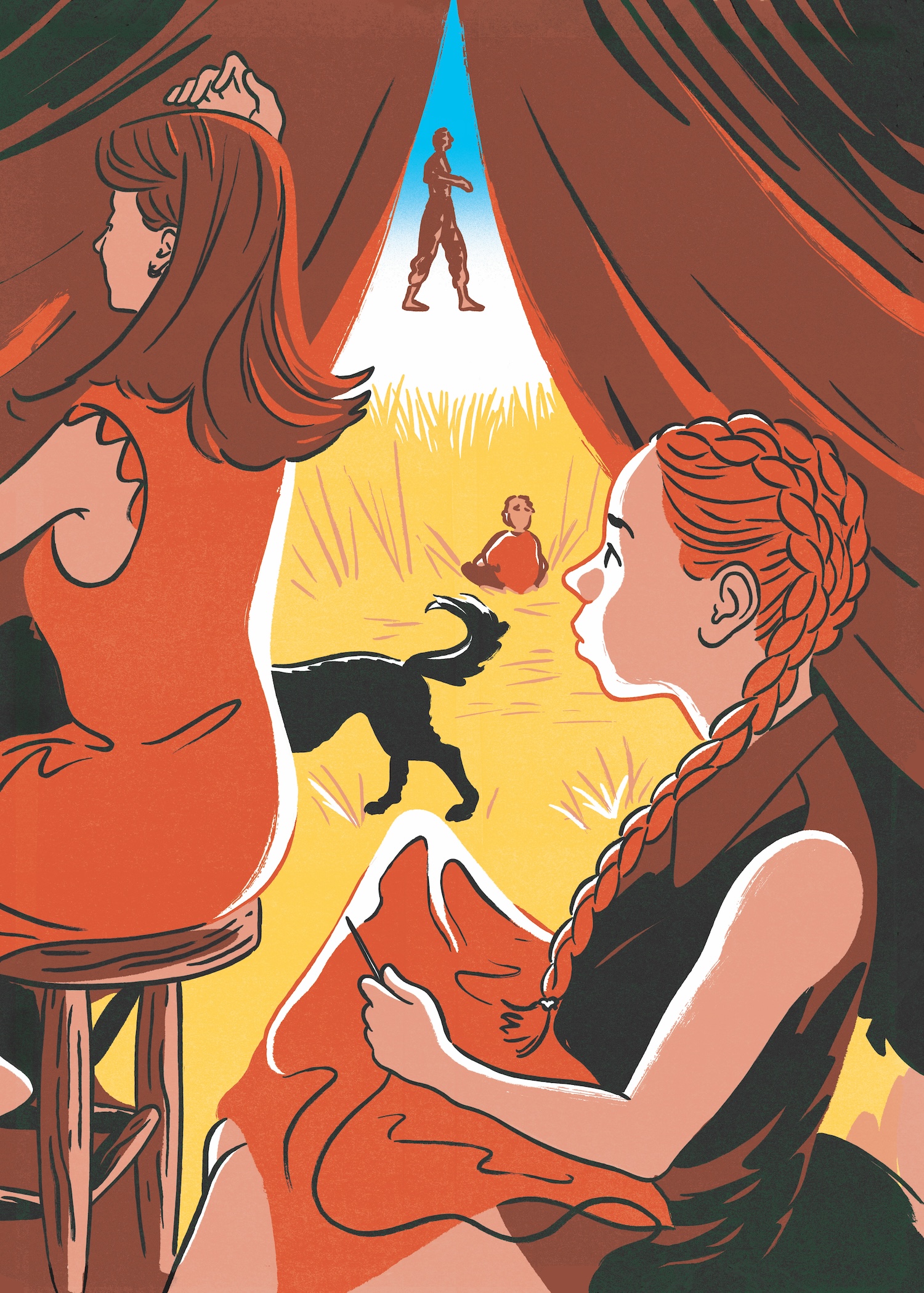
Billie feared the moon and her brother could walk through the sky. They had been frequenting the circus grounds and by then it could have been home although it wasn’t, and the larva man had given Frank a pair of small leather slippers that bound his feet into two black skipping stones, worn and soft and lighter than water. The larva man was called the larva man because it sounded nicer than the maggot man. His face was half rotten, the blood browned and loamy, his jawbone wormholed and crawling with bugs. The shoes he had given Frank were for tightrope walking, as Frank had quickly proven to possess a great skill for it. The larva man did not know how to tightrope walk; on show nights he sat on a frayed and padded stool, his booth hung with moth-eaten velvet curtains the color of the wound on his face. People paid and gasped, a fat white maggot—one of many—humping through the rot to curl in the crook of the larva man’s ear, its dimpled body unsoiled by blood. He had not yet told Billie and Frank what had happened to him, although they knew it did not matter and they would not listen when he did.
The circus came in the summer and would stay for fall, the camp a great sore for the people of town. The townspeople gathered and held meetings with coffee and wooden folding chairs and the women smoothed their skirts and fingered their necklaces as the men spoke and discretely wiped sweat from their brows. The town-hall rooms were hot, stifling. As the townspeople described those who were now staying on the campgrounds their cheeks and necks and chests flushed pink then red, their throats drying, but it was not with heat. They came, in the end, to the conclusion that the whole business of it would be good for the town—the circus would attract visitors from nearby cities, and even those gathered at the town-hall meetings knew they would venture out of their homes on weekend nights, their purses open, their breath held tight beneath the black of a starless sky. And so the circus stayed, tents sagging and mildewed but still and wholly reflecting the sun.
Billie and Frank began riding their bikes to the edge of town to stand in the yellowed grass with the crickets and the worms and the hot white light of July. Standing before the camp and beneath the sun they felt the great, suffocating grip of high noon slither through their rib cages and they found themselves sapped of anything, their bikes dead in the grass, their lungs and heads heavy with lack. Frank spat sunflower-seed shells and stamped them into the soil and Billie’s braids were loose and neither shielded their eyes or squinted. They just watched the circus’ camp and stared at the blinding stretch of white tents until someone started to watch them in return.
It was Montana—a woman in a pale, sleeveless nightgown made of soft linen. Montana did not tell them to leave nor did she invite them to stay. She asked Billie and Frank to please do something besides stand there, still as statues, as everyone was beginning to find it unsettling.
“It’s the sun,” Billie said to her. “It makes everything thick.”
“It’s hard to move in a field like this, where the sun can’t hide,” Frank agreed.
Montana stared and considered the two children before her. “Do you prefer the night, then?” she asked.
“No, ma’am,” Frank said, and Billie nodded in agreement.
“And why’s that?” Montana asked. Birds chirped and an accordion played and somewhere food was being cooked; they could see the smoke but the smell had not yet reached them, the air already too full of summer and mosquitoes and the shrill endless sounds of the cicadas to hold anything else at all.
“’Cause Billie is afraid of the moon.” Frank nodded his head smally in Billie’s direction and Billie looked down at her shoes and then up at Montana’s face. Her face was young and beautiful, and she didn’t look like she should be in the circus.
“How old are you?” Montana asked.
“I’m ten and Billie’s twelve,” Frank said. “She’s older, but it doesn’t really count. I know more than her.”
Montana laughed and shook her head before she turned to leave. Billie and Frank watched her go, her white dress and dark hair unmoving because there wasn’t a breeze—she could not be a ghost for she was too still.
As Montana walked back to the tents, Frank’s eyes suddenly widened to fit the whole of the sky. A man was midair, balanced on nothing but a blue so clear and present you could, in fact, stand on it. Neither Billie nor Frank had, up until that moment, noticed the sky; it had seemed like nothing in the light of the sun, and the sky’s sudden blueness seemed as emergent and alarming as the man walking through it. The man had orange hair and he was as pale as a cloud, his chest bare, his hands held palm up in balance or offer. He walked slowly and carefully but surely he walked.
“There’s a wire,” Billie said.
“Is not. Where?” Frank squinted.
“Beneath his feet, of course.” Billie crossed her arms over her chest.
“Let’s go see, then.” Frank left his sunflower seeds and his bike and he began to follow Montana toward the man who could walk through the sky. Billie hesitated, then followed, for she decided she did not fear the circus, but her feet were still slow because the sun was still hot.
“Miss,” Frank called so Montana would stop, and she did. “How’s that man doing that?”
Montana looked to where Frank was pointing. “That’s Paul. He’s our tightrope walker. On opening night he’ll walk a wire twenty feet high. I’ll introduce you, but it’s best not to interrupt him while he’s already up there.” She shielded her eyes against the blue of the sun.
They did not speak to Paul that day or the next but they spoke to Montana and the others and did so regularly for weeks. They sat in the shade of the various tents and washed dishes and ate sandwiches and Frank shared sunflower seeds from his pockets. There were dogs that were kind and dogs that were mean, their teeth yellow and their eyes glassy or clouded with cataracts. There were other animals, too, both bigger and smaller, and they stayed in cages and moaned and paced and laid with their eyes open to stare at the sun. Billie and Frank could both see and hear the animals, but they did not approach, for the animals did not want Billie and Frank to come near. The sun made them reek and flies bit the flesh exposed by mange or something like it, their hair or scales patterned with sores and blood and split-open skin. Each day before dinner the larva man would sit at the wooden tables beneath one of the tents and he would stare at the animals the way the animals stared at the sun: with blind eyes that did not want to see.
“Everything we do is bad,” the larva man said, because his mouth was decayed but not blind. On that day, two weeks into their time at the camp, Frank and Billie had not yet met the larva man and they were still full of fear of him, though they had met everyone else. Frank, however, was not in the tent with Billie when the larva man first spoke to her; Frank was out in the sun, bare chested with red shoulders, balancing on one foot on something that could have been a small metal cannonball.
The larva man gazed from the animals to Billie so Billie could see the whole of his face if she looked up from her lap where she stitched a costume and patched its holes. The needle was quick in her fingers and the thread was long. When the silence between her and the larva man pulled longer than her thread, Billie stopped sewing. She would soon need to meet the larva man’s eyes and see the truth of it, but not quite yet. Billie looked instead at the costume in her lap. It was Montana’s—a purple-and-black bustled dress with a corset and ribbons. One day, a week prior, Montana had shown Billie the costume while Frank was off with Paul practicing the tightrope. The dress was on a hanger in Montana’s tent and was nearly as beautiful as Montana herself.
“Can I see it?” Billie asked shyly, and Montana shrugged, slipping off her simple linen dress and unhooking the costume from the hanger. Montana stood naked and her fingers carefully unlaced the corset’s black ribbons and, without seeing, Billie became aware of a man at the fold of the tent. He seemed to be an ordinary man—as ordinary and out of place as Montana—and while he was dressed in shadows Billie could still see he was entirely undressed from the waist down. Montana stepped into the costume and Billie did not turn but looked from the side of her eye at the man, his arms and hands loose at his sides, his legs hairy. He did not touch himself and his fingers did not twitch and his mouth was closed tight, pressed into a line, but his chest rose and fell with careful breath, and his eyes and body did not move. The fold of the tent hung white behind him and surely outside it still reflected the sun, for even in the shadows Billie could see everything. When the dress was on Montana, Billie pulled the corset so tight she worried Montana’s sight would go dark. Montana, though, was fine, and she twirled to show off her dress and the man was gone but Billie felt sick and hot and excited.
“You have to stay out of the sun,” Montana had said when she stopped twirling, Billie’s wet skin pale and red at once. Billie nodded in agreement, although she didn’t know if it was the sun that had suddenly made her look unwell.
In coming days Billie looked for the man, but if she had seen him she did not recognize him, and Frank advanced from a one-foot wire to a three-foot wire and then to a four-foot one. The camp was beginning to feel like home although it wasn’t, and the white tents and their reflected white light seemed as simple and everyday as the sun.
When Montana had tried on the dress, she had noticed some small tears, and Billie, who had learned sewing in school the previous year, offered to mend it. But the circus did not begin proper for weeks yet, and Billie put off the task until the day she first spoke with the larva man. Billie sat with the dress in her lap and a needle in her hand and she glanced from the dress to the fold in the tent. Outside and beyond the fold she saw Frank who no longer balanced on the cannonball but now hung in the sky. If the summer heat had not already taken all her breath, seeing Frank on the wire would leave her breathless, she was sure. It was like seeing God without the cross. Billie looked back to the dress then and considered trying it on rather than thinking of what to say in response to the larva man. She wondered if it would bring the man from the tent’s shadows.
“You really don’t think so?” the larva man asked again. “You don’t think it’s true we’re bad?”
Billie did not know what was true. Frank could walk the wire six feet off the ground with an ease he never before possessed. Billie had once suggested—in their room in the dark, the curtains drawn against the moon, Frank already drifting to sleep in his bed—that someone on the grounds had bewitched him. Frank’s sheets rustled as he shook his head no.
“That’s ignorant, Billie,” Frank had said then.
Frank understood ignorance because Frank understood Paul. They had finally spoken to Paul on their third day at the camp. Paul’s sentences came out wrong, often in a tumble of words that did not fit and were not words at all. Paul was handsome and strong and a quick and effective teacher and he bared his chest to the sun, but he had fallen often from both small and great heights. When Montana first introduced Frank to Paul, Paul had stared at Frank, and, after a moment that stretched beyond them, Paul informed Frank that walking through the sky meant hitting your head all the time. Or at least this was what Frank had assumed Paul to say, as it seemed a logical fact. And so Frank stayed with Paul and his bare chest and words that weren’t words while Montana and Billie left toward a tent. Billie could not understand Paul, but she saw Frank’s rapid advancement at the tightrope and felt she understood enough. And she was not ignorant, because the camp—with its cloudless, emergent blue sky and the tricky white light reflected off tents in stretches across the field and everything else—was, in fact, bewitching. Montana with her young face and costume dress was bewitching, too.
“That’s ignorant,” Billie said to the larva man, for certainly he was not bad, just rotten. The people in town said those in the circus were Godless, but in that moment Billie knew they were wrong.
The larva man stared at her but still Billie did not stare at him.
“Montana told me you’re afraid of the moon,” the larva man said.
“Yes,” Billie said. She neatly folded the costume and set it aside on the table. She would not, she decided, ever try it on.
“Why?” the larva man asked.
Billie looked up at the larva man’s face. She saw the brown blood that looked like soil, the maggots that crawled through it. The wound was dark but she could see everything, the pale bone and festering flesh and all that lived there, just like she could see the man in the shadows.
“Do you think Frank looks like God out there, in the sun and the sky like that, just hanging there?” Billie asked the larva man.
The larva man looked out at Frank and Paul on the wire. “I suppose I stopped thinking about God, so I can’t be sure,” he said.
Billie ran a hand over the dress—maybe she would try it on—and nodded. “Our mama used to tell us this story, I guess. It was about the moon, and how we shouldn’t listen to it because it shows us the dark.”
The larva man stared back toward the animals in their cages. They were silent and their eyes were open.
“What good is the sun, either, then?” asked the larva man after a long moment that hadn’t felt long at all.
Billie thought about the sun and the moon and the sagging, mildewed white sheets of the circus tents. She thought about Frank on the wire and the maggots in the larva man’s face, about Montana’s naked body and the man and the dress beneath her hand. In a few weeks, when summer ended and night finally fell, the circus would open and Montana, Billie knew, would have sex with the men from the town. The larva man would sit behind the curtains the same color as his wound. The trees would dry, branches as pale and brittle as the moon or bone, and leaves would fall and decompose. Paul, without his words, would walk through the sky with the falling leaves and the animals would leave their cages. Children would shriek and parents would gasp and the sounds would try to fill the sky even though Paul would already be in it. Billie watched the maggot in the larva man’s blood, its head bobbing and burrowing.
“Yes,” said Billie to the larva man. “What good is the sun?” 
Katie Harms was shortlisted for the Malahat Review’s 2024 Open Season Award, Writer’s Digest’s 93rd Annual Writing Competition, and the 2024 Novel Slices contest. Her work can be found in the Ilanot Review, Every Day Fiction, Qu, Creation Magazine, The Other Journal, and Action, Spectacle.
Illustration: Calum Heath
