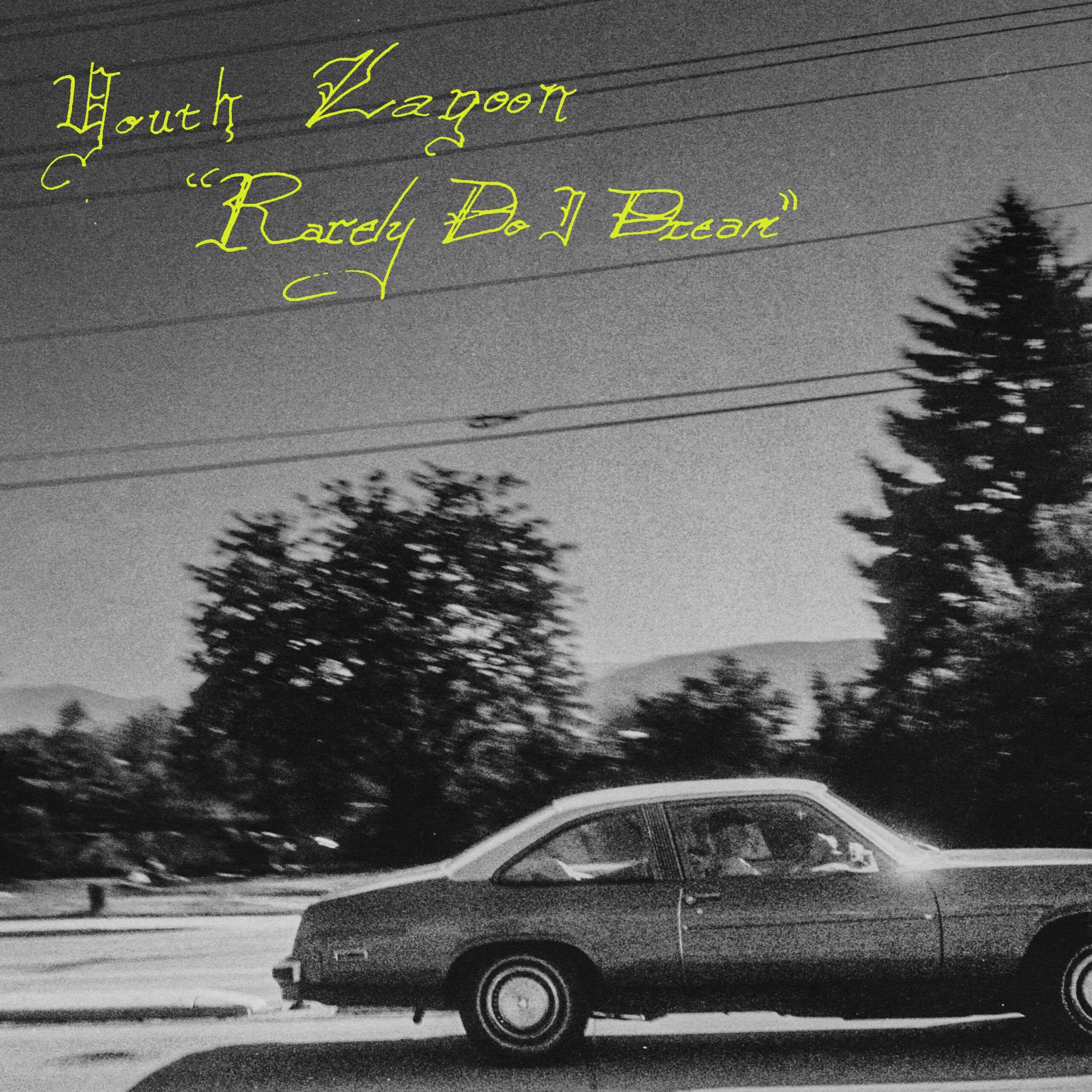
The Guest List is a regular book column that surveys the reading habits of our favorite musicians. In this edition, Jimmy Cajoleas talks with Trevor Powers, the critically acclaimed musician who records under the name Youth Lagoon. His excellent new album Rarely Do I Dream was released in February on Fat Possum.
Jimmy Cajoleas: What are you currently reading?
 Trevor Powers: I’ve been reading a lot of manga lately. My wife is way more into manga than I am, but she’ll introduce me to certain series or books that she knows I’ll become obsessed with, because she knows me so well. I gravitate to manga that is really gritty, splatterpunk, ’90s or early-2000s manga because the stories are way more dystopian and surreal and dreamlike. That’s a reason I love manga: it’s based around dream logic, where you’re stretched so much with regard to what reality is. There’s a book called Dorohedoro by Q Hayashida. Hayashida, no one really knows who she is. She’s stayed completely anonymous somehow, which is pretty impressive in 2025. This series has to do with two different worlds. There’s a world of sorcerers, with all these beings that can do magic. And there’s another world called the Hole, with everyone who can’t do magic. The sorcerers visit the Hole to experiment on everyone who can’t do magic. So it’s super fucked up, but it’s amazing.
I try to keep a balance. There’s so many different parts of my brain that have different cravings or itches that need to be scratched, so usually if I’m reading something on that side of my brain, then my brain is also craving something that feels a little bit opposite. I’m a huge Andrei Tarkovsky fan, and this goes back to my love of film in general. His mind was so spectacular, the way he viewed not only movies, but the way he viewed art and poetry and every single expression as something with weight, that he took seriously. Have you read his book Sculpting in Time? It’s fantastic. It’s essentially a memoir about what his process was like on each film, where he was in his social life, with relationships, and the toll his films were taking on him. Beyond all that, he talks about the importance of art and the weight and significance behind anything you do creatively, even if it’s not to be shared, even if it’s just for yourself. I fucking love that book so much. I’ve read it multiple times. It’s become almost a bible for me.
JC: Are there any books that inspired the writing on your new record?
TP: That’s always so hard to pinpoint because every single thing—every book I read, every conversation I have, everything I scroll past on the internet—is a part of it. There’s something about the idea that everything washing over you becomes a part of who you are, for good or bad. With regard to books, I had recently read The Devil All the Time by Donald Ray Pollock. I love the whole underbelly aspect of those small-town rural American settings. I’m drawn to that because so much of my childhood was spent in those worlds and my current life is lived in those worlds. With The Devil All the Time, there’s so many different characters that feel so exaggerated that you can’t really imagine a scenario where they are real. But so many of those kinds of people not only actually exist, but I’m talking to them on a regular basis.
JC: There’s a thing about living in a small town sometimes where you can be a truly strange person, but if you’re just around and you’re part of the community, there’s this little corner where people just let you be.
TP: Yeah, that’s so true. When you think about small-town living, there’s not the same amount of checks and balances that people tend to get in metropolitan areas. Obviously, there are intense characters wherever you go, but I would say there’s a different type of intense character in small towns versus large cities. Because (a) people’s worlds are so small, and (b) because their worlds are so small, people tend to try to expand them through chemicals. Addiction is such a huge, rampant issue all across the world, but it can be particularly bad in small-town environments. But in the middle of all that, there’s so much beauty too. The reason I relate to a lot of the characters in The Devil All the Time is their good intentions. Not to say that everyone in that book by any stretch has good intentions, but there are these hidden good intentions that end up completely getting annihilated by addiction or pure debauchery or ignorance. It is such a fucked-up book, though. It’s so gnarly. Super gnarly.
I don’t know if you’re a sucker for a good book cover, but covers are often a reason I end up reading a book. There are so many books I’ve bought based purely on the cover that have changed me. And one of those was a book called The American Way of Death by Jessica Mitford. The cover of the edition I have is phenomenal. If I’m in the bookstore and I see a certain cover that grabs me . . .
JC: That’s one of the great things about browsing, walking through a bookstore and picking a book up just because the cover struck you. It’s such a rare experience now, with the internet. That’s why used bookstores are a little bit of heaven to me.
TP: I get to go into so many used bookstores when I’m on tour. There’s something similar about all of them, but also so different. The difference tends to have a lot to do with whoever the owner is or the person helming the shop. Their energy can basically be the captain of that entire ship.
I bought my copy of the Mitford book at a local bookstore. It came out in the ’60s, and it’s about funeral homes and corruption in the death industry and how so many families are taken advantage of because they only have so much money. And the funeral homes are like, “Well, if you love your mom, you would get her this kind of coffin instead of the less-expensive option.” And what’s wild is even though the book is so old, it feels so applicable to everything that still goes on today, to the point where it’s shocking how much things haven’t changed. I highly recommend that book.
Another really fascinating book for me is one called Strange People by Frank Edwards. It has all of these deep dives into stories about superhuman people. A story about someone who is telepathic. Another about someone who dies and ends up ten years later resurfacing as a reincarnated soul. I had seen the book in a list of David Bowie’s favorite books of all time. I don’t remember where I saw the list. I think it came out just before he died. He was asked about his top 100 books of all time and this was on there. So naturally I was drawn to it. And it’s fucking wild. It’s also one of those books that you have to take with a grain of salt. Because you’ll read one story and you’re like, Oh, you know, that’s believable, and then you read another one, you’re like, There’s no fucking way. And I love that so much. That frame of mind. Anything superhuman goes back to the surreal elements of life, because there’s so much of life that we pretend to understand, but we really have no idea what’s going on. And some of this stuff we never will understand, no matter how much we advance as a society. Books or ideas that dive into that always get my attention pretty quick.
JC: Do you have any favorite music books or books about musicians that you’d like to recommend?
TP: I recently read John Lurie’s The History of Bones: A Memoir, which I loved so much. As a thinker, a musician, and a painter, there’s so much about John Lurie that I love and respect. The book dives into his history with the early New York punk scene and art scene and his past with the Lounge Lizards and how he got into painting. His transition from music into painting was a wild one, because he got really bad Lyme disease, which he didn’t know was Lyme disease for years and years. His body just started freaking out and he had all these bizarre things start happening, which doctors didn’t have any answers for. There was a span of almost nine years where he barely left his New York apartment because he was so sick. And that was what got him into painting, because he was too sick to make music in the way that he’d been used to making music, especially when it came to touring. I related so much to that book because I’ve had my own past with health issues and just really intense challenges and adversity when it comes to dealing with shit from my body. It’s much better now, but there’s something about that book and his honesty and vulnerability with everything he went through that really spoke to me.
JC: Any other books you’d like to mention?
TP: I’ve been reading a lot of spiritual works too, like old writings from Meister Eckhart. That goes back to my relationship with health issues. It’s so strange how life has a way of dealing you certain cards that in the moment feel so bad, but end up being some of the best gifts you’ve ever been given. That’s my experience with those body challenges that I’ve gone through. It showed me the importance of the present moment, how stillness is the greatest and often the only teacher. So with Meister Eckhart, there’s something about those writings that I’ve been getting really deep into that resonate with me on a level that I’ve really been needing.
JC: Do you have any all-time favorite books you return to?
TP: One of my all-time favorites is The Killer Inside Me by Jim Thompson. I was gifted The Killer Inside Me by the owner of Fat Possum, Matthew Johnson, years ago. One of his main love languages is books. So when I have a certain conversation with him on the phone, it’ll make him think of a book, and five or six days later a book will show up on my front door. Which is such an incredible and underrated way to show someone that you care about them or show someone that you’re thinking about them. So, shortly after I had signed to Fat Possum years ago, Matthew and I had a conversation when I saw him in New York, and he was telling me about The Killer Inside Me. So he gifted it to me and it’s been by my side ever since. Mostly because it shows that juxtaposition between how someone appears and who they really are. I’ve experienced that so much in my life with people I’ve known through the years—certain personality types present a certain way, but who they really are can often be someone that’s totally different. All that matters in life is who you are when no one is looking. That’s who you really are. That’s true character, and that’s where everything genuine grows from.
Jimmy Cajoleas was born in Jackson, Mississippi. He lives in New York.
