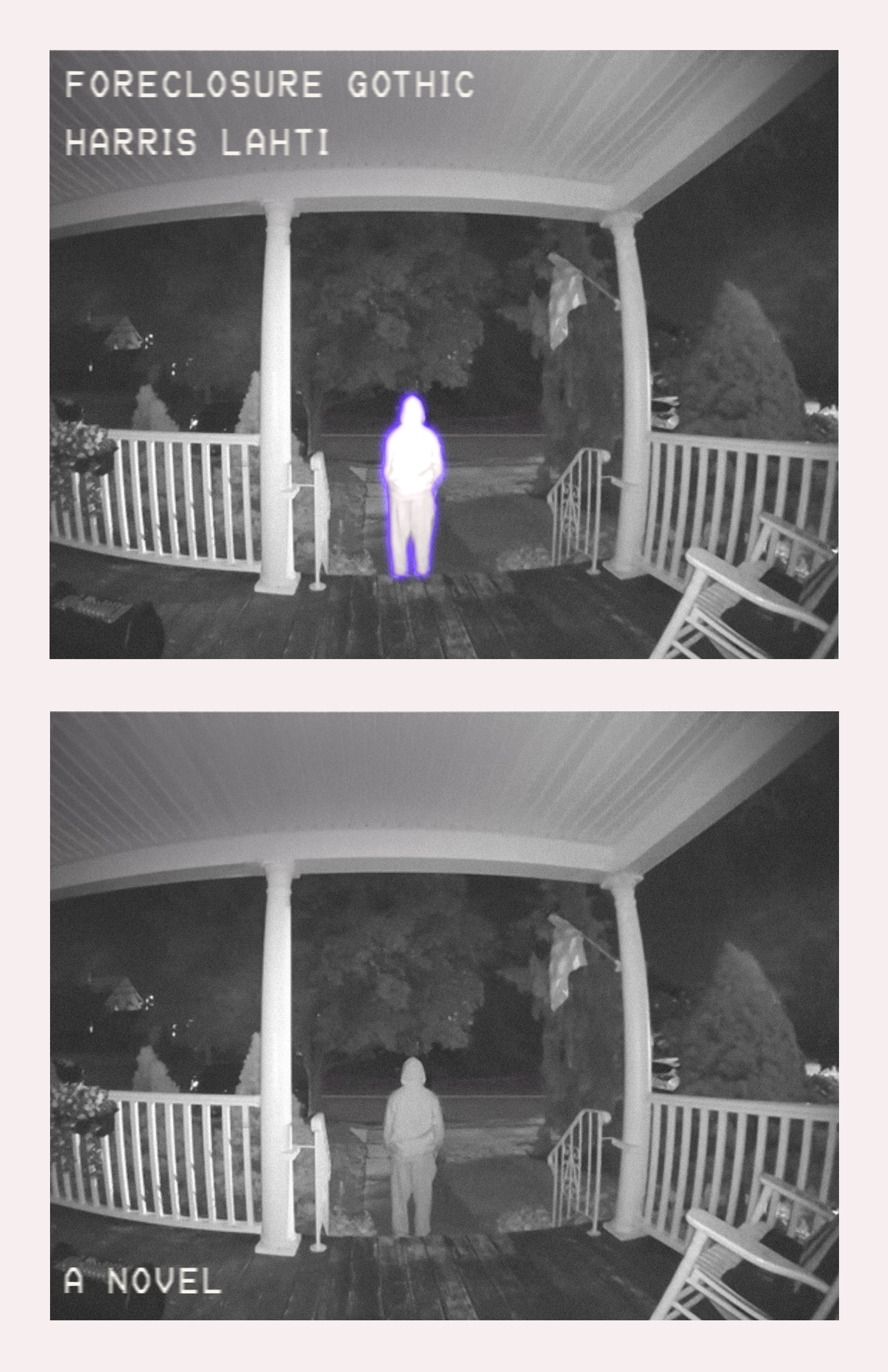
“A Catskill varmint hotel turned quaint summer cabin. A half-charred farmhouse hiked up on carjacks overhauled into a popular farm-to-table restaurant. A haunted gingerbread with a basement full of graves, exorcised and revitalized as a church. A successful career by any measure. Four decades of hard work Vic Greener’s family can look back on with pride,” writes Harris Lahti with characteristic fragmented eloquence toward the end of his excellent debut novel, Foreclosure Gothic (Astra House, 2025).
The novel follows the life of its dubious protagonist, Vic Greener, an ex-soap-opera-handsome turned workaholic patriarch, from youth to old age, the larger part of which he spends buying and flipping foreclosed homes in the Hudson Valley to provide for his family and grow his rental empire. In the process, Lahti furnishes the American Gothic family saga with a unique and subtle spin: the humdrum of the everyday. Because granted, Foreclosure Gothic does contain terrifying seven-foot-tall, possibly psychotic garbagemen, black-dirt gardens that grow freakish, superannuated vegetables, corpses pecked apart by vultures, and abandoned hunting lodges full of kiddie porn. However, the novel has arguably even more lawn mowing, floor sanding, trips to Lowe’s, meal preparation, property upkeep, and lackluster sex. Like so many great novels, like life itself, Foreclosure Gothic contains multitudes—not to mention a sharp yet also notably nondidactic critique of what Alexis de Tocqueville called “the bootless chase of that complete felicity,” our poor, decomposing American Dream.
Vic Greener’s version of that dream begins in Hollywood at some point in the indeterminate past, when Vic, then an aspiring actor preparing for the role of a “sociopathic cocaine-addict doctor” on Days of Our Lives, meets his future wife and business partner, Heather Roswell, on a ledge overlooking the Venice Beach boardwalk, watching the parade of oily grotesques. That sociopathic cocaine-addict doctor, whose face Vic is able to “slide” on and off at will like a mask, simultaneously haunts and harries Vic’s progress through the book’s many unpredictable (and in other ways completely predictable) narrative phases: Vic’s courtship of and marriage to Heather—who is in some ways just as much of a destabilized cipher as Vic is. Vic’s abandonment of his acting career alongside the newlyweds’ subsequent move to Upstate New York, where they welcome a child into the world—the glibly named Junior—and where they buy and flip their first foreclosed home. The steady metastasis of Vic and Heather’s house-flipping empire, which, even as it cheerily consumes them into their golden years, is initially resisted and only later grudgingly accepted by Junior. (Rarely do any of the Greeners stop to contemplate the screaming moral implications of building their dream on the ruins of a destitute stranger’s.) And finally, the empty-nester anomie of Vic and Heather’s marital life in late middle age—so on and so forth, until death does them part.
On the surface, that’s a pretty accurate rundown of everything that actually happens in Foreclosure Gothic, presented here as a series of sentence fragments to approximate Lahti’s arresting prose style, deployed throughout the book with a chopped-and-screwed lyricism that recalls Barry Hannah or Helen Oyeyemi. Cleverly, this hyper-stylized prose also adds to the distance between the reader and Vic, lessening the immediacy of Vic’s morally dubious actions and allowing the reader to see them as he does: a means to an end that Vic dares not look back from.
Following the Greeners through their lifetime of foreclosure renovations are many amusing variations on the grotesques they encounter in those early years on the Venice Beach boardwalk: a trio of uncanny nursing home residents with skin so “thin” and “papery” that it “delaminat[es]” from the asphalt after one of them collapses from dehydration; a pair of incestuous, snow-suited twins named Inga and Otto, the latter of whom soothes his inflamed sties with freshly hardboiled eggs. These creations of Lahti’s recall no other writer so much as Shirley Jackson, especially in her bejeweled mini masterpiece We Have Always Lived in the Castle, an influence that is well served in lending the tight focus of Foreclosure Gothic its idiosyncratic texture and expansive strangeness, not to mention (in one of the novel’s most riveting passages) “cheap bastard” of an ex-general who suffers a deadly stroke before he can pay Vic out. Vic finds the man “in a high-ceilinged living room flooded with crimson dusk,” causing him to remember forever “the way the woods burned through every window, the way the general sat there in a bathrobe, his white hair appearing to burn, too, as he watched TV with these enormous headphones on.”
In spite of Foreclosure Gothic’s gestures at episodic linearity, its structure and pacing (interspersed with unsettling found photographs) are actually far more unorthodox than one might think. Indeed, in many ways, the book reads more like a series of interlinked short stories than a novel of off-kilter domestic realism; yet it satisfies the narrative demands of both. Plus, Lahti himself proves to be a writer capable of drawing the reader’s eye with a miniaturist’s stateliness and intensity in the space of one paragraph, then managing to hustle her through decades of recorded time in the next. This considered balance of storytelling technique lends Foreclosure Gothic a tilting funhouse energy whose pull becomes inexorable.
The novel is Paul Thomas Anderson’s There Will Be Blood by way of Ian McEwan’s dread-soaked early work, or Jac Jemc’s haunted house parable, The Grip of It. Although really any accurate comparison seems lacking to the extent that Foreclosure Gothic is truly, thrillingly its very own thing; I’ve never read a novel like it. At the center of it all is Vic Greener himself, a man Lahti manages to imbue with pathos and humanity in spite of the fact that he lacks a center, still “sliding” down the mask of that “sociopathic cocaine-addict doctor” he played on Days of Our Lives even many years later to chase his death-stiffened American Dream. But you can’t really blame him for it. At least Vic is conscious of wearing the mask.
Adrian Van Young is the author of three books of fiction: the story collection The Man Who Noticed Everything (Black Lawrence Press), the novel Shadows in Summerland (Open Road Media), and the collection Midnight Self (Black Lawrence Press). His fiction, nonfiction, and criticism have been published or are forthcoming in Electric Literature’s Recommended Reading, Black Warrior Review, Conjunctions, Guernica, Slate, BOMB, Granta, McSweeney’s, and The New Yorker online, among others.
