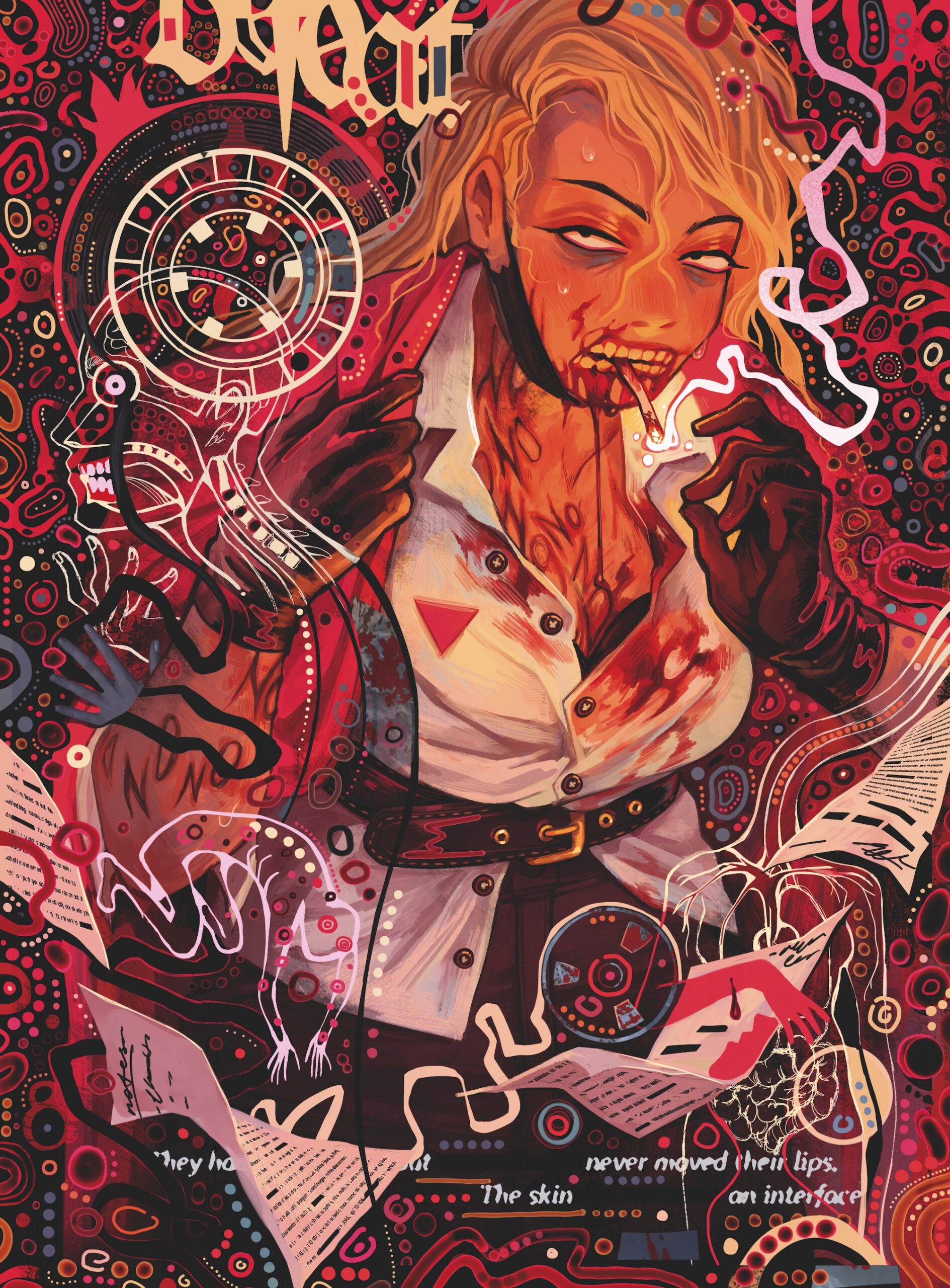
Her form is incomplete. Virginal-white paperwork waiting for ink to spatter it in some approximation of “This is why people are dying.” Her black gloves grip the clipboard like it’s a shield, swatting at mosquitoes.
She came to the atoll in search of sickness. She went to the hospital, an old malaria ward surrounded by rusted bars. She found the name of the disease and brought it back, and the world, or a galaxy of blood vessels which may or may not have bearing on any attached nervous tissue, was saved.
But first she visited the man, which took only ten minutes. The man was the “man on the ground” for her organization, a clear perspective untainted by local hysteria. After that, she interviewed a few colorful characters, including his son and a woman infected by the disease.

Their words have raindrops.
She wakes to the rain. Then with a great gasp, it falls away.
She had fallen asleep in her car. You can’t trust hotels. In her car everything is observable and exactly where it should be. In the glove department: quinine, antiparasitics, antibiotics, and experimentals banned for lack of testing or severe toxicity. Weapons-grade theological medicine for the fight against the pathogentry, flagellating your bloodstream.
Her blond hair falls in tentacles over her face, made slimy by humidity. Black brows and a sunburn mask her eyes. She flips through stacks of poorly transcribed interviews, looking for the pomegranate. She always thinks of that damn fruit. The moment of contamination when the girl was trapped forever. It all came down to a lack of food safety in the underworld.
Language keeps coming up. Aphasia? Lockjaw?
They had a lot to say. But  never moved their lips.
The documents are charred with redaction. She considers that one day her own words will be entombed in these black coffins. The reward for piercing reality.
The skin an interface.
Sun on white paper is making her snowblind. She grips the wheel with inky gloves—redacted hands for a redacted future.
Fever-trees surround her on this remote road, bark like pale-green paint heaped impasto on itself, scooped and scraped and drying messily. The crystalline mall is no longer visible, nor the lagoon bloody with algae: postcard hallucinations. She had been surprised by how vast the atoll felt as she rolled from the ferry onto shore, this speck on the horizon. A pathogen is the same way.
Aching in her pelvis as she dismounts the car. No time to stop for tampons. She prays for a mild bleed and walks up to the house, rolling up her sleeves against the heat. Her white blouse melts with rose blooms of skin. The gold buckle on her high-waisted trousers winks at the sun.
She notes the freshly cleared road, oozing mud like a septic wound. Roadwork could have dislodged deep-soil bacteria not normally experienced by the human immune system. People like the petrichor smell of geosmin well enough, little knowing it is a bacterial metabolite. But there are worse things in the soil. Melioidosis and other curses. She straps on a flu mask, black cloth clinging to her damp face.
As she enters the yard, her boot strikes something heavy. A thick chain running through the grass. The atoll is full of rusted debris. Acres of tetanus. The dark analogue to geosmin—it’s not the rust but the Clostridium tetani in the dirt, which jagged metal exposes you to. Not rust, not rain, not beauty or love, just a hungry and mindless curse with a seductive name. Clostridium tetani, she whispered once, the slit in her calf stinging with antiseptic, a bandage chastely laid across in bridal white.
She knocks on the door. No answer. She pulls her mask down under her chin and lights a cigarette. She smokes Standard Reference Cigarettes. She likes the old-school flavor, and the aggressive toxins. These cigarettes have no filter. And they burn whether or not you suck on them. Fire regulations are tested with an older formulation no longer available to the public. Cigarettes intended to fall from the fingers of a hypothetical old lady smoking in bed. To burn rigorously on couches and cribs. The Standard Reference Crib, of course, with perhaps a Standard Reference Baby, if the technology allows.
THESE CIGARETTES ARE FOR RESEARCH USE ONLY.
She wonders if they have a Standard Reference Interrogation Cigarette. Ignition-testing human furniture. Cue laughter. She’s seen some things. But the war is over.
THESE CIGARETTES ARE NOT FOR HUMAN CONSUMPTION.
She holds the smoke hot and deep in her lungs. The cigarette casts a shadow like a cleft lip.
The door opens. She drops her lip, her cigarette, and it hisses in the mud. A pang in her hand, of something lost.
The man has eyes like his suit, very nice but slept-in. Blond hair, slick with pomade or sweat. The impression of a family man going nuclear. He looks over her shoulder, as if expecting someone else.
“I didn’t get your name.”
She gives it.
“Trotula. Thank God you’re here.”
The parlor is a cluttered room, dimly lit by jaundiced lamplight. It reeks of chain-smoking.
She sits on the couch, hemmed in by a hulking coffee table. Reclaimed wreck wood, thick and chestlike. On top: cassettes scattered around a tape player. Junk mail spilling off. Magazines in plastic wrappers. AMMOUR MAG. Girl avec gun. Sans-culottes.
She tells him about the hospital she arrived at after this conversation. But first—she produces her clipboard with the thrill of a flasher legitimized by the government. You don’t like this paperwork, but I do. I can do this for days. I hope your wife doesn’t mind.
She gets his name. His age. All the preliminaries. A cassette is spinning in the player. She hadn’t noticed at first because there is no music, no voice. But she hears now the faint hissing of dead space, and becomes fearful of some greater bureaucratic process that has inhaled her like krill. Tapes still have something of the living to them, have not yet been killed by cold viral transcription.
But the man is docile. Waiting for her next question.
Your file says you have a son.
“Beautiful boy, yes.”
Where is he now?
“Sleeping.” The man leans forward seriously. “Should I wake him?”
That won’t be necessary, she says.
But this is what she enjoys. The omnivorous thrust of fact-finding, their uncertainty as you seek not meat or vegetable but information. This sexless hunger that protects her from the demands of biology.
“I hope you don’t mind—” The man places his suit on an ironing board. His hand slides across it as if hot enough to crush the wrinkles out. The heat from the iron stirs her cravings. Her pen vibrates, briefly turning into a cigarette.
The air is stuffy, the kind of poor ventilation that gets her mind in a bad loop and sweats invisible ink into the paperwork. She doesn’t want to leave that trace. Paperwork is her perfected form. Something purer than this cramping carcass she is forced to drag around.
She mentions the closed window and he says, “Well, you know, the mosquitoes. Super-malaria this time of year . . .” She doesn’t care. She’s already asking:
In your last report, you mentioned being afraid of someone. (At that, he looks out the window. And mosquitoes do cover it, big ones that make her think of spiders, flying spiders deformed by the air, long legs slapping the glass as if puppeted on strings—)
Is there. Someone on the island.
“There was.” He’s still facing away from her. The iron sits on his suit.
And now?
“He moves around. But he always comes back.”
FOREIGN AGENTS? She considers HOMOSEXUAL BLACKMAIL, but he’s married, so HQ can read between the lines. OUTSIDE AGITATORS is good. Anyone can be an outside agitator, all the more pernicious for having been born and raised here. This indicates foresight and cunning.
She says, do we still have the local police?
“I pay them every Sunday. After service.”
She thinks of the church she passed earlier. She didn’t see a church, only a choke point for contagion. She learned early in life to despise those who eat warm mayonnaise in the company of others. The despicable amateur communitarian. If she wanted community, she would sit in the dark with the radio, masturbating.
LOCAL ASSETS: TENTATIVE
She dreads to ask the next question. She is at risk of being contaminated by responsibility. Terribly close to being the one who will have to Sign Off. She asks, and her voice drops away: is quarantine needed.
“I’ll give you the facts. And you can decide.”
It irritates her, this buck-passing. Whatever is written, she is certainly writing down something like ON ’s RECOMMENDATION.
Did she drop something? She reaches under the couch. But her pen is in her hand. For a moment, she hears her breathing in her ears, unusually loud. The phantasmal smell of smoke. After the ruined climax of the yard, her nicotine craving is becoming violent.
He tells her what she already knows, and she endures this for a while. She is a cold, anal bitch, so she has to be careful. Her mask does half the work, but her voice quickly dries out, becomes skewering. And he’s hiding something. So she finally says, do you believe something is hidden here. Which we should know about.
He leans over the coffee table, staring at her pristine form. Her pen hovers above the page, poised as if to make an incision. Reminding him that all truth flows through her.
“I should tell you a story.”
The story of the immortal tyrant. At his side, an advisor who had long served him faithfully.
The tyrant had captured the great tomb, where the sacred dead were buried with their riches. He emerged from the tomb onto a field of giant chess pieces, where the conquered had once played. Each piece required three men to carry it. The tyrant grabbed the king piece and flung it through the air, and it crashed down and rolled across the grass.
The tyrant’s bedroom was filled with treasure. Spilling into every corner, crunching with each step, even filling his bathroom. A vast tub, itself made of gold. A toilet of blood porcelain. Above the sink, a shockingly shabby mirror in which the tyrant admired himself while taking languid counsel from his advisor. And that was when the hem of the advisor’s sleeve brushed the countertop, and from this vast fortune, a few coins of smallest denomination were dislodged and fell, rattling down the drain of the sink.
The tyrant gave his advisor the germ that makes one immortal. Then he had the advisor bound in a frame of wood and rope, and a man with a giant sword split him down the middle.
Was it from the top of his skull? Or from between his legs? And was it a sword? Or an enormous, ugly saw, rusted from disuse since the trees it was for no longer existed, felled for the tyrant’s war machine . . .
The head was split open in such a fashion that it seemed much larger than a human head could be. Swollen and elephantine. But the advisor could not die. His brain survived in cauliflower lobes, waving in the sweltering wind.
Day after day, an endless rotation of torturers bludgeoned, whipped, and sawed his undying flesh. But this was not his punishment. When they were done, they were to bury him in a coffin for all eternity, to suffer in that configuration.
The advisor completely accepted the judgment of the tyrant. In fact, he begged for worse. So they bound him in extreme positions made possible only by his immortality. Spine broken, limbs shattered. And still he screamed for more. So again they brought out the huge saw, and began to grind into his misshapen head.
Why did he do this?
The first possibility: Genuine belief in his punishment. True zeal and devotion.
The second possibility: A ploy to bait them into giving him true brain death. To save himself from an eternity of unspeakable torment.
The third possibility: Hoping the tyrant would see his devotion and spare him for his complete acceptance of the punishment.
But the tyrant is a tyrant for a reason.
The story has nothing to do with the case whatsoever.
Suddenly, she sees the oblique connection. A chemical burst of epiphany. Thank you, she murmurs. Humbled.
She considers whether to make a note of it, in the yawing pit titled NOTES. NOTES is dangerous. NOTES is an open wound. And so much has filled it, to her surprise. Her shorthand is a hundred dead ants that she cannot read. She needs glasses. Why did she never consider this? The answer is vanity. She will leave soon and buy them. From a twilight optician. She makes a note of that as well. It seems everything can be reduced to a note. Notes are contagious.
There was something she wanted to ask. But she recognizes the neurosis: using paperwork to delay her engagement with reality. So she should stop asking questions, and close the case, and finally, finally smoke that cigarette.
The blank tape skips. She inhales sharply. Her pen slips. She was signing her name, a melted line falling off the page. Sorry, she says. I just—
A name has weight. This last name she was signing, she shares with someone else. But for them it’s about a hundred pounds.
The doctor had barely looked at her brother. “He’ll be right as rain. Feed him plenty of soup.”
Orange puddle on the floor. His golden borscht kept coming up. And another color, confusing, for tomatoes were not in season.
She wiped his mouth and he said, “I’ll get you sick.” She recoiled and went to the door, uncertain of the boundaries of the invisible miasma surrounding him.
She prayed for him, as if remotely working upon his body, which had begun to float between her and God. She made increasingly desperate bargains. Doing her schoolwork was no longer enough. She had to cut her wrists open and pour the blood into his mouth. It’s blood he needs, right? So much has come out of him.
The rain came.
Just before the funeral, she stole her father’s cigarettes and smoked the pack. She lay in her brother’s bed, pale and shivering like it meant something.
They raped her brother. She realized this a decade later. They raped him in that classroom. He had been made to sit in a poorly ventilated room as they denied the effect it would have on him. They even said children were immune to the disease, as if children were a completely different species and only became adults through a chrysaline process, liquefying the child into a soup of teeth and baby fat, and from this forming an entity with absolutely no connection or allegiance to the mewling slave it was sculpted from.
If a parent were asked, Can we inject your child with syphilis, that would elicit an emotional reaction. If they were told, We will put your child in a device like a tanning bed and press a button and then for the rest of his life a boot will crush down on his chest and little razors will swim through his blood and his dreams will be halved and no one will ever tell him the truth, they will always think, Why am I so weak—if they were told a machine would do this, they might feel something about it. But the machine of a room, the mechanical lung of death, this is acceptable. Rooms of learning that in fact damage the organ of intellect, the capacity of blood to supply oxygen to the brain.
And in exchange, the adults don’t have to think about death. They obsess instead over elixirs, because of course you can buy something in this market society, anything but the only cure, which is not becoming sick. Which is save your children.
All along the drive, she saw the dead. Driftwood crosses leaning as if to embrace what they marked, wooden mothers. Names already rotting away. And those remaining carry the weight that does not mark those graves. So someone has to tell it. The name of this disease. She owes them what her brother was owed. What she can never have, but only give.
She took the mask off at some point. She doesn’t remember when. Her gloves as well, laying next to the clipboard like a molt of gangrenous skin. It has become obvious that the man is only tired, not contagious. And it is so hot. It is so hot because of the tropical climate. She can think only of returning to her car and blasting the AC. Her cold and lovely womb.
She flips through the form, one last double-check. Then she spots the blank line. She squints in the dim light of the lamp, tracing it with her pen.
Hold on, she says. Can I get your response again for—
To which she receives a satisfactory response. She starts to sign the form, but it takes only a few seconds to make sure she hasn’t missed anything. She skims the pages, annoyed with this obsessive impulse, and starting to feel like a fool. She knows this is because she fears the hospital. Fears coming into collision with the ultimate truth. This visit has been such tender foreplay, and she will miss his gentle tone and shared cultural values. She spots the blank line. Still blank.
There had to be a reason, because she’s been past that part a few times. Was it N/A? On some forms, you can just leave it blank. But she always writes it down. Never leaving it to chance.
She goes to sign her name, then twists her hand, slicing her finger across sharp paper. She wonders why she did that. She goes to sign her name and there is blood on the page. Next to it, a blank line. She opens her mouth, but hears instead a warm voice coming from the darkness.
“She asks him the question. And receives a satisfactory response.”
She stares at him. She can see only his hands. Those interlinked fingers are like two pale arthropods joined together in mating. Devoid of mammalian vibration.
“She gets up and leaves.”
She grips her pen like a paralytic trying to regain the use of their hand. It feels like squeezing a shard of glass. Her pen jags up the page, a ragged constellation pointing at the blank line.
NAME OF DISEASE
Her pen crashes onto the blank line and she writes: DEFEAT.
Something bangs nearby. Like a branch slapping the window during a storm. Rain, she thinks. And indeed, the atmospheric pressure has changed. Arthritic pain throbs in her hand as she writes, overspilling the line.
DEFEAT. DEFEAT. DEFEAT.
She says, of course the burden is on me to prove to you that I am not infected. I have been having irregularities, this is true. But it can be ascribed to the length of my travel, and nicotine dependence.
He nods seriously. “Perhaps you should go to the hospital.”
Yes. But I do need to ask you about . . . And as she searches for her question, her head throbs at the whispering of the tape deck.
Can you shut that off, please?
Click. The reels stop spinning. The hissing remains.
DEFEAT. DEFEAT. DEFEAT. Her pen stabs through the page, and keeps writing.
The man inserts a key into the coffee table. It twists harshly, then the surface pops up, hinges screeching. She grabs her paperwork just in time. Magazines flop to the floor until she is faced with the whorls of this wreck wood. The texture is mesmerizing, like the fingerprints of something grown too large in the black water.
She looks around the side. There is an animal inside, a pale jungle cat. Not an animal. Hairless. The skin is covered in what seem to be more bug bites than she has ever seen. A naked body, curled up. Not bug bites. Cigarette burns. A petite woman, she thinks at first. Then understands it to be a boy. His breathing is shallow, encrusted with mucus. Whistling.
The man reaches inside, and the boy’s limbs tumble onto the carpet.
She says, is he sick?
Then: are you?
Is this containment?
If someone is ill. Extreme measures can be taken. Is she the one who is ill? She is deeply aware of how unaware she must be. How delusional and self-serving she has become in her compromised state. The impression of the impression of the impression of—
She says the man’s name, as if dropping a stone in a black well. As if she desperately needed to hear the bottom of it. But the stone she holds is a hot coal.
Her finger trembles on the form, dropping from line to line like ledges, finding her way an inch at a time. NAME OF SUBJECT is a violent cloud of black ink. The pages below are stained with this receding cloud. She tries to find the last page where perhaps it has not reached and the paper is unruined. But she can only pull at the edge over and over.
The man leans forward. After a few seconds, his leather shoes creak.
She can’t understand what he is saying. The ripping sound makes it difficult. Like a skipping record. She looks down at her hands, which have been tearing up the form.
The boy crawls across the floor, showing her a different view of what has been done to him. She considers life on this planet, and the nature of gravity.
“Take a look at the TV, son.”
The boy stares into the black screen.
Six hours every day. Until you see something.
She becomes aware of a terrible itching. When she scratches, it feels like some plastic band or tubing is caught in her clothes. But this is her rash, ridged and red. Which says:
NO NO NO NO NO NO NO NO
From her perspective, it says ON ON ON ON ON ON ON ON. She feels activated. An overpowering current that should be felt only by the wires buried deep within walls, or the sheaths of subterranean cables, or electric chairs. Something insulated from the world by concrete or custom. But now she is the sole sensor of that current. The rash gnaws up her neck and she scratches under her ear until the cartilage grinds and throbs. ON ON ON.
“Rash words.”
Every scratch tingles into the extremities of her body, nipping at her deepest nerves. This surrender rolls her eyes back. This surrender rakes fire between her legs.
“Would you like to stay and raise him with me.”
Her fingers dig bloody sores, punctuating the sentences that spiral her arm. They turn from periods to apostrophes.
“So he will fit me.”
Her throat pulsates. As long as she is scratching, she cannot speak. She finally rips her hand away, as if from a live wire. She cannot hear herself, but her lips move.
When she looks up, the room is empty.
She burns terribly but can see no fire. Her hand disappears, returning periodically. She wipes it off on her blouse, adding to the red stain.
Something slides through the hall. Kicked forward by the man inches at a time. A large box of beige plastic, a pet carrier crushing the carpet behind it like flattened grass. The boy’s pale fingers poke through the bars. There is a sweet smell of urine.
She blinks, and they are gone. After some hesitation, she approaches the darkness of the hall. Look both ways before you cross. She goes the opposite direction of the carpet trail, and finds herself in the kitchen. The oven is on. Of course, she thinks. It’s only the oven. She opens the back door and goes outside. Even hotter. As if the night were a larger room and still part of the house. The itching is a lethal sunburn, wasp acupuncture, she tries not to scratch but her fingers keep coming back.
She moves through the dark overgrown area between the house and the fence. To her left, a lighter patch indicating the frayed albedo of the house. The smell of trash cans, which are oceans kept at the side of houses. She smells them and it grows darker where they should be. They smell like what remains of her vision, a sensory noise in this last percent of evening. You cannot call it sun, what has reached here. Any more than you can call a rotting corpse the living.
She pauses. The thought that she accidentally exited the front door and is heading to the backyard, not the front. But there was heat when she left, of machines kept at the rear of houses. Boxlike, maybe washer and dryer. So she keeps going.
In this dark, if you saw between a tree and the side of the house a figure that seems to be coming closer. But which does not walk. Or run. Or crawl. But lifts its foot high and stretches it toward you. Then plants that foot on the ground and slides the other foot behind it, until both are right next to each other. Like a parody of sneaking. And if it were so dark that you saw only the silhouette of this movement. And even that became the darkness a child stares at while falling asleep. So you could not tell how close it was. What then.
She becomes aware of the smallest sound; her tongue sits dead in her mouth; she is afraid to swallow. Her fingers needle in place on her irritated arm flesh. If there is moonlight, if a cloud should move, his feet are shiny black slugs, hammered out. The sickness wears fine leather shoes that are ends to it like the cap of any material might be.
The foot lifts again, so high it seems to be floating. Above the ground she knows only because she is standing upon it.
The foot stretches forward. And she pushes her pen into his stomach. It bubbles onto her hand, hot as his mouth. Like the mouth of an animal in the dark.
She runs past him. Behind her, the foot lifts again. And comes down.
Heavy period tonight. Her boots slosh with each step. She walks along the road, at the edge of the light. Fearing exposure. But fearing the dark at her side like a canyon drop.
She slows. There is something ahead. The shape of a human being on the dirt. Jacket wrinkled with shadows, insects creeping into the folds. Trousers. Socks. A leather shoe.
She looks for something naked in the bushes. The wind bounces the branches the way it always has, but now something is coming behind each gesture. She walks faster, still trying not to make noise. Tensing her skin as if she can be unseen with muscular effort.
Her car sits in a pool of yellow sodium light, dry and toylike, as if a flashlight shone into an unlit terrarium. She looks into the backseats, trying to see into the dark beneath them. She opens the door and waits. It seems the same inside. Trash arranged just how it was. She grasps a handful of receipts with shuddering relief. Now that she is away from all that, it seems not so bad. Measures can be taken. Affordances will present themselves.
Liquid fills her throat, rusting her sinuses. She tries to cough and blood spatters her cleavage, filling her bra like acid. It does seem that something may be a little goofy tonight and her fever may be fairly high, because until she looked down, she forgot about this extremely interesting rash. She watches an evil alphabet type her thoughts across her arm and she unbuttons her blouse and shrugs it off her shoulder and reads her bicep. She had some pretty decent ideas ten minutes ago or whenever it was that rash broke out. GLOVE COMPARTMENT
She opens the glove compartment and injects herself with the syringe inside. She was keeping it around like a cyanide pill, never expecting to be so unlucky.
Nothing happens. Her flesh continues to disintegrate. Her chest is spattered with rash, jeweled with ruby wheals. In her breasts she reads a monologue of terror, upside down as if she were a plaque for museum visitors.
Her clothes are soaked and heavy, clinging to her evacuatory parts. The pomegranate, she dimly thinks. Some evidence of what happened. She wonders if the pomegranate could have been intercepted when it was chyme or bolus, vomited up or cut out, and the curse stopped.
But by the time she noticed, the pomegranate had long been consumed, the juice already dry. So much has been lost and cannot be recorded. She thinks of her brother and the brothers of others, and other life forms derivative of this essential recipe. Longer and shorter hair, eyes in various colors, echoes on doorframes and floorboards. The erosion of the right to see our own exit.
She lights a Standard Cigarette. It quickly dies, turned to a tampon by her mouth. She holds out the fuming red cigarette, beautiful and singular against the gray fog, and considers the increasing demands of the public health sector in a modern and changing world.
Her itching burns away like flames of alcohol. Her rash chars black, up her neck and down her décolletage, her debrief. The cure is branding her words into her. She has become a negative of the symptom. And somewhere on her skin is the name of the disease.
Her form is complete.
Porpentine is a game designer, illustrator, and author of Torture Works (Apocalypse Party, 2024) and Serious Weakness (2023).
Illustration: Vich
