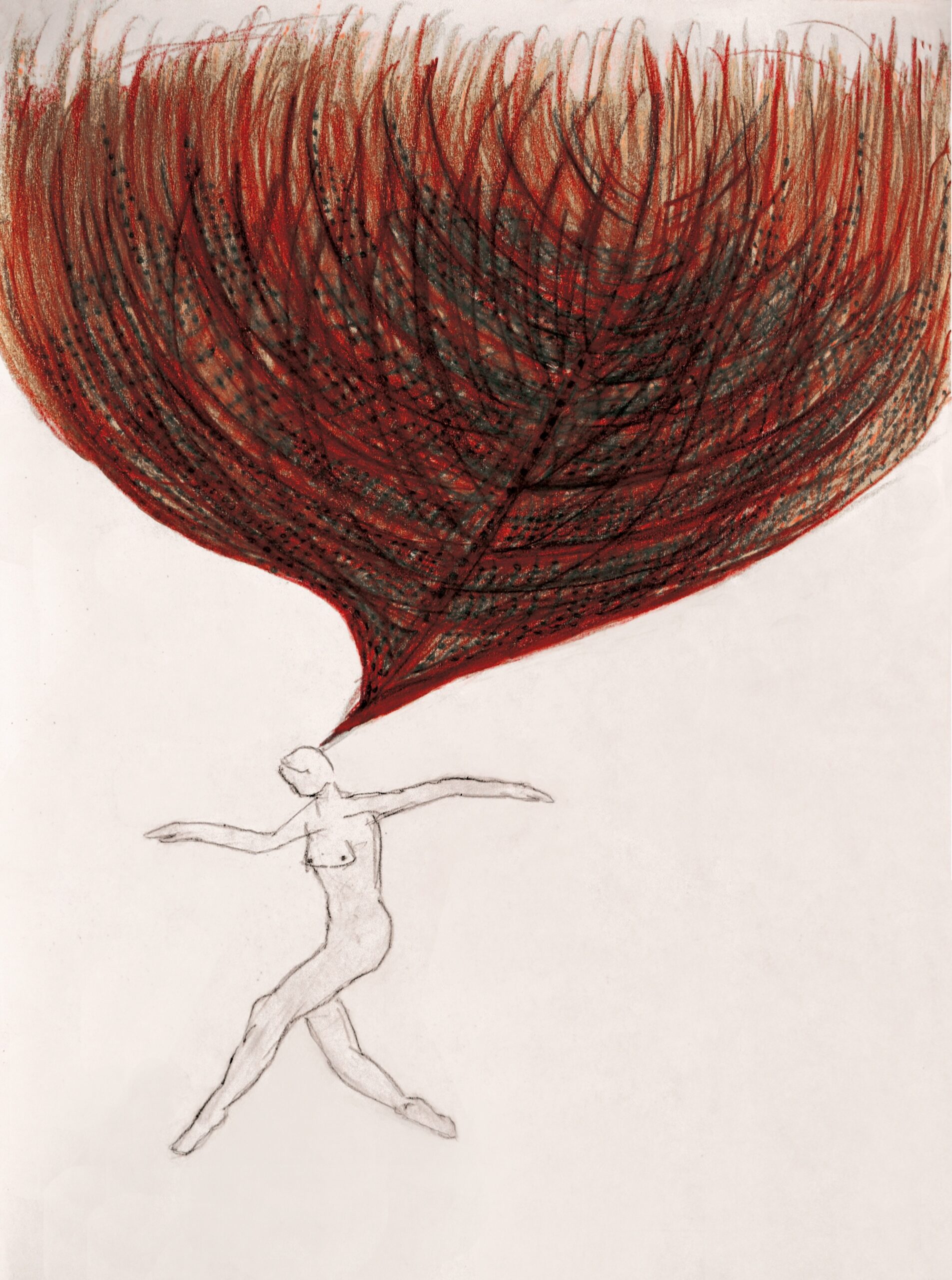
That awful globe without enough hair to hide its shameful spots is bobbing again. Black and silk and dust-colored strands; he knows they’d look better as stubble, but his grip has gone precarious, and to reach all the way back and around in one fluid motion without dropping the razor or opening an old wound is . . . is . . . is . . . He shakes with impotent rage. It’s too much. He sobs, head quivering, nodding. An added mockery that he must see from every angle, see what he never asked to see and yet remain helpless. Eyes clenched shut, all mirrors verboten in his room, and still the prismatic reflection of the physical humiliations of age hatch in fractals like a brain infection.
His gift gone bad, the psychic eye invaginates. Runnels of weeping mothers, drowned boys, dead swans, and fostered poisons; graves dug by means of plausible fabrication, coerced denial, and the corruption of witnesses, his special expertise.
Though the company claims otherwise in official case files, it was his primary job to obfuscate. Refined in his ability to silence ghosts, he cries alone; alone his mind mutes with cannibal imprecision. If only he had a case to work instead of this frenzy of deadly vision without object.
Occulted and aware, it has become impossible for him to predict when the rebellion of ghosts will arise, and if it will happen in his lifetime. Perhaps they are waiting for him after death, biding their eternal time, ready to reach up from the swamp with poisoned talons and diseased beaks. They will peck him until he is green with irradiated particulate matter or swallow him like a fish. He shakes, crying, the sliding snot on his salty lip as gelatinous as an undersea creature’s skin.
Throat gagged by inflammation, dehydrating, he’s unable to stop until a nurse knocks twice and enters. Something solidifies where he’s been rattling apart. The new air admitted recompresses the terrifying entropy of isolated space that swallows the small room he lives in.
He experiences the shift as a welcome synesthetic invasion, blue notes of creeping rubber footwear, chill of kindness like a discount vanilla-dessert flavoring, scenes of a southern beach. Before the nurse catches him wet-faced, he rubs the sock he was struggling to put on across his nose, mouth, eyes, and feigns a cough to hide his embarrassment.
The wool is cloying, spongy. It smears more than it absorbs. He bends and yanks off the other sock, then bunches them together and shoots the ball across the bed and into a corner hamper.
“Hole in one, my man!”
“Don’t shout at me. I’m not deaf.”
“Sorry about that, Mr. M.” Wafting breezily through the small space despite their great size, the nurse J. C. opens the sock drawer, pulls out a few pairs to examine, and settles on a darker shade than the other damp bundle. “You know, sometimes I forget you’re not like these other old farts. Ain’t got their shit together like you, Mr. M.” J. C. offers him the new socks and frowns. “You ever consider an argyle, some sort of pattern? Take your fashion game up a notch.”
He snatches the socks.
“What for.” It’s not a question, but rather a declaration of resignation.
Martelloni scrubs away any facial expression with his raw knuckles while J. C. rummages. Force of habit. What remains after bone has burrowed into swollen eye sockets and stretched the thin sheath of his flagging skin is a scowl more forlorn than angry.
At least he can’t see it anymore, the soft egg of his head encumbered by tears. And he’s grateful for intrusion, though he acts caustic. Relief afforded by indifferent empathy, a reflex of his second sight.
He hears the suntan breeze between dunes that J. C.’s presence brings, the smell of skin baking and glowing with coconut lotions, young and stupid about disease. Skin taut and supple, hiding the veins and geography of disaster it’s destined to reveal. Youth is an illusion, like the beach itself, a myth of the past eroded into innumerable pillars of salt. Holes in dry earth, skeletons of driftwood and broken shells, jellies like fragments of cling wrap. The last time Martelloni worked the coast, it had already begun to mutate into an alien horizon.
Unless the memory is another hallucination, a trick of misfiring neurons or creeping dementia. He’d like to ask J. C. if there’s still an ocean, and what the beach really looks like these days.
“Well, you know. For the ladies, Mr. M.” J. C. smiles freely, more pretty than handsome to Martelloni’s critical eye. Broad like a woman below the chest, yet agile, graceful; compelling in their unquestioned comfort with abundant girth. The welcoming strength of an expansive beach, of a radiant sun. “Be so drab up in here. Gotta show some flair if you want to catch a fine lady’s eye.”
Struggling with the second sock, Martelloni snorts. He’s having a bad hip day, can’t bend at this angle without a stabbing pain. “You make us sound like a natural history museum exhibit, which I guess is what we are doomed to become. Ha. Displays of plumage. Collecting shiny things and building—ugh—traps.”
He gives up, half done. With dainty efficiency, J. C. darts down and secures the sock, cloaking the gnarled protrusion of ankle, the hairy glimpse of shin. Slides on the slippers before there’s time for Martelloni to catch his breath and protest.
Coconut fragrance, grit of wet sand; J. C. shows no disgust with Martelloni’s troublesome body.
He marvels at how rocklike his feet have become, stiff things with too much texture, twisted like strange corals. They belong in a dead or dying ocean. It’s hard to believe he was once a boy climbing dunes and dashing across sand when marine life was abundant and the water was clear. His frail body has evolved, adapting to some future dystopian landscape, starting with his feet. New bone growth reshapes them; knobs where once there was limber sinew, toes a massacre of angles and calcified branches that defy pruning. Wincing as he stands, his faux-suede slippers take on their impractical shape.
“It’s never too late,” J. C. says, rambling while Martelloni acclimates to standing. “My grandma—now, there’s a lady you gotta admire. Buried three husbands and two kids to date, got a fake leg and one glass eye, and she still whip your ass playing spades. Mind you, she’s spoken for—I’m not suggesting anything between the two of you—but that’s what I’m talking about.”
The first step is a stab in Martelloni’s thigh. Pain radiates from the hip, deep within, as if the bone has grown teeth to grind. He’ll need his cane today. God help them if anyone suggests a walker. Where’s the strategy in that? A cane is a viable weapon, at least.
Before he can finish the gesture, J. C. slides the handle into his palm with a reassuring touch. Sand dunes, the swaying grasses grown tall and collapsing with seed, the loud silence of white noise in the waves.
It’s hard to believe he was once a boy at all.
“Anyway, you got a visitor today.” J. C.’s hand rests for a moment on Martelloni’s shoulder.
Not only the beach, though; a cracked glass window. A broken windshield? Faces peer through. No, not glass, not exactly, but a web connecting J. C. with grandparents and a stepfather, two uncles lost to cancer, an aunt who served in Afghanistan, a young cousin caught in the crossfire buying a frozen Coke when some asshole decided to rob the corner store. Other faces populate beyond, more obscured: neighbors lost, or maybe classmates. Maybe J. C. belongs to a big church or country club. Martelloni’s never thought to ask them about their outside life.
“I’m sorry,” he says, patting J. C.’s hand as the shadows proliferate and the cane receives his weight.
“Oh, no, my friend. Nuh-uh. You’re not talking your way out of social hour. You got a visitor today.”
Martelloni stammers. “A what? That isn’t possible.”
“Not just a visitor. A client. Got a job for your retired ass.”
Smell of ink from a copy machine, windowless rooms haunted by the body odor of smokers and drinkers, rusted plumbing in a basement stall. Concrete, glass, and codes to keep the doors locked. Women—shivering, gibbering, or silent—and always, the tears. He feels bad for them, but the alternative is much worse, though they’d never understand. Obfuscation is protection. He has always had the best interests of the vulnerable at heart.
“I need my—where is my hat? I can’t meet a client without my hat.”
“That’s the spirit. We’re stepping out.” Hat procured, J. C. walks him down the carpeted hallway toward the courtyard.
Attired, Martelloni feels less pathetic than usual, even though the jacket hangs loose over his shrinking bones and there’s no chance of fitting his feet into real shoes. Ah, but the thought of a client makes him jaunty. His steps lilt a little more than they shuffle. The stoop of his shoulders uncurls. Passing Madame Belzinsky, he nods with a tip of his hat as he takes care not to trip on her entourage of small dogs.
She halts dramatically at the sight of him and rears up her chin.
Reaching across the corridor with one trembling hand, she clutches Martelloni’s sleeve. Her eyes roll back in her head. Her eerie vibrato shakes the blood cells in his veins and the very marrow from which they originate.
“In summer, when the bleached skeletons sprout new leaves of green, the island reverses to infancy. A petrified trunk breathes poison where once, long ago—long ago, but in your lifetime and mine—the spirit of the wood did dance. But not for you. Now it is a smokestack. Nothing will be left for you. None of this will be yours.”
“Let go of me, you melodramatic hack,” Martelloni says. She’ll crease his jacket. “Save it for the Friday-night séance club and your tabloid hangers-on.”
Her eyes roll forward and settle into a level gaze. The scent of heliotrope saturates the narrow hallway. Madame Belzinsky pinches Martelloni’s arm hard through the fabric of his jacket. “There is more truth in well-crafted lies than you admit to your victims.”
Martelloni jerks his sleeve away, suppressing a yelp. He lifts his cane in his fist ever so slightly and brandishes it in her direction, putting his weight on his good leg. “Your place is in the theater, Madame. You mistake me for a dramatist. I deal in facts.”
She frowns and tilts her head. “But listen. Heed me. You must not return.”
“Oh, stop it. Have any of us ever quit?” He sighs, drops his fist. “Don’t you have some bereaved widow or gay Toddy to scalp so I can get on with solving a real case?”
“Solve!” Madame Belzinsky laughs in a lugubrious chortle that excites her small dogs. They yip, bustle, and jump. “A strange choice of words!”
Bellowing, she picks up one jittery pup, fishing a treat from somewhere in the folds of her clothes to calm it. As it nibbles from her fingers, she kisses its head, still amused. “Good luck to you, then, my friend. May the dead be kind in their reprisal.”
“The dead, the dead, everywhere and nowhere, yes, yes, I know,” and despite his harsh tone he finds himself chortling along with Madame Belzinsky, tortured sibling in arcane gifts. Second sight misfires too often, like a gun aimed by a shaky hand, and the moment he thinks it, he feels the bitter cold coming through the poorly insulated slats of a cabin, smells the unwashed liquor reek of a man, and sees the mother’s bruised cheek. Eight years old, Madame Belzinsky thrusts her undernourished body between her mother and the gun, and yells at her father to go ahead and shoot or get the hell out.
How can Martelloni fault her frivolous career? He leaves her to the comfort of her menagerie, the praise of her deluded Friday-night fans. As J. C. lifts their head from texting to point out the visitor in the courtyard, Martelloni stays their hand. “No, leave me. I’ll take care of this the old way.”
“Yeah, that’s what I’m talking about. Spooky action at a distance. I’ll check on you later, boss.”
The next trick he performs is easily debunked. The courtyard isn’t crowded, and the grounds are generous—more generous than Martelloni could afford without the company’s special dispensation. Few wait with no elderly resident in their midst: a tall white man, effortlessly handsome and well dressed, who dallies by the shrub roses; a nervous couple avoiding each other’s eyes, shrouded in the aftermath of an argument; and a middle-aged woman with a large tote on the bench beside her who reads a public library book with prudent efficiency.
The texture of an outlier draws Martelloni to the well-dressed man. Unselfconscious, almost childlike, he bruises the petals of a rose. Then he sniffs his fingers with a pleased demeanor. He’s placed himself in the courtyard with the instinctual vanity of a cat, his sculpted physique framed by the most beautiful flowers. At a distance, he comes across with a bright aura of youth, citrus, and expensive soap, but as Martelloni draws closer, the flecks of gray in his once-dark hair become evident, the weighty mien of his skin, the calligraphy of advancing age inscribed on his brow.
“Mr. Martelloni,” he says, extending a hand. “Or is it doctor?” As he completes the handshake with practiced care toward elderly ligaments—a gentleness Martelloni notes and appreciates—he laughs awkwardly, with forward charm. “I’m afraid I don’t know what sort of training or qualifications you hold in your specialty, or if any are required. Anyway, you come so highly recommended that I really don’t care. I’m Chris.”
Martelloni takes in the surface of the man: the fitness, the casual ease in his body, the openness of his presence. Less than ten years younger than himself, he’d guess, and yet almost like a different species in his uncanny agelessness. It’s hard to imagine people ignoring or denying him anything. In Martelloni’s experience, such magnetism often conceals cruelty, petty greed, or a wealth of accidental aggressions, but when he looks below the muscles and teeth and what feels to Martelloni like a plausibly true and earnest kindness, everything simply . . . stops.
Martelloni is locked out.
“Where is it that you heard of me?”
A puzzle. His work was always secret, and intended to hold secrets in check.
He doesn’t get to hear the answer. In the split second after the words leave his mouth, the garden courtyard becomes a shrinking black box. On all four sides of his skull, lightless black walls slide inward to block the sunlight. Corners joint and close him in. A void, a grave, a torture device for solitary confinement. He totters in a sleek walled vehicle black with absence as the question exits him and the last pink rose on the shrub snuffs out of sight.
Chris catches his arm, bicep thrust under armpit, supporting Martelloni’s weight with medical expertise. He eases him to safety without straining. “I’m so sorry. I should have offered you a chair right away. Here we go. In the shade.”
Seated at a quaint garden table, with the black grave waning foggy and gray, Martelloni says, “I don’t think I can help you.”
“But you haven’t even heard what I ask. I thought you loved your work.”
“Who told you that?”
“J. C., of course.”
Disconnected, unable to see into this man, Martelloni must resist the creeping fear of isolation, the surrounding selves poised to maraud him in empathic absence. He reaches for J. C., a cognitive tendril like a rootlet seeking sustenance in blighted soil. He smells—no, not the beach this time, but something more animal. Loud. Elemental. Pungent with salt.
The images hit him with relief and some surprise. He’s never thought to ask J. C. about their outside life. “You two are . . . close.”
“Yes, I’m very fond of them.”
Acclimated by years of exposure to private acts, Martelloni has mostly overcome his knee-jerk conservative judgment and schoolboy’s amusement over intimate visions. Still, he’s embarrassed to be a sudden Peeping Tom to J. C.’s heavy thighs and belly jostling, flesh unbound, and to the older man’s aberrantly scarred nudity. What multitude of injuries could have caused such an accumulation of striations and lumps? His skin stretches over muscle, firm and pallid despite the web of scar tissue that seems to knit him together. With equal parts tenderness and brutality, he digs into J. C. Hands grapple, hips shove, mouths gape. Soon, waves of fluids splatter and cascade.
“Do you ever wonder,” Chris says, “if seeing into the future gives you the power to change the past?”
With a gentle scoff, Martelloni says, “That isn’t how it works. Everyone in life has regrets.” He tries to glimpse into the other man again, below the scars and the sex. His vision slides off and threatens to plummet into darkness again. He feels as though he’s teetering on a cliff. He rests his palms on the table, his eyes on the nearby shrub rose. Breathes to take in the faint scent. Though the rose blooms pink, the smell to him is green.
“My mother grew roses like that,” Chris says, following his gaze. “Hardy workhorse shrubs—not the formal roses you saw in finer homes. I think it was deliberate. She despised snobbery.”
Green like rainwater, pooled. What is he saying? Something about flowers? Martelloni has almost forgotten why he and the man are out here. He shakes his head. “I’m sorry, my friend, but I won’t be able to do any work for you. I’m afraid you must find someone else.” He doesn’t say out loud that if he believed in the devil, he’d suspect it was you.
You speak of hybrid roses bred for their extravagant double-flowered blooms, much more fragrant than these hardy shrubs your mother grew. Flowers so heavy the stems sag under their weight, petals in the dirt, the fault of overly ordered and sanitized landscaping. Thorns evolved to cling and catch on something more solid, less fluid. In the wild, the rose would claw its way to beauty on the backs of other plants.
“Have you ever noticed how the scent of old roses has some of the cloying intensity of sweaty flesh?” Chris says. “It’s indole, a chemical. It’s also part of decomposition—that sickly sweet smell of animal flesh after death. A small hint of rot is essential in the formularies of some of the world’s most famous perfumes. Chanel No. 5, for instance. Perhaps someone with your sensitivities understands why allure can’t be separated from what we viscerally abhor.”
As Martelloni struggles to find ground, he squints against the harsh angle of the lowering sun. He scans the courtyard. The grounds have grown empty. The nervous couple has vanished, with or without resolving their argument. The efficient woman with her library book has vacated the last bench. No one strolls in the distance between the shaded greenery.
“Did the company send you here?” Martelloni asks. “For what, to test me? Aren’t we well past that?”
Bemused and beguiling, almost innocent, Chris leans forward with his hands clasped. “Don’t you remember? Don’t you know?”
“I told you, it doesn’t work like that.” Martelloni slams the end of his cane against the ground and grips it with a tight fist. The other man remains smooth, unthreatening, interminably patient—and weren’t the worst of the executive staff and the best senior interrogators always like that? His gift defies him with blindness. Needles prick the corners of his eyes. No, not now, not more tears.
Voice reedy and high, he defies his labile emotions. “Knowing is next to meaningless, for all practical purposes. It happens in fits and starts, muddles with your dreams, your memories, too. There’s no science. There’s no formula to be applied. It’s not like using a machine. The older you get the less clear the borders are between . . . everything.” The sun sinks much faster than it should. The grounds remain deserted. He doesn’t know if he wants to cry now, or laugh. “For instance, I’m not entirely sure I’m not dreaming or lost in a memory right now.”
Chris shifts his chair closer. His physical warmth active, pulse flourishing, he puts a strong hand over the shaky fist of bones that grips the cane, then wraps a reassuring arm around Martelloni’s brittle shoulders. “You’re right here, right now, with me. This is real.”
Darker still, it has truly become night, or perhaps Martelloni has suffered corporeal loss to mirror his extrasensory block. The black box like a steel coffin encloses him. Within the oiled flat confines of its encroaching planes, this other or devil or doctor—but it’s true, haven’t they met before in the exam room? Or perhaps in some seaside ambulance—manifests another presence, flesh to flesh, an impermeable figment of the real. Warm, unlike the old man’s chill enervating Martelloni’s bones. Warm and green, like the reckless scent that the sun extracts from the blooming face of the rose.
He views them, Chris and himself, from a slight distance, two elderly men embracing at the quaint garden table. The sight is less prismatic than when he is alone in his small room, and the tension between them—not of romance, but of something more domestic and weary—allows his vison to roam. From this vantage point outside immediate experience, Martelloni sees the ghosts leaching between them like transparent tentacles of a man-o’-war hunting in the tides. He wonders if there’s still an ocean where jellies drift, or if the tall stumps of salt, like swamp trees broken and malformed on a dead beach, are memory rather than omen.
He watches the devil talk to him, explaining the case. Does the pebbled garden path form a crossroads where their table rests? It doesn’t matter what the man wants. He’ll take the job; he has no choice, never has. Like any job, it will exact an emotional cost, a small loss of soul. Between fact and vision, between night of life and daydream, Martelloni’s psychic senses tell a different story than the lies that come out of your mouth.
Puppets of desire at our best, you know. One of those boys who went missing long before anyone realized it was an epidemic. Who could imagine such a thing, an outbreak of viral disappearances, a vanishing sickness unconnected to any known crime? So many boys, so many sons. Still missing. A whole quotient of our generation forgotten. I don’t know if he’s alive or dead now, or if there was any difference.
Grabbing, clinging, we think we understand something as obvious as the difference between life and death, but what do we really know? What about the process that goes on inside a cocoon? What do we make of the spiral patterns of overlapping petals that mirror the swirl of muscle tissue powering the human heart? What if mythology is just biology and boys can become swans?
Chris leans back from his overly intimate hold on Martelloni’s shoulders, which have grown sweaty despite the elderly detective’s inner chill. “I understand you were stationed near the coast, that you often traveled through the wetlands,” he says. “They’ve fenced it all in now, you know. Toxic waste site, they say—though, to be frank with you, I have other ideas about what’s buried there. Maybe you don’t need psychic powers to help me. Maybe you can just tell me what you remember.”
“Paper-shuffling, mostly. Mosquitoes. I was a petty bureaucrat.”
“Do you know that the parents have forgotten? It’s astonishing.”
“Oh, well . . . that’s very sad.”
“Who did you report to? Where did the orders come from?”
Martelloni smiles. “That’s the beauty of psychic advisors. Intuition responds to specified triggers without any conscious decision-making or vertical orders. Eradicates the need for a paper trail.”
“Does it?”
“That’s what I’m told. Personally, I remain a skeptic about our so-called gifts.”
“If that’s so, then exactly what were you shuffling?”
A sudden twinkling. Martelloni takes a sharp breath. Around the courtyard, garden lights flicker on like giant fireflies, freeing him from the dissociative fear of the black oiled walls of the coffin box. He returns to his body with a dizzying shock.
“It was . . . a figure of speech.”
Shadows of figures, of body, speech, and mind arise and populate the building’s windowpanes. Movements connect the prosaic routine of his uneventful life to the nameless and disappeared who cannot be counted, who are fed into the maw of time. He was also once somebody’s son—wasn’t he? Or has he forgotten the vast body of water that once held him in limbo with the rest of the rejected? Or worse, has he lied?
His interrogator has resumed a casual pose, relinquishing his commanding intensity. “Perhaps I’ve kept you too long. Will you at least consider it?”
“There’s no case without a crime,” he says.
“I said no known crime.”
“Unknown crimes?” Martelloni cocks his head dubiously. He’ll take the job; he has no choice. Like any job, it will involve a small loss of soul. Although this late in life, Martelloni doesn’t know how much soul he has left to lose. “You don’t sound much like a doctor.”
“I’m retired, like you. This is a volunteer position.”
“Yes, I recognize you now, your hands.” The exam room, the human heat of his touch combined with the blank slate of his . . . psyche? Not soul. There must be a better word for it, for the animal force of a creature both gentle and perverse, both kind and inhuman. A troublesome thing Martelloni can’t parse. “You must forgive my forgetfulness,” Martelloni says. “Please don’t think me rude. I rarely know any longer which is the dream, the memory, or the vision. Or how long I have sunk into nothingness.”
A good lie, for there is never nothingness. The many perfumes and colors of the world’s inhabitants, the invasive stench of sensation, of touches and tastes, of places and people he has never met; even this man’s impenetrable unknown. Martelloni teases his captor, who lacks any comparable gift. “If mythology is biology, didn’t you learn all you needed to know from my exam?”
“I learned—shit.” Chris looks down, cursing to himself. His hand rifles through his hair before he looks back up. “Why are you refusing to take me seriously?”
Another boy with that wounded look, though they never start out that way. They come cocky or vapid, or carelessly greedy, maybe sweetly affectionate and silly as hell before some form of institutionalized terror chews them up and spits them out. They wander the land, broken. They wander the broken land. Is there any difference?
And what happens to the ghosts of drowned boys when all the water dries up? What will become of all of Martelloni’s years of work? He desperately needs to know if the ocean is dead, but to ask would be giving too much away. He chooses silence.
“Your exam was unremarkable. I learned that you miss your wife and regret not spending more time with her,” Chris says. “Because you told me so. You also told me you’re afraid you’ll die alone.”
“Why would you lie to me?” Her incredulous eyes shame him.
She doesn’t understand the price of comfort, the security she’s taken for granted. And he’s told her only a small fraction of the truth.
“I wanted you to know I’ve done everything I could for you. I wanted you to be happy. Happier than I could be.”
“But I thought we were happy. What else haven’t you told me?” The soft shock of betrayal leaves her winded. She sinks back onto the hospice sheets.
He takes her hand, a tiny, brittle, age-spotted bird, a thing he cherishes like every familiar part of her failing body. Not for the eroticism of flesh or what it represents, but because it is animated by her, because it is her.
“Oh, no,” he says. “Nothing like that. Not ever. There was only you.”
“And your work.”
“You came first.”
“I didn’t need to come first. I wanted to know you, support you—fight with you if we had to. What else have you hidden from me? What have you done?”
“Nothing,” he repeats, paralyzed by the thought of exposure, not saying an infinite number of things he’s burning to say, naming none of the facts that have eaten away at him for decades. He tries to speak of it, in confidence, because she asks, because he loves her and trusts her, because he needs so badly to speak, but his throat is frozen. He rubs her fragile hand. “Protecting those who need it most. That’s what I do, what I’ve always done.”
She looks away, eyes turned inward.
“After all this time, to find out you’ve treated me like one of your clients.”
A door clicks shut with a clinical snap. Martelloni says, “Don’t we all, though? Die alone? That is, I suppose, the one specific condition of death. That we become truly and finally alone.”
Grief and stripped privilege hover below the devil’s charmed surface, a ghost circulating where it has touched the skin and been touched. A remnant from a lost generation, a thing that inexplicably survives. Not the devil, but a common enough trickster. Worthy of some degree of pity, Martelloni thinks, like all children at play.
Indignant frustration flushes the handsome face. “I’m here in good faith. The boy was real. Stop trying to be so cagey, pretending to be some harmless old man.”
Martelloni laughs. The laugh is a bark, a bitter slap. “Which boy? How many? When did someone like you suddenly start caring about children?”
Chris stands, tall and formidable, yet with a fallen desperation in his tone when he offers his defense. Were his posture less coercive, it might approximate shame. “Is a ghost still a child if it’s forty years old? How about seventy? How was I to know? Can’t you see I’m trying to make things right?”
“You’re looking for someone who’s not there. Maybe you need to accept that there’s nothing after death.”
“It must be misery for you to witness what you never asked to see and be helpless. But I don’t think you are. You hurt people when you live at a distance from yourself; believe me, I know firsthand. If I’d come out younger—well, I refuse to live like that any longer. We can both make amends.”
“Ghosts aren’t real.”
With a hint of contempt, Chris says, “Is that so? If I said you were talking to one right now, would you even know? Would that change your mind, or have you forgotten that you yourself are untraceable? I can’t find any records prior to your admittance. What sort of spook does that make you?”
Martelloni rises, fist shaking harder than normal as he grips the cane and propels upward. He’s going to walk away and forget this conversation ever happened, even though his cane is solid hickory, a weapon he’s trained to use, and especially effective for quickly subduing a target with superior strength. With Martelloni’s body weight pressed upon the staff, the prone doctor’s esophagus would quickly be crushed. No one would ever suspect it was anything but a bizarre accident. Martelloni craves the sensation of his shins bruising with pain as he kneels on the cane, the satisfying crunch of gristle as the throat gives out under him. A waft of air across his chin, warm; the sighing wheeze of a successful assassination, a man’s last expelled breath.
But Martelloni is not an automaton. He has always tried to do what’s right. He hopes he’s been wrong about the ocean, wrong about many other things now that he’s old enough to look back.
“I have a confession,” Martelloni says. “I’m nothing but a charlatan. I couldn’t help you if I tried. The psychic bit is a cover-up for certain, uh, public relations difficulties, shall we say. I appreciate you getting invested in my performance, though. It’s very flattering.”
Chris points down at the garden, to a patch of grass. “You want the same thing I do. Don’t be a coward. I will lie down right here with my arms spread out, and I will not fight. I will not make a sound.”
His voice wavers with quiet violence. The terrible unknown below the surface, the fear that both of them are already ghosts. If this man is death itself, why does he invite Martelloni to kill him? What conundrum would arise from his assassination? What swans unleashed? Martelloni can’t see below the scars. A web of flesh obscures his center with too many intersections, too many threads. Within the web is a spider not poised to attack, but yearning—for what? For death?
“Sorry to disappoint you, son. Good night. It’s wrong that you sought me out.” He shakes his head, the hat shifting on his thin scalp. “Wrong. It’s very wrong for us to have met.”
Chris beseeches Martelloni with that wounded look, his inheritance from a generation of vanishings and denials. His face strains with sudden age, and his eyes well up. He weeps openly, arms slack at his sides, forlorn and helpless, in contrast with his armored physique. He’d be reduced to the schoolyard laughingstock if time hadn’t gotten hold of him first.
Martelloni enjoys making the surface of the man break. He’s never reaped such gratification from his own despicable tears, never been so confounded by a case or a client this hard to crack. Regardless of how many drowned boys may meet him with vengeance in the afterlife, Martelloni won’t betray the truth he’s sworn to conceal.
It’s beyond company loyalty. He owes it to the boys hidden under the swamp. Even the parents have forgotten, but not you.
You weep for the dead bloom, for the question, as the roots age and the planet changes, of whether or not it will come back. You’ve done nothing to earn this magnificent rebirth. Will the next death be your last?
As Chris weeps, J. C. strides out from the corridor. Martelloni fakes an infirm step to falter and grip J. C.’s arm. He needs to ask a question, needs to know he’s made the right choice. “Is he good to you? Are you happy with him?”
Speechless for a moment, they give Chris a stern look. “You told him about us?”
“Tricks of the trade,” Martelloni says, patting J. C.’s arm and seeing with satisfaction the domestic embrace, the space they cohabitate, J. C.’s flirtatious disruption of some research Chris has been poring over for far too long. Maybe dinner is getting cold. Maybe they’ve been apart for many more hours than the older man realizes in his distracted pursuit of some obscure truth, and because life is short and J. C. is not one to tolerate bullshit, they remind Chris of what matters. This. The doctor’s unbothered laughter at a frisky scolding, the loving way his arm circles and sinks into J. C’s waist.
The way they kiss.
Before returning to his small room, Martelloni, who was once young and is now forgotten, speaks kindly over his shoulder. “Even if mistakes were made, no one wants to go digging all that up. The toxicity, the rot—none of it’s going to do you any good.” His voice wavers. “Forgive yourself. Live your life. No one knows why any of us survived. I forgive you.”
“You?” Chris says.
“Yes.”
“Do you forgive yourself?”
“Oh,” Martelloni says, certain that he’s done his job a bit too well, and that he’ll never go to the ocean again, never know if it’s alive or dead. “Oh, I wouldn’t go that far.” 
Joe Koch writes literary horror and surrealist trash. Their books include The Wingspan of Severed Hands, Convulsive, Invaginies, and The Couvade, which received a 2019 Shirley Jackson Award nomination. His short works appear in Nightmare Magazine, Southwest Review, Vastarien, The Mad Butterfly’s Ball, and many others.
Illustration: Lumierbelge
