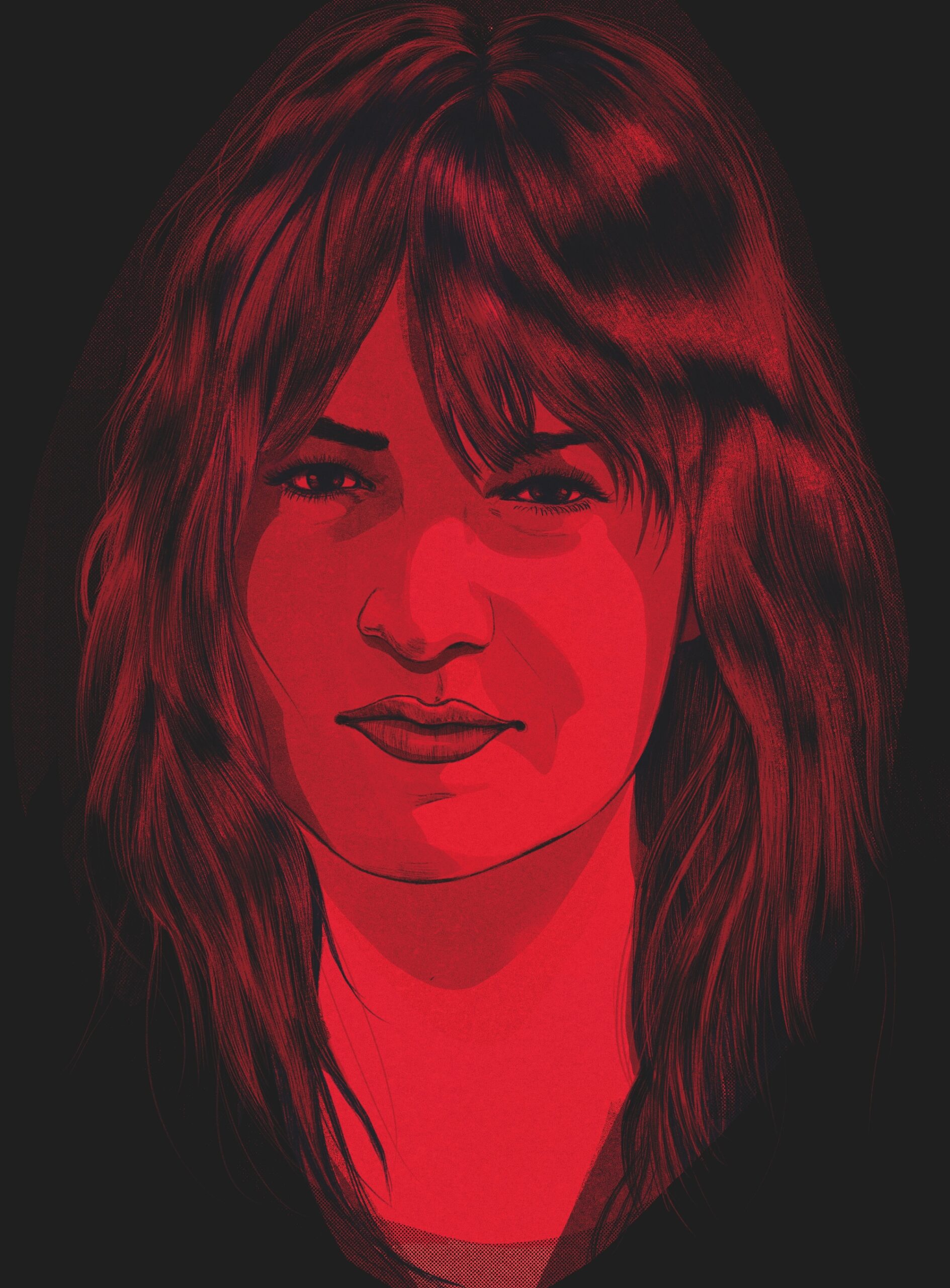
Grace Krilanovich’s The Orange Eats Creeps is a landmark of independent American fiction. Originally released in 2010 by Two Dollar Radio, the book submerges its reader in a world of nomadic crust punks and wannabe vampires as they rove the derelict infrastructure of the Pacific Northwest. What begins as the somewhat straightforward narrative of a girl in search of her foster sister quickly unfolds into a surreal landscape of extreme poverty and ethereal intensity. Characters suffer anti-dreams, drug-induced ESP, they walk along the Highway That Eats People, and hide away in near-abandoned Safeways.
Following the recent fifteen-year anniversary re-release, I had the chance to sit down and speak with the author about her original novel, surrealist narratives, cut-up techniques, the failed utopianism of the ’70s, and the translation of her forthcoming book, Acid Green Velvet. This conversation has been edited for style and clarity.
Mike Corrao: The Orange Eats Creeps opens: “Dislodged from family and self-knowledge and knowledge of your origins you become free in the most sinister way.” And this very much seems to paint the experiences of the protagonist—a child of the foster system, now homeless and wandering the Pacific Northwest. Listening to her speak, the reader gets a sense that the world she occupies has very little in common with our own. She and the vampires she spends her time with exist outside our capitalist reality. They steal, they trade, they share. They don’t think about money—they think about food and pleasure, survival. In some ways its hard not to envy the way the vampires live. Do you ever wish you could live in the world that they do? Somewhere outside of capital, and in their case, somewhere decadent, surreal, occult?
Grace Krilanovich: Well, lately, the urge to drop out is strong. I already feel irrevocably out of step with popular culture, and that’s not just because I’m middle aged. But this shared moment we’re in? Maybe it’s great timing for the book being reissued. Aside from the escapist quality of reading fiction, and we all need that, we want a way out. These kids have “left society.” But they haven’t left; they’re regularly getting acted upon violently by the straight world. At the same time, the kids are appropriating normal places—the video store, supermarket, 7-Eleven—using them in new, profane ways. Forcing us to consider that all sorts of other things can happen there.
The adult children of hippies intrigue me. This novel is set in the late 1990s. It’s decades removed from this movement, of course. But not in the sense that these are children of the era, and there’s vestiges of the utopian thing (West Coast version) still lingering in the anarchist squats, underground music, et cetera. The hippie movement was like “Other worlds are possible” and then proceeded to put woman hippies in service to man hippies for meals, shelter, and childcare at these utopian communes that were supposed to exist outside of capital.
It predates the 1960s here, of course. My new book touches upon that. But the kids are dealing with the fallout of this culturewide mass questioning of every societal given, the parents’ exhilaration in casting aside structures and hang-ups—the body freed to be the center of this revolutionary joy. And the kids are a product of the shortcomings of that. They’re assembling a sense of self out of these shards. So, I see my characters as children of the counterculture as much as children of mass culture.
MC: Yes, there are these lingering traditional, heteronormative, nuclear modes that seem to still have their grip on these characters, no matter how much they seem to detach themselves from the straight world. Early on, the narrator’s voice feels wholly invested in this utopian dream. Her descriptions of the vampires and their lifestyle read almost like a manifesto. But as the book continues, she doesn’t so much denounce this world as she seems on the verge of being consumed by it. The boundary between reality, dream, fantasy warps and blurs. By the third act, it’s almost entirely gone. What draws you to these spaces—to the places where what is and is not concretely real no longer really matters?
GK: I knew early on that I wanted an unraveling, a falling sensation to the text. If it counts as transcendence, it’s the bad kind. There’s suffering, exhilaration, but also a numbness and her nagging awareness of sensations impeded. Dreaming, waking, all of it blending together. The status of her body as a discrete entity does erode as the book goes on. And you wonder if that’s any sort of body at all, and why a female character has this kind of non-body. There’s not a plot in a conventional sense, but there’s a progression; we’re moving from one place to another; at the same time, there’s a fracturing and falling away to some primal endpoint.
It’s not the supernatural. It’s very much rooted in someone’s fracturing mind, not the “other side.” I did generative games, old-school, on paper—cut-ups, substitutions, Oulipo and Surrealist things. That was an attempt to have stuff to work with early on, and with the cut-ups, to get the effect of these trace elements echoing throughout the novel.
So in the beginning, the protagonist might say, “Look, we’re doing it too—making our own movement, a fringe society, our nihilistic fantasy.” Then it’s “Well, I am forging ahead with my own individual version, separate from theirs,” then there’s a shedding away and she can’t even sustain the category human by the end of it.
MC: Working outside those conventional narrative modes often seems to require working outside of a conventional writing process as well. You mention generative games, Oulipo, cut-ups. It feels so intuitive that you would use these methods in exploring the fractured mind. Were these games, constraints, techniques guiding the early steps of creating the book as a whole? How did you begin writing The Orange Eats Creeps? And the book that you’re writing now—has it been guided by those same approaches?
GK: Yes, that’s how I started. Orange was my first fiction, aside from a few stories from an undergrad creative writing class several years before. I was strictly a nonfiction writer. I couldn’t conceive of how to go about inventing out of nothing—so awkward! But at CalArts, avant-gardism was encouraged. The writing program was in on that, but kind of an outlier at the school too—the program was literally relegated to a butler building in the parking lot of an art school in Santa Clarita. It felt far from the watchful eye of the literary world, the esteemed MFA writing programs, far even from Los Angeles. Nobody cares what weird shit you try—this was the mood. I’m so grateful for that. I already seemed like I’d ended up in that program almost accidentally. This is a theme with me. It’s kind of scary how things inadvertently work out for the better, over and over. For me in 2004, conditions were right to try something different.
The whole spark of writing the book emerged from a joke prompt, one of several I had on a list. “Ancient Egypt High School,” things like that. I had written “Slutty Teenage Hobo Vampire Junkies” on the list and a classmate said, “You should write that.” It was like, pull your dream B movie out of a hat. There was also the fact that I was jealous of the attention the fiction people were getting in the grad program. I wanted admittance to their prom.
With raw text I could at least start to shape something, pull out choice lines or images and expand on them. But it was hard to move forward because the unit of my writing became reduced to these isolated grafs floating on the page, pages of that. Cranking out dialogue was torturous. I was really an amateur just going by feel, but I had no feel for storytelling, spinning yarns. I settled for crafting something more like a horrible ride.
The writing of the new book was quite different. I wrote Orange in three years. The “new” book (it’s called Acid Green Velvet) took fifteen years. Whole eras of publishing and several life stages went by while I was writing it. There were ten years of torment because I had no time. Simply no time—three hours of childcare per week to just barely stir these coals so it wouldn’t die. This unique, unpleasant writing process had the silver lining of nearly infinite percolating time, years and years. So the book’s got that going for it.
I used cut-ups for Acid Green Velvet too, but not as extensively. I used them twice where I wanted to have a slightly off feel to these two scenes that take place in a downtown park that’s been commandeered by tramps. The French edition will be published next year by Le Gospel out of Bordeaux. It’s a little strange to have it come out in translation first—maybe strange good?
MC: I think strange good! There’s something almost anachronistic about it—to be translated before the original work releases. In the early sections of Acid, which you’ve generously shared with me, the language feels so inventive and vivid. Characters are “smeary-eyed,” dock workers are “absorbed into a hole somewhere,” the narrator strives for a life of “ritual ascent.” Often it seems like works that play with language—that have this strong, unique voice—are the hardest to capture in translation. What was that process like? Do you see these two versions as the same work, or were there mutations that formed when crossing the language barrier? Has the translation affected how you view the original, English version?
GK: Le Gospel published the French edition of The Orange Eats Creeps in 2023, as Ce qui vit la nuit. Right now I’m finishing a revision of Acid Green Velvet so it can be translated this fall.
I don’t read French, not with any proficiency, so I can’t directly experience Orange in translation. I can’t speak to mutations or cool connections between the editions, but I hope they’re in there. I loved working with translator Janique Jouin-de Laurens. The subject matter with underground music and such was up her alley, and I think she appreciated how messed up the novel is. That was nice to hear because early on I felt like I was putting her through the works and for no good reason.
So there was the back-and-forth of Janique emailing long lists of questions and then I’d have to go to the book (shudder) and figure out what I was even trying to say in a given paragraph. That, or it would be a matter of defining phrases like exercise tapes, ice plant, skinned switch, or space gel.
Mutation is the right word, though. For readings, I always cut and move things around, reassemble a passage to suit the time limit or simply create something that is more fun to read aloud. Kind of like a mood sampler. The text is very modular this way. I’ve never read a passage straight from this book at an event.
I may have once considered the novel untranslatable. This seemed evident because there was zero interest in translating it—for twelve years. Then Adrien Durand, the publisher of Le Gospel—who’d found out about Orange from a Reddit for “crazy books” or something like that—reached out. And it’s always just the one person who decides to go for it and then everything changes.
I think it was Le Gospel’s first novel, after the press launched in 2022. Their logo has the tagline “This Book Is Not for Everyone,” cribbed from one of my Goodreads reviews. The whole thing was a lovely surprise after so many years. This book has bounced up out of its grave so many times, it just refuses to die. It’s funny, but I’ll goddamn take it. It’s been a beer, some songs, artwork. Orange Eats Creeps is a band from Las Vegas. Maybe it’ll be a Mary Harron movie.
MC: I’m very interested in the way cut-ups and collage play into your process. You mentioned earlier that you used it to begin writing, to generate ideas. Then here, as something you do to the “finished” book for readings. I noticed as well that the cover art for this new edition is a print collage that you had made—of abstract, xeroxed papers that form a landscape overshadowed by the massive weight of a gaunt crescent moon. Do you often find yourself exploring and creating in these mediums/modes outside of writing? Do you see those works approaching the same ideas, the same universes as your novels?
GK: The reissue cover is a collage I made using scraps of xeroxed paper from 1995. I felt that was fitting. I found a folder of random photocopies I made in high school—silent- and golden-age movie stars, Warhol superstars, kid-book illustrations. What I was mostly after were the flat areas and margins where it was just gradients of toner. I wanted an image that echoed the original Mat Brinkman cover while also suggesting a punk flyer or zine or other degraded artifact from another time. A copy of a copy, something that has lost clarity but gained a primitive delicacy.
The landscape drawings inside the book are mine too. You’ll find them up front, a kind of overture to the text. I can’t recall if I’ve touched on this in previous interviews, but the drawings are from a series of butcher-paper scrolls I made in 2003. The way it went was, I’d scribble landscapes over a vast swath of paper and then search for hidden words formed by accident by the scribbles. So then I’d have some text I could pull out as a found poem of sorts—the drawing wrote the poem. Slightly batty, and I was told as much by my art school classmates. The drawings were large, about thirty feet long, titled Exterior Scroll. I included them because they’re in keeping with the setting and actually, more pointedly, of what’s presented in the novel itself—the kids digging in the ground for clues and artifacts, trying to decipher the hidden truth of what happened there. And of course, here we have another text-generating device, one that’s a little too weird to be useful. But I like that it extends beyond the scope of writing but is in the service of writing.
For me, the Scroll drawings represent the shift from art to writing, because that’s when I stopped making art. If I do anything 2D, it’s to serve the writing. Recently I started attending a regular figure-drawing session, and that has been for the benefit of my writing. On one level it’s an escape from the news; it’s switching off for a few hours in favor of experiencing the present, drawing this nude person in a room full of other people in real time. It’s a low-tech, tool-on-paper moment. But the most significant thing it does is force you to radically observe and engage with what is actually there in front of you. During these sessions, a couple hours in, I will flag a bit—I feel the exhaustion of maintaining that focus. My eyes glaze over and settle on the page and I find I’m looking at my graphite stick instead of the figure. And I’ll start to draw from memory, to fall back on what I think something looks like, because really looking and transferring that to the tool requires tremendous effort. I say “figure,” but the process is in breaking it down to these minute body passages: “The skin draped over the clavicle segues to these oblong wells on the upper ledge of the chest,” or “There’s a wedge of bisected meat overlaid by a fat pad on the underside of the forearm.” That kind of thing. “The ankle crinkle is five folds where it flexes, with a larger roll on top.” That’s my interior narration as I’m drawing.
MC: There’s this way that you can observe a body so closely and with such detail that it no longer really seems to be a body. It begins to more resemble a landscape, like your scroll. Revisiting those first few pages, it’s hard not to look for language in the almost asemic linework of the foliage. It makes me think of a few moments that appear throughout the book where the novel form breaks apart into something more poetic and open. As if the language of these passages could not exist—or at least could not say what they are meant to—within the conventional structure of the paragraph. Do you often have a sense of when a section, passage, line has to take on a different shape? How do you navigate those moments of formal tension?
GK: This is a difficult question, and I’m trying to recreate the process in my head. I would say I write through it. The more I can get on the page, the better. Pull out things that are interesting and expand them. And then with a draft, work sentence by sentence, dozens of passes. Toward the end, revise with an awareness of the time the reader spends moving through the passage. And the color of it, the tone. The units working together, sounding just right. Basically there’s some shape in my head and the trick is making it match.
I guess you can get away with it being a certain kind of book if it’s short. With Orange, the language is extending the themes, reproducing the setting, and becoming a landscape in itself. So, with that thinking, you get dense thickets of text. Or you’re wading through. It’s sticky in places; in others, there’s artifacts, glimpsed images—artifacts in the sense of vestiges or traces of wordings from other sections showing up. There’s repetition, recurring motifs and structures, like features of an endless road. There’s maybe a sense that the text is a body that’s infected, stricken, possessed. There’s sluices, floods, paragraphs running a page or more. Sometimes stewing, marinating.
During the writing of the book, there wasn’t really a plan, just pages. It was the B movie framework, and then that fell away pretty early. It was marshaling assorted moods drawn from music or film, some intangible quality. The charisma of the thing, for lack of a better term. It’s that surprise juxtaposition of elements that generates this weird energy.
With fiction, it’s clear. If I’m reading something and there’s just sentence after sentence that makes me say Whoa!, I keep rereading the same lines. And then moving down the page, paragraph by paragraph, the accumulation of sparkle from odd things being put together and the gaps, of what’s not supplied. Things that are missing in between, that then takes on a mystifying shape in the reader.
I can’t resist these poets who write novels; Charlie Smith is one who comes to mind. I’m just grabbing this off the side table, currently reading his novel Three Delays, and it’s full of paragraphs like this: “So I went down to the Keys for a few days, lay drunk on the back porch of Willie J’s house, eating shrimp and throwing up into a bucket. Willie and his wife left me alone. A goat came to the screen door and looked at me. It seemed to be a very important goat, able to understand the vagaries of human behavior. I wanted to get something straight, but I forgot to mention it.” It’s like Charles Portis writing Jesus’ Son.
MC: That sounds incredible. There’s something so immediately exciting about that move across genres. Ingeborg Bachmann’s Malina and Joyelle McSweeney’s Nylund, the Sarcographer both come to mind as well. Maybe it’s this sense that a poet would be more interested in language and atmosphere than plot or narrative beats. It’s something that I very much see in your novels, and in the way you talk about your work. Each sentence has this great sense of rhythm and movement. There’s this refrain that carries the reader through the first pages of Acid Green Velvet. With each page beginning, “The spectacle of . . .” It’s a line that immediately gives the sense that our role as the reader is to witness, to watch. Do you often find yourself considering the position of the reader in your work? You mentioned above the way you approach your writing as a reader. In these more atmospheric, surreal, ambiguous works, have you found that the reader has more—or perhaps just a different kind of—agency?
GK: That’s an important frame, to consider the reader’s agency. I hope there’s a lot for them to bring to it and take from it. In a review I recall someone describing reading Orange, then setting it aside to do something else, but the voice was still there in their head and in fact was rambling on independently of the novel. Something about the voice had taken hold and converted the reader’s interior narration to its own style. That’s kind of nuts, and I love that.
There’s the hypothetical reader, or the readership, I have in mind who I think might appreciate what I’m trying to do, and I write for them—kind of. I want to push and challenge this reader, of course. But when I’m writing and I’m thinking about The Reader, it’s that I want to keep them. It’s a revision strategy:Where in this draft might they be getting ready to shut the book in annoyance? And address that.
But the reader I’m actually writing for, drafting for, sometimes it’s those select few real people, individuals I know and maybe had crushes on, and I wrote the novels for them. Just shameless pandering to a few particular people who were on the other end of that. I wanted to wow them, or I wanted to freak them out. It’s nice to have somebody out there to energize the work. You can write without [them], of course. I find that you get something a little different with.
With “The spectacle of . . .” passages leading into Acid Green Velvet, I wanted to cue the reader into an act of watching, taking in a show. There’s a lot in the book about artifice, costume, poses, disguise. There’s play and wasteful acts, antisocial, defiant, and cathartic moments. The spectacle is a step removed from reality, and invites scrutiny like a kind of freeze-frame. In the novel these short grafs up front could be lenses to unlock certain interpretations of the rest of the book.
MC: There’s this great way that those short paragraphs guide the reader into the text. Before the full scene has materialized, before we really know who anyone is, we see what they’ve done and where they’ve done it.
As we near our end, I wanted to ask you one last question: What do you like to read? You mentioned Charlie Smith’s book, Three Delays. Do you find yourself gravitating toward certain genres or styles while you’re writing? Are there any authors you’re particularly excited about right now?
GK: First I want to tell you that I’m grateful for this interview. It required a level of introspection about the work and my process that I haven’t done, maybe ever. You caught me at an interesting moment, sort of hanging on the outskirts of the next thing after many years. Fifteen years since my last book. Yet it never quite went away. I’m reflecting on the significance of that, despite every other uncertainty. Now the new novel is done, a version of it set to be published. But a deal in the US for the original—we’re not there yet.
A lot of what I’ve been reading is for research purposes, although it’s a fairly loose definition of research. With fiction I want to be a bit selective, at least while I’m writing, because stuff tends to leave its mark. That said, two novels I think about all the time now are Juan Rulfo’s Pedro Páramo and Wilson Harris’s Palace of the Peacock. Old novels, for sure, but I read them a couple years ago and they rewired my narrative brain. I just read Cookie Mueller’s Walking through Clear Water in a Pool Painted Black and Cosey Fanni Tutti’s Art Sex Music back-to-back, which had the cool effect of amplifying the contrast and connections between them. Mueller’s is a mix of memoir, fiction, and journalism. Cosey’s is autobiography. But in each, [there’s] the question of who gets to have an art life, their struggles to carve that out in their milieus and scenes, the times working against them and also feeding the work.
Lastly—and this is a big one—kid lit parachuted into my life a dozen years ago. It’s full immersion in that world and I find myself thinking in phrases from them; the characters are in my head and the books are literally everywhere in the house. The best and most alluring are part of the fabric of our household now: John Bellairs, James Marshall, Ellen Raskin, Wanda Gág, Trina Schart Hyman. William Steig’s Rotten Island is so over the top. The most exquisite is Joan Aiken. Just through sheer bombardment, it’s there, it seeped in. There’s a passage toward the end of Acid Green Velvet directly influenced by [Margaret Wise Brown’s] The Little Fur Family. 
Grace Krilanovich is the author of The Orange Eats Creeps, a NPR Best Book and finalist for the Believer Book Award in 2010. She was a National Book Foundation “5 Under 35” honoree for 2010. Her work has appeared in Black Clock, The Rumpus, The Comics Journal, and Los Angeles Review of Books. The French edition of her second novel, Acid Green Velvet, is forthcoming from Le Gospel in 2026.
Mike Corrao is the author of numerous books including Gut Text, Surface Studies, and Stealth Anxiety Megamix. He lives in Chicago.
Illustration: Nicole Rifkin
