The American miracle: that of the obscene.
—Baudrillard, America
1.
In western Texas the oil rigs shine like a city at night, flaming scherzos leaping in time to a ceaseless metered drilling. I left Dallas, having tricked this magazine into inviting me to their yearly festival, at 2 p.m., hungover and trembling. The road beckoned and I did not feel ready. The goal I set for myself is both perfectly clear—I have a week to reach San Francisco—and utterly diffuse, almost incomprehensible. I will cover 3,500 miles, traversing stupidly in unreasonable directions in a country that is not my own and a region I’d never before encountered. Why? I have come from the South—the true South—to conquer America, and they told me that the road (Interstate 20, more or less) is the way, the beast’s arteries. The America of unquestioned power and limitless extensions is dying, shrinking into nothing, and I want to recover what is left behind, take it for myself.
The roads out of Dallas are mazelike. The freeways interlock and mingle in illegible patterns, stacked dozens high like scaffolding and bending off unexplained or ill advised. My rental car’s dogshit GPS (the thing has AI driving but I can’t connect my phone) insists on the toll roads, which run straight and empty. I steer clear; being stuck in 4 p.m. traffic is as close to Americana as I will ever get, and I intend to make the most of it.
I drive—always west, despite miniature detours north or south—for five hours. They promised me crushing monotony, flat grass, Holiday Inns littering the horizon of a once-great state now brought down by fast food or inflation or fluorinated water. I try to count the number of gas stations I pass and lose track within fifteen minutes. The buildings here, I realize, don’t have windows—at least, none I can see. This is the land of warehouses and fuel.
To my right, a ridge or a mine obscures the plains. I’m amazed at how lush the vegetation becomes: Texas lies flat and abloom. The sun burns my arm as I drive. My attention falls groundward, into the pavement and its details. Small bumps and ledges, asphalt textured like a nail file or gray and grooved like a record. Uneven lanes and strips of dried tar, expanding and contracting as if the interstate itself could breathe at the touch of my wheels. Sounds like a dentist’s drill or a grinder or static or nothing at all. A pitbull’s mauled corpse lies on the side of the road, bloody mouth agape and one hind leg shredded away, either by the car that killed it or a starving scavenger. Cows graze.
The sun hides behind wind turbines, some spinning, some still. Ironic, surrounded as I am by oil wells sucking the ground dry. “I need my high octane,” I can hear Neil Young sing. At one point, I reach out to the orb with my eyes, briefly raise an arm in the astral direction and catch myself. Alone for now, I must stay sharp.
The Colorado River passes; others too. Day turns golden, then orange and oily brown, dropping carefully into a half-moon night. I pass a refinery: shiny knotted pipes and barrels hundreds of feet in diameter, sinister in the rigged penumbra. I fear the night—American roads are largely unlit—but the Sunoco glow assuages my fears. Licks of fire, each brighter than the one before, and warmer. I stop inconveniently, admire their enormity, the anger of unnecessary fires shooting upward. Were they left here like icons to remind a people, unfairly aggrandized by ever-larger, ever-taller vehicles, of our voracious fragility? I am a distraction to these titans. A neon cross slapped on the front of a church on my right, diagonal freight trains on my left. Everything seems so organized, the freight trains and their tracks regular and calculated amid the engineered rage of the rigs.
I’ve diagrammed stops along the way; today, Odessa, one among many identical small towns in this plain. Population: 120,000, admittedly more a city than a town. All around me, the Texan Pampas undulated. Apparently, there’s a replica Stonehenge somewhere in Odessa, and a crater left by the impact of a seventy-pound octahedrite that fell to Earth 63,500 years ago. Fitting—Odessa is primitive, unearthly, a site of relentless brutality, not a place at all, in fact. George H. W. Bush and his wife moved here in 1948 on their savage hunt for oil wealth, and Bush would later say his family “became Texans and proud of it” in the city, though they spent most of their time in Midland, right outside. The Bushes have a long history of ransacking: Their Wall Street magnate patriarch, Prescott Bush, became a US senator in the ’50s, but rumor has it that he and his Skull and Bones chums dug up Geronimo’s skull and femur from his grave in Fort Sill, Oklahoma, at some point before then. In 1953, H. W. founded the Zapata Petroleum Corporation and grew even wealthier overnight. When the Nation’s Joseph McBride claimed, in 1988, that H. W. had been in the CIA’s employ by 1963 (which the then-president denied), he had nominally been working for that corporation, “using his oil business as a cover for clandestine activities,” per McBride. The Bushes had a good nose for oil and other things buried underground, though their well-established stupidity often got in the way. In any case, now, like then, Odessa is populated by oilmen here for riches and Mexicans here to work; it is named to honor the Ukrainian steppe from which my family fled to Argentina.
I’ve arrived in this empty devil land late at night, crossed a dozen parking lots for something that resembled food, and am now in my room. There is a low rumble in the background; I wonder if it’s the AC or the entrails of Earth, groaning at the intrusions of oil-drunk drills that never stop. It is 12:25 a.m.
2.
My insomnia thrums in my ears like the siphons around me. I’ll take the opportunity to clarify that, as I told you before, I’m here to conquer. The Southwest is this war machine’s jugular, where America sits naked and unkempt with its brutal machines and pleasurable injuries in plain sight. I am driving toward the West of myth and founding, of power and glory for a few; I smell death, expect to see little else. The desert is not empty and does not excuse sentimentality.
To the foreigner, America is a cinematic land, each experience its own cliché. The Southwest is perhaps the most cinematic site of all, the great expanse where Hollywood staged the myth of its own rise from the so-called dirt. I have spent months imbibing Westerns; I even read Larry McMurtry’s Lonesome Dove, a well-crafted hunk of imperfect nostalgia. Mine is a stupid endeavor, really, though perhaps that makes it more American. There is a uniquely American addiction to a specific myth of the past, of the West in particular: wooden shacks, brothels and saloons, Smith & Wessons, cattle herding, and, above all, money. The West is in the heart, was won to fill the nation’s wallets with gold and copper and oil and whatever else could be found hidden under a rock. Since then it has become a fairy tale, some digestible biscuit of history fed to those desperate for the nourishment of congratulation.
I’m not charmed by these reductions, which seem best suited to a gift shop. The West is massive and shapeshifting, hidden in plain sight, in even the simplest of disguises. I want to peer behind the curtain, touch its traces. Own it.
3.
I leave Odessa later than expected—had to stop at Target and get gas. Today’s drive is not too long, only a couple hours, but what has been an ample and relaxed highway becomes a skinny and grinding road. Trees become shrubs, grass turn yellowish, oil rigs and telephone poles laid out like crosses are the only constant in the flats. I listen to Hank Williams nonstop, learning quickly that there is such a thing as road music: rhythmic and consistent, rich in loss, humble in defeat. Pedal steel guitars help. At one point, overconfident, I let the car’s AI “adaptive cruise control” drive for me; perhaps I am a techno-optimist after all, one more San Francisco hopeful.
In these slender paths, trucks become your leaders. A kind trucker’s wake shelters my puny car from the storm, guides me through the emptiness. On either side, brambles lunge for the track like talons, thorns hungry for flesh. My car sprints through a dust cloud and I wince for no reason. In the shade of the trucks, I find myself growing large, expansive even. The depths of novelty I experience strike me as enviable and at once my fundamental claim to authority here: This is not my country but I will make it mine in writing, claim America like Carlos Bulosan, Domingo Sarmiento, Jean Baudrillard, or José Martí. In the bloody crawl of world transformation—the long twilight of America—these fragments I will ruin against my shores.
I arrive in Alpine, a small town stocked with Big Bend National Park hopefuls and probably still looking like it did in the 1970s. After a piss, I head to Marfa, apparently named after a character from Dostoyevsky’s Brothers Karamazov or a Verne novel; some rich guy’s wife came up with the name. In America, a friend reminds me, myth comes before its realization, mythification an end in itself.
Driving into Marfa, I see mangled sculptures and illegible structures that may or may not be art pieces. The town itself feels like some art project. James Dean shot his final film, Giant, right here, and stayed at the Hotel Paisano, which preserved his room; unfortunately, it’s solidly outside my price point, and the only cheap hotel is fully booked by the construction crew I passed on my way here. I’ll be sleeping back in Alpine, forty minutes away.
Marfa might be the smallest town I’ve ever seen. There’s only one real road, which leads to a main intersection with a run-down city hall and two gas stations. The town’s buildings are flat and frankly unremarkable—though they have the casual monumentality given to unimportant towns—the houses grounded and whitewashed. A Catholic shrine lies outside a corner, proudly devout and demonstrating the town’s Chicano majority.
I eventually make a left and head for the Chinati Foundation. Marfa, if you don’t know, became the capital of minimalist art after the minimalist legend Donald Judd, tired of New York, relocated to the sleepy town near the border in the ’70s when he realized it had ample hangar space (Marfa had been an air force base and POW camp during World War 2) to fit his increasingly voluminous works and collections.
I knew of Marfa because of its now-terminated writer’s residency, which Ben Lerner wrote about in his novel, 10:04. In that book, Lerner’s autobiographical alter ego heads to Marfa and scrambles, reading Whitman, watching Carl Dreyer’s Joan of Arc, and composing a Whitmanic but literal lyric about his activities, a poor first draft of the chapter we’re now reading. He attends a dinner hosted by locals and, believing he is doing cocaine, snorts some ketamine, which has an immediate dissociative effect. Together with a Polish poet who is staying in “the house where Creeley began to die” and who he thus calls Creeley, he heads to the outskirts of town to see the “ghost lights,” “brightly glowing spheres, the size of a basketball, that float above the ground, or sometimes high in the air” from the viewing promontory set up by Presidio County (presidio meaning “penitentiary,” or, if you’re feeling Kafkaesque like Lerner, “penal colony”). Looking out on that “ridiculous night,” he decides to write about “an actual present with multiple futures,” a tale of uncertain life as it is lived.
My throat catches as I spot two separate Customs and Border Protection facilities on my way to Chinati’s spacious complex. Marfa is near the border and decidedly isolated—a hotspot of ICE activity, ideal for monitoring the area. Chinati is officially closed on Mondays, but I figure I might as well try and talk someone into letting me in. I park by the shitty wooden gate, Texas sun stinging. Inside the fence, a woman is getting into an Audi. She stops to open the gate and I beg her to let me in, but she shakes her head, feigning heartbreak through sunglasses and apologizing. Presumably, they’re used to idiots like me coming by on a Monday. Dejected, I improvise.
Behind Chinati lies Building 98, home to German POWs that made art on the walls. Run by a German guy who asks me to call him when I want to visit, which is not going to happen, though I take some pictures. Maybe the visitor center can help. After I pick up every brochure available, the woman tells me that “Mondays are our Sundays” but if an artist is what I need, to go next door. A sports car is parked outside. Dennis Dickinson, the owner of a gallery called exhibitions 2d, moved to Marfa twenty-one years ago; he’s bald, with a slight lisp and a generous smile. The gallery is airy and sleek and his welcome is disorientingly warm and elegant, particularly since I don’t exactly look like an art buyer in my dusty Dickies pants and blue flannel shirt. He hands me a chilled San Pellegrino—“you’ve been traveling, you look tired!”—and I tell him that I’m here on the American trail. He doesn’t really seem to get my project—fair enough—and after showing me his artists (though I am distracted by a small tile painting of Borges in a corner—rather Argentine of me) instantly readies to help. He says, “You should meet Tim!,” the owner of the Marfa bookstore. Tim replies to this stranger’s text and says to meet him at 4:30 outside the store.
Tim Johnson is tall and relaxed. He has a small pouch and a beer in hand. He quickly welcomes me in, not quite smiling but offering the stern attention that I have come to associate with a specific brand of American leftist. The bookstore is astonishingly well curated; the space itself is simply, even recently built and sparse. I’m not sure why but we hit it off. Tim tells me about his family—Houston-based, border-crossing anarchist Catholics—and his life journeying between El Paso and Juárez. I tell him about my little project and this idea I’ve had that as the United States becomes increasingly Latin American in its politics and beliefs, Latin Americans will become increasingly American too. I mention my passage through Odessa—we were discussing Silver Jews—and he concurs with my assessment: “It’s a dead place,” he tells me, and explains that the plumes of fire I saw are mostly unnecessary and for show. He came to Marfa twenty or so years ago, the bookstore’s previous owner sold it to him for cheap and he stayed; his wife works at Chinati. Marfa is his life now, though he opens the store only a couple days a week, and they also travel to Mexico and LA or New York. Apparently, he’d been a local liaison of some kind for the Marfa residency that brought Lerner here. A local artist, Mateo Galindo, has a show in the store’s gallery space. Tim gives me his number, and we agree to meet later to discuss the show, titled Landscape Music.
Before that, Tim invites me elsewhere. His friend, the painter Christopher Wool—“probably the most important painter of his generation,” per the New Yorker art critic Peter Schjeldahl—had relocated to Marfa in semi-retirement. Tim helped him set up a private exhibition space for recent works, “not for sale, just for friends,” he explains. His invitation was flattering—a friend, already? Wool, I’ll later learn, catapulted into artistic genius after seeing the words sex and luv graffitied in black on a white delivery truck in the ’80s. He spent his career painting bleak words on spartan canvases, espousing a moving, assertive pessimism.
The gallery space is ample, with several rooms that go from booming and spacious to snug and intimate. The Wool works on display have all been made in the past decade: twisted concentrations of copper tubing or barbed wire that reproduce, with mathematical exactitude, paintings in purplish reds and silvery blacks and a massive tile mural, lines overlapping and traveling adrift in every which way. Some sculptures hang; some rest on pedestals. I glimpse the West again in the brutal rhizomes of barbed wire that fences in land to demarcate property lines and the all-important copper.
Marfa is where Wool began to sculpt, and the work is inconceivable elsewhere. Wool’s interested in mediation, so he transfers a painting into sculpture and then photographs the sculptures and prints the photographs distorted into semi-unrecognizability. From abstract to material to abstract yet again, but pain is never far from the surface. The tangles pulsate with mineral violence, the brutal calculus of land and distance. “To make the world appear uniformly horrible requires rare discipline,” Schjeldahl said of Wool. The blood spilled to build these outposts is not hidden; Wool’s Marfa sojourn has only made him even more subtly brutal.
Afterward, I drive Tim back and run a stop sign, which he doesn’t appreciate. His house is behind the store and he has to make dinner for his wife; fair enough. I wait in the car for Mateo, who’s punctual and sharp, with a thin face, braided hair and a quiet, watchful smile. He’s a little taken aback by my exhausted energy, and he offers me a little mescal as we discuss his show’s component pieces. Three Sisters consists of a trio of drums with corn, beans, and squash seeds, respectively, resting on the skins (the “three sister” crops grown in Central/North American Indigenous agriculture, he explains). A transducer and an amplifier establish a feedback loop, turning minute vibration on the surface into rustlings and whispers, ever-growing clusters of quasi-distortion that themselves stimulate further vibrations. Close your eyes and it sounds a little like Gérard Grisey’s Prologue (1976) pour alto Seul, just ebbs and flows of pure tidal desert timbre.
In a corner, an old tube television set is encased in adobe and shows videos of trains and helicopters. Specifically, Mateo explains, they are military trains that bring weapons to the area and CBP helicopters surveilling the Marfa desert for migrants, which he has filmed and looped. The sounds are bladelike, slicing through the quiet harmony of the room. The show’s centerpiece, titled Landscape Music, consists of a wheelbarrow (“True Tone” brand, Mateo notes with a grin) with a serape cloth inside, on which rests a tone generator, a violin, and a transducer, all of them tied together so that the wheelbarrow works as an amplifier and establishes a feedback loop with the violin. Four thorny branches of mesquite converge pyramidally, and a violin bow, wired headphones, and similar details hang on the branches.
In Mateo’s work, artistic and musical minimalism smash together. Despite minimalism’s monumental, landed quietude, its self-enclosed simplicity and obsession with process abstract it from the world. Landscape Music reminds me of the minimalist composer Steve Reich’s “It’s Gonna Rain,” which loops a Black Pentecostal San Francisco street preacher’s apocalypticism into sublimity but also somehow captures a pigeon taking flight in the background and which becomes like percussion, blurring the line between composition and speech, music and sound, environment and melody. In Landscape Music, feedback loops emphasize the desert’s delicate ecosystem, its wired liveliness. (Mateo is from nearby Carlsbad, New Mexico, and knows this region well.) Minimalism’s cult of repetition and seriality, of infinity and material cycles of perfection and putrefaction somehow becomes inseparable from this place—itself a kind of destructive infinity, dry and windy, repetitive and endless in every direction.
To my surprise, Mateo’s wife also works at Chinati, and he says he might be able to give me a tour tomorrow morning but for now he has to go. I sit in my car waiting for the dark and eat some pizza before heading back to Alpine for the night. The viewing platform has a plaque explaining the Marfa lights, first spotted by some Yankee in the nineteenth century; it is dark and empty. I stand, shivering in the crude wind, and at first find nothing out there. Once my eyes can focus, I begin to see gentle bulbs far away before the mountains twinkle in slight reddish greenish yellowish pallor and move nonstop, advance and combine, recede and reemerge just above the horizon. There are stars in the Marfa mountains, phantoms in the West, some quantity left unsold or half explained. The present does feel alive with multiple futures here—touché, Mr. Lerner.
For once, I drive Eastward, back to Alpine in the dead of night. The road dies beyond my headlights, though nothing goes awry. “I started rollin’ down . . .” It’s 1:04 a.m.
4.
Today started early: I woke up at 8:24 a.m. to Mateo texting me that he could show me Chinati. I head to the hyper-realistic train-car diner that also serves as my hotel’s reception and settle my accounts. On my way, I overhear Argentines speaking and betray my American persona: They’re here to bike through Big Bend and are genuinely shocked at my own salutation—funny place to run into one another. I check out and have breakfast (two eggs, scrambled, two strips of bacon, two pieces of sourdough toast). I headed out. Mateo greeted me at the gate.
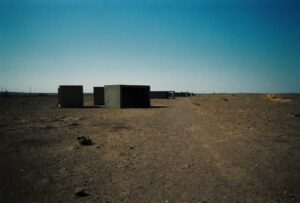
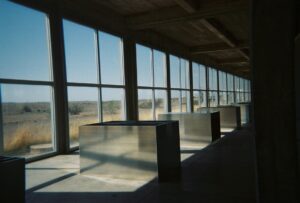
First, we see Judd’s 15 Untitled Works in Concrete, massive semi-cubes set in a straight line and left to erode in the harsh desert sun past the former hangars. As we look on and a small falcon circles above us, Mateo tells me about Presidio’s history—the now-empty silver mine in nearby Shafter, the construction of the fort to defend the border during the Mexican Revolution, the Porvenir Massacre in which Rangers and ranchers slaughtered fifteen unarmed Mexicans, the untold murders of Indigenous populations by Spaniards and Americans alike. Mateo doesn’t detail these events, but gestures at the blood that wets the Marfa sand. We discuss the assertive harshness of the weather, sun and wind and sand having left these near-ancestral concrete slabs pockmarked and puddle-prone. Minimalism’s materialism is open to the world; the enormity of its sculptures and the interminable extension of minimalist musical constructions are conceivable only here, in the eschatological American desert. Mateo points out the domes above the sheds (installed by Judd when he bought the place), where we head next and meet his wife, Malinda, who has the keys.
In the former artillery sheds lay the central highlight of Marfa: Judd’s 100 Untitled Works in Mill Aluminum, 1982–1986, a series of identically sized aluminum boxes with distinct interior configurations. The boxes seem both alien—hyper-industrial and machine-perfect—and in a strange way deeply at home in the desert, as though their smooth surfaces were of a piece with the flat asymmetry of the pebbled, windswept landscape. I notice a gecko crawling outside. One of the sheds has German words written on it: “Access for unauthorized persons forbidden” and, as Ben Lerner also says in 10:04, “Using your head is better than losing it.”
In the shifting morning light, Judd’s pieces look transparent, their textures and shapes inexplicable. Sometimes they resemble windows or tables, simple and see-through, but sometimes they demand one look inside closely, examine every angle, at which point their strangeness only resolves further. Some look as if they might levitate. They haven’t been conserved but allowed to adjust to their environment, expanding in the dry desert heat of their first years here and moving slightly, shifting again as temperatures continue to rise nowadays. In a meaningful way, they are now part of the desert, in all their hyper-technological, near-cinematic simplicity.
We leave the shed, and Mateo’s wife returns to work. We chat about the first peoples of the area and contemplate Richard Long’s Sea Lava Circles, three concentric circles of Icelandic stones that sit outside almost unnoticed. He shows me an events space, the Arena, furnished largely by Judd himself with exacting geometry; the chairs, Mateo confirms, are not comfortable, but they look great. A Claes Oldenburg sculpture, a horseshoe titled Monument to the Last Horse, sits gigantically occidental in the distance. At times, even in its relaxed emptiness, all of Marfa feels like a memorial, a cemetery for a slaughter they dare not acknowledge.
Mateo leaves. It’s 2 p.m., and time for me to continue. I am surprised at the pleasure of these drives. They’ve never felt unbearable—my back doesn’t ache, I’m not bored. To drive inspires tremendous agency, a liberating and peaceful solitude for which I am grateful, however fascist the undertones. I stop by Prada Marfa, a faux–Prada store art piece executed by some Frenchmen, the joke of which is: What if a luxury brand opened a store in this hokey town? The building smells like piss, and though surveillance cameras are all around. Then again, how different is Prada Marfa from Marfa itself? The town has a significant Chicano population that long predates Judd, and I wonder how they feel about what the onslaught of hipsters like me has done to their home. There’s a reason people call Marfa an artist colony.
I drive on. The landscape changes from arid dirt and shrubbery to occasional trees, from a dusty yellow to orange and even greenish. After El Paso, I leave the interstate—which has felt fictitious and detached, smooth in excess—and take the scenic road down New Mexico State Route 9. The sun is coming down, and the desert sky soaked in reds and oranges and purplish blues when I realize that the border is at my left. The wall . . . the wall rises up like a second horizon, more a fence or a mesh than the solid concrete or steel structure I imagined. Border Patrol vehicles appear in multiples of two, up to eight at a time, every few miles, and I see a number of military-style depots. This area is heavily patrolled, and the classic rich, White Latin American’s fear—Will they come for me?—arises in my gullet, though of course the answer is a resounding no. No one cares. I did not see another person for miles and miles and miles. To my right, the abandoned rail track, built to ferry the purified copper ore from Douglas to El Paso and now dead, along with the mine. The valley and the mountains go on in every direction, splashed with sunlight, and the wall sits still, yet another minimalist sculpture.
I arrived in gray, miserable Douglas, Arizona, where the air always simmers in a dull, smoky brown. I ordered Pizza Hut. My motel room is loud and I don’t know why. It is 12:54 a.m.
5.
I wake up early and meet my friends Caroline and Mariana, who live in Tucson, for breakfast. We decide, for some reason, to visit Douglas’s most infamous landmark: the warehouse where Chapo Guzman’s Sinaloa cartel made a tunnel in the 1980s, one of his first. Douglas sits right on the border, clearly half of a larger city riven in recent years; we walk for some time by the old and new border walls (two, just in case). The building, once we find it, is utterly unremarkable: a beige vehicle depot owned by the city’s waterworks department. We ask around, and a bemused driver tells us that the hole is in fact still visible, though they’ve filled the tunnel with cement. The sun is sharp and hot, and bears down on us as we walk. The walls—the old wall, pale white and low down, and the new wall, barbed and black and twice as high—looms just a few feet behind us.
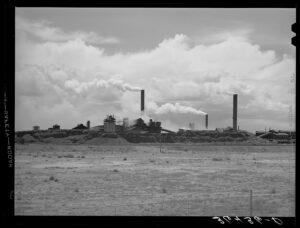
We then drive toward the former smelter, hoping to see remnants of structures, some indication of great industrial operations, traces of modernist terraformation live in front of our eyes. I find Russell Lee’s Farm Security Administration photographs, which depict the smelter in Douglas, its stacks pouring out smoke and, between the camera and the chimneys, what I at the time think is coal. When we arrive, all we find is a titanic pile of rocks. Black ore litters the dirt path so we pull over and walk. Inexplicable structures—remains, really—litter the piles, and there is apparently nothing else to see. Streaks of color washed down the artificial hillside. What chemicals are left here? Are those minerals or some leftover acid leeching into the groundwater? The rocks themselves are shiny, reflecting rainbow light like diesel on water and full of wrinkles and bubbles and traces of their melting or dissolving or whatever it is. Between the path and the mound there is a small ditch and about thirty feet of thorny bushes, so we decide further approach is not feasible or particularly interesting. A smelting town like Douglas is, in the end, the place where you leave the shit. We head to a different pile of rocks that seems more accessible and climb on top to look out. Beneath us, a CBP officer comes and goes in his car, undecided about our activities. Mere feet from the border, there is a distinct shit smell; the Douglas waste treatment plant sits beneath us. Some of the rocks have been ground into gravel—presumably the only use for the upturned material that has sat here, shattered, for almost a century.
We eventually drive on to Bisbee, which holds several now-closed mines. As with Douglas, the history is violence: mining began in the late nineteenth century, first at the Copper Queen Mine with tunnels and later with the pit. In 1917, faced with a miners’ strike represented by the IWW, some two-thousand-odd vigilantes, Phelps Dodge employees, and local law enforcement “deported” all one thousand or so strikers to Columbus, New Mexico, by train. Operations continued until the mine ran dry in the 1970s, though of course the wound has not healed. As we drive, the land falls away to the left of the road into a chasm of infinite depth: the mine pit itself.
We pull over and look out: a chasm, wide open, orange and gray and even a light bluish green, and between us a rusted fence. The walls are like stairs, white streaks running down into a pool of an ungodly fluid, deep and dark and grim, like some infernal oil. Mine pits are the world’s least subtle metaphors for violence; in fact, they might not be metaphors at all, just holes on the ground made through sheer concentrated explosive force. This main pit (the Lavender Pit, named after an engineer) has been abandoned since the 1920s. I remember Odessa; the stench of its particular abandon, of its disregard for any motive but profit, lingers over and under Bisbee, though now disguised.
Bisbee has, since the mines closed, become a haven for “mining tourism,” where people pretend to be miners and head into the now-sealed tunnels. There’s a lot of denim and a cutesy pseudo–mountain folk aesthetic reminiscent of the Seven Dwarfs ride at Disney World. Perhaps they need to assuage their own consciences by listening to a guide provide a well-crafted yarn about the horrors of the period, as if to assure us that they are not ongoing. Nothing is more Western than mining, and the West always sells.
Mariana and Caroline buy some extra-virgin olive oil at a store that sells oil, bread, and vinyl records. In the town bookstore, as we browse, I am approached by Erik Holland, a short and bearded former North Dakota archaeologist-cum-bookseller who moved to Bisbee to be near his daughter. He’s a Quaker whose grandmother went to my own Philadelphia-area Quaker college, and compliments my “noble enterprise.” I wonder whether nobility is to be found anywhere in this expanse. America’s charms grow weaker in my mind.
We get lunch while a bronze statue of a miner watches over us, and once Caroline and Mariana head to Tucson, my drive continues toward the indefinite mountains. It’s 11:17 p.m.
6.
Tempe, Arizona, isn’t cold. The city bustles with vitality, though it might be my college friend (and host, and now travel companion) Sonia’s intensity and her quiet, semi-ironic passion for the place that makes it apparent to me. We eat burgers in front of a man-made lake while automated security robots whirr around us like idiots.
The night before, I had slept in Safford and ate breakfast at my hotel before heading to Morenci, a mining company town owned by Freeport–McMoran. The drive is a typical Arizona sojourn into nothing, an upward slant into the clouds. Morenci shares the polished and well-developed mundanity of every American suburb, though one must cross the same train tracks numerous times to enter a town filled with identical houses with slatted roofs and pickup trucks. Outside the town library, near the Starbucks and the movie theater, I find a copy of Marilynne Robinson’s Gilead, a book about a dying preacher contemplating a world and a tradition that die with him. It’ll come in handy, so I take it with me.
I drive past Morenci and toward the mine, which sits next to the highway and after a series of short, precarious tunnels in the mountain. First, I pass the open-air conveyor belts that ferry crushed rock downward to be smelted. The dust falls gently all around, coating my car and the mountain face and everything to the side of the road in a rock-white chalky powder like snow. This cannot be good to breathe; I wonder how the workers here feel about it. The smell—presumably of some chemical used to pre-process the rubble—lingers somewhere between burnt rubber, rotting flesh, and sour candy, with no organic sweetness at all.
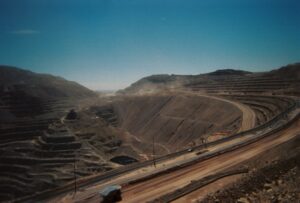
I reach the pit, which I instantly apprehend to be the largest human creation I’ve ever contemplated. My foot, on the gas pedal, trembles before the chasm. We tell ourselves that America’s greatest accomplishments are edifices, walls, highways or bridges or God-defying skyscrapers. Visit a pit mine and you’ll realize that this country’s great talent lies in blasting rock and digging holes. Standing at the lookout, made especially for tourists, the Lavender Pit seems like a ditch dug up by some children at the beach. The hole is miles wide, miles long, miles deep. Cowed Americans in basketball shorts next to me tell each other, “What a heavy piece of machinery that is!,” dumbfounded by the technical accomplishment and the dimensions of everything around us. Each of the megatrucks—there are dozens—can carry 230 tons of rock fragments from the pit to the conveyor belts and is tagged: “We Are Morenci. We Are Freeport.” I wonder who that’s for. The wheels alone are tens of feet tall. I wonder what Kerouac would’ve made of them.
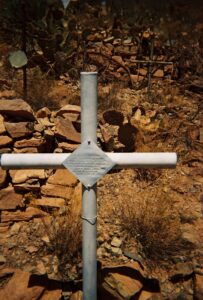
Bored—the thing with a hole this big is that not much happens, overall—I drive toward the “Mexicano Cemetery,” which lies abandoned and off to one side of a gravel road. The graves are perched on the hillside like bird’s nests among the thorns, and they all sport Spanish names and Catholic crosses. Some are made of iron and rusted, some not rusted; most memorialize a person deceased before the age of forty; many are women and there are not few children. Most of these people died in the 1930s and ’40s, and I fail to even imagine the conditions they lived in. They have all been forgotten—that much is clear. As I walk along the cliffside, a couple of lizards crawl out of the ground between my feet. Spooked, I get back in my car and return to air-conditioned safety. I find the following online:
The old Catholic Cemetery is all that remains of old Morenci. The rest of the town was either blasted away in the expansion of the open pit mine, or has been buried under mine waste. In 1983, Tony Enrico, a field surveyor for Phelps Dodge, said the cemetery would not be disturbed because “the surface indications show there is no mineralization of value there.”
I head downhill to the older town of Clifton, where I walk through a deserted downtown, shop windows barred. In 1983, the famous Arizona miner’s strike began here. Phelps Dodge tried to fire thousands of workers due to a drop in the price of metals the year prior—courtesy, in part, of the end of the Vietnam War. A strike spread across the region and reached Morenci, Clifton, Douglas, and other places, with walkouts and picket lines linked to thirteen different unions. Operation Copper Nugget went online when Phelps Dodge decided to skip negotiating and reopened the mine with scabs. A ten-day cool-off was used by management and Arizona governor Bruce Babbitt to organize a militarized force: They brought in snipers, tanks, choppers, and SWAT teams. Unsurprisingly, they broke the strike, and by 1986 the thirteen unions had been decertified. The price of copper exploded soon afterward and, with it, Phelps Dodge’s profits, as a 1989 Wall Street Journal piece proudly proclaimed. The communities in the area relied on union wages, and many—like Clifton—have never recovered.
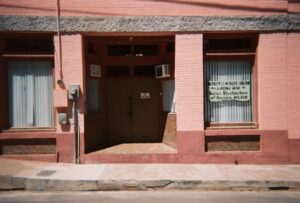
Walking through Clifton’s single street, I see the old union local. The union has been dead for forty-five years, but the sign on the shop door is unfazed and unchanged. I wonder what they’ve done with the place; a quick Google search reveals it’s now an Airbnb. The painted glass reads:
LOCAL 616,
Morenci Miners Union,
United Steelworkers of America, AFL-CIO.
As I read, a pickup truck drives right beside me and stops. The owner gets out to go to the dispensary—there are several in this tiny town. I also saw a crypto ATM—the first I’ve ever seen. Death walks the streets, and its victims are as much the mountain to which it was attached as those who served the extractive overlords. What will be left?
On my way to Tucson, where I’ll pick up Sonia, I stop in Tombstone, a fetish town that was once the seat of its county. A mining boomtown that has since become a crummy half monument to a reductive and lazy conception of the West. The West: bucket hats and guns. Most famously, Tombstone was the setting of the “Gunfight at the O.K. Corral” between cops and outlaws, much mythologized and turned into a film. If they memorialized every murder that transpired in this area like this, Arizona would be nothing but monuments. Tombstone doesn’t even have good merch (always disturbing in the country that pioneered the gift shop), though I encounter a cashier who refuses to lift her hand from the bright-pink handgun she carries on her hip. America is fear and blood. Some things don’t change.
When we arrive at Sonia’s family home, in Tempe, her Mexican father is fascinated by my Argentineness. Y usted qué hace aquí?! Well . . . good question. It’s 1:40 a.m.
7.
We wake up early. Vegas, of course, is next; if this journey requires a passage through hell then what better?
We drive into the desert. It begins as rain (surprising to me, considering we are still in the desert). Soon, we are slicing through heavy snow as if we’ve been teleported to Vermont and stuck in traffic. AI driving stops working, the sensors covered with frost. Sonia says this is normal in the area, but I’m stunned: It’s snowing in the desert! Of course, the shrubs and low grasses here bloom into pine trees. Before Vegas, we’ll drive a small bit of Route 66 and stop in Seligman, Arizona, the tiny road town that allegedly inspired the Pixar film Cars. Remember: The West! Lightning McQueen trains for the Piston Cup in Monument Valley! How could the site of horrific battles be reduced to a cartoon?
Of course, Seligman has little to offer except bored mannequins and fridge magnets, which I dutifully purchase to fulfill various familial obligations. We don’t stay long. By this point, AI driving is more than welcome to hide my lackluster driving abilities—I like to call myself a city boy, facts of my life notwithstanding, and driving badly is part of the costume. Annoyingly, the machine drives better than I do.
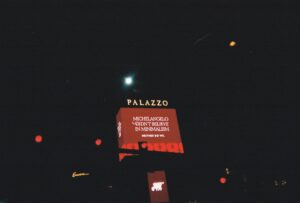
When we arrive in Vegas—I wanted to stop at the Hoover Dam, but the visitor center was closed—I feel like someone has hit me across the face. You don’t know bright and broken until you’ve seen Vegas stick out like a neon wart upon the battered Mojave. We check into the motel and cruise the Strip—after days of silence and near-solitude, of emptiness and calm, Vegas’ populist desolation overwhelms. As we drive, I wonder about the tunnels beneath us, where hundreds or thousands live until some downpour forces them out, killing many. Once we park, the true scale of the city dawns, the Strip feels endless, like a saturated allegory for its own absurdity. I vow to leave as soon as I can, but not before visiting Caesars Palace. Someone I admired was a regular at those tables—was even flown in from Argentina in the ’80s—and I wanted to get a used deck of cards in his memory.
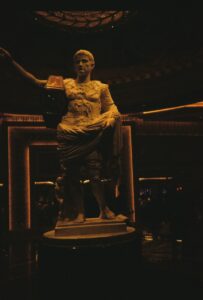
The Caesars Palace is, in fact, a network of fifteen buildings, an incomprehensible complex, a gambler’s Library of Babel. We can’t even figure out how to get inside and amble for a time in a no-man’s-land of escalators, LED screens, screaming drunks, and empty CVS stores. When we manage to enter—up an escalator, across some stairs, through a veritable ocean of human flesh and stained red-and-blue carpeting—we arrive at the lobby. Cast-white marble all around, sculptures that gesture at the Greek originals but lack the detail or craftsmanship. We’ve come on a WWE weekend, title belts hang from the statues’ shoulders and formerly buff men in overly tight black T-shirts with dyed beards and hair plugs take pictures while pointing at the belts. All around the lobby are casino machines and tables. Gamblers robotically press buttons on endless machines and masseuses travel around with pillows specially designed for patrons to keep playing while getting a massage. The pace is frantic, the tables fitted into a hallway. Smoking indoors is permitted, and the remains of countless cigarettes coat a once-golden vaulted ceiling. I go to the bathroom and lose Sonia, who has left in search of another bathroom; there’s no reception inside Caesars Palace, and neither of us feels like gambling. We finally find the gift shop hidden away in the lobby, and as I’m paying for the used cards, we turn around and notice a couple rail a line of coke off a garbage can and immediately take a selfie before hitting the blackjack tables. We have to leave this place.
Back in the car, we cruise the Strip again. The Sphere, at the end of it all, shines like a neutron star that runs ads. It’s 1:57 a.m.
8.
The following day, we ship out early. I want to see a nuclear crater—nukes being the ultimate terraformers, maximal world-destroyers, fulfillers of a prophecy of their own making. A purely Western invention, the spectacle of ultra-engineered American apocalypse hidden in the middle of nowhere. Unfortunately, the testing grounds are inside a military base. Places like Yucca Mountain, where they store nuclear waste, might as well glow in the dark as ions rip through the air. So, the next best thing: the National Atomic Testing Museum, set in a gray, unremarkable Las Vegas office building.
Tickets are overpriced. Offended, we head into the gift shop, populated with aliens, bright yellows, and inedible “astronaut food.” The doors to the museum are open, so we sneak in and travel backward in time. First (well, last, but first for us), a “unique collection of stone tools” and a series of Indigenous artifacts “found” at the Nevada Test Site, presumably after just about everything there got blasted into the stratosphere or melted into glass. As if they hadn’t picked that place precisely because it was “empty” Indigenous land. Turning around the rubber-floored, gray-walled museum, with its faux-industrial feel, we spot a series of memorials to “Cold War Patriots” who built various dimensions of the weapon either at Los Alamos or elsewhere, and, for some reason, a twisted shard of rusted, tarnished steel from the World Trade Center.
We walk on, viewing rockets, Geiger counters, hell, everything but a centrifuge. T-shirts in white and light blue celebrating Soviet visits to the Nevada Test Site. A quote attributed to Monroe Glazer, pit boss at the Dunes Hotel: “The dice kept rolling through it all. We had maintenance men standing by, but they weren’t needed.” Well, thank God. A side exhibit on the Manhattan Project apologizes for the “outdated language” and its “artifacts that may be culturally insensitive,” but it is—as with the rest of the place—mostly a celebration of the American power for mass murder. I doubt any Americans felt especially offended.
The desert beckons. The Mojave is flat, but as we drive, the mines surround us, dig their talons into dirt and rock: copper, silver, gold, lithium, whatever they can sell. At the advice of a friend, we stop in the appropriately named town of Boron, California, where the largest borate mine in the world has operated for a century. There’s no smell like there was in Morenci, but the pit—growing nonstop for a century—is large enough to swallow a small city in its entirety. Was there once a mountain here, or even a hill? Was this land flat before it became a gaping chasm? Sonia (somewhat bored, I suspect) lights a joint on the visitor center roof while I asked the tour guide, a brunette with a pink heart tattoo on her temple, about the mine. The visitor center from which we are looking out was built in the 1990s, after public opinion on mining had started to turn on mining and environmental destruction, or maybe the profits just weren’t sweet enough. We are, conveniently, far enough away to miss any real detail. As we leave, a life-size recreation of the mule packs used to schlep boron in the nineteenth century sits outside the center.
One final detour: Garlock, a diminute ghost town in the middle of nowhere built before the railroad reached the region to feed and water thirsty prospectors as they traveled the mountains. The precarious wooden buildings are fenced off; a stone with a plaque marks the place. There was a “stamp mill” here built by Eugene Garlock to crush the gold ore extracted from the mountains, until in 1898 water piping reached the area and the town was abandoned, now economically useless. Next to the fenced-off area of rotting, sloughing wood, a modern sign with large red letters reads GARLOCK in all caps, and right next to the ruins is a dog breeder’s run-down ranch.
We drive on and, after a curve (the first in days), the landscape transforms. We are in the land of wind turbines and mountains, lush vegetation and rich cliffs and even crops. The desert dies down, and in its place the Edenic wealth of California floods our eyes. Some things don’t change: again, to our left and right, the familiar rhythmic hammering of oil wells. We reach Bakersfield—“the armpit of California,” a hideously unremarkable town and the state’s oil-extracting epicenter. From the motel balcony, a dark patch in the landscape reveals oil wells as far as the eye can see. In California they drill in the shame of darkness, without glowing city-like and proud. Destruction is a constant; illumination, less so.
It’s 2:52 a.m.
9.
The last day is short. California is replete with flourishing crops, its mountains and valleys rich with fruits and vegetables and protest, traces of social conflict and demands for fair wages that make even clearer its tranquil abundance. No longer in the desert mirage, the violence that has followed me from Texas to Arizona to Nevada to here would seem to have subsided, or at least be hidden from view. Before, the wanton destruction was naked and open; here, in California, violence hides behind a tree or in the dark, behind a scientist or inside a billionaire’s compound. A final turn on the road reveals San Francisco and the Pacific from behind the mountains, a jewel covered in smog.
We return the car at the airport and my friend, a PhD student at Stanford, takes us to Palo Alto. It is nighttime in the corporate suburb, the infamous heart of Silicon Valley’s schemes. Violence is kept secret here, enforced upon its quieted poor and exported to the world with engineered precision. The drill’s heartbeats are distant memories, replaced by the whirring of windowless data centers that will soon cover the land, drink its water with abandon, and shoot their poison out.
And when you ask, did I conquer America, make its vast and joyously violent landscape into my own dominion? I don’t know. For now, I have assembled a compendium of its scars, the wounds it has visited upon rock and tree and bone and flesh alike. The Hoover Tower’s grim eye gleams with sick, mute joy from my friend’s balcony in the Palo Alto night. I recall a line from Larry Levis: “It is so American, fire. So like us. / Its desolation. And its eventual, brief triumph.” In the end, I came here for this. 
Federico Perelmuter is a contributing writer for Southwest Review from Buenos Aires. His essays and review have appeared in the Washington Post, the Baffler, and Parapraxis, among others. He is at work on a book project about the history of metal extraction in the Americas.
