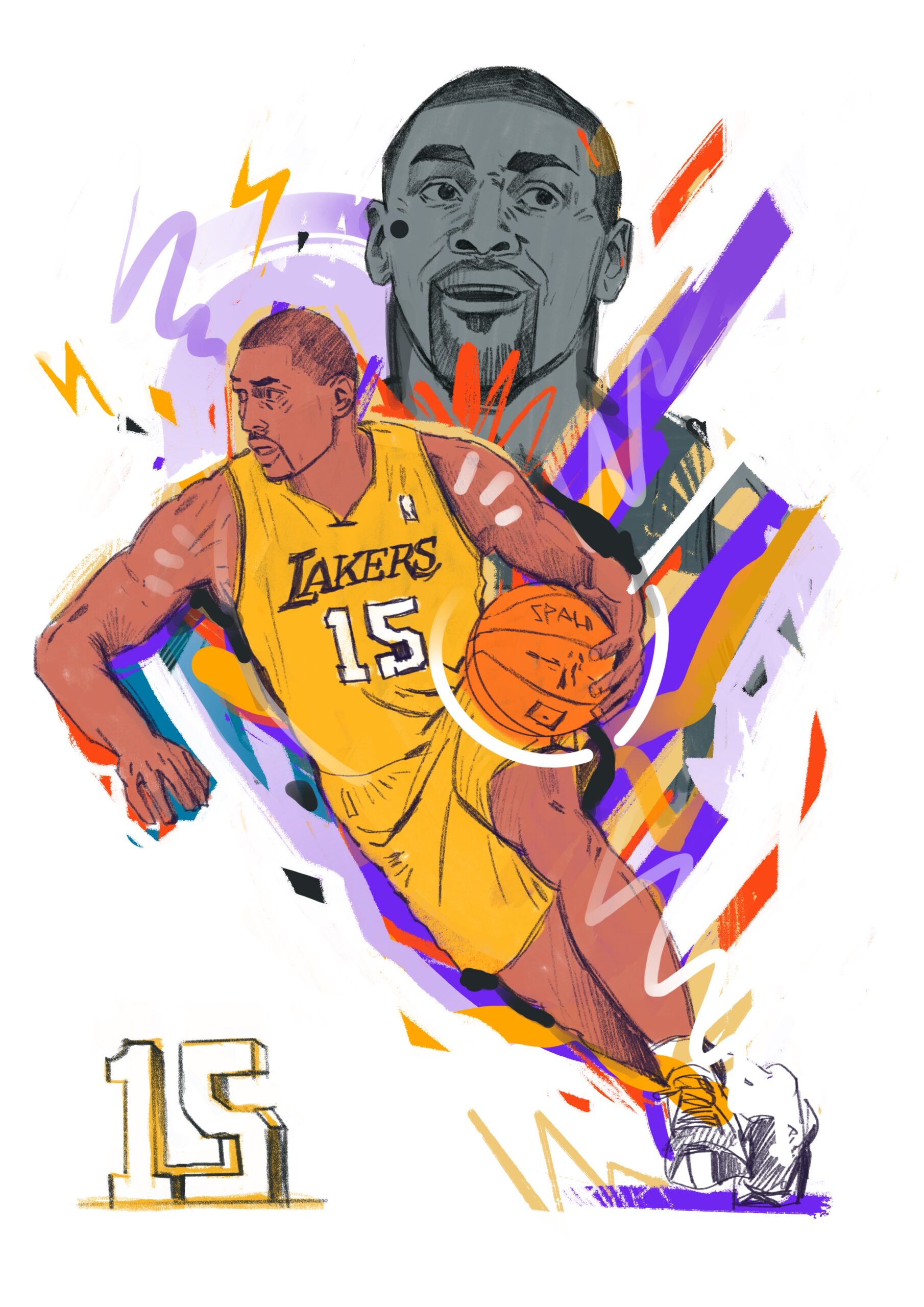
Let Us Now Praise Giant Men is a regular column about NBA basketball. This edition is about Ron Artest, Metta World Peace, Metta Sandiford-Artest, The Panda’s Friend, and non-carbon-based forms of life.
On television, it’s hard to know what NBA players are saying. Crowd noise and blaring loops of the “Truffle Butter” beat drown out defensive communication, profanities are muted on time-delay, and when players are wired for “Mic’d Up” segments, the selections chosen for broadcast are generally the type of utterly unrevealing exclamations (“Let’s go! All right! All right! Let’s goooooooooo!”) that, in an ontological miracle, somehow subtract from the sum of information in the world. Once in a while, it’s possible to read players’ lips in emotional or demonstrative moments (Draymond Green really likes to call Kevin Durant a bitch) but usually, despite being watched by millions, most verbal communication on the court goes unheard, contained by an impenetrable aural terrarium that stretches from baseline to baseline and to a height more or less rim-high.
The only common exception comes in the non-time of the foul shot, the one statistically significant section of the game that takes place without the clock running. Side by side and in relative quiet, the players chat. You can hear what they say if you pay attention, and it’s great, like we’re being let in on a secret. What I love seeing most is these dudes contextualizing makes and misses as tiny resolutions to their conflicts; this is the stage on which Rasheed Wallace coined his “Ball don’t lie” catchphrase, and where Stephon Marbury erased any doubt about his personal distaste for former teammate Keith Van Horn by loudly telling him, “I knew you’d miss, motherfucker,” after Van Horn bricked a late-game free throw. At the foul line, spoken language—with all the self-projections and ego construction that go along with language-as-performance—merges with the broader and just as imprecise language spoken by a physical body, as well as the very precise language of a scoreboard, to shape what we see as a player’s character.
My favorite example of this came in the 2016/17 season, when Metta World Peace hit a free throw and immediately shouted, “I love basketball!”
As you may know, Metta World Peace is not the man’s given name. Early in his career, Ron Artest had a reputation as both an uncompromising defender and a volatile bully. It’s easy to read a racial component to the latter insinuation; Artest, who brought a game full of palpable anger from the Queensbridge housing projects and who was (it was later revealed) battling mental health issues, exemplified threatening stereotypes that the league was consciously trying to play down in the early 2000s. For what it’s worth, lots of Artest’s shenanigans (that’s a technical term) exacerbated a reputation for personal unpredictability: He wore a bathrobe to shootaround and applied for a job at Circuit City during his rookie year because he wanted the employee discount, using Jerry Krause, president of the Chicago Bulls, as a reference on his résumé. He later admitted to occasionally visiting the liquor store nearest to Chicago’s United Center in uniform to buy bottles of Hennessy to drink at halftime.
At the time, it might have been possible to read the character of “Ron Artest” as a type of kayfabe, a construct accepted by both viewer and performer as real life. This character may have integrated Artest’s off-court eccentricities but didn’t preclude the possibility that, somewhere, it might dissolve into an offstage ether. But in 2004, when he and several teammates left the court (Artest, lying on the scorer’s table after a confrontation with Ben Wallace, had a cup of soda thrown on him) to beat up Detroit Pistons fans in the stands at the end of a game, it laid the limits of this construct bare, shattering a fourth wall where characterization was supposed to end. Maybe it’s a stretch, but it seems significant that the “Malice at the Palace” came in the same cultural era as the American remake of The Ring, with its resonant image of a spectral girl crawling out of a television screen. The horror is in the idea that the boundary between viewer and viewed might not be as impermeable as it seems. Some things don’t go away when you shut your eyes.

A long-ago acquaintance of mine has become something of a conspiracy influencer. If you want to know which conspiracies she’s into, the answer seems to be “all of them.” Her Stories cover everything from vaccines to pedophilia to Atlantis/Lemuria to free energy to Joe Biden clones to occult antisemitic tropes from the nineteenth century to ghoulish Republican talking points (a republic is not a democracy!) to crypto and the coming crumbling of the Federal Reserve and with it, the worldwide system of fiat currency. These are all loosely held together under an umbrella of a coming apocalypse in its ancient sense, having as much to do with revealing as destroying. In this version, the fall of the Western order will usher in an era of rejoicing in untold abundance, and also you should probably invest in XRP.
A lot of mainstream explanations for the appeal of conspiracy theories center on alienation: It’s comforting to enter a community of those who feel the same disconnection from the world as you do, and the mutual discovery of who’s to blame for that disconnection reinforces that community by restoring a sense of collective agency. This makes a certain amount of sense, but it also relies on a blanket distinction between believers and skeptics, which I think obscures something crucial about them: Conspiracy theories are stories first and foremost, which in their communal creation function like folk tales—even bespoke conspiracies like QAnon rely on long-established formulations. You can’t debunk a folk tale, which survives because of its figurative rather than literal truth. If you’re scared of the dark woods, what matters is the fear, not the darkness. And if you’re not scared of the dark woods, you’re probably kind of an idiot.
A crystal healer once told me that in the coming energetic upswelling we would become crystals, our bodies evolving to be silicon- rather than carbon-based. As far as I know, I’m still made of flesh, blood, bones, and stardust, but when I’m futilely trying to convince my students not to outsource their consciousnesses to the silicon world of some distant AI server farm, I can’t help but think that maybe she was on to something.
At first glance, it seems like you can get a lot more access to an NBA player’s character now than you could twenty years ago. Our knowledge of a player beyond the court was once limited to cartoonish advertising avatars or clichés spouted during interviews, but now we get an avalanche of content: social media posts and in-season Netflix docs and pregame tunnel walks where players show off their cool clothes. We know that Nikola Jokić loves horses, that Tobias Harris loves reading, and that Jayson Tatum built his son Deuce the world’s loneliest-looking playground and named it Deuceland. On his podcast, Draymond Green proves himself an erudite basketball strategist and historian who still thinks Kevin Durant is a bitch.
But character is a key word here. No matter how personal these glimpses into a player’s supposedly real life are, we’re still seeing performances created for an audience, and since so many of them take place within the larger, perverted landscape of the internet, where story is corrupted to be a term of advertising and not art, what we see in the flickering magic lantern of character construction is more branding than personality. We know this, and so do the players. And in a lot of cases, this construction might be better for all involved—if players choose, they can still keep something of themselves hidden behind the false verisimilitude of a public image, while as audience members, we’re shielded from a lot of messy personal specifics that might make some of these dudes harder to root for. We get the silicon-based version; they keep the carbon-based version for themselves.
I don’t know if this division ever existed for Ron Artest, who, remember, wore his uniform to a liquor store. After the “Malice at the Palace,” he spent a half decade in a relative basketball wilderness, playing stints in Sacramento and Houston before signing with the Lakers in 2009. But recast as a role player, he thrived in Los Angeles, his defensive contributions made essential, his aggression framed as toughness instead of thuggery. He thanked his psychiatrist in a press conference after the Lakers won the championship, then changed his name seemingly on a whim—giving the switch a vague justification in his 2018 autobiography, No Malice, writing that “it all went back to trying to be [himself]” while asserting that “Ron Artest never missed an opportunity to entertain.” His cryptic and contrary self-deadnaming seems significant here; it’s as if World Peace was throwing his former self to the wolves of public consumption, creating a new character in public so that he might have greater control over its borders.
I don’t want to gloss over the social/racial context of World Peace’s image rehabilitation. This was an era when lots of Black entertainers who were previously placed on a spectrum of threatening instability were being embraced and softened by being memed in a largely White-gazing internet culture: “Trapped in the Closet”–era R. Kelly was bro-ing down with Will Oldham, Samuel L. Jackson was fully embracing his own Samuel L. Jackson impression, Snoop Dogg was striking up a friendship with Martha Stewart. World Peace’s new name seemed to fit in to this paradigm of commodified defanging, the linguistic opposite of a forearm to Rip Hamilton’s face; while the surname is self-explanatory, he took the name Metta from a version of Buddhism that translates the word as “loving-kindness.” Later, while playing in China, World Peace claimed he was changing his name again, this time to “The Panda’s Friend,” which is kind of a twee-er version of “Metta World Peace,” refined for the endless scroll’s elevation of the non sequitur, the kind of half joke that might give a temporary frisson of pleasure as your phone lures you deeper into its digital chamber of horrors.
Yelling “I love basketball” after hitting a free throw seems way more genuine. It’s still an audience-facing performance, but it reads like an expression of a deeply internal truth, a joyous statement of purpose proven true through the very fact of its utterance. It’s thuddingly reductive, as simplistic and inarguable as Marc Bolan yelling “Rock!” before ripping a guitar solo. You never doubt for a second that Metta World Peace loves basketball. That fact, in that moment, becomes the most important thing about him.
Artest yelled “I love basketball” in the fourth game of a season during which the Lakers were deeply shitty, with a fever-dream roster made almost entirely of gloriously remorseless chuckers—Nick Young, Jordan Clarkson, “Sweet” Lou Williams, D’Angelo Russell, Julius Randle, Brandon Ingram—a game the Lakers would lose to fall to 1–3. But a strange thing happened immediately afterward: The team began to break huddles by collectively shouting “I love basketball,” and for a short time, they played better. They won six out of their next eight games, including a twenty-point victory over eventual champion Golden State. This stretch would account for almost a quarter of the games the Lakers won for the rest of the season.
This came mere months after a video recorded by Russell leaked, of Young musing about cheating on his then-fiancée, the Australian one-hit wonder Iggy Azalea, which resulted in Russell’s teamwide ostracization for being a snitch. That this scandal (endlessly dissected by sports and gossip content mills at the time) was a fully online one is exemplified by the video’s setting, a pixelated funhouse of screens: Young, lounging on a hotel bed, is triangulated by the MacBook he’s idly using, local news blaring on a television off frame, and by Russell’s phone itself. This final screen, through which we see, is different from the others—it pulls Young outward, rather than walling him in. To this day, it’s unclear how the video got leaked, which means Russell’s transgression isn’t just about snitching, it’s that he’s scrambling the liminal borders that insulate Young from his brand—subject from object, viewer from viewed. On Russell’s phone, Nick Young thinks he’s carbon-based, but he’s not.
Now imagine “I love basketball” as a yogic mantra, a meditative om based on a version of loving-kindness that’s no less true for being a commodity, and you can see how it might have zeroed out the Lakers from their personal and professional alienation. Let’s squint and see the Lakers avoiding a doomed attempt to navigate internal fissures in their individual selves, instead shifting their focus to functioning collectively in the public-private space on the court. In this narrative (admittedly taking correlation as causation, and as concerned with figurative rather than literal truth as any conspiracy theory), Metta World Peace isn’t a figure of redemption but one of ascension, a guru turning a game into a form of quantifiable spiritual enlightenment.
I love basketball.
In retirement, Metta Sandiford-Artest (in 2020 he changed his name again, adding his wife’s last name to his original surname) has become an advocate for mental health issues and also entered the venture capital space, becoming a partner in a company that makes cameras meant to show viewers an athlete’s point of view during games.
Do these disparate paths meet? Can transforming the viewer into the viewed, in an era when monetized alienation is called connection, stop the vortices of the mind? Is this resisting the energetic upswelling turning our bodies into silicon, or surrendering to it?
I love basketball.
To a crystal healer, your body becoming silicon-based would be a joyous occasion, the transformation of your soul into light. The apocalypse reveals as much as it destroys.
I love basketball.
You can find the “I love basketball” clip on YouTube, where watching it will become another data point in an invisible shadow of your world. You probably know this shadow world through the dystopic shorthand “the algorithm.” My algorithm is full of bearded assholes yelling at me to buy a knife.
I love basketball!
Liam Baranauskas is a writer from Philadelphia.
Illustration: Arunas Kacinskas
