“The smell is coming over from the pile of sand.”
“Sand doesn’t smell.”
“No, it’s not the sand that smells. It’s the boss’s boat, that ferried those three mares across.”
“So it’s the mares that smell?”
“The dead one does, yeah.”
The young men are hollering at each other as they pedal toward the sand factory. The smell, increasingly intense, fills their senses, and Milton, who has a touchy stomach, feels like he’s going to vomit. Today Ana didn’t go to school, so he was able to come out early. He loves days like this, pedaling with Jorge when the breeze is still fresh and there are barely any people on the riverbank.
“It’s disgusting.”
“The stench is too brutal to work.”
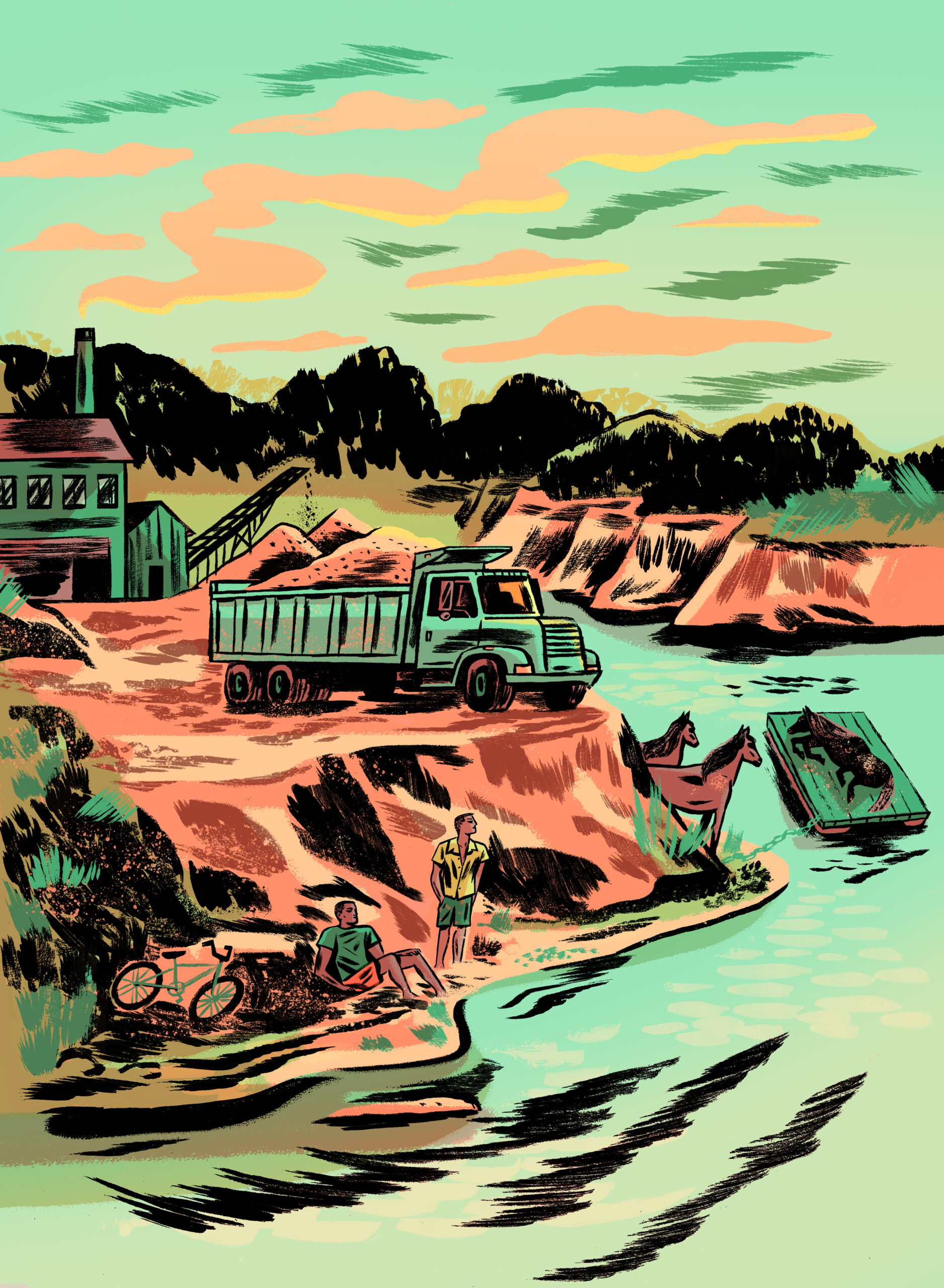
“Poor critter,” Jorge says, gazing toward the river. Further ahead, on a kind of floating corral, the mare is bobbing this way and that with the current. She has a dark spot on one eye, brown on the dun-yellow coat. An eye patch, it looks like. The immense belly, swollen with fermented guts under the sun, is covered in flies. On the bank, the other two mares, the living ones, are looking at her and huffing. They’re thinking things.
The sand spreads toward the riverbank and in the sun’s glare it might seem as if they were in the desert at midday—lost, alone, invisible. But the noise from the motorbikes bursting their exhaust pipes on the road pulls them out of their reverie about a desert place they have never been to, have not thought of for a long time, and will never visit. The gusts of wind blowing on the river pick up veils of sand along with the rotten smell, swirling in every direction. Fine particles coat the men completely. Tiny yellowish crystals stick to their bare, sweaty torsos. They narrow their eyes.
“It’s like a golden shower.”
“Don’t say that, dude. Do you know what that is? A golden shower. Forget it. You’re so clueless. Dude. That’s when someone pees on you,” Jorge says, filling in the day’s paperwork. The machine clatters, loading sand onto the truck.
“No way someone’ll pee on me. I’d kill him.” Milton smiles. He smiles at Jorge.
“It’s not about peeing just like that.”
“So what is it?” Jorge is tickled by the half smile on Milton’s face as he squints from the brightness.
“You want me to show you?”
“You wouldn’t dare,” he replies, looking the other way so Jorge won’t see he has turned red.
The boss hands out the lunch items and the machinery goes silent. Milton watches Jorge as he takes the paperwork to the warehouse. He watches him walk, decisively, sweating, yelling at the other workers that it’s time for lunch before coming to sit down with him. The two gaze into the distance for a while. The wind is roiling against the ground. In the shade, they sink their hands and bare feet into the last sliver of cool sand under the tree. Milton always does the same thing. Under the sand, his foot touches Jorge’s foot and caresses it, coarse with grains. Jorge doesn’t flinch so maybe he likes it, Milton thinks. If he doesn’t flinch and keeps talking like nothing is happening, maybe it’s because he likes it. The truck beside them offers a little shelter from the wind, but still, as they eat their lunch, the nauseating stench of rot makes their stomachs churn, while a few grains of sand crunch between their teeth, mixed in with the bread, cheese, and salami.
The shift is over at sundown. They get dressed, their clothes sticking to a day’s worth of acrid sweat. The stench keeps intensifying in the wind. The boss is concerned about the situation.
“We need to bury the mare. If it keeps stinking like that, the council can catch me out. The catamaran people have already said several tourists complained.”
“Tourists, here?”
“Yes. They like to visit the castle museum and those places of interest. And they go for a boat ride.”
“We’ll bury her tomorrow,” says Jorge, who is more decisive, and he turns his back to the boss.
“It needs to be today. By tomorrow she could explode, or worse. Take the dolly to move her. I’ll bring her over.”
The young men glance at each other. They’re the only ones here, since they’re always last to leave. Which is why they get roped into these kinds of tasks, like when they had to clean all the machines after the flood. Their own muscle power will have to suffice to drag the huge inflated horse toward the grass and across the factory premises. They watch their boss walk to the pier, board his boat, start the engine, and chug over to where they’re standing. They thought the smell couldn’t get any worse, but they realize, as the boat comes near, that the mare is much heftier than they’d imagined, and the stench far more overpowering. It will take them ages to dig a hole to bury her.
The boss moors the boat and turns off the engine. He wishes them good luck, and leaves them to it. Milton is annoyed because the boss never helps with anything and always asks favors after everyone else has gone home. But he doesn’t say this, and instead goes aboard to analyze how they will offload the mare. The water tilts the boat slightly, creating a gap from the bank which they don’t know how to remedy. The dolly is big enough, but how to get the mare onto it is the problem. Jorge goes aboard too, and together they touch the mare, which is hard and soft at the same time. The eyes sunken into the skull, that dark spot resembling a black eye, and the dirty, tangled mane. Jorge pushes the animal from behind, and Milton grabs the legs and pulls forward, his hands gripping tightly around the bones at the knees. The stench envelops it all. The flies are nervous too, with the body being taken away, and start buzzing loudly around their ears and hands.
“No chance we can do this,” Jorge says, and he brings his arm to his forehead to wipe off the sweat. The mare won’t budge. As if she were glued to the deck. “We won’t be able to carry her to the dolly.”
“Yes we can. Push harder.”
“That’s as hard as I can. She’s a big girl, isn’t she? We need to do something else.”
“We need to bury her like the boss said. There’s a reason he told us to. If we leave her here, the stench will be even worse tomorrow, in this heat.”
“Let’s throw her into the river.”
Milton immediately shakes his head. Then he says no, no, no.
“Yes, yes, yes. I want to get out of here, and there’s no moving this mare. The water is dark now. We sail that way”—he points in the direction opposite to the bridge, following the current, away from the village. “We push her in, and the river will carry her away. She’s sure to float from all that swelling.”
“The boss will find out.”
“He won’t find out because we’ll dig the hole and pretend we offloaded and buried her.”
Milton speaks inwardly. He thinks it’s a bad idea because to do that—first they have to steal the boat, and then they have to do something opposite to what they were told to do. He looks at Jorge, kneeling beside the dead horse, his black hair sticking to his forehead. He grabs Milton’s ankle and strokes his leg up to the knee as he goes to stand up. Then he says, Come on.
“I don’t know how to drive a boat,” Milton says. The closest he’s ever gotten to a boat was when he rode a tourist catamaran on some school trip, years ago.
“I do,” Jorge says, and Milton thinks of course he does; he always knows it all, and when he doesn’t, he pretends he does and everything works out so well that Milton can never guess when he’s telling the truth and when he’s lying. “Come on, cast off.”
They release the boat. Milton’s heart is racing. The doctor would say it’s anxiety, but he knows it’s the nerves from doing something they shouldn’t. They drift a little. They move away from the bank. Total darkness. Fifteen minutes or so, until Jorge says, okay, here. Now what they have to do is destabilize the barge, where the horse is. Jorge decides Milton has to do that because he’s stronger. So Milton clambers onto the barge, which is perilously hitched to the boat with a chain, and stands beside the mare. Because the boss already removed the mesh fencing, all that remains is the floating wooden platform. Jorge says, jump on the edge, that way you’ll start to make waves and when it’s at the right angle, the mare will slide down. Milton jumps as hard as he can beside the mare to cause the surface to tilt enough. He jumps. He jumps. Jorge can’t see properly, but he can hear how agitated the water is around them. The wood sounds loud as it begins to knock against the boat, propelled by Milton’s jumping and the weight of the horse. There are so many waves that Jorge has to hold on to the handrail of the boat, which is also rocking, chained as it is to the barge. Then, the immense splash. Milton jumps one last time and at last the mare slips and falls into the water. He loses footing. His sneakers want to land on wood, but he slips. He falls on top of the mare, which half sinks into the choppy river. Under the water he feels the animal’s body against his. The mare on top. With all his strength he pushes against the fermented belly, his hands sinking into it, and he pushes himself away. He comes up to the surface. The air, heavy with summer, takes hold of his mouth and nose, flooding his lungs. Jorge, falsely calm, tells him to climb up. Up, come on. Let’s head back. Milton swims toward the boat and when he reaches the point where he can hear Jorge’s voice calling him, he stretches out a hand so he’ll help him up. Jorge’s dry body makes him feel calm. With much strength, he raises him up to the boat and they stay there for a moment, one dry and the other wet, their bodies fast together, Milton’s frightened breathing mixing with Jorge’s, who is also scared to death.
They dig a hole. They calculate, roughly, the size it should be if they’d done what they were supposed to do. And they leave the dirty spades in the warehouse. See you tomorrow, they say on the street, before heading in different directions.
Milton can’t sleep now. Even though he showered and counted up to a thousand and prayed twice, he doesn’t feel sleepy. And Lulo won’t stop barking. Milton realizes there’s something outside that is upsetting the dog when Lulo fitfully climbs onto the chair and is able to see out of the window. Milton huffs. He shushes at Lulo and says quiet, dammit. But the dog barks and barks and barks and Milton gets up. He looks through the window and under the light of the porch, he sees her. Standing there, rigid, looking in. Inflated and dripping wet, the mare with the spot. He has to blink several times, switch the light on and off, walk across the room and back to the window again. He sees the same thing. The mare with the spot, alive, outside.
He grabs his phone to call Jorge, who picks up right away, with a sleepy voice. What’s up, he says. Milton yells at him: She’s here, she’s here. He’s shaking again. He tells him the mare with the spot is in his patio. Standing, like a living mare. Still fermented, but flicking at the flies with her tail. Jorge says, stop pulling my leg, it’s too late for these pranks, and he hangs up. Milton sits in the chair, Lulo on his lap. He stares at her. The mare seems to stare back, although she is facing him head-on and her eyes are at the sides of her head. Seen this way, she would be beautiful if she weren’t a dead mare.
Milton can’t sleep all night. His mother, who always gets up early, finds him still sitting up with Lulo asleep on his lap. She gets a fright when she sees him there and even more of a fright when she sees the mare on the patio. She speaks quietly so as not to wake Ana, allowing her to speak to her son in private.
“What’s that?” She approaches Milton and puts her hand on his shoulder. She finds him cold and a little absent.
“A mare,” he replies, and a shiver runs through her body.
“Who’s is it?”
“The boss’s, she was.”
“Don’t tell me you stole her.”
“No, no. She was the boss’s mare, then she died and was stinking on the river.”
“I don’t understand.”
“Me neither.” Milton feels like crying, but he already cried in the small hours, thinking about his boss and Jorge and himself and the mare. “She died and the boss asked us to bury her, but we couldn’t because she was too heavy, so we did something else.”
“So the mare is dead?”
“Of course.”
“And what did you do, if you didn’t bury her?”
“We threw her in the river,” Milton puts his face in his hands. “It was Jorge’s idea. We couldn’t carry her and we dumped her in the water.”
“Got it,” Clementina says, and starts to prepare breakfast. She yells at Ana that it’s time now, she needs to get up, she’s late for school. That Got it sticks in Milton’s head.
“Got it? Got what?”
“I mean, it makes sense, you didn’t bury her. And what doesn’t get buried stays alive forever.”
Milton remains seated next to his mother while Ana eats her breakfast. His mother knows things. She always has, ever since she lost her hearing in one ear due to an infection. She says an intuition opened up in there. Milton doesn’t know what it means for an intuition to open up for someone, but he believes her when it comes to the mare. She was old when she had him, and nearly fifty by the time Ana was born, and his aunt says it was a miracle they were both born healthy. Although Ana was born cross-eyed and it’s never clear which way she’s looking. It was a high-risk pregnancy for her and a premature birth. His mother says the bad genes were brought by their father. He gave them the blond hair, the pale eyes, the squint for Ana, and for Milton, a strange sensitivity. Neither of them ever met him. He was from Finland. And a few years after inaugurating the factory, he went back to his country. Their mother doesn’t have his name or surname. She doesn’t speak about it either. They just know, Milton and Ana, that one day she fixed his trousers, and his shirts another week, and before she knew it, she was pregnant. And some time afterward, again. And she doesn’t let on or say anything else, but when she thinks about it, she cries and stops working for the rest of the day.
When Ana has finished eating, Milton gets her dressed and takes her to school, holding her hand. It’s a month before she’ll finish the summer course. And then it all gets complicated, because their mother has to work and Ana gets uppity and is too young to be wandering about, and Milton is saving up for a motorbike and high school starts soon as well, and when classes start, he’ll have to leave the sand factory. Ana’s hand is sweaty and she asks to let go. The mare with the spot following, clip clop, clip clop, behind them.
“So the horse is yours?” Ana says. He saw how happy she seemed as they left the house. How the child looked at the mare and the mare let her stroke her nose.
“I’m just looking after her.”
“So whose is she?”
“Jorge’s.”
“But Jorge has a field and you have nothing.”
Milton laughs and pulls her ponytail. He messes up her hair and Ana kicks him but he barely notices. He drops her off at the school gate and continues toward the sand factory.
The patch of disturbed sand. Underneath, nothing. Sand and more sand. Some logs at the bottom, to simulate volume.
“Did you manage, then?”
“With the mare?”
“Of course.”
The boss stares at them, then at the burial site. Milton is scared that he’ll notice they dumped her in the river. He gulps and notices he’s sweating. He’s more afraid of the mare appearing right there, even though he tethered her by a tree opposite Ana’s school.
“We managed, yes.”
“There weren’t too many roots there, where you dug the hole?” The boss walks around the mare’s resting place and inspects their work.
“No. Just sand and damp soil underneath,” Jorge says. Milton nods.
The boss claps and congratulates them. Then he heads to the warehouse. Jorge approaches Milton and grabs the back of his head with one hand.
“See, I told you it would be fine,” he says. And Milton makes an effort not to flinch, but still every hair on his body stands on end as he says, the mare came back from the river. And she was at my place last night. And today I will show her to you. Jorge removes his hand and stops laughing. He says, stop messing with me, Milton. And he returns to his work station.
The shift goes fast because Milton is worrying about other things. About Jorge, who refused to have lunch with him; and about the mare, which he had to leave, tethered in the sun, with no water, and he feels sorry for her, even though the animal is just an apparition. He goes to look for Jorge in the warehouse before signing off, but freezes when he sees the mare with the spot standing there, on the pile of sand. Inflated like she was the other day, the stench almost gone now. Standing like the living. Milton shouts at Jorge. He whistles at him to get his attention. So his eyes can verify what he has been trying to tell him.
At first, Jorge tries to ignore him. But then he can’t, because Milton is Milton and something happens in his body when Milton shouts his name that way, that’s why he turns. And what he sees causes his knees to buckle. The mare seems to realize what is happening, because she starts walking toward Jorge, straight on, and presses her nose onto his shoulder. Jorge is stiff, his hands hanging by his sides, his face blank. The mare opens her mouth and chews at his T-shirt. Gently. Not biting his skin. Jorge leans back a little and looks at her. He examines her face, her coat, her eyes. It’s the mare. He lifts a hand and touches her neck. His hand moves in the direction of the fur and then against it, upward. He forgets about Milton for a second. He can feel the mare’s hot, humid breath against his chest. He doesn’t believe anything and at the same time he believes everything, and it is so overwhelming that later he can’t remember how he came to be with Milton by the river.
The tippy-toes sink into the strip of greenish mud of the riverbank. Back in the olden days, the water in this river used to have healing properties. Not anymore. Now it does harm. They hear the tour guides say this on the catamaran that comes and goes at eight in the evening, when they reach the riverside. On your right, the Martínez sand factory, the oldest in the region. Their trousers are down to their knees. They pee side by side, hidden by the bushes by the riverbank. The two streams froth against the water and mud. They watch each other urinate. The mare with the spot whinnying between them. They don’t say any more words because they are a little embarrassed. There is no one left now, they think. Just the machines and the mare close by, sniffing at them. Milton always wants more from Jorge. Anything, even if it’s just a glance, twisted and wry. They walk on top of the patch of sand, and Jorge laughs. He tugs gently at the mare’s mane and points at the ground.
“You should be in there, you weirdo.”
The mare stops to inspect the burial and snorts, causing some sand to fly up.
“We should have buried her. And this mess would be over.”
“Let’s bury her, then,” Jorge says, his back to the animal. “Let’s bury her. We kill her, shove her in, done.”
“You can’t kill what’s already dead, don’t you realize?”
“So then, what? What do you want us to do?”
“Nothing. What can we do. Nothing. I’m just saying, we should have buried her.”
The horse is whinnying, and in among the willows, the boss is watching them. He seems calm. His posture is sometimes deceptive, slightly hunched, hands in pockets. The young men don’t notice him. They leave together. Jorge ahead, riding his bike, too small for his tall and skinny body, and Milton dragging his feet, walking beside to the mare. It’s sundown and, back home, they both have similar thoughts. It’s something they never thought before and that they will never say.
It’s a Saturday and Milton arrives early. On the way, he dropped off the mare at Jorge’s because it’s Jorge’s day off and that’s what they agreed. To take turns looking after her and at some point, find out if she can be killed or if she has to be kept forever.
“Santana, do you think I’m stupid?” the boss bellows from the warehouse as soon as he sees him arrive.
Milton is startled at his voice, so stern this early. He thinks about the question he just heard. He is planning on saying no. He tries.
“You think I’m an idiot? That I wouldn’t notice?”
“I don’t understand.”
“Did you bury the mare?”
“Yes.” Milton lies because by now the lie has gone beyond the threshold of the false and has become more than that. To him, whether or not they buried her does not seem very important, and it would be a bit silly if the boss were more concerned about the lie than the mare.
The boss seems to puff up. He lets out a loud chortle that fills the space and pushes the air in the warehouse to the outside. Milton notices and takes a deep breath.
“I want you two gone. Far, far away.”
“Excuse me?” Milton does not want to be far away. He has his home and he has the village and the sand factory and the river. Not far away, no. No desert, no city, no relative.
“You two. The mare. Gone. I saw everything yesterday.”
Milton feels himself go pale.
“It’s not our fault,” he says, and he knows he is about to cry. “We didn’t do anything to make her come back. She came back on her own—”
“There was always something funny about you two.” Saliva is frothing between his teeth from the rage as the boss says these words. Milton knows that expression well.
“But we didn’t—”
“Leave!” he nearly screams. He is nervous. The boss’s body is trembling as he repeats that Milton must leave. “And don’t let Ortiz come back either. You need to leave, the two of you, and never come back.”
“But I need the money. And so does Jorge. What you saw isn’t what it seems.”
Milton sees how the boss slides his hand in between his clothes. The firearm glints from behind the jacket zipper.
“I’m not kidding. You will leave and you will take her with you, goddammitfuck!”
Milton staggers back a couple of steps, as if the yelling has whipped up a gust of sand, wind, and pain. He runs several blocks, fleeing from the sand factory, slowing down only when he feels he is far enough. The tears have left shiny streaks under his eyes. The trails of a sad slug. He has to cover the same ground on the way back, riverbank and then blocks uphill, real steep, heat hitting the back of his neck and behind him the clip-clop, clip-clop of hooves. The mare with the spot appears at a corner, and when Milton sees her, he thinks how stupid of Jorge to let her out, instead of tying her up properly and looking after her. But afterward he thinks how hard it is to tie up something so different and so difficult to name. And he realizes: The mare would come straight to him, knowing where to find him. 
Tamara Silva Bernaschina published her first short story collection, Desastres Naturales, at age twenty-three. It won two Premio Bartolomé Hidalgo awards as well as the Uruguayan national book award for a debut work. Her novella Temporada de Ballenas received an honorary mention from the Juan Carlos Onetti Award in 2024. Her latest short story collection is Larvas. She lives in Montevideo.
Juana Adcock is a Mexican Scottish poet, translator, and editor whose work deals with themes of migration, geopolitics, translingualism, and ecopoetics. Her first book, Manca, is a cult classic in Mexico, with an English translation by Robin Myers due in 2026 from Pamenar Press. Her latest collection is I Sugar the Bones.
Illustration: Mike Reddy
