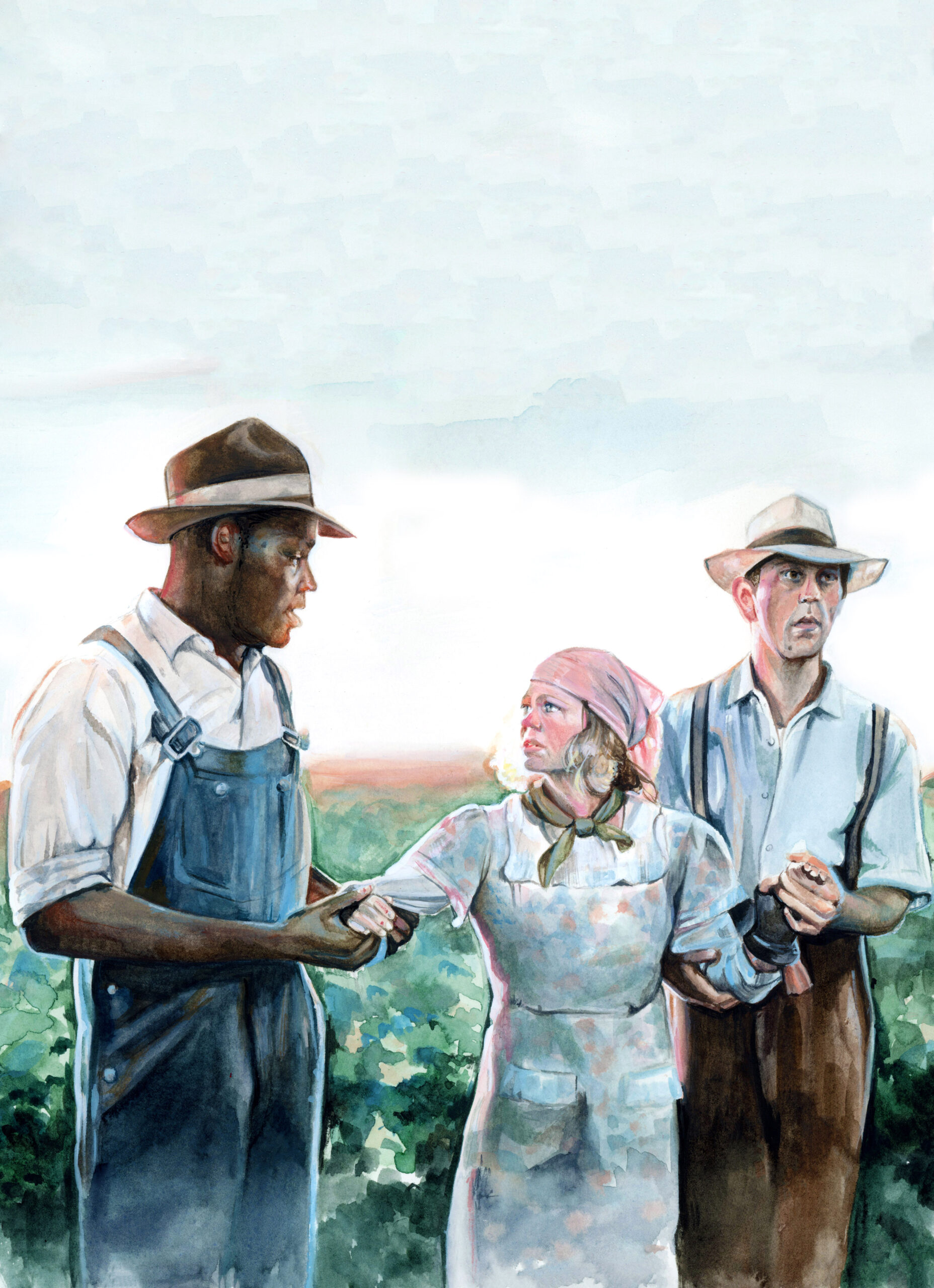
When lists of the great American filmmakers are compiled, Robert Benton, who died in May of 2025 at ninety-two, tends to be left off. This might be the byproduct of his subtlety and modesty—qualities that rarely impress the keepers of the pantheon. As both a screenwriter and a director, Benton, who was born in Dallas and raised in Waxahachie, was mainly interested in what people do and say, and the specific environments they live in. He captured them with words and images that were precise and full of feeling but never showy. Benton’s masterpiece, by his own reckoning as well as that of critics and audiences, was 1984’s Places in the Heart, a tough-minded valentine to his hometown in the years before his birth.
Set in 1935, toward the end of the Great Depression, it stars Sally Field as Edna Spalding, a White widowed farm owner with two small children who builds a biological family into a chosen one by taking in a White blind boarder named Will (called Mr. Will by almost everyone, played by John Malkovich) and a Black drifter known as Moze (played by Danny Glover) who helps Edna win a cotton-harvesting contest that pays enough in prize money to keep the bank at bay. The movie did quite well at the box office for a period drama that did not shy away from the rough parts of life, and it was nominated for seven Oscars, winning for Best Adapted Screenplay and Best Actress (Field, who won the category five years earlier, for Norma Rae).
In the intervening decades, Places in the Heart seemed to have been forgotten outside the cinephile community and Texana buffs. But it received a boost after Benton’s passing in pieces appreciating a robust filmography that encompasses his screenwriting for Bonnie and Clyde and Superman: The Movie and other films; and his work as writer-director, which included the anti-Western Bad Company, the divorce drama Kramer vs. Kramer, starring Dustin Hoffman and Meryl Streep, which was nominated for multiple Oscars and won for Best Picture, Director, Original Screenplay, Actor, and Supporting Actress; the slapstick romantic comedy Nadine, set in Austin in the 1950s; the melancholy Upstate New York comedy-drama Nobody’s Fool, featuring Paul Newman’s final Oscar-nominated performance; the race-relations drama The Human Stain, adapted from Philip Roth’s novel; and the crime dramas The Late Show and Twilight, both of which center on seventysomething private eyes (Art Carney and Newman, respectively).
Hopefully the luster won’t fade this time. Places in the Heart is one of the great films of the 1980s, and the greatest Texas movie of all time. Texas movie is used here in a particular way: It is not referring to a movie that happened to be shot in Texas but is set somewhere else (as Dallas played Detroit in Robocop and DC in Logan’s Run). Nor is it a movie that uses Texas as a geographically nonspecific real-world soundstage (see Wes Anderson’s Bottle Rocket and Rushmore, which were filmed in Dallas and Houston, respectively, but are never identified as such); or a movie that uses Texas as a vehicle to make larger statements about, say, the magic of old movies and the ennui and hypocrisy of small-town American life after World War II (The Last Picture Show, adapted from a novel by Texan Larry McMurtry but directed by New Yorker Peter Bogdanovich); or the relationship between Texas and Mexico, and “the border” as a metaphor (Lone Star, written and directed by John Sayles, who was born and raised in Upstate New York and didn’t set foot in Texas until 1978, when he was in San Antonio doing a cameo in a movie he wrote, Joe Dante’s Piranha). Places in the Heart, in contrast, is a Texas movie in every way. It’s set in a specific Texas city during a specific time, and written and directed by an artist who didn’t come to the material as an outsider but was a native son with a compassionate but unsparing eye. It has larger points to make, of course. But for the most part, it’s a splendid example of how to illuminate the universal by drilling down on specifics.
Benton was inspired to write it after a lunch with the filmmaker Arthur Penn in Dallas, where they were making the taboo-busting, medium-realigning 1967 drama Bonnie and Clyde, Benton’s first produced screenplay (co-scripted with his regular writing partner, David Newman, who worked with Benton at Esquire). Penn told Benton, “You ought to put those stories down—they’d make a wonderful movie.” Edna, Benton later said, was based mainly on his wife, the artist Sallie Rendig, plus his grandmother, whose remembrances provided many of the period details that make the film feel lived-in. A New York Times profile published when the film opened sums up the relationship between the storyteller and the story:
His family had lived in Waxahachie for five generations, and there were several times as many tales as there were aunts and uncles and cousins and grandparents and great-grandparents, since there were at least two or three versions of each story – like the one about his daddy’s brother, who started having an affair with a very young lady and was shot to death by her outraged father, or the one about his daddy’s other brother, who was also shot to death, this time by a man who chased him down Main Street in a Model-T Ford, firing all the way, for reasons never entirely clear but having to do with the bootlegging wars raging in the area at the time.
Then there was the story of little Robert’s great-grandfather, the local sheriff, who got called away from Sunday dinner one quiet afternoon to go down to the railroad track and pacify a drunk. The drunk shot him; the sheriff’s body was brought home and laid out on the dining room table.
Edna is the life force that pulls viewers into the story and leads them through a series of hardships, including a tornado that destroys part of the town and a finger-bloodying week of cotton picking that’s intended to raise just enough money to prevent foreclosure on Edna’s farm. But Benton told The Times that he felt the film was really “about all of them . . . I think what interested me was that [Edna’s] husband was taken away from her, one family unit was destroyed, and it was replaced by three people trying to survive. They were the least likely people, in that time and place, to make it—a White woman, a White blind man, a Black man. But they were a family.” Places in the Heart is about that family.
But it’s also about the different iterations and interpretations of the word, negative as well as positive. There’s an unconventional family living at Edna’s place, where Will and Moze become father figures to Edna’s son, Frank (Yankton Hatten), and her daughter, Possum (Gennie James, born in Navasota). There’s a more conventional family in a small house a few minutes away, headed by Edna’s sister, the beauty parlor owner Margaret Lomax (Lindsay Crouse), and her mechanic husband, Wayne (Ed Harris), a charming lothario who’s having an affair with married schoolteacher Viola Kelsey (Amy Madigan, who had been Harris’s partner since 1980; they got married during the production of this film). And there’s a menacing “chosen” family lurking about, in the form of the local Ku Klux Klan chapter that terrorizes the city’s Black population.
The small-scale dramas taking place in 1935 Waxahachie illustrate truths about far larger groups that are themselves often referred to, sincerely or opportunistically, as families: the city, the state, the nation, and humanity itself. Benton shows how disparate elements of the Waxahachie family are connected by spirituality, legacy, and the impact of the Depression. The film’s opening montage unfolds over audio of a local church congregation singing “Blessed Assurance,” with its refrain “This is my story, this is my song.” Benton, editor Carol Littleton (Body Heat, E.T. the Extraterrestrial), and cinematographer Néstor Almendros (who shot half of Days of Heaven, as well as many features by French New Wave filmmakers that Benton adored) lay out a series of briefly held but potent scene-setting images, including Moze being gifted with a plate of food by a Black woman on her front stoop and saying grace before eating it; and an unnamed White woman living out of her car, cast, posed and lit to evoke Dorothea Lange’s iconic 1936 photo, Migrant Mother, Nipomo, California.
At the same time, Places in the Heart is careful not to imply that all suffering is equal. Edna’s and Margaret’s families are hit hard, with Edna made destitute by her husband’s death and Margaret’s beauty parlor doing so poorly that she regretfully tells Edna she can’t give her a job. But we are always gently reminded that, as White people of at least some means, the Spaldingses and Lomaxes have more options than those who are desperately poor, or worse, desperately poor and Black in 1935 Texas. The same opening montage that shows such economic misery also shows Viola and her oblivious husband, Buddy (future Lost star Terry O’Quinn), sharing an after-church lunch in the window of a downtown restaurant, and the Spalding family enjoying what will be their final meal together—an idyllic tableau that could have been painted by Norman Rockwell. Minutes into the story, Edna’s husband, Royce (Ray Baker), is summoned to the nearby railyard, where a Black teenager named Wylie (De’voreaux White, aka Argyle the limo driver in Die Hard) is drunkenly firing a revolver. We immediately understand the strange intimacy of a place like Waxahachie circa 1935, a big small town that calls itself a city, when Royce and Wylie affectionately address each other by name. Then Royce, who mistakenly assumes that the last click of his gun’s chamber means he is out of ammo, points the gun at Wylie and pulls the trigger, a wild shot that kills the sheriff instantly. The act is portrayed in medium and long shots, save for a close-up of Wylie’s horrified face as he realizes what he has just done.
Soon afterward, Wylie is hung from a tree branch by Klansman. We don’t see the act itself, only the aftermath, with the killers taking his body down the next morning. This approach is characteristic of Places in the Heart, which finds pictorial and cinematic ways to approximate the way its characters see the world and relate to each other. Benton doesn’t want to rub our faces in misfortune for purposes of melodrama; it would be untrue to the people in the story. The discreet presentation of violence creates a consistent emotional temperature that allies Places in the Heart with tales of long-gone times, handed down by elders who might have been too young to properly digest what happened, or who are repeating stories told by someone else.
These distancing techniques delay the emotional impact rather than quash it. It all hits hard, just not instantly. We experience horror, fear and, sadness of the movie’s most intense moments first as events—as facts; as things that happened—and much later as catastrophes that destroy pieces of those who survive them. The way the pain of a scene sinks in over time is akin to an injury that initially seems like it’s not as bad as you thought, but hurts like hell the next day and produces bruises that seem to take forever to fade—or scars that never do. The film’s moments of racial oppression and brutality are depicted matter-of-factly as well. An especially vexing scene finds Moze saving Edna from being cheated by the owner of a cotton mill where she wants to sell her harvests; the man swallows his pride and admits he charged Edna too high a price, but addresses Moze as “boy,” uses the N-word twice, then ends by calling Moze “a credit to his race,” smirking like a bully who knows he’s done wrong and will never be punished for it.
There’s casual, ingrained racism all over the place. Even characters coded as “likable” manifest it at times: Early in the movie, when Moze tries to insinuate himself into Edna’s life to make a few bucks doing odd jobs for her, Edna’s resistance is undergirded by palpable fear of the Other. Her sister is far less diplomatic than she is, addressing Moze coldly and with a hint of a threat to try to get him to leave and not come back. When Moze is picked up for stealing silver from Edna, we get the first of the film’s many New Testament allusions to forgiveness as a path to grace: Edna declines to press charges and makes him an official employee of the farm. Sometimes racism and sexism combine, as in a scene where Edna tells the bank officer Albert Denby (Lane Smith) of her plan to pay off her debt, and Denby says, “You mean to tell me you let some Negro hobo talk you into planting cotton?” and then quickly escalates to the N-word, something you hopefully would not hear spoken in the lobby of a bank by an employee today. (And the character Will, by the way, is Denby’s brother-in-law, and has supposedly been forced upon Edna as a boarder to show that she’s making “a good faith effort” to pay back the bank, even though the real reason is that Denby doesn’t want to take care of Will anymore, and the only other option is an institution. This is but one example in the film of how generosity and self-interest intertwine, creating hypocrisies that the powerless have to pretend not to see.)
The environment is so dominated by White men of a certain economic status that little Frank cluelessly uses the N-word in casual conversation with Moze. Most period films dealing with race would follow such a moment by having the offended party explain to the child why racism is bad and that he shouldn’t use such words. Moze knows how the world works, so his only notable indication of disapproval is the way he pauses while hammering. Then he tells the boy about the superstition that one should never rock a rocking chair with no one in it, shows Frank his lucky rabbit’s foot, and leads him in a ritual cleanse of the area’s energy. (“These people ain’t no reason to get yourself killed,” we later hear Moze say, in one of many self-directed monologues he mutters when he thinks nobody’s listening.) This is the world as it probably was, not as Hollywood likes to pretend it was. There are no characters who are intended to represent the “modern point of view” on race, class, gender, or anything else, just people who are nice and people who are not so nice, or just plain awful. And even the “good” ones are unpalatable to contemporary progressive attitudes, in ways they themselves would never recognize because they are conditioned in a particular way and lack self-awareness.
One of the many minor pleasures of watching Benton’s films is becoming attuned to his unhurried but efficient storytelling rhythms and realizing how strictly he observes the film storyteller’s maxim that one should enter a scene as late as possible and get out the instant that the point has been made. Unsurprisingly, perhaps, Benton got into drama through journalism: After relocating from North Texas to New York in the late 1950s to pursue a master’s degree in art history at Columbia University, he became a contributing editor and art director at Esquire, a double threat rarely seen in the magazine world. It seems clear in retrospect that this experience had a formative effect on his film sense: Strunk and White’s The Elements of Style advises would-be writers never to use a long word when a short one will do, a central principles of graphic design is that one should get the visual point across as simply as possible—including treating negative space as an ally and realizing it’s not necessary to have five images on a page if you can choose one that says it all. Benton’s breadth as a screenwriter was remarkable, and you can see the characteristic mix of leanness and lyricism in everything that bears his name. His screenplays to Bonnie and Clyde, the retro-flavored screwball comedy What’s Up, Doc?, and the original megabudget superhero epic, Superman, gave their directors (respectively, Arthur Penn, Peter Bogdanovich, and Richard Donner) a taut structure even when the stories ran long, as well as quotable lines that, even in fantastical settings, sounded plausibly like things humans might say. (After Superman saves Lois Lane when she falls from the Daily Planet’s roof, he says, “Don’t worry, miss—I’ve got you,” and she gasps, “You’ve got me? Who’s got you?”) Benton’s films are similarly economical. If one could describe them as poetic (an adjective that the clear-eyed Benton likely wasn’t aiming for), it would be in the vein of Emily Dickinson’s eight-line “I know Suspense—it steps so terse” than Walt Whitman’s fifty-two-section “Song of Myself.” Some scenes in Places in the Heart are less than thirty seconds long, and others are even shorter, getting in and out in three lines.
But that’s not to suggest that Places in the Heart isn’t an auteurist statement that takes big swings. It is—but the often impressive displays of technique are always in service of the story and the characters, and try not to be too flashy, much less call attention to aesthetics apart from all else. There are two long, unbroken tracking shots in the film, both of which reinforce the idea of the interconnectedness of all people and all things, regardless of the differences they observe or invent. One is set at a local dance, the camera slowly wandering the crowded room as people drink, dance, and flirt while a band (led by the legendary Merle Watson) performs “Cotton Eyed Joe” (a choice that’s thematically perfect for this movie because it merges the musical traditions of the enslaved and formerly enslaved, White Southerners, and Irish traditions; Watson performs it again on acoustic guitar a few minutes later as the band’s roadster passes the Spalding place). The uncut long take is a superb way to establish affinities and similarities, and this one is a beauty. More profound, though, is the final shot taking place during a church service—it follows a communion platter being passed from one parishioner to another. This is the only shot in the film that is figurative or metaphoric rather than literal: It ends with the long-dead Royce and Wylie seated next to each other, the former passing the plate to the latter. It’s a fitting follow-up to a passage from Corinthians read by the pastor, warning the flock that if they speak in the tongues of men or angels and they have not love, then they are nothing, and that love is not boastful or jealous and it never ends.
There is another passage from Corinthians worth mentioning here: The body is not one member, but many, and thus “the eye cannot say unto the hand, I have no need of thee: nor again the head to the feet, I have no need of thee,” and that “there should be no schism in the body; but that the members should have the same care one for another. And whether one member suffer, all the members suffer with it; or one member be honoured, all the members rejoice with it” (1 Corinthians 12:25–27, King James Version). If Benton had gone with this instead, it would have hit the thematic nail on the head even more squarely. But he didn’t have to. He already said it with cinema. 
Matt Zoller Seitz is a Pulitzer finalist for criticism; a staff writer for New York Magazine and its entertainment blog, Vulture; a film critic and editor at large for RogerEbert.com; and the author or coauthor of twelve books on film and television. He was raised in Dallas.
Illustration: Brianna Ashby
