It was the first day of spring when Reese’s takedown of the new funeralface went live. He was a music critic for Torch, a blog that had its moment in the early 2000s, when journalism was still considered somewhat cool. In response to the ubiquity of puff pieces, Reese took on hatchet jobs, roasting bands without mercy. He was attacked by fans, who called him Reesetard and posted ugly pictures of him from his private Instagram. He dealt with it by rarely logging on.
Charitably, Reese did not air out his frustration with the artist’s stupid name (it was stylized like that—no capitalization, no spaces) in the review. He focused solely on the music, which was dull. Funeralface was a mysterious emo rapper who reached quasi fame on SoundCloud after his monotone freestyles over sputtering beats went viral. That stuff had intrigued Reese, but the debut mixtape, thereisnohopeforthisworld, revealed funeralface as just another sad boy doing the same woe-is-me shtick over and over. “If you’re looking for bars, you won’t find them on thereisnohopeforthisworld,” Reese wrote in his review. “What you will find is mumbled pseudo-poetry about how funeralface wants to die. Hopefully the mixtape will make him enough money to afford him a therapist. The title is accurate, though. The unconvincing melodrama of these tracks genuinely makes me feel like there is no hope for this world—not if people are willingly listening to this shit.”
The reaction poured in as soon as the social media editor of Torch sent out the tweet linking the piece. The sun shot in through the window in the kitchen, where Reese sat stuffing his face with scrambled eggs, and the glare made his laptop screen dark as an abyss. Reese shrugged and closed it. It was a special day: his girlfriend Lauren’s birthday. He’d reserved a rare edition of one of her favorite novels from the local bookstore and had to go pick it up. Outside, kids were playing in the streets. A little girl scream-cried over a scraped knee. A teenager smoked a cigarette. Reese recalled the first and only cigarette he ever smoked; he had been interviewing a folk musician on the back patio at a show, and when his subject offered him a Newport, he felt he had to accept for the sake of the story. It irritated his throat and that was it.
Reese’s phone buzzed in his pocket. At the same time, thunder crackled. Reese looked up and watched clouds overtake the spring sky out of nowhere. The downpour was immediate and merciless. He took refuge underneath the overhang of a karate studio. On the other side of the translucent wall, teens were chopping wood boards at a rapid pace. The vibration in his pants continued. Reese took out his phone to find several DM notifications, all from @funeralfaceofficial.
u dont know what ur getting urself into, one message read. I curse ur name.
Reese couldn’t help but laugh. But he also thought of his ex-girlfriend Andrea, who identified as a witch and sometimes held séances in her bedroom. She would light candles and break out a Ouija board. She’d had a morbid obsession with Ian Curtis and claimed to be in a supernatural relationship with his spirit. Reese had never quite been sure if that counted as cheating.
After twenty minutes, the storm let up. Reese resumed his walk. The sun was back out, and it seemed as if the deluge had never taken place at all. The sidewalks were suspiciously dry. He felt disoriented and tired. Everyone passing by him appeared untouched by the disruption. Reese entered the bookstore and went up to the counter.
“I’m here for that special copy of The Picture of Dorian Gray,” he said.
The girl, blue-haired and tattooed, frowned. “I’m afraid we just sold that one.”
Reese was befuddled. “I called yesterday and asked to reserve it. I was told it would be reserved for me.”
The apologetic look disappeared and was replaced by an expression Reese couldn’t quite decipher. “Someone came in an hour ago and grabbed it. I assumed it was you.”
Reese wanted to argue some more. “So it’s your fault,” he would’ve snapped. But he just sighed and walked away, wandering the bookshelves, hoping to encounter something thoughtful for Lauren. She loved classics but already owned them all. What could he possibly get her? His meandering led him through sections that offered no help—cookbooks, art books, political books—until he stumbled upon a little corner with hardcovers in other languages. A sleek French copy of Jane Eyre caught his eye. Lauren adored the glamor of French culture: cafés, clubs, Chanel. This would do.
“Glad you found something,” the blue-haired girl said as he handed the book to her.
“It’s for my girlfriend,” he said. “It’s her birthday.”
She raised her eyebrows. “She’s French?”
“No.”
“Okay. Your total’s fifteen dollars and thirty cents.”
Reese reached into the back pocket of his jeans. There was nothing there. He tried the other pocket. It held only his keys. “You have to be kidding me.”
“I don’t think it’s that expensive.”
There was nowhere else to check. Had he forgotten his wallet before slipping out of his apartment? He’d never done that before. Keys wallet phone before you leave the home, he often sang to himself.
“I’m sorry. I forgot my wallet.”
“Oh.”
“I’ll just grab it and come back, I guess.”
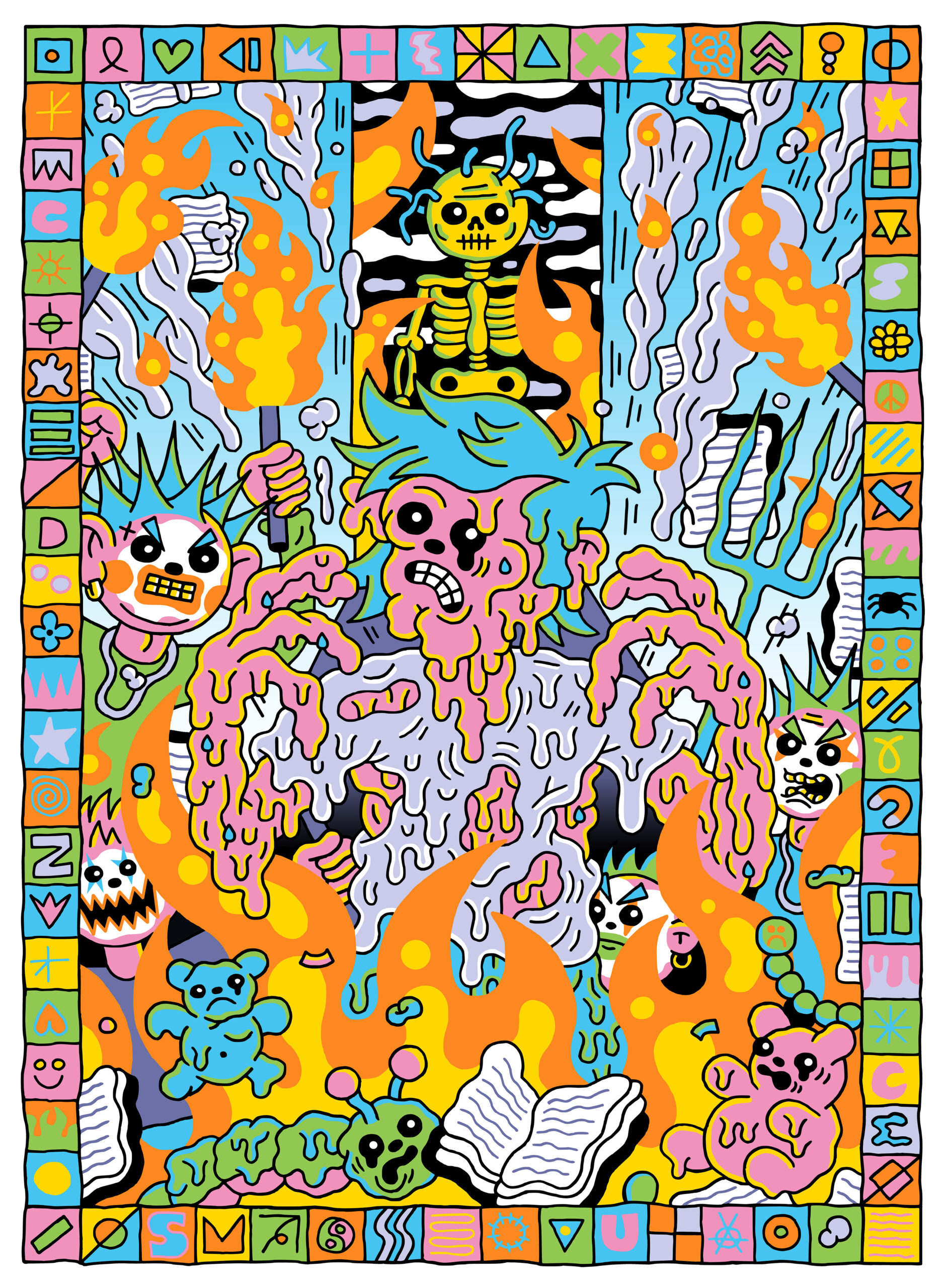
Reese left in an embarrassed hurry. It was just a stroke or two of bad luck, he told himself. But as soon as he passed through the glass door, he heard a voice call out, “That’s him!” He looked to his left and saw a throng of Hot Topic mannequins barreling toward him, holding torches. They were decked out in ripped jeans adorned with chain belts that clanked as they moved, but their clownish face makeup told him everything he needed to know: They were fans of funeralface, who wore the same ridiculous look on album covers and in photo shoots, with dramatic black circles around his eyes and a sloppy pentagram drawn with red lipstick on the left cheek. Reese retreated back into the bookstore, turning the lock behind him.
“Um, excuse me?” the blue-haired girl shouted from across the store.
“You don’t understand,” he said, running back toward her, hiding behind a bookshelf. “They’re coming after me.”
“Who?”
They were banging on the door now with the hands that weren’t holding torches. Their fists knocked hard against the glass. “It’s hard to explain,” he answered.
The blue-haired girl abandoned the counter and went over to the door. “Go away,” she yelled through the glass, but they ignored her. Reese could hear their chant from where he cowered. It went: “Torch him! Torch him!”
The blue-haired girl dialed 911 on her phone. As the operator asked for her location, the glass splintered. Fingers bled. Bodies scrambled. The door dwindled into shards, crunching under the rioters’ shoes. Reese was running through the vinyl section now. The shelves mostly held old jazz. Miles Davis, John Coltrane, Chet Baker. He halted for a moment. He realized he was dumb; Lauren loved Chet Baker. He should have gotten her the copy of Chet Baker Sings that was staring at him. She was a sucker for “I Fall in Love Too Easily.” He couldn’t deny its beauty either. He knew that tragedy wasn’t necessary to make good art, but there was heartbreak to Chet Baker’s voice and his life that undeniably enhanced the feeling of his music, how he added layers of sadness to old jazz standards and made them his own.
A feminine shriek disrupted his pleasant reverie—it certainly belonged to the blue-haired girl, but he didn’t have time to think. He took off again. Down the red carpet, he was now shooting through the section of new fiction that was on sale. This section always upset him, gave him secondhand embarrassment. He wanted to write a novel about an alcoholic music critic who gets drunk and leaks a major pop star’s album. But what if it ended up in this section because no one bought it? He stopped to take a look at the authors who were suffering from public humiliation on these shelves. He basked in his sense of superiority for a few seconds, despite never having attempted to write a book. It still felt good.
Reese felt the heat of the torches behind him. He dashed into the sprawling, cozy reading room. Stained glass art hung from the ceiling, couches were positioned into a semicircle, lamps offered an inoffensive orange radiance. Sometimes he spent full days losing himself in a book here. The other week he’d devoured a brilliant memoir that he thought obliterated the boundaries of modern literature—the kind of book that makes you realize there are no rules in writing. In his amazement, he’d looked up reviews of it online and found they were all scathing. The book was tacky, try-hard, critics argued. Reese wondered what their real problem was. Jealousy, he theorized. He had been infuriated, contemplating sending the critics a strongly worded email, when he remembered who he was and what he did.
Reese recalled that memory as he ran. He realized that he understood where the mob was coming from, but this information wasn’t exactly useful as they chased him with fire. He needed to think. He rounded a corner that led to a room of children’s books and slipped into a bathroom toward the back and locked it. He slumped against the door and heard the throng storm past. He’d lost them, at least temporarily.
Reese melted onto the cold tiles in defeat. He’d never thought it would get to this point. Sure, a fan once tweeted at him saying they wanted to skin him alive and wear his face as a Halloween mask. Sure, fans once spread rumors that he was dead and got #RIPReesetard trending. Sure, a fan once emailed him saying they were going to hold him hostage in their basement and only let him out for walks on a leash. Sure, a fan once posted on his mom’s Facebook page that her son was a waste of air and it was a shame she didn’t have enough money for the abortion she’d desperately needed. Sure, his mom then called him and asked him why he didn’t switch professions—it wasn’t like this one paid well anyway, were these horrid messages really worth it? Yes, Mom, he’d answered, it’s my passion. But he wasn’t quite sure if he meant it—if it really was his passion, or if at this point he persisted out of spite, because leaving it behind would look like giving up.
Reese would not give up. Even if he wasn’t necessarily as excited to write reviews as he once had been, he felt obligated to stand his ground, to reject the PR machine that journalism was becoming. Maybe it was his purpose. He remembered his first time loving an album: the soundtrack to The SpongeBob SquarePants Movie when he was six. He still stood by it. Along with oddball earworms “The Goofy Goober Song” and “The Best Day Ever” sung by the sponge himself, there were also gems from respected indie acts like Wilco and the Shins. It was a freak masterpiece. He also remembered his first time hating an album: His dad showed him the Doors’ L.A. Woman and ten-year-old Reese hated everything about it. Jim Morrison’s grating vocals, his arrogant attitude, his pretentious lyrics, his dramatic delivery. As for the guitars? They were always doing too much, desperate to evoke an atmosphere but only floundering. Same with the keys. But Reese would listen to the album, investigating his hatred, and the activity electrified him. He ended up with an appreciation for the band for helping him discover what he did and did not like about music.
Lauren hated the Doors too. It was one of the first things they bonded over. On their first date, the obnoxious intro of “Light My Fire” blared in the bar and Reese flinched and blurted, “I fucking hate the Doors,” to which Lauren said, “Me too.” He could tell from her tone that she wasn’t just blindly agreeing to try to impress him. Reese quickly realized she was an honest girl and never tried to be something she wasn’t, which was ironic considering she worked in marketing and her entire job was saying things she didn’t mean.
He rose from the floor, emboldened by nothing but ambition. Ambition was everything, he needed nothing else. He didn’t need a gang, a weapon, or a silly chant like these nerds. Fueled by his own values and confidence, he would knock some sense into these victims of groupthink. He would sway them in the right direction. He knew what it was like to be pissed off at an angry review of something he loved. He knew what it was like to want to defend something with his life. But he just had to convey to them that criticizing something negatively is also a way of respecting it. It’s a way of showing love. It’s a way of wanting better for everyone. He could do this, he was certain.
Reese unlocked the door. He found the horde wandering confused among the children’s books. Surrounded by artwork of colorful caterpillars and fluffy animals, he raised a finger, ready to launch into a speech. He didn’t yet know what the speech was, but it would be good. He would deliver a brilliant spiel that grappled with the complicated nature of love, the urge to defend what we hold dear, and the maternal instinct that art can sometimes bring upon us. It would supersede everything he’d written in his career thus far, and his enemies would become his admirers, transcribing his monologue so it could be printed in magazines, newspapers, and, eventually, textbooks.
But before a word could form in his throat, the rioters lurched onto him and toppled him to the ground, brought their torches to his face, his chest, his legs, his whole body as they held him down, roasting him as he flailed like a rebellious marshmallow. There was no hope for his escape. They’d already done the same to the blue-haired girl—who could no longer be referred to as such, as her hair was now nothing more than a pile of ashes—a sad case of collateral damage. They had a knack for burning people alive and leaving no traces of their identities behind, thanks to the makeup and the extravagant goth outfits. They each plucked out a tooth from his gums to keep as a souvenir; they’d put it on a funeralface-themed charm bracelet and show it off at the next concert.
The next day’s headlines read Controversial ‘Torch’ Critic Torched to Death. @funeralfaceofficial smugly tweeted a fire emoji. Fans celebrated by getting #ByeReesetard trending. Torch editors found another freelancer to pan albums. Andrea broke up with Ian Curtis’s ghost to flirt with Reese’s. Lauren—tragically giftless on her birthday—provided a floral arrangement for Reese’s funeral. The world spun on and on and on. 
Danielle Chelosky is a writer from New York. She is the author of Female Loneliness Epidemic, among other books.
Illustration: Sam Taylor
