News of Pancho’s death rattled feelings of nostalgia, wonder, along with damp disappointment and failures for the ventriloquist master’s old students, who’d all long since given up on the craft.
Fito found out it was by heart attack after Tam texted him: Pancho’s dead.
He was walking out of his shift at the library when he saw it and texted back: Paredes??
Not Villa for sure, Tam’s gray bubble replied.
Fito got home after a long commute and quick drink. He sat on a kitchen chair, set up his laptop, and did what he was accustomed to do when the wreck of abandoned dreams crunched his heart: He watched old videos of his alien-autopsy performances on the internet, some nearing twenty years old by now. Fito wore a hazmat suit in all recorded performances available. It amazed him every time he rewatched one how he could see himself under that darkened mask, looking upon the alien corpse he’d constructed, carefully clamping down the puppet, dissecting along the incision marks, the fake green blood oozing, trickling, and, with any luck, spraying. Fito used to play experimental synth music during these performances—that, along with gasps and nervous laughter from a ghost audience, were the only sounds in these streamed videos.
Pancho Paredes had taken Fito on as a pupil in his prestigious yet irregular ventriloquism workshop, even before the details of the performance were worked out. Pancho was initially skeptical of a fake-alien corpse being a puppet on a stage. Not one that sits on a knee, or walks and talks with strings attached, but a puppet that spasms and wheezes and cries a little during a fake autopsy. Part of what made Pancho a master ventriloquism instructor, however, was his ability to see his art as a growing organism, one that adapted alongside every age.
Fito could never forget that time backstage after his first performance before an audience, when Pancho, bottle of Coke in hand, commended his ability to throw slurps and gurgles from his own vocal cords over the loud music into the alien puppet. Pancho even called him “the quintessential ventriloquist for the paranoid digital era.” That was the type of encouragement from a mentor Fito never encountered again. For various reasons, all adding up to not being able to make enough money, Fito abandoned his dreams of being an avant-garde puppeteer and instead studied library sciences.
Tam was the only person in his cohort Fito kept in touch with, and through her learned the details of Pancho’s funeral.
Clouds from an early-morning storm parted over Valdez Funeral Home just as Fito and Tam arrived in a rideshare. A blown-up color photograph of Pancho wearing his purple-and-green suit and holding his famous puppet, Macario, greeted them upon entering. En route they’d been mostly quiet, so the first real conversation they had was about the scribbled notes tacked onto the wide corkboard in the vestibule written by schoolchildren from all over South Texas. Tam and Fito were surprised to discover that Pancho had performed his family-friendly routine in elementary schools until the end. When Pancho began his act, Macario would be a diva and refuse to come out of his case, Tam recalled. Macario would exclaim, “I’m not ready” in his high-pitched comedic voice, and Pancho would beg Macario to not embarrass him in front of such a fine audience, to come out so they could start their routine already. Pancho would then convince the enthralled schoolchildren that Macario would come out only if they all clapped and cheered really loudly. So that’s what the audience would do, and Macario would emerge triumphant from the case and begin cracking jokes about his misadventures with Pancho.
Fito and Tam hit the refreshments table and agreed it was remarkable Pancho had never rewritten his routine, so three generations of Texas schoolchildren had cracked up at the same jokes. They looked around for familiar faces and spotted Seanster leaning against a corner all alone across the room. Seanster had made a ton of money inventing a popular computer game in the early days of high-speed internet, and he’d donated seed money so Pancho could start his ventriloquism workshop and award scholarships to prospective students. Now Seanster wore a crumpled designer suit, and, despite his dark shades, his puffed face revealed to Tam and Fito he’d been crying. Fito tried not to react to the sour red wine from Seanster’s breath, while Tam noted a cheap pine scent coming from the suit, masking layers of dried sweat.
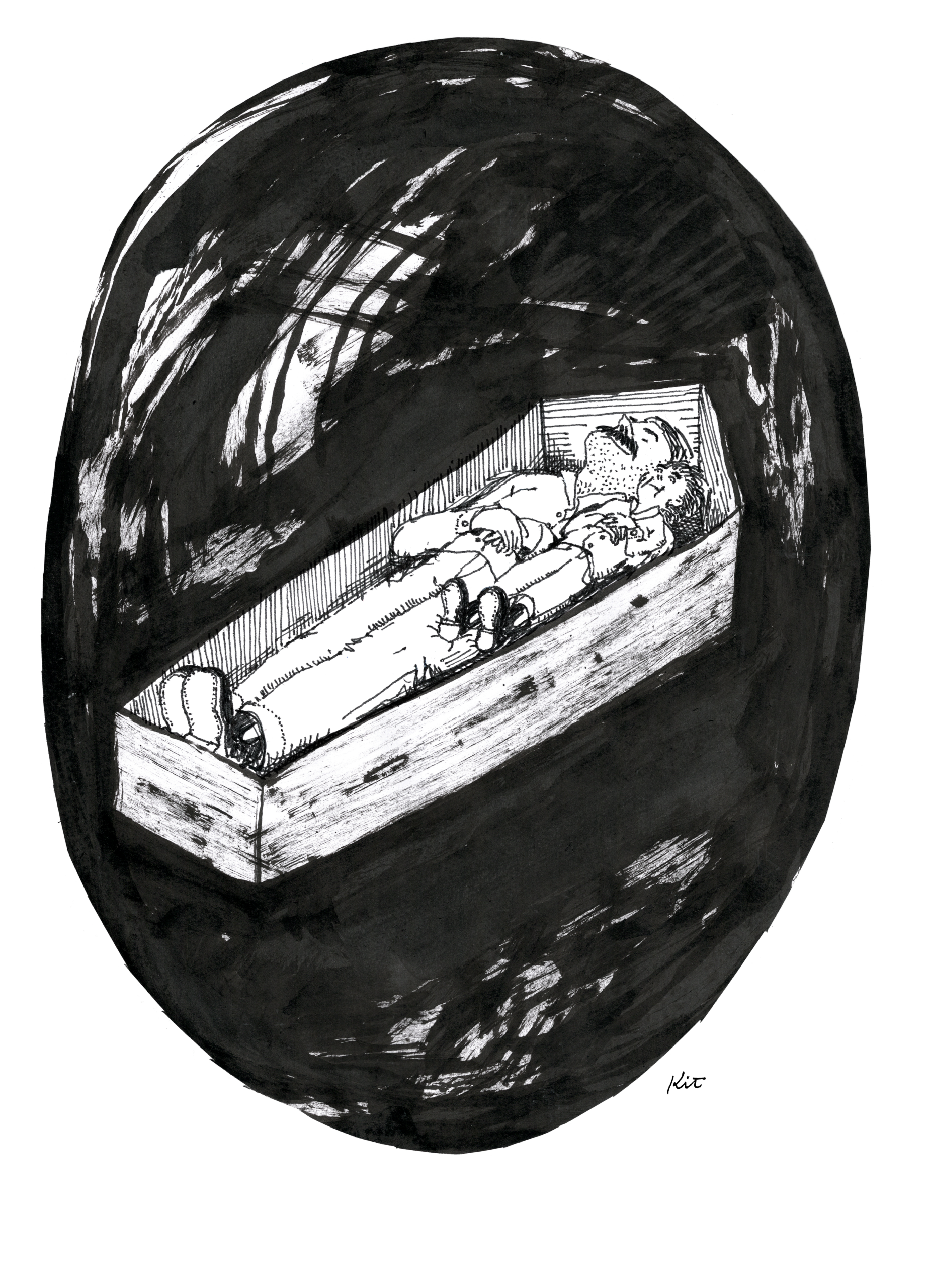
Seanster requested they follow him out by the hydrant, where he smoked a Gustav Gold while Tam and Fito watched and listened as he informed them that he’d nearly been kicked out. “Have you looked in the casket yet?” he asked. “It’s open. They got ’em both together, Pancho and Macario. I was much against it all along. No one listened. But Macario lying there face up, his eyes weren’t closing. It really bugged me. Everything about it. If a person dies, why should their puppet? Whatever. Pancho never had kids. His extended family all showed up. I didn’t mean to make a scene in front of them. I opened the case over the body to close Macario’s eyes. That’s it. People freaked on me. But I had to. Macario should be given a different home instead of below the ground. That puppet deserves it.”
He stubbed out the cigarette and stamped his feet into the building. Tam and Fito hung back and agreed Seanster looked unwell, wondered how he was holding up since losing his fortune to crypto. Out of everyone, Seanster was always closest to Pancho, so they understood that his grief was real. He led them toward a futon occupied by two other former classmates, the twins Elishah and Elijah.
Elishah and Elijah had been going back and forth about Seanster’s points. Elijah felt that burying Macario was mostly a symbolic gesture and didn’t see anything wrong with it, whereas Elishah could see everyone’s point but didn’t have a firm opinion on the matter. “I mean,” she said, “none of us are ventriloquists anymore, right? We studied under Pancho, but we didn’t follow through. It’s fine—we all got our own things—but what happened to our old puppets? Who are we to judge?”
A long line formed for mourners to pay their final respects to the regionally famous ventriloquist Pancho Paredes, along with his comedic partner and creation Macario.
Seanster separated from the cohort, got in line to view the open casket, then everyone else followed. The visitation was reaching its third hour, and more people were showing up. Surprisingly, not many children were in attendance, which inspired our group to muse philosophically that everyone there had once been a child full of that wonder Pancho encouraged not only in his students, but in his performances, in his day-to-day life.
“A big funeral for a ventriloquist may be the rarest of things,” Elishah said. “But here we are.”
The two armed guards must have been watching Seanster because as soon as it was his turn at the casket and he reached to take Macario, he was wrestled to the ground. Mourners reacted in disbelief. “Don’t bail me out,” he said to Tam as he was cuffed and escorted out.
The line to the open casket continued. Elishah and Elijah each took selfies in front of Pancho and Macario at their turn. Fito and Tam stood over Pancho’s deceased body and Macario and held hands. They could see Seanster hadn’t fully succeeded in closing Macario’s eyes; they were three-fourths shut so he appeared merely sleepy or stoned. “He’s not ready,” Fito said to himself, evoking the puppet’s first lines in Pancho’s routine, but he found the joke too soon to share with anyone.
The old cohort stayed until the end, trying to mingle or reminiscing about classmates they never kept up with. An older woman in a wheelchair reminded Elishah that Pancho never used the word dummy when talking about a ventriloquist’s puppet; he reserved that word for humans. Fito and Tam smiled at each other in agreement. Since nobody recognized other old students from Pancho Paredes’s Ventriloquism Workshop and Seanster had been arrested, the cohort of four agreed to continue the conversation at Delia’s down the road. Once there, Elijah broached the subject of their puppets. Elishah admitted that the sight of Macario beside Pancho’s powdered deceased face was unexpectedly more than she could bear.
Tam and Fito had forgotten the way the twins spoke—their parents were both classicists—so they paid careful attention when Elijah carried on: “My puppet was born in a grim place at a grim time and brought a grimness so grim I dare not even speak the puppet’s name. For it was built from the flora and soil of these borderlands. Y’all remember the twigs, leaves, weeds mixed with the soil-clay solution to create my baby. It never could make the kids laugh. Nobody except Pancho understood, that was the point. Not even my sister. The soil reminding you it’s a living thing in your image. That’s what puppetry was to me. It’s different for all of us. We didn’t play many shows, my puppet and I, but in our own way we killed. As an encore the puppet would be at stage right, me stage left, and we’d walk backwards to each other—the puppet would fall into my arms. What a closer, right? Not sure people knew what to make of that. I had to let it go at the beach. Saw something similar happen in a black-and-white monster movie. We made a whole ritual out of it in South Padre Island. The puppet had a small feast and we parted. Puppet walked into the ocean and I back here.”
Elishah salted her steamed spinach. Due to the mournful occasion, she let the slight dig at her slide. Everyone assumed she was following her brother, so Elishah said, “Sometimes I miss my Nettie. I have no problem saying her name. We’re not together through no fault of my own. She knows what she did. When Nettie came into my life, I could not live anywhere. Noise complaints were never too far behind. Nettie and I left a trail of terminated leases and neighbors who had it up to here. She was hard of hearing, and always playing those recorded soap operas on her VHS. Blaring the same four or five episodes that she obsessed over. For some reason we could never put together an act. It was hard to see what she even found funny. This isn’t a space opera. A puppet without a sense of humor in this frail business is a dead fish. You gotta keep the parents and the kids laughing. Nettie wasn’t that. Some puppets are just meant to be closet puppets. Not stage puppets, or even street puppets. Pancho would tell us that, remember? What was I supposed to do? I took her to the Goodwill by the used bookstore and left her atop an upright piano someone was donating. We hated each other from the beginning, so I could tell there were no hard feelings.”
When it came to Tam, her phone got a repeated call from the same number, so she answered and excused herself from the table. Everyone already knew Tam’s history well anyway, since she was the only of Pancho’s ventriloquist students who did not ever have a puppet yet graduated with his highest accolades. As a young girl, when her family first moved to America, Tam would go into wild hysterics every night she reached REM in her slumber. Her family dealt with it in various creative ways, by soundproofing, earplugs, therapists, until one day a documentary about Lebanese puppet designers inspired her to learn about the artform. Tam was 16 when she joined Pancho’s workshop as both ventriloquist and puppet. The craft and philosophy behind ventriloquism brought Tam down from her fog and helped keep her other puppet self at bay.
Tam returned from her call and the server brought the check. “I’ve been in charge of the bat hospital since the head guy’s been at a big job in Fort Worth. Gotta hit up Gonzales Elementary—the library there’s got a bat.” She invited everyone to tag along. They paid the bill, then rode together in Tam’s van as Fito explained to everyone the expenses and complications that went into constructing a dead-alien puppet with insides and juices that could appear real to an attentive audience.
There wasn’t a single cloud in the blue clammy sky. A patrol car got around them and the van hit red lights all the way to the other side of the highway. Elijah and Elishah, Tam and Fito regretted what had happened to Seanster and discussed the visitation, were all glad Pancho would be buried in his purple-and-green suit. Discussed Macario and his not-quite-shut eyes. Maybe supplicating. Yearning. A real kick in the ass.
As Tam parked and they stepped out of the van, she pointed to some bare palm trees and a bushy one by the library. “You see those fronds on that one?” she asked, carrying a flashlight, gloves, and a threaded cage to the school’s entrance. “You’re not supposed to cut palm tree fronds around here. It’s the only place where bats and certain birds mate. Most people cut ’em because they think it looks nice. But you’re not supposed to. There’s probably a bunch of bats clustered in that one untrimmed one, when they should be scattered everywhere.”
Tam was greeted by the vice principal, and as they all walked down the hall, she introduced her old ventriloquism cohort as potential volunteers at the bat hospital there to witness the safe removal of a bat. “You’re all wearing dark clothes—I like that,” the vice principal said. “The bat finds its way out, usually. It’s hard to know when she’s around, unless she’s flying. The librarians named her Mary Shelley, since we consistently find her in the literature section. It scares a few students. But most think she’s cute, and they’ve all seen videos on their phones of people touching them. So we don’t want that. Very grateful y’all came. It took us a while to even know who to call . . .”
At the library, the librarian who’d named the bat escorted everyone to the literature corner by some tall red velvet curtains and a loud water fountain. Tam set down the threaded cage, put on black nitrile examination gloves, and preached about the palm tree fronds.
The librarian pointed to the red spongy curtains. “She likes it there.”
“I’m sure she does,” Tam said, approaching the thick curtain folds. She uncurled the right side, and everyone stood a few feet behind helping survey it against the flow of daylight. She opened the left side wide and stepped into it so that it covered her body. Then her left hand peeked out to signal everyone over. Tam opened the red velvet curtain. Just above her head at arm’s reach was what looked like a fuzzy orange with bald wings hooked to the curtain. A bat no bigger than a billiard ball. The bat opened her sleepy dotted eyes, revealed her pointed ears, snapped her little mouth open and shut three or four times. Her tiny teeth suddenly ready to tell a joke. Gleaming.
Fernando A. Flores was born in Reynosa, Tamaulipas, Mexico, and grew up in the Rio Grande Valley. He is the author of the collections Death to the Bullshit Artists of South Texas and Valleyesque, along with the novels Tears of the Trufflepig and Brother Brontë, which was one of Kirkus’s Best Fiction Books of 2025. He lives in Austin.
Illustration: Kit Schluter
