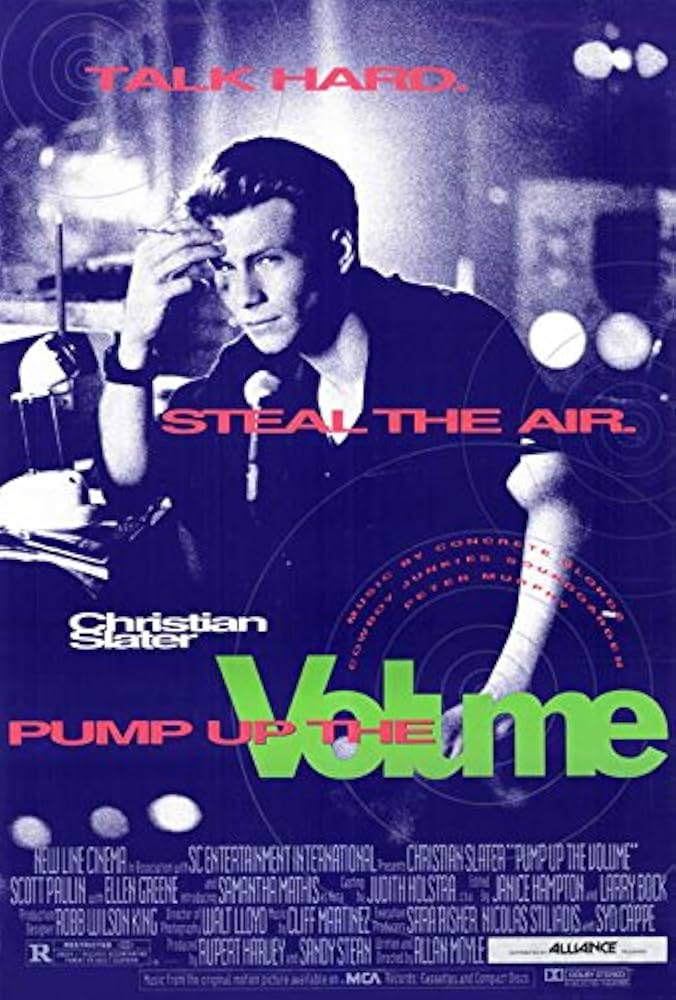
Needle Drops is a column that asks writers about—you guessed it—their all-time favorite needle drops. In this edition, William Boyle remembers Leonard Cohen’s “Everybody Knows” from Allan Moyle’s 1990 film Pump Up the Volume.
“Everybody knows that the dice are loaded . . .”
You’re twelve when you rent Allan Moyle’s Pump Up the Volume. It’s mid-March 1991, and it’s just come out on home video. You don’t know anything about it, but you’re a fan of Christian Slater from Gleaming the Cube and Heathers, and he’s what draws you in. It’s a Wednesday after school, and you commandeer the VCR and TV in your grandparents’ living room and fight off intrusions from your Italian grandma, who is hawking around and wants to know what the movie’s rated and if it’s inappropriate for a kid your age. At around the 3:48 mark, Slater’s pirate-radio deejay character, Mark Hunter, drops the needle on Leonard Cohen’s “Everybody Knows.” This is before we know about Mark, an East Coast kid who has recently relocated to the Arizona suburbs, or the hothouse high school world he exists in and the persona, Happy Harry Hard-On, he’s created to survive. “Everybody Knows” functions as a theme song for Mark’s nightly show, and it identifies his perspective on the world before we even hear him say much.
Twelve is a big year for you. In a few months, you’ll rent Stephen Frears’s adaptation of The Grifters and then you’ll buy and read the Jim Thompson novel it’s based on. Soon after that, you’ll rent David Lynch’s Blue Velvet. In six short months, Nirvana will release Nevermind, and you’ll dump all your hair metal tapes into a garbage can on the corner of your block. This is the run of art encounters that rewire you, that switch your brain fully, that you’re still driven by. It all starts right here, in this moment with Cohen’s voice. The words he’s talk-singing. You’ve never heard anything like it.
“Everybody Knows” is five minutes and thirty-six seconds long. Cohen wrote it with his backup singer and collaborator Sharon Robinson. It appears on his 1988 album I’m Your Man, an album you won’t buy and listen to in its entirety until you’re a freshman in college, at which point—along with Tom Waits’s Small Change—it will dictate your identity. Cohen was bummed in the years following his 1984 album Various Positions, which received a lukewarm reception (though it features what would become, many years later, his most well-known song, “Hallelujah”). He was feeling resigned and cynical, leaning toward retiring from music and joining a monastery.
Cohen is a Canadian, but it’s hard not to think about “Everybody Knows” as an anthem for the death of the American dream, something that Pump Up the Volume taps into beautifully. Of course, writer/director Allan Moyle is also Canadian, but it often takes an outsider’s eye to show us what we are, what we’ve become. The song is featured twice more in the first forty minutes of the film, drifts in for a moment late in the action, and then Concrete Blonde’s cover of it (which was featured on the iconic soundtrack, not Cohen’s original) has a pivotal role in the homestretch. That first needle drop—when it plays over the credits—is a beauty, but the song is threaded throughout in a way that accentuates its purpose, its meaning. “Everybody Knows” is a thesis statement of sorts. Pump Up the Volume riffs on its dark themes. The dice are loaded. The boat is sinking. The good guys have lost. We are fucked. Nothing to do but fight with what you’ve got. The movie, to its great credit, doesn’t ever yield from this outlook. There is no sunny resolution. Though there is a romance between Mark/Harry and Samantha Mathis’s Nora Diniro, aka “Poetry Lady” or the “Eat Me, Beat Me Lady,” love doesn’t save the day. The goal is simply finding the people who feel like you do, who want to confront the truth, who don’t want to turn tail and hide from it, don’t want to bury it under houses that look alike and façades of success. The cast of high school outcasts make a last stand. In its way, strangely enough, Pump Up the Volume has the heart of a Western: The good guys refuse to buy the lie, no matter the cost.
At twelve, this is a revelation, like uncovering some truth you’ve felt building but haven’t been able to articulate. Pump Up the Volume and “Everybody Knows” crack open the world. Society is rotten to its core. You’re being lied to. The routines and the rituals are bullshit. It’s a broken world, getting more broken every day. Your words matter. Expressing how you feel matters. You’re moved. And, yes, you’re in love with Nora Diniro. She knows. And you’re in love with Cohen’s voice. If only you could sand the southern Brooklyn out of your voice, the barbed wire and concrete. If only you could sound like him, like the voice of the wind carving valleys through the earth.
You watch the movie that first time, and you’re wrecked by it. After dinner, when you go home to the apartment you share with your mom, you watch it again. The next day after school, you take your mom’s VCR to your grandparents’ house and steal a blank Maxell VHS tape from your grandma’s stash, and you connect the VCRs and dub a copy of Pump Up the Volume before you return it to the video store. It is this copy you’ll watch almost every day for the next four years, your handwriting on the front sticker spelling out the title in a way meant to duplicate the writing in the opening credits, the tracking getting wonky, the shell of the VHS tape wearing out.
At Sam Goody, you buy the soundtrack on cassette. You listen to the Concrete Blonde cover of “Everybody Knows” repeatedly, and it’s great—Johnette Napolitano’s voice is a different kind of dream—but it somehow lacks the dark wisdom of the Cohen original. You write letters to Nora Diniro. You write bad poems that rip off the lyrics. When you graduate high school, under your yearbook photo, there’s a quote from “Everybody Knows.” This is true. Or maybe it’s not. Maybe your memory is simply a ghost of living in the movie.
You still go back to that first moment often: Mark dropping the needle, “Everybody Knows” kicking in, a tenderhearted kid getting your world rocked. Now you’re so much older, and you live in the future. You could be one of the teachers at the school. You’re haunted by your silence, your retreat, your age. That’s how it goes.
William Boyle is the author of eight books set in and around the southern Brooklyn neighborhood of Gravesend, where he was born and raised. His most recent novel is Saint of the Narrows Street, available from Soho Crime. His books have been nominated for the Hammett Prize, the John Creasey (New Blood) Dagger Award in the UK, and the Grand Prix de Littérature Policière in France. He writes an online film column for Southwest Review called I Wake Up Streaming, and he coedited (with Claudia Piñeiro and Frances Riddle) the noir issue (108.3) of the print magazine. He lives in Oxford, Mississippi.
