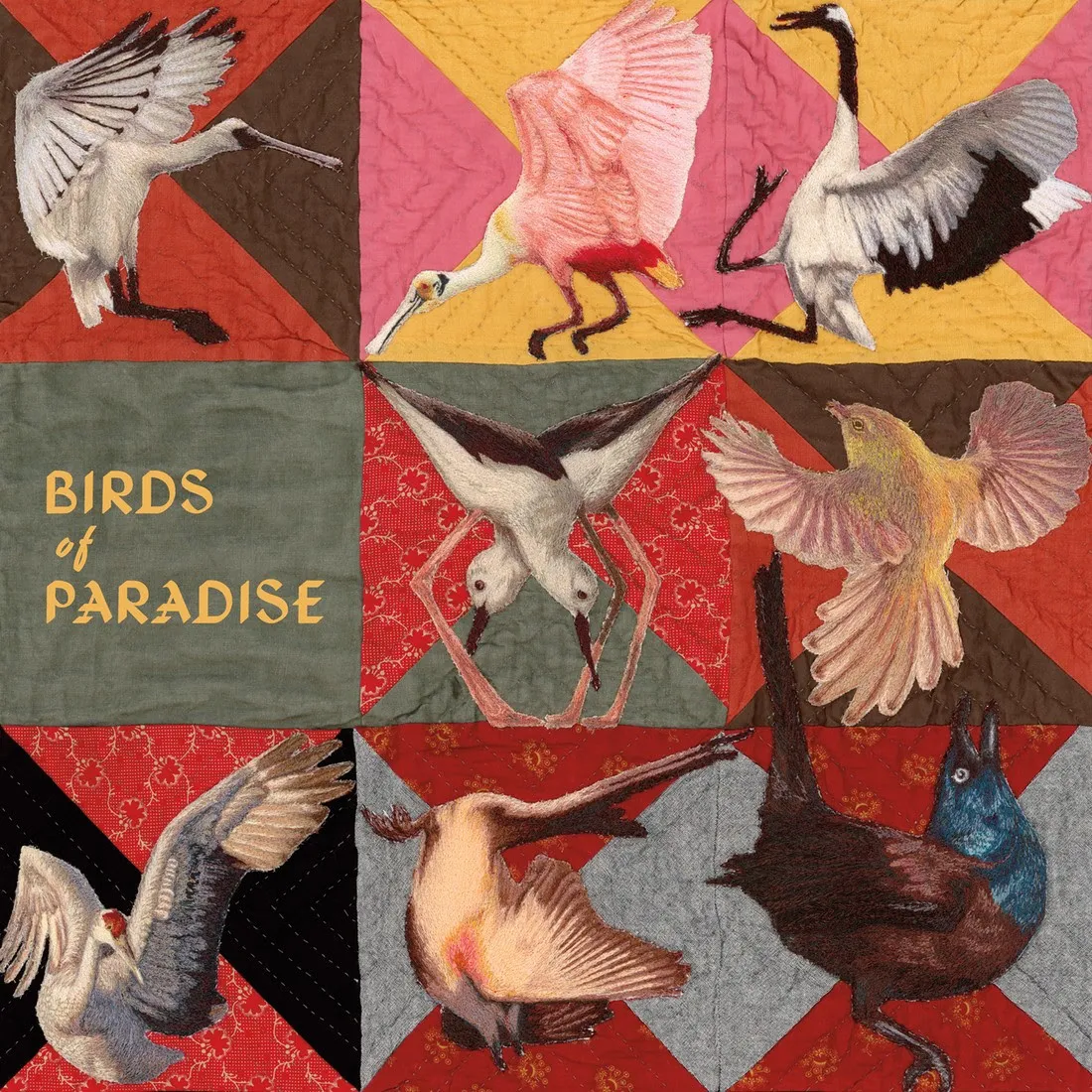
The Guest List is a regular book column that surveys the reading habits of our favorite musicians. In this edition, Ashleigh Bryant Phillips talks with Thomas Dollbaum. His new album, Birds of Paradise, is out now from Dear Life Records.
Ashleigh Bryant Phillips: What are you reading right now?
 Thomas Dollbaum: I’m always revisiting poetry books. I just flip through; I don’t read them front to back. It’s just hard for me to read a poetry collection straight through because there’s a lot to gather.
ABP: I read short story collections the same way. I don’t ever read them all the way through. I find a story that I get obsessed with and I read it over and over and over. And then I might not read anything else in the whole book.
TD: That’s how I am with Raymond Carver.
ABP: Any stories of his that stick out to you?
TD: There’s two. “The Third Thing That Killed My Father Off.”
ABP: I don’t know that one.
TD: This guy fills a bass pond up and he’s kind of slow. And his wife is sleeping with everyone around town. And so he’s upset about it. It’s all a big extended metaphor, because he’s not letting anybody fish on his pond. It’s the only thing he’s got control of. It’s really kind of heartbreaking.
ABP: Damn.
TD: And then the other Carver story that’s always stuck with me is “Bicycles, Muscles, Cigarettes.” These two kids steal a bike. And the dad goes and confronts the other dad and it ends up in a fist fight. Have you read that one?
ABP: No, I haven’t read that one either.
TD: That last scene in it is crazy because the kids are going to bed and the dad’s just had this really embarrassing fight with another father about a bike getting stolen in the neighborhood. And then he comes home and his son meets him and says something like, “Was Grandpa strong like you, Dad?” And then the dad walks out of his son’s room, talking about his own father. Raymond Carver’s so good at leaving these little moments for you to be like, “Damn, that’s such an intense scene.”
ABP: And also, I feel like he’s so good at dialogue and just letting people talk. It makes sense to me with your songwriting that you’ve read Raymond Carver.
TD: Yeah, he’s a pretty big influence on me in general. His stories might have different subject matter than my songs, but my songs are similar in that they look at slices of life.
ABP: Let’s go back to poetry. You said you’d been revisiting some collections, flipping through.
TD: Yeah, I’ve been revisiting Philip Levine. His collection What Work Is is the kind of poetry I’m really into. And I’ve been reading the Polish poet Wisława Szymborska.
ABP: How did you find her work?
TD: It started with me reading her poem “The End and the Beginning.” She grew up during World War II in Poland and it was pretty terrible. And that poem is about how after war you have to just clean up and do the day-to-day. Now I’ve got two different books of hers, two different translations. I think she only wrote like 120 poems or something like that. But they’re all very succinct, really tight. And she likes to focus on these really mundane things, you know, like a grain of sand. And she’ll explore a grain of sand in a way that’s so intense. The way she looks at the world is really interesting to me, her attention to detail. The reason I love reading and writing is, it’ll expose you to something that you didn’t see.
ABP: Were you reading Szymborska while writing Birds of Paradise?
TD: Yeah. But another book I want to mention that I was really into while I was working on the album is Still Life by Jay Hopler. It’s one of my favorite poetry books. He was my old professor, and I think he only wrote three books. And they’re all good, but the last one, Still Life, he wrote after he found out he had inoperable cancer. You can feel him saying, “I’ve got one more in me.” There are these meditations on dying, but they’re magical. And he lived in Florida, so a lot of the poems are about the natural world. And there’s this really cool poem that starts the collection: A composer composes a poem of his life, so the first thing you see when you open the book is music notations. It’s so immediate. He’d already died by the time I read it, and I didn’t even know. A friend of mine said, “Did you hear about Hopler?” And I was like, “No, Jesus Christ.” But now through his work, I can still access him.
ABP: Did you have Hopler in your MFA?
TD: No, just my undergrad, but he’s the one who pushed me to do poetry.
ABP: Oh, whoa.
TD: Still Life is incredible. I’m definitely influenced by the way he writes. It’s very much like . . . did you ever read James Tate?
ABP: Yes. I know James Tate.
TD: I love James Tate. And Hopler’s the one who showed me Tate and all those surrealist poets.
ABP: When you were writing Birds of Paradise, did you find yourself trying to replicate anything Hopler was doing in Still Life?
TD: Not that I can think of, but a lot of times I’ll read poems just to get my mind writing again. ‘Cause if I’m trying to write a song and I don’t really have anything lyrics-wise, I’ll just pick up a poetry book. I like keeping five or six poetry books to get me in the songwriting mindset. If I’m not reading, then it’s almost impossible for me to write.
ABP: Exactly. So what else would have been in your stack for Birds of Paradise?
TD: I was reading some Joy Harjo, How We Became Human. Then sometimes I would read some of C. D. Wright’s One with Others. She’s pretty incredible. And I always keep James Tate around because his poems are great resets. They pull you out of your normal thinking.
ABP: Do you have any favorite poems of his?
TD: I love “The Cowboy” for a prose poem. He wrote that a little later. Some of his later prose poems, some of them are two pages. You think, “Is this a poem at this point?” But, his first collection, The Lost Pilot, is interesting to me because a lot of the poems aren’t as developed. In that collection he does sets of three lines . . .
ABP: You know it better than I do.
TD: Yeah, but I’m digging deep. I haven’t been in school in a while.
ABP: This isn’t book-related, but one of my favorite songs from your new album is “Rabbits.” It’s like a short story, told from the point-of-view of a kid down near Lake Okeechobee. And I know that it was inspired by a documentary . . .
TD: Yeah, The Rabbit Hunt. There’s this town in Florida called Muck City, where some of the best football players come from after spending their youth chasing rabbits. It’s a great short documentary. The imagery got me writing.
ABP: Yeah! Are there any other documentaries that inspired Birds of Paradise?
TD: My favorite documentary I go to all the time is called Vernon, Florida. And it’s an Errol Morris documentary. Basically, back in the early ’90s or ’80s, this town in Florida had the highest rate of farming accidents. These people in the town were cutting their limbs off, getting settlements. So Errol Morris went down there and when he got there, the people in town were like, “Yeah, you’re not doing a documentary on this. We’ll kill you.” So then Morris just filmed the people he met in town, the people he saw, and they’re just happy to talk. It’s just a beautiful documentary. There’s this one guy who remembers every turkey he’s ever killed. And then the only police officer in town, he’s like, “Yeah, I just wait here all day to see if somebody goes over the speed limit.” Morris just captures these weird little moments. And there’s really great landscape shots too. It’s only like 45 to 50 minutes or something. But yeah, I love that documentary.
ABP: Do you have any favorite bookstores?
TD: Good bookstores are getting harder to find because the only way they’re gonna be viable is selling bestsellers, you know, Where the Crawdaddies Sing kind of stuff. I like the bookstores that look like they’re about to close. You know what I mean?
ABP: Hell, yeah.
TD: My favorite one in Florida, where I grew up, is Mojo’s Books & Music. That bookstore was my favorite place in Tampa because it was a record store with great used books. But the last bookstore I went to that was really cool is Kaboom in Houston.
ABP: Remember when we were talking about Birds of Paradise a couple months ago and you mentioned a photography book you loved . . .
TD: A Particular Paradise by Nathan Benn. That book is really amazing. Photography from like ’80s to ’90s Florida that I really like. I’m always flipping through and finding scenes.
ABP: Any books SwR readers have to pick up immediately?
TD: Definitely Still Life by Jay Hopler. Also a buddy of mine—we went to school together—David Sanchez wrote a book, All Day Is a Long Time. And I love it. A lot of times I have a problem with drug-addiction books because they’re like, “This is raw,” or they make drug use seem cool or something. And I think Sanchez does a really good job of delving a little deeper. He has a really good chapter in the book about the main character going from the library to the place he’s having to stay to the place where he’s getting drugs and how it’s this huge triangle. And the main character starts reading about triangles in the library and it all just becomes this big blend of reality and imagination. I’d say pick that up.
Ashleigh Bryant Phillips is the author of Sleepovers. Her stories appear in The Paris Review, Oxford American, and Southwest Review.
