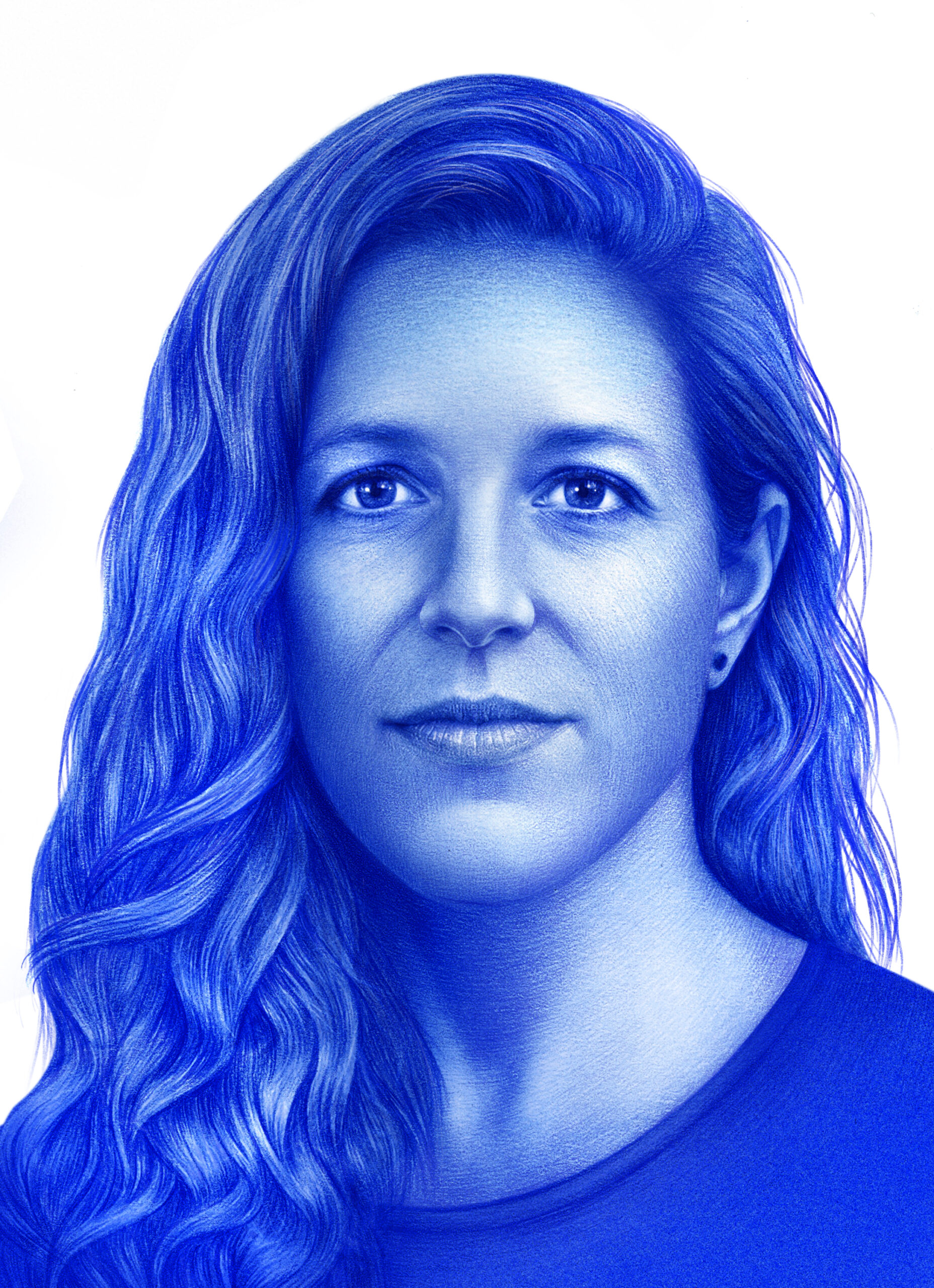
“I wrote the three novels with a spirit of vengeance” is the first line that Ariana Harwicz wrote for La Trilogía de la Pasión (Passion Trilogy), the Spanish edition that comprises her three novels: Matate, amor (Die, My Love), La débil mental (Feebleminded), and Precoz (Precocious). For Harwicz, literature has the ability to provoke and rebel, to fascinate and frighten, to roll language over, to transgress.
Fourteen years ago, Ariana furiously wrote Die, My Love, a novel about the alienation of a young mother who must take care of her baby with a husband who, lost in the marital routine, finds it difficult to connect with his wife’s emotions. The entire novel—fragmentary, at moments chaotic, and undoubtedly hypnotic—takes place in the French countryside. Family ties, desire, violence, bodies in tension all form part of a story that leaves the reader shaken. And though the novel took some time to appear in bookstores, after initially being rejected by Argentine and Spanish publishers, once on the shelves it resonated with readers around the world. One of those readers, Martin Scorsese, acquired the rights to the book and produced the 2025 film adaptation, directed by Lynne Ramsay and starring Jennifer Lawrence.
I met Harwicz during the hustle and bustle of the Guadalajara International Book Fair in 2022. A year later, she accepted my invitation to present her novel Feebleminded in Saltillo, the city in Northern Mexico where I’ve lived for many years. Although brief, during this visit we were able to talk about what was next for Die, My Love, as well as other literary projects, over a barbecue with Nona Fernández and Brenda Navarro. This interview is a sort of continuation of that long conversation we began three years ago and completed last November through email messages and WhatsApp calls.
Sylvia Georgina Estrada: When you began to write the novels, did you realize you were developing a series, La Trilogía de la Pasión? Or did the stories of these family ties weave with each other naturally?
Ariana Harwicz: Before we gathered the three novels into a single volume, which was published in Argentina by Mar Dulce and by Anagrama in Spain, I didn’t have the idea of joining them together, or of calling them a trilogy. I wasn’t aware that they form a group, a very close family, and that really they’re like photographs from a family album. I wasn’t aware of that, or of the form, style, music, not even the theme.
Ultimately it’s obvious, but when you write, you are not aware of everything, of many things, and that lack of awareness is fundamental. There must be a moment of mystery. And so, it was something that happened post-reading, when the similarities began to emerge like a game of resemblances.
SGE: It seems to me that a point of union between the three novels are the characters, who are not part of what is considered normal—rather, they are marginalized, somewhat unbalanced. Perhaps the idea is that these characters are not what others believe they should be.
AH: It’s true. When I write, I’m not aware of their abnormal condition, of how extreme they are, how pathological. Alienated or not, they’re included in society, but they’re misfits. When I’m writing, they seem normal in their madness. They consider themselves more normal than their neighbors, but they aren’t. There is an inadequacy between them and the world.
I always work within that inadequacy. My characters don’t fit in the world, don’t function normally. They don’t understand the world and the world hates them, rejects them, abhors them. I simply observe human beings: I see cases of violence and crime, and I try to think about how a human being turns to that. That’s where the characters come from—the extremes of being human.
SGE: In Die, My Love, you explore the dark side of motherhood, which isn’t talked about as much. Motherhood isn’t easy; it’s not always beautiful and pleasant. Now there are many novels about motherhood, in Spanish and in other languages, but when you wrote this novel, there weren’t as many published yet.
AH: The journey has been intense. Die, My Love is over 10 years old. Of course, there are books that last centuries, but the decade-long adventure that my book has gone through is a reflection of social and political change. When I wrote it, I wasn’t thinking about feminism. If I had, the book wouldn’t have been any good. I simply wrote it like many do, out of desperation.
At first the novel was rejected. It was too eccentric. It was a book that bothered women, a book that was stigmatized—as though I’d worked with murderous mothers, or mothers who hate and reject their children. That was never the case. Ni uno menos [Not one less] happened in 2015, and so this was before that. Argentina was different, with different kinds of books being published. Women’s place in literature was already entrenched, of course; it’s true, though, there were not as many books on motherhood. But then the understanding of the book, its exegesis, changed, as often happens with any work when it impacts society. When the ways of reading changed, it became another kind of book. When it finally reached Spanish, Argentine, and later Latin American readers, they were different readers. There was a different consciousness.
SGE: In your books there are tense and violent relationships that place the characters—and readers—in provocative situations. Is there anything in particular that triggers your interest in this theme?
AH: I always struggle to think and talk about violence—as though violence is something separate from human relationships. As though violence is in one corner and human relationships are in another, or love on one side and violence on the other. When really it’s indivisible. Violence is inherent in feelings, in love, in jealousy, in possession. What is there that is completely free of violence? Nothing; it all goes together. I observe a scene—ducks on a lake, a family that goes outside in the middle of winter—and there’s always potential for violence. Everything engenders violence.
SGE: In an interview you mentioned that literature exists on a different plane of reality than the one on which we move. Now comes a time of political correctness where books and writers are canceled on social media not only for their public discourse, but for the themes their work approaches, too.
AH: We shouldn’t mix things up; we shouldn’t place them on the same plane and deliberately make an amalgamation of the author and their books. I am not my work. What a work of art says is not the same as what the artist thinks ideologically or politically about the war in Russia, or about machismo. I love politics, and since I love politics, if someone asks me what I think about Putin, Ukraine, or femicides, I’ll answer the question. But I don’t make my characters say what I think.
We should always separate the figure of the writer from their work, because if not, the author gets blamed for things a character says, or they’re venerated like gods because they have characters who are righteous, even though, maybe, the author is a corrupt person, or a discriminatory one. Sometimes a book contradicts the political opinion of the author. If it weren’t this way, it would be very simple for our books to be our representatives, but a book is not a spokesperson.
SGE: In Feebleminded, there is an organic, almost animal relationship between the mother and daughter. Their feelings are rendered without filters. There are those who say these characters suffer, precisely, from mental illness.
AH: There’s a tendency to pathologize. In the same way that a writer isn’t a politician or a political spokesperson, we aren’t psychiatrists, social workers, or family court judges. I refuse—no matter if it’s written on a back cover or in a prologue—I refuse to think of my female characters from a place of criminal categorization. Perverse, incestuous, crazy, unbalanced, unstable. These are all epithets, categories that don’t help when thinking about the whole dimension of a character.
What I say is obvious, but nowadays that contradiction, that complexity isn’t fashionable. A character has to be good and bad at the same time, innocent and guilty, extremely violent and yet also submissive. We’re all like that. We tend to diagnose characters using categories of health-related behaviors, but this is a book, not a hospital.
SGE: Die, My Love has won awards, been translated into several languages, and now has been adapted for the big screen with Martin Scorsese as producer and Lynne Ramsay as director. What’s that been like for you?
AH: I was very patient, I waited for the pitch that was most interesting to me, the one that did it justice, that honored it. Obviously, it is crazy. But then again, I self-published in Argentina, and in Spain I began with an independent press, and then spent many years with a single translation into Hebrew. The English translation came out in 2018; then, with the Booker Prize nomination in 2018, the other twenty languages arrived. Sometimes that’s the path: A book gets rejected so many times, until it doesn’t.
The path is very long, like an entire lifetime inside a lifetime. Whatever kind of work—a novel, an opera, a play—they all have a long life from conception until birth, and later if they can find an audience. Sometimes the work disappears and later reappears. There are many lives and temporalities. I was told my novel was impossible to translate, unadaptable. Later it was proven that it could be translated, that it could be adapted. It seems to me that it’s not a work exclusive to its time.
SGE: Just like you said, many things have happened during these years: the new wave of feminism, Me Too, the legalization of abortion in several countries, including Argentina, a greater platform for women in the publishing industry. Has this influenced your writing in any way, or the themes you approach, the ways you explore them?
AH: It influenced me in that I try, anyway, to never give in to the temptation of writing a book—not even a line—to please that place won by women in the industry, in the market, in the literary field, and in art in general. I try not to take advantage of that—not because it’s wrong, but because if you write a book of women’s stories just to fish for editors or advances . . . literature should be bulletproof to economic speculation. I’m not writing a book with a heroine from Greek mythology, thinking it might garner editorial interest so Netflix or Amazon will buy it. I’m aware of it, but I try to write the truest thing I can, knowing that later I’ll reach women at bookfairs, on the radio, or through an interview that many people will eventually read. Not giving in to the temptation of what’s easy, taking the most difficult path—that’s what an artist does. There is no other way; they must forge their own path.
SGE: You’ve been living in France since 2007. In terms of language, but also of politics and social relationships, how has that distancing worked when you’re writing?
AH: It has influenced me very much because I really began writing in France. I completed my studies, made documentaries, short films, small theater plays in Argentina before I left, but all my novels, my entire path in literature, really, was paved from the outside.
I always say that I don’t know if I would have written in Buenos Aires. Thinking about Argentine violence, about Argentine history, about the use of our language—it was much more interesting to do from the outside because I have a more interesting mirror to look into, a rearview mirror. I appreciate Argentina much more from a distance. All the details appear to me, all the contrasts—in our history, in our language—everything becomes estranged. This exile of mine consists of writing.
Ariana Harwicz is one of the most radical figures in contemporary Argentinian literature. Her “involuntary” trilogy of books comprises Die, My Love, Feebleminded, and Tender. Die, My Love was longlisted for the Man Booker International Prize (2018) and shortlisted for the Republic of Consciousness Prize (2018), and has been translated into more than 10 languages.
Sylvia Georgina Estrada is a Mexican writer, cultural journalist, and editor. Her most recent book is Músicas. She is an associate editor at Southwest Review and a fellow at the Borchard Foundation Center on Literary Arts.
Manuel Calvillo de la Garza is a writer and visual artist. He is the translator for Yael Weiss’s forthcoming collection of short stories from Ad Lumen Press, for the Borchard Foundation Center on Literary Arts, and for A Leer Más Cuentos. He sells books and shucks oysters at Ostiones y Libros Yoko in Mexico.
Illustration: Aiste Stancikaite
