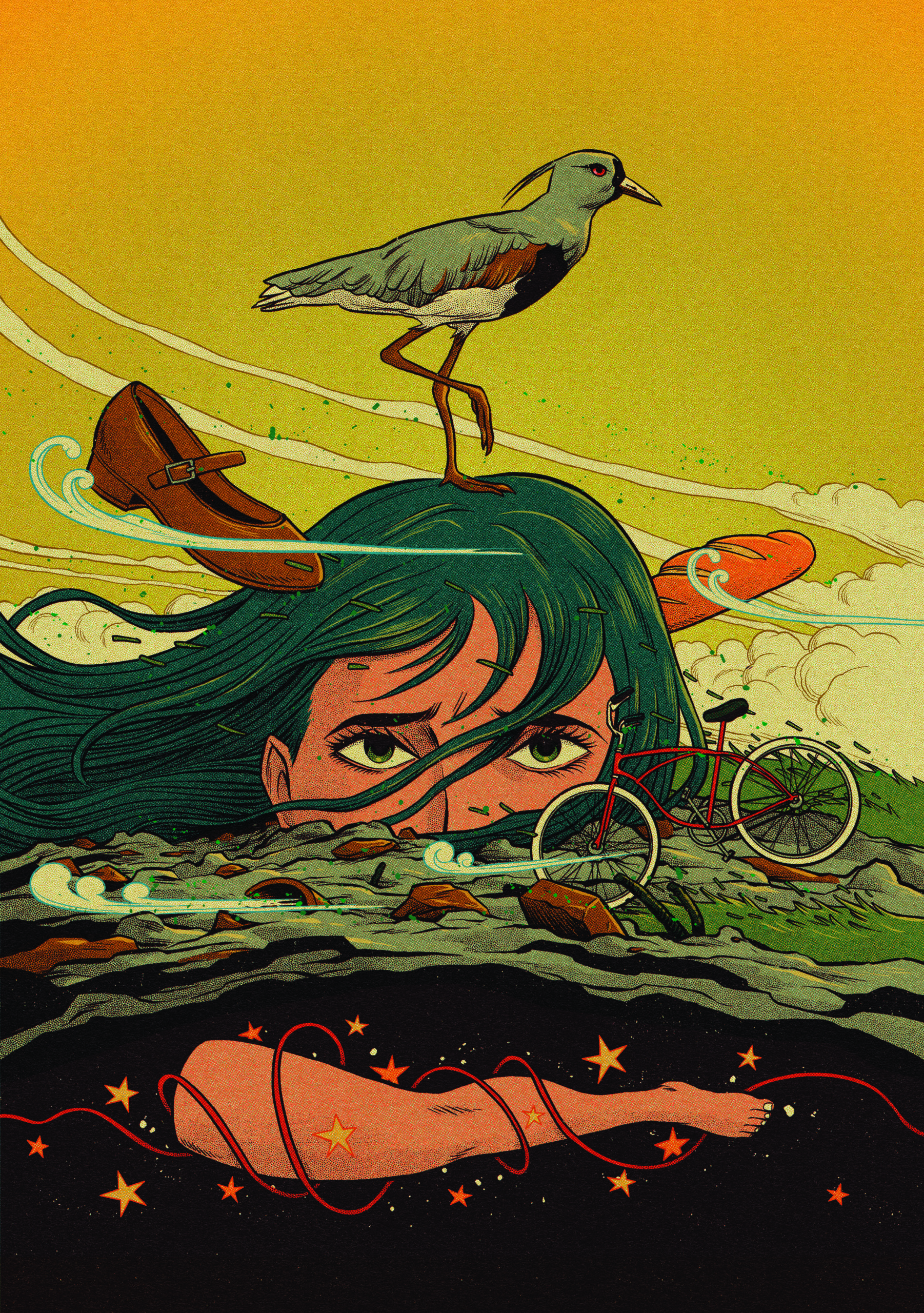
I can’t find my leg. She’s gone. She was here a moment ago. I could see a small patch of skin in between my white teacher’s coat and my leather shoes. Or rather, the blur of movement that proved I was still alive. My leg was quite polite about it; she left my shoe behind for me, by my elbow. I don’t really mind being alone with just my left leg. I’ve never liked my legs. My mother said I got them from Miguela, my maternal grandmother. Gleaming white with round thighs—sturdy, firm, and well rooted. They grew more than the rest of my body, so much so that people spend more time looking at them than me.
She must have gotten bored. She wouldn’t have been scared off by the cave-in; she’s finally decided to leave me for good. I have no complaints. I don’t need to move around that much and, after all, I’ve always preferred my arms. To give her her due, my leg had always been loyal until today, long enough to keep my full height of almost six feet upright. Fortunately I’m slim up top, with small breasts to balance out my thighs. There’s only one thing that my leg likes, but there I am cleaning, picking up other people’s children, standing at the blackboard, grocery shopping, cooking . . . a workhorse.
I was just thirteen when I was told my mother wasn’t coming back and I’d need to take charge of everything. There wasn’t anyone else older to do it. My grandparents were gone, and my father was a hollow log: When I spoke to him, my voice bounced around in his head; I might as well have been talking to an owl. In addition to school, I had to take care of the household, see to my younger sister’s needs, and run the family bakery. Meanwhile, my father was a ghost who kept having to go to the capital to do paperwork. Because I didn’t have any time for myself, I just grew tall all at once. Now everything’s a little better; I’m far from that place and buried under rubble. My leg’s clearly a restless soul. The other one is still here, a little bruised, but she doesn’t hurt—I can feel my hand when I touch her. She’s curled up like a snail shell.
My whole body is fixed in the strange kind of position you see in the images of saints at church. I can see a sheet of roofing, a chunk of plaster, my coiled, snakelike body, everything except my right leg. The classroom doesn’t look like a classroom—it’s all gray, like a desert after a war. Floating particles of dust and sand shimmer before my eyes.
Maybe my leg didn’t understand what had happened; she’d never seen the wind gust so hard. The first time the earth blew like that was a few months before my mother disappeared. I was outside hanging laundry when my ears blocked up for a few seconds. The leaves on the trees fluttered around, and the wind wouldn’t let up. I dropped the basket of wet clothes and listened to the trees swaying, they sounded like waves. That noise was a symphony. But the one just now was a bomb going off. Back then, we had a mango tree, and ripe fruit started to rain down around me like sticky missiles. My mom called to me from the kitchen, telling me to come inside if I didn’t want to lose an eye in the hail of fruit. But I stayed where I was; I was listening to the new sound, a concert of leaves all around me. It was overwhelming, the sound of movement, the treetops rubbing against each other, touching for the first time. My mom kept yelling, and I closed my eyes until one of the mangoes fell a few feet from my right leg. Actually it landed closer than that, and the sticky yellow liquid from the splatter started to run down my legs as though a whole life were catching up with me.
To appease my mom, I withdrew to the gallery with my legs covered in juice. Safe from the mangoes now, I used my finger to clean up, following the path of the liquid down to my white socks, which were beginning to get stained. A shiny pattern gleamed on my legs, a river branching in different directions. Once the juice had dried, I picked up the mango, which had pretty much slipped out of its skin, and started to eat it, sitting down with my legs open to keep from staining them any further. When I was done, I went inside to wash the stickiness off and saw that the storm had reached inside too, blowing dirt and leaves across the floor. Mom was already sweeping, humming a tune, while my father, Don Justo, ran in to see if we were OK. What I would give to be splattered in mango right now, to have the spicy sweetness on my tongue instead of sand rasping against the back of my throat. What I would give to hear my mother again.
Another time I heard the wind, my leg was a leg and my mom was just a murmur. Or maybe the wind had blown on other occasions and I just hadn’t heard it. The absence of my mother had made me more sensitive; I was always expecting her to come up behind me and say my name. Perhaps that’s why when I heard the crash of crockery falling from the cabinet, my thoughts dropped into place and I knew that the sky had grown wild. There was no one at home—my sister was at school, and who knows where my father was. The wind rattled the windows as though it wanted something from me. I remembered our tero bird and went out to look for it. Dad had brought it back from one of his hunting trips and for the past few months the tero had looked after the house, like he was our guard dog. He wouldn’t let anyone in without permission; if they were foolish enough to try, the tero would fly straight at them, his beak flashing within an inch of their eyes. When I went out, the storm was raging all around; the tero was gone, and again I was befuddled by the trees.
Maybe the leg went looking for the tero? The bird’s feet are skinny but they’re what make him who he is, what differentiate him from other birds; they’re his foundations. That day, though, the tero wasn’t sturdy enough; the sky got even darker and I was trapped in a cone of wind swirling around my body. I couldn’t see or hear, but I could feel the wind shaking hands with me. My body opened up and I could hear my bones begin to creak. I heard the tero cry out and for a second I was allowed to open my eyes so I could see him in the distance, giving me one final look. It lasted a few seconds. And in spite of the crunching sound, I came out unaffected, except that my right leg had gone to sleep. Not like now, when my leg was so wide awake that she up and left. I wonder whether another gale might bring her back.
I felt a maddening tingling sensation, so I stayed still, surveying the mess the wind had made. Once the tingling had faded, my leg regained her usual motor functions and straightened up along with her partner. A while later, Don Justo appeared, also in one piece but with his big toe all purple—a log from the bakery oven had fallen on top of it. I thought it looked beautiful. It was like he had painted it: At first it was lilac, then it darkened into a purplish black. You could see the crushed crust of blood through the translucent nail. I worried about his toe; I didn’t want the nail to fall off. I liked it fragile, like a toe that could speak to the dead. Weeks passed, almost two months, and the nail stayed violet, almost painless now, a little raised but still in place. It didn’t seem to want to go.
That leg of mine is alone. I’m lying down and can see the dust settling on my coat and shoes. I can’t see all of my arms, just the elbow of one and the hand of another. They’re both stiff. I wonder what I look like from above—a fossilized mermaid, perhaps. My right leg was restless today; she was warning me that she was going to leave. On the way to school I stumbled several times, like she didn’t want to go that way. I’ve been making the same journey for a year now, since my aunts suggested that I move. They had me named the new first-grade teacher at a small school. A very small school, but it was something.
My dad’s mind was all over the place. The purple in his toe had begun to rise, and it got harder and harder to talk to him. I had to leave. It’s nice to be alone but it’s even better to be able to do what you want, and I’m still a long way from that. To be a teacher is to be almost like a daughter still, only now watched by the owners and the board, who report to my aunts. Which is why the leg did what she did; I think she’s given up. She’s realized that things aren’t going to change and so she left me.
When you leave home, you miss the good and even the bad. I’m always thinking about the bakery; it did have something going for it. The other bakers called me Doñita and were polite to me. They never got rowdy and always came to work on time, even though during the first year after my mom died, Don Justo left me there all alone. He said he needed to do errands in town or deal with the inheritance, or he went hunting with his friends. During that time it felt as though I stood so close to the oven that my skin was gradually being baked. I was turning into a bun. My cheeks were almost always red and warm, rough from the dry air in the heated bakery, my wavy hair greasy from the sweat on my forehead. My sturdy legs, which I tried to keep covered up in spite of the heat, got tired.
The sun is going down; I don’t know how many hours must have passed, two? Thirteen? I rushed the children outside when I saw the desk practically blown up into the air. It’s not a big class, eight girls and seven boys, and they’re all very small, like little mountain birds. The school is little more than a hallway. There aren’t many grades, and all the children are kind of mixed together; there’s nothing much to this town. The train comes only once a week, and that was partly why they chose this school for me. My other leg, the one that decided to stay, has started to throb; she must miss the other one. Clouds of dust are still rising from the classroom, and the final rays of sunshine are filtering through the surviving blinds. My body is impatient. It’s a month until classes end, a month from summer, and the walls weren’t strong enough to withstand the earthly gale.
One day, the leg decided we were going to be friends. I think this was after I got my period for the first time, when I started to spend more time on my own. My father was growing more and more self-absorbed; the violet stayed with him, spreading through his body. When I tried to tell him something, he locked me in the house and took the keys. My aunts helped me out—they’d made Don Justo promise he’d let me finish school, but I still had to work at the bakery and do the household chores. Another aunt with time on her hands and a desire to be a mother had taken my little sister, and I sent her letters. It was better for her in the city, where they had restaurants and parties. There was no chance of that in our town; it was full of people with empty gazes who never finished anything.
Things started to change the day the mill was set up to grind flour for spaghetti and with it came a lot of workers from out of town. I passed by the factory every morning because it was close to the bakery. They’d arrived in spring when my leg liked to walk. She was fresh, athletic and a little sweaty, so I wore a skirt. I crossed the street so I could wave at the mill workers but from a distance, because I was a little afraid of strangers. But then one day I bumped into one getting out of a truck. My sturdy legs helped me stay upright while he fell to the ground. The men opposite laughed and said his name. And so I met Juan.
I can feel my body throbbing, and every throb takes me closer to things. It hurts. My shoulders are pressed against the remains of a wooden bench; it feels as though my belly button is lying on top of something cold and metallic that sets my teeth on edge; lower down is some air, allowing dust to get into the space between my leg and where the other one used to be. A while ago, I felt something similar lying on the ground. I liked to stretch out my walks to and from the house so I could feel the wind a little longer. This was two years ago, when I was wearing my hair long and wasn’t covering my knees the way I had before. Miguela’s legs were by then what they still are today; I had no idea what was going on with them.
What I do know is that I’ve learned a lot from my leg. One night, with summer approaching, my father asked me to go see my aunts to pick up some jars of chayote jam they’d made to sell at the bakery. My aunts lived some way from the center of town, so I took my bicycle. It was a warm night; the air was still, but my legs lifted my skirt just the same. When I got to my relatives’ house, my legs didn’t want to stop, so I rode straight on. I needed to preserve the freshness for as long as I could. I closed my eyes.
I remembered the guy loading the truck at the spaghetti factory. I’d seen Juan several more times since our meeting. He never looked me in the eyes. He had dark-chestnut hair, and his eyes were green as the hill in January, like lettuce fresh from the market, like the screeching parakeets in the plaza that flew off when you approached. Then, one day, he did look at me. Juan was busy taking delivery of some orders and didn’t notice me, so I called his name. His face appeared from among the boxes, and our eyes met for a few moments. His ran down my neck, chest, hip, legs, and feet. Then they hit the floor, and that’s where they stayed. It was the first time I’d said his name out loud, so I said “Juan” several times as I continued on my way home.
I stood up on my bike and his face melted into the air. My skirt flapped over the bicycle and the wind stroked my legs. The sound of the crickets and cicadas put me in a different mood. I rose up and down on the bicycle as I pedaled, sitting in such a way that my panties were pushed a little to one side by the seat, and I kept rising and falling until a feeling that was both irritating and pleasurable sank deep. I thought of the color green and the temperature of wet grass; I wondered whether the dew had fallen in the garden yet. I needed to stop and lie down in a garden, any garden. I rode on another block and found a house that had been empty for a long time, up for sale, apparently, because the grass had been cut fairly recently—it was at the spongy stage, ready to embrace anyone who chose to lie down on top of it. So that was what I did, welcomed by invisible drops that wet my clothes, shirt, bra, skirt, and the rest. I smelled the scent of green, the chill of the dew, and I turned over so the rest of my body could absorb the water. I lay on my stomach for a few seconds and put my hand between my legs. The grass hugged my entire body, as though I was being touched for the first time, like the trees on the day of the windstorm, and I let myself sink into the ground. It prickled, but that only enhanced the pleasure. Then I fell asleep.
I’m sleepy, uncomfortable but calm, in tune with the uncertain reactions of my body, with the leg that hasn’t come back, with the silence. It’s better to remember: When I awoke back then, the sun had come up, people were walking to work, women were sweeping the sidewalks, children were walking to school in their uniform coats. My head was pumping, my legs were covered in grass, and I panicked. I’d never been out all night before. I grabbed my bicycle and went straight to the bakery, wondering what I’d say to Don Justo, wondering whether he’d spoken to my aunts or if there was any chance he’d believe I’d spent the night with them.
It wouldn’t help if I arrived all covered in sweat, so I savored the journey. I’d never been out in the town in the morning, the light was weak, but people looked strong and the children well fed. I stopped at the main avenue to let some trucks pass by and was surprised to see Juan raising his hand in the distance. He was saying hello. I didn’t wave back, and then I did start pedaling as hard as I could.
When I got to the bakery, I didn’t say a word; I walked in as casually as I could, wearing the same clothes as the day before. My father was standing where he always did, at the register, counting out change. The bruising on his hand contrasted with the bills. Suddenly the door opened and my two little aunts were standing in the threshold. They never usually left the house, but today they were crying, their handkerchiefs soaked under their noses, and they began hugging and kissing me as though something terrible had happened. In a hoarse whisper, Don Justo told me that I’d been seen the night before, that I should be grateful to be alive, and that from now on I’d be living with my aunts. I’d have to help around the house earning the wage they’d pay me like any other employee, and he would work in the kitchen, not at the register like before. I didn’t get time to answer because after giving me the speech, he slapped my face with the back of his purple hand, walked past me, and left without turning around. I stood holding my cheek with both hands.
My leg itches. I wonder whether the other one is ever going to come back or if she’s ditched us both. That leg is very naughty. After the episode with the bicycle, I went to live with my aunts. Time passed and I got used to living with women. There were more rules, but also more conversation, more food, and more distractions. My legs seemed happy and so was I, although I’d lost my means of transportation. I felt something I never had before, which perhaps my mother’s death had kept me from feeling earlier: I wanted to talk loudly, to laugh until I peed, to have picnics by the river and stay up all night. One day when I was on my way to my aunts’ house, I decided to stop by the mill for a while. I loitered around there; it was all locked up, and there was no sign of Juan or his wet grass. But someone whistled at me from the corner. It was him. He jerked his head, asking me to follow him. I thought about it and almost without meaning to started out. My legs were tense, but they were walking, keeping pace. I wasn’t sure whether I wanted Juan to see me like that, all dirty and sticky, but it was the first time he’d spoken to me and I couldn’t be sure it wouldn’t be the last.
We arrived at a small house that looked to be his, in the neighborhood they’d built for the mill workers. All the houses were alike, painted a faded pink with flat tin roofs. Juan opened the door and let me in. There wasn’t much furniture, but everything was tidy. It smelled of rain, but that might have been poorly done laundry. He pointed out a chair for me to sit in and brought me a glass of water. He stood and looked at me. Without making a sound, he asked permission and put his two hands on my legs. I looked at the contrast between his dark hands and my knees, tracing small circles that turned into pinches before his hands rose very slowly, rubbing my legs as they crept upward, hiding under the fabric of my skirt at first, then under the fabric of my panties. That was all we did; we didn’t kiss, and the rest of our bodies didn’t come into contact.
Night has fallen and there’s no sign of my leg. The other one is getting impatient. I’m a little afraid it will leave too. They detach very easily—quickly and painlessly. Not like when you lose a tooth or nail; it’s more like cutting your hair, only they won’t grow back. It was when I was with Juan that we realized my body was different. We’d gotten into the habit of seeing each other some nights after work. I let him touch my legs; we did it naked, but the rest of our bodies continued not to touch. We didn’t even kiss. We just looked at each other and I let him run his hands up and down my legs again and again. The wet grass feeling stayed with me for a few days. I made it last until the next time; we couldn’t see each other too often or my aunts would get suspicious.
We’d been meeting for a couple of months when I felt the earth begin to blow again. The clouds gathered all of a sudden like they were preparing for a race and I heard a whistling in my eardrum. I ran to Juan’s house. The door was open, perhaps pushed off the latch by the same wind, so I locked it behind me. Juan wasn’t there, so I looked for him in the other room. I found him lying in bed with the fan turned up to maximum. The noise of the machine had drowned out everything else, but he was eating one of the mangoes that fell all over town. I asked him not to wash his hands and to quickly put them between my legs. I closed my eyes and suddenly I was the same as I’d been a few months before, lying on the spongy grass, but I could also feel a tingling in my leg like the day I saw the tero through the wind. I heard a noise—something came apart—was it Juan’s sticky hands moving in and out of me? I suddenly opened my eyes because I was burning down below and just then I saw my leg slipping quickly back into place. The burning was gone, although my leg still throbbed. Juan hadn’t seen a thing; the leg had left my body to touch him, she had rested on his shoulder. He kept touching me, lowered his head and kissed me for the first time.
Now I have my eyes closed again, but all I feel is the dry building on top of me. My body throbs and I imagine it white, but not my whiteness, which is more pink, it’s a gray whiteness, of something that has been hollowed out. I don’t know whether the leg is going to come back, but the other one is sure to leave too. I can hear noises. It sounds like they’re moving sheets of metal, stomping through a dry, warm desert. I don’t know how, but this time the earth blew straight at me. I was in the school when I heard the birds crying out and the chorus of trees rubbing together. I told the children that we needed to get to a safe place, that we’d better escape into the playground, where there wasn’t a roof that might fall on us. I managed to get them out but when I went back to check that no one had been left behind the door closed behind me, the wind came in through the windows and pushed down the walls from below.
My leg began to do whatever she wanted. And yet the little lady had manners—I only noticed she had gone when I saw her through the window, coming back: It happened when Juan and I were touching each other, or when I was asleep and suddenly woke up, or if I’d been sitting in the same place for too long. When she knew she wasn’t needed, she went off to do her own thing. I never knew what that was, but she was never the same when she came back. I’d been worried about the storm; they’d been predicting it on the radio and told people to make sure their cars and pets were safe and to take in their washing. The wind had been forecast for weeks.
Another day I heard the rattling of rain on the roof; the sky was gray darkening to purple, like my father’s toe. I looked down and there was a tero standing there. I thought I was still dreaming. I tried to get up, and I fell—I had just the one leg. The other had gotten into the habit of leaving at night and still hadn’t come back. I’d never had any problem with her absences; I called them her “little trips”. I decided to go outside just the same, so I could get a closer look at the tero. I managed to support myself on a pair of my aunts’ old broom handles. As I hobbled along, the tops of the trees swayed and crashed together, their sound casting their spell once more, and leaves and dirt swirled around me, clouding my vision. The wind had never been so strong before, and I could hear cars being moved, people calling out and telling each other to lock themselves inside, and I could also hear the police siren. I was blown over by the wind; my leg hadn’t come back. The tero was standing stock-still. I dragged myself over the ground toward him, but just as I got there, he let the wind take him. That was the last thing I can remember because something hit me hard in the head and I blacked out.
Hours later, I woke up in the garden; no one had come. I was alone. My aunts had gone to visit friends in another town for the day, so there was no chance of their catching me on one leg, but I was worried that the wind would blow it a long way away. I’d lost the broom handles, so I had to drag myself to my room and I found her there in the bed, lying still. I’d never seen her like that; she looked dead. I lay down and she attached herself to my body on her own. Apparently she’d had a scare because, she didn’t leave again until today.
I’m tired now, but I still hold out hope: Maybe she’ll appear in the doorway, or I could just go to sleep and she’ll be back when I wake up. What I need is water, a mango, or at least to feel a little wet grass. How long has it been? A few days? I wonder what I’ll do if she comes back, because the last time, we had to leave town. Everyone had seen her wandering the streets. It was Juan who grabbed her. He’d never seen her on the loose before, but he recognized her, cleaned her up, and brought her back to me swaddled like a baby. All that tenderness just to leave me alone afterward. Juan left after the storm, just like my mother. My leg had been reckless; she wandered freely because she knew I didn’t mind. So I came to work here, a place a hundred miles away that needed a teacher and didn’t have a mill or a bakery, somewhere where everything was just starting out.
Shhh . . . I can hear someone coming; I can hear them clearing the rubble; but I can’t see anything yet; there’s no light and my eyes are dry. I listen a little harder and I can hear the sound of cars, people, even birds outside. It sounds as though the whole town is coming into the school. Now I can hear someone in the classroom; no one’s brought any light yet, but I can feel the presence coming closer. I can also hear a cough; I don’t know if it’s the person here or someone outside. I’m beginning to feel freer—first they’ve moved a beam, then the rubble from my feet, my leg, my belly, one of my elbows. Now they’ve got to my head and I can feel their touch. 
Sofía de la Vega, born in 1993 in San Miguel de Tucumán, is a CONICET research grant recipient. She has published three volumes of poetry and the story collection De los potrillos nacen ríos.
Kit Maude is a translator based in Buenos Aires. He has translated dozens of Latin American writers for a wide array of publications.
Illustration: Pedro Correa
