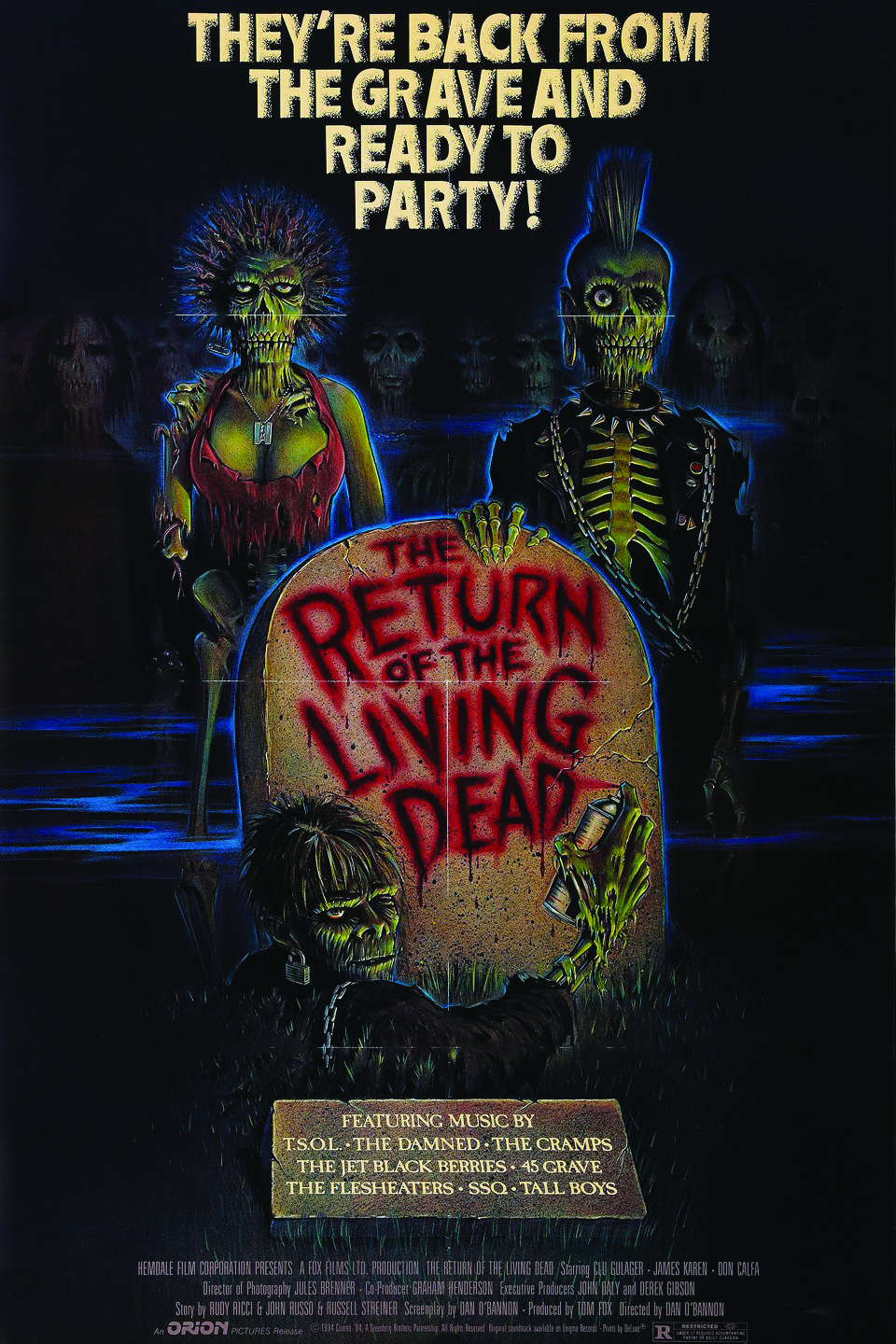
Needle Drops is a column that asks writers about—you guessed it—their all-time favorite needle drops. In this edition, Nick Pinkerton offers “Partytime” by 45 Grave, featured in Dan O’Bannon’s The Return of the Living Dead (1985).
Of the many emotionally resonant roles that a strategic pop music cue can play in a film—provide ironic counterpoint to what’s occurring onscreen, say, or offer a privileged perspective on a character’s emotional inner life—I would like to say a few words for perhaps the most dunderheaded function of them all: cranking it up to 11 and just getting a body gassed the fuck up.
To hear J. T. Money’s “Who Dat,” with its bouncy “Ay yai yai yai yai yai yai . . .” chant, is to see in one’s mind’s eye the opening credits of Larry Clark’s Bully (2001): the drive-by POVs of the split-level ranch-style homes and strip malls of scenic Hollywood, Florida, the perfect evocation of that feeling of anticipation you’d get as a teenager when your shift’s almost up at your shitty minimum-wage part-time job and the night ahead is full of boundless possibility. (Of course it usually wasn’t, and consummately isn’t in Bully, but that does nothing to dampen the excitement here.) And who, prithee, could fail to feel something akin to religious ecstasy when Urbano Barberini pilots a commandeered dirt bike up and down the aisles of a devil-infested movie theater in Lamberto Bava’s Demons (1985), laying waste to marauding “instruments of evil” with a katana to the tune of corndog German metal outfit Accept’s “Fast as a Shark”? (Sample lyric: “On a one way track and you’re not coming back / ’Cause the killer’s on the attack . . .”)
The precipitous rise of the tie-in soundtrack through the ’80s—and, consequently, the pop needle drop—did not, as the Demons example evinces, bypass the horror/thriller film of the day. As further examples I might cite the music-video-within-a-film Frankie Goes to Hollywood interlude in Brian De Palma’s Body Double (1984); Lucio Fulci’s giallo-musical curio Murder Rock, featuring original songs by Keith Emerson of Emerson, Lake & Palmer; jarring, bum-rush appearances by Iron Maiden and Motörhead tracks in Dario Argento’s Phenomenon; and, most invigorating of all, the nigh-omnipresent punk/death rock/psychobilly accompaniment to the carnivalesque carnage of Dan O’Bannon’s The Return of the Living Dead (all 1985).
The last named belongs to a cottage industry of zombie pictures that appeared following the watershed of George A. Romero’s Night of the Living Dead (1968), among them Fulci’s Zombi 2 (1979), an unauthorized sequel to Romero’s Dawn of the Dead of the previous year, released in Italy as Zombi. While Return has more claim to official provenance than most such fare, having had its origins in a 1978 paperback published by the coauthor of Night’s screenplay, John Russo, it’s an entirely different animal from Romero’s unremittingly grim, largely subterranean Day of the Dead, released just two months before O’Bannon’s film. The tagline featured on the Return poster speaks volumes: “THEY’RE BACK FROM THE GRAVE AND READY TO PARTY!”
And The Return of the Living Dead is nothing if not a festive affair. Though the one-sheet deceptively promises mohawked, spray-can-wielding zombies in various states of moldering decomposition, the motley assortment of punks, New Wavers, and other stereotyped subculturati who appear in the film are—when first encountered, at least—alive and well. Looking for somewhere to cut loose away from police harassment, they barrel through the industrial flats of Louisville, Kentucky (very clearly played by some of the less picturesque corners of Los Angeles) in a graffiti-covered Cadillac convertible, passing a bottle around and blasting a metal-tinged tune called “Young Fast Iranians” by Boston’s Straw Dogs. (“Former members The F.U.’s,” I might add if this were a photocopied flyer.) This band of misfits, with sobriquets like Trash and Suicide, are en route to rendezvous with a member of their crew who is just started a job at the Uneeda Medical Supply Warehouse. With a couple of hours to kill until he’s out, the gang decide to go fool around in the neighboring Resurrection Cemetery, “fooling around” in this case consisting of Linnea Quigley’s Trash stripping fully nude and dancing on a funeral slab to the strains of synthpop outfit SSQ’s “Tonight (We’ll Make Love Until We Die).” Next door, meanwhile, their pal Freddy and his none-too-bright supervisor have uncorked a steel drum whose contents—a fictional toxic gas, Trioxin, developed for military use—wake the dearly departed from their long slumber with a hunger for brains, which means incoming party crashers at the boneyard next door.
Essentially a coauthor, with John Carpenter, of 1974’s sci-fi jape Dark Star, O’Bannon was by all accounts the individual most responsible for injecting Return with its guignol humor. In giving credit where due for the qualities that distinguish the film, however, we mustn’t overlook the role of Enigma Records, home to the abovementioned groups as well as several other eyeliner-and-fishnet friendly artists featured on the soundtrack: T.S.O.L., the Cramps, and 45 Grave, whose “Partytime,” heard twice in the film, is something like its theme.
The first occurrence of “Partytime” comes when the dead rise en masse, following a blundering attempt at a cover-up by the Uneeda personnel and an unfortunately timed downpour that allows the airborne contamination to penetrate the cemetery soil and disturb the permanent residents beneath. A skeleton stripped of all flesh leads the charge, rising from the mire under a tombstone. As it opens its jaw and its improbably intact, piercingly blue eyes, 45 Grave frontwoman Dinah Cancer poses the immortal question: “Do you wanna party?”
Panicked punks scatter. (“It’s partytime!”) Corpses surge through the swampy soil. (“We gotta party!”) Trash, who earlier we’ve heard fantasizing about “a bunch of old men [who] get around me and start biting and eating me alive,” gets her wish, disappearing under a scrum of slithering, ravening ghouls. (“Do you wanna party?”)
Though connected to this scene now for time immemorial, “Partytime,” first recorded in 1983 with the subtitle “The Story of Sabine,” was written, per Cancer, after reading about a little girl’s abuse and murder by family members, the shindig in question being presumably one of ritual, sadistic torment. While the horrors catalogued in the song’s sing-song verses have been excised (“Cut and beaten / Brutally raped / The five -year-old / She didn’t escape”) for its employment in Return, the thundering chorus retains its air of combined exhortation and threat: The invitation here is to the last party you’ll ever attend, a going-away bust-up for humanity, a riotous celebration of the Triumph of Death. We’re on a one-way track and we’re not coming back! I feel like popping a magnum of Veuve Clicquot just thinking about it!
The song will get a reprise over the closing credits, not long after we’ve seen a mushroom cloud spreading over a “Louisville” skyline that appears to have been made of empty milk cartons, the city rendered collateral damage in an attempt by United States government officials—in vain, we’re given every reason to believe—to contain the now-snowballing outbreak. In contrast to Stanley Kubrick’s acerbic employment of Vera Lynn’s wartime ballad “We’ll Meet Again” over the Armageddon closing of Dr. Strangelove, or, How I Learned to Stop Worrying and Love the Bomb (1964), the concluding note here is less tongue-in-cheek wistfulness than jubilation. This world ends not with a whimper but a headbang.
Nick Pinkerton is a film critic, screenwriter, and editor at large of the Metrograph Journal.
