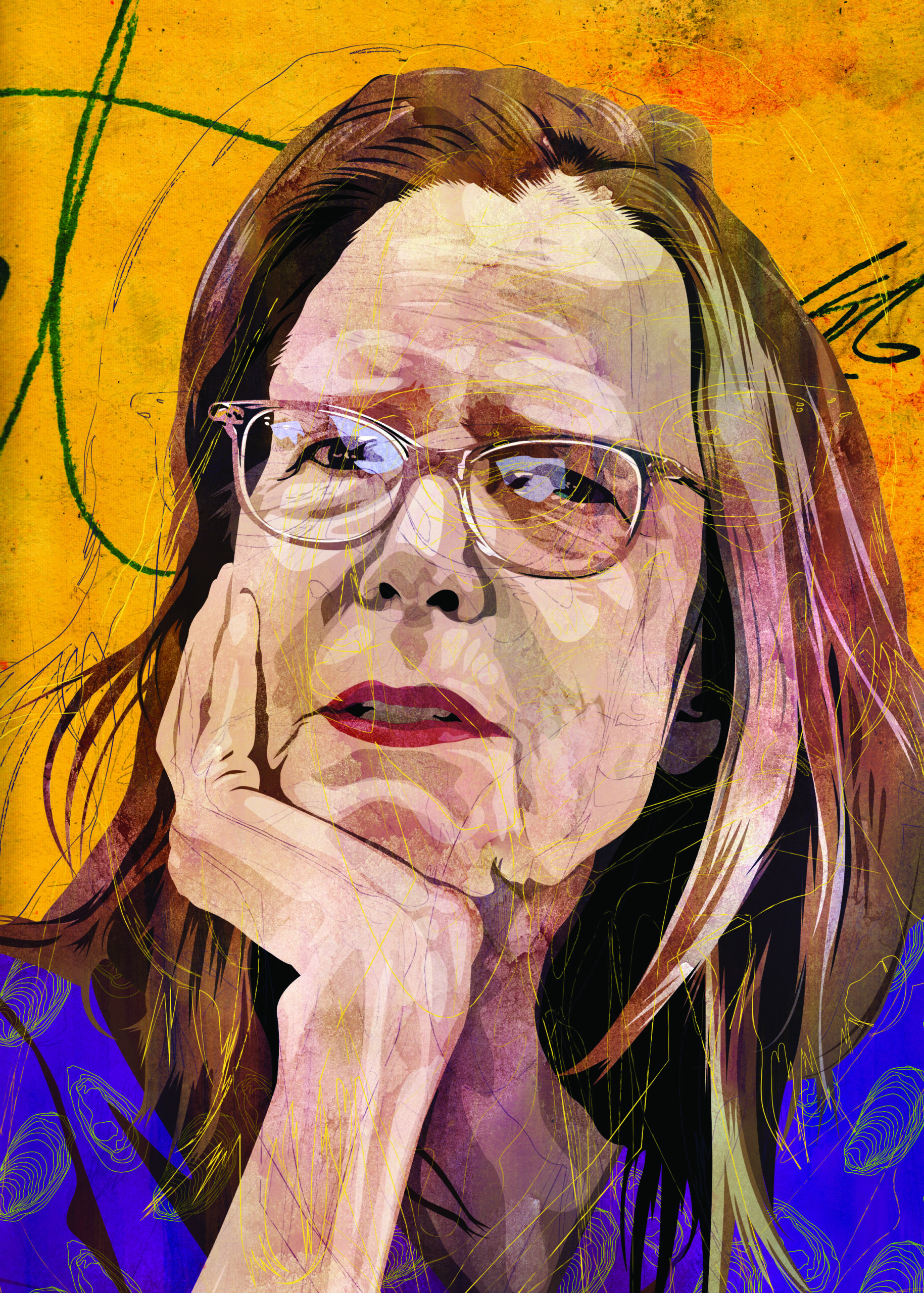
I first read Nancy Lemann on the recommendation of a friend. This—especially in a time of targeted ads and the bludgeoning algorithm—is still the best way to find a book. It took me about a sentence and a half to fall madly in love with her 1985 debut novel Lives of the Saints. Set in New Orleans, the book is a blast of pure, giddy, heartbroken romanticism, but it’s all about the voice. Lemann is a master stylist, each sentence an astonishment. I’d found a new favorite author.
To my great joy, Lemann had other books. The Ritz of the Bayou, a 1987 work of nonfiction about the trial of Louisiana governor Edwin Edwards, I might have liked even more than Lives of the Saints. The book isn’t so much an account of a trial as an invoking of carnival, into which Lemann flings herself with a kind of delighted wonder, propelled by her penchant for weirdos, oddballs, and nuts. Another stylistic masterpiece. I’d never read anything like it.
Through three more novels—Sportsman’s Paradise, The Fiery Pantheon, and Malaise—Lemann further refined her voice, while circling many of the same thematic concerns, and I see them all as one continuous work—a parade of eccentrics. It’s Lemann’s pleasure in other people that is the heart of these books, her keen eye for their strangenesses and their mysteries, and her refusal to be less than fascinated by everything.
With the recent reissues of Lives of the Saints by NYRB, The Ritz of the Bayou by Hub City Press, and the publication of her new book, The Oyster Diaries—her first in over twenty years, also from NYRB—it’s time for Lemann to receive the recognition her work truly deserves. She is sui generis, one of our greatest living novelists, and it was my honor to speak with her.
Jimmy Cajoleas: You have quite a fan base. The people who know your books and love them really, truly love them.
Nancy Lemann: Well, you have to worry about how maybe your first books are better than your later books, but you just keep writing them anyway.
JC: I don’t feel like that’s the case. The Oyster Diaries is absolutely wonderful.
NL: Thank you. I tried so hard to make it as short as possible, so as not to bore people. That’s how beaten down I am.
JC: Oh, why are you so beaten down?
NL: My daughters would say maybe the patriarchy. But I don’t know. I’m beaten down because there’s a lot of failure and rejection in the life of an artist, so more like that, really.
JC: I was thinking about the last book you published, Malaise, in 2002. It’s quite a turn in your career as a writer in some ways because it starts in such a dark mood, as opposed to your other books, where the voice is a bit more . . .
NL: I think frothy is the word you are searching for. But I think, number one, Malaise is a book I would like to edit and cut by about a fourth or so. I started to do that on a copy in pen, but then I realized I would have to retype the whole thing, so I sort of lost heart after about twenty pages. The Nancy Lemann repetition, as my husband says, is biblical. But it has to be conscious and intended. When I read Malaise, the narrator just kept saying the same thing, and after a certain point, we get it. It’s like, “The Englishman, far away in California,” on and on. But I am still frothy. I’m frothy and fizzy. I think Malaise is also frothy and fizzy.
JC: I’d agree with that. It starts off in a slightly different register, but when Fleming gets swept up in her romance, it takes on that effervescence. It’s a beautiful book.
NL: I mean, it’s out of print. The Ritz of the Bayou and Lives of the Saints are back in print, but I still have to get the others back in print as well. I just feel like I want to cut Malaise down a little bit. But I don’t have the time or the heart to retype it all. What do you think? Is that really dumb? Should I do it?
JC: I mean, I think it’s so wonderful as it is, but why the hell not? I say go for it.
NL: I do love that book too. To me, it’s my satire of California, but secretly, between the lines, I adore it. I adore California, I mean. The minute I got there, it just totally grabbed me. I went into it with a prejudice against California, but the minute I saw the place, I just wanted to explore every inch of it. Whereas when I moved to Washington, DC, it was kind of like, “Okay. Fine.” I think California did remind me of New Orleans in a little bit. Everything that I seem to be most delighted by turns out to just remind me of New Orleans.
JC: What was it like growing up in New Orleans?
NL: Well, you don’t know that it’s anything unusual until you leave. And the minute I went to college, at Brown University up north, suddenly, it was just like a thunderbolt: “Oh my God, this is my place. It’s in my back pocket.” Meaning New Orleans. You just thought it was normal when that’s all you knew.
The reason why New Orleans is so individualistic is because of its remoteness and isolation, and the high nativity rate. People who are from there stay there. I don’t know if they still do, but my generation, a lot of them did. Those are the reasons that it fosters individuality. You’re off in your own world.
JC: Were you writing back then in New Orleans?
NL: I was a copious journal keeper from the age of at least about fourteen. Hideously copious journal keeping, because I had so much angst and I didn’t want to burden others with my angst. I’m still like that. I’m still doing it, not wanting to burden others with my angst. And so then, finally, I just said, “Well, this is what I’m going to do.” Compulsively. Maybe I can get something out of it, turn it into something. I’ve always gone back to these journals for my ideas and material and dramas.
JC: How did Lives of the Saints come about?
NL: I was living in an apartment on St. Charles Avenue, which was after college at Brown. I returned to New Orleans. It took me three months to write the book and eight years to get it published. Because it’s so hard to break into the business. And it’s still hard. That’s why there’s a twenty-year gap between Malaise and The Oyster Diaries. It’s a business thing.
JC: Tell me more about that if you would like to.
NL: Well, you have low sales figures—that’s one factor. But ultimately the big point is, you don’t stop writing. You just write books. You can’t get published, but you’re always writing. You’re never going to stop that. If I didn’t write, I wouldn’t be okay. So the best way to look at it really is to blame yourself because it’s less painful that way, and it’s probably true anyway.
When Lives of the Saints was published, I was twenty-eight. And it was smooth sailing for a while. And maybe I got sloppy or I got grandiose or I got imperious, so then maybe I lost my way. I don’t want to blame the publishing industry, although everyone will tell you that the publishing industry is very difficult, but they’ve been saying that for fifty years. This place I’ve landed at with NYRB is really the perfect publishing model for the business if you can afford it. They barely pay you anything, and then if anything good happens, it’s gravy for everyone, but there’s really no money in it. Unless you’re Stephen King or whatever.
JC: That’s also the beautiful kind of forbearance and stiff-upper-lip quality that is in so many of your characters, and your attitude toward the publishing industry as well.
NL: It all came from the whole journal-keeping thing so that I wouldn’t have to burden other people with my problems. I could just analyze them until I made my peace with them somehow and figured them out.
JC: Do you think the books themselves also serve that function in your life?
NL: Maybe, but slightly less so. It’s kind of an interesting dichotomy because if I try to just put a blank page in the typewriter, that doesn’t work. I have to go back and look at my journals, even to remember what my voice is, to get the famous quote-unquote “voice” that we’re all looking for.
JC: You do have an incredibly distinct voice. Nobody writes like you do.
NL: It’s not for everyone, though. I’m just really not everyone’s cup of tea. I think it’s a pretty rarefied audience.
JC: Style scares people. It always has. But it’s also what can allow things to last. I mean, I think that your style has a lot to do with the way people love your books. People revisit them almost as they would—and I know this sounds corny—but as they would visit a friend they missed.
NL: Well, the reason why I have that voice is because you have to analyze what are your strengths and weaknesses and go with your strengths and try to improve your weaknesses. I think my strength was the whole voice thing. I was able to identify that, and I just ran with it. But no, I don’t know why my books feel that way. It’s very surprising. I mean, you feel pretty divorced from them sometimes afterwards.
JC: Can we talk about The Ritz of the Bayou?
NL: Okay, what do you want to know?
JC: I don’t know. What do you want to tell me?
NL: My brother’s a journalist. I asked him what he thought about me doing that as a book and he said, “Oh, no, stay in your lane. The journalists won’t like it. They don’t want to hear your little poeticisms.” When I handed in the story to Tina Brown at Vanity Fair, who originally assigned it as a journalistic piece, it turned out she wanted facts. That was not my angle.
JC: I don’t think we get the details of the case until maybe fifty pages in.
NL: But I do get them in at some point.
JC: It continues the theme of your love of these eccentric characters, these “nuts” that populate all your books. You have that beautiful line: “The people are wild. They were close to unsavory characters, and they danced on the edge of the law.”
NL: Gosh, I hope I still come across people like that now that I’m older. You know Shelby Foote? I was friends with his son, and I also knew him through Walker Percy. I remember once being at their house in Memphis, and Shelby was in his study, and there was a curtain, a white curtain fluttering on the window, and he said, “I hardly know there’s a world out there.” Meaning, he was just in his own head all the time. And that’s kind of how it is lately. So I hope there’s enough in there. I don’t know. I’m going to have to start dreaming these people up.
But when you’re at a trial like the one in The Ritz of the Bayou, the humanity is just right there. All you have to do is report it, chronicle it. But dreaming it up out of your head, that’s a whole other thing.
JC: Would you say that you write from life mostly?
NL: Probably, yes. Now they call that “autofiction.” I’m doing air quotes. Why do they call it that?
JC: I don’t know. It began in France but now it seems like a short term for the kind of flat, no-frills writing about people at parties in New York. That was rude. I shouldn’t have said that. But you have this way of conjuring people almost that makes them seem so alive and dynamic as opposed to a lot of the kind of flatness that most people would associate with autofiction.
NL: You are always aiming to make it alive. You’re looking for what is alive when you’re trying to find out what to use out of your material.
JC: I love The Ritz of the Bayou so much. I’m so glad it’s coming back out. That was a book I would find used copies of and give out to friends.
NL: I mean, it’s been out of print all this time. It didn’t even make a paperback sale.
JC: As is the case of so many wonderful books I love.
NL: That’s true. The fate of the artist.
JC: People are finally catching up with you.
NL: Wow, it’s just really a dream come true. Truly. What way to go out.
JC: Did you not see this coming?
NL: No, God, no. I tried to get a new agent, which during all those twenty years of not publishing—I call it “the Doom,” that period—I would try to get agents. It was just a gigantic failure. It was really chastening. But so are many of the best things in life, actually. I mean, they’re chastening for a reason. You needed to be chastened, I guess. So then I just got a little bit businessy about it. I mean, I have a lot of anecdotes, and more. You don’t need to hear all of them.
JC: I’d love to hear them.
NL: Well, it was all after I met Kaitlin. She is an amazing, just magical person. But this PR team at Hub City Press is incredibly impressive as well.
JC: They’re very good. They’ve published some of my favorite books from newer younger writers. A wonderful press.
NL: Yes, and I just have this dynamic group of girls who I am totally in awe of. I’ve never had anything like that, a PR team. They didn’t used to do that for the artistic, low-sales people. At the big houses, you know. I mean, every author you talk to will complain about it.
JC: May I ask about Gordon Lish?
NL: Okay, I’ll tell you the seminal story. I heard a lecture that he gave once, and I said, “That is the man who would take a chance on me.” This was before computers, this was rotary telephones. This was another century. I had my manuscript, just typed pages. I went to Alfred A. Knopf. I went to the reception and I said, “Is Gordon Lish here?” Then he came out. He said, “I’m racing, babe. What is it?” I handed in my manuscript and I said, “This is my heart’s blood.” Okay, this was on a Friday. This story is a complete fairy tale, I assure you. On Monday morning, he calls me and says, “You and me, kid, we’re going straight to the top!” He is just adorable.
JC: Wow.
NL: And then there’s this really funny, interesting story where he told me, “Okay, I just have to show it to Bob over this week.” That was Robert Gottlieb, the editor in chief of Knopf at that time. Gordon said to me, “Will you be willing to make changes?” And so—this is just one of the rare times it happens once every twenty years or so when, suddenly, you just get businessy by accident, by natural causes—I just said, “Yeah, after I sign the contract.” And the minute it came out of my mouth, I thought, “Wow. What possessed me? How did I think of that?” It just came out! But I know it was inspired by the story that was then current where John Kennedy Toole, the author of A Confederacy of Dunces, had worked for years with Bob Gottlieb, making changes on his book, without a contract, until he committed suicide. So that’s what prompted it.
JC: That line from Gordon Lish about going straight to the top sounds so much like the magazine editor in Sportsman’s Paradise.
NL: Well, that character has a lot of Gordon in him, for sure. Gordon was a real nut. And he was so adorable. I believe he had a reputation as a lothario, but he never was anything but ultra professional with me. In fact, when the Me Too movement came out, I was going to write a humor essay called, “Why Not Me?” Because that did never happen to me.
JC: What about Sportsman’s Paradise?
NL: A friend just sent me this thing from YouTube where a white-haired guy is reading from it in this brilliant way that I should take lessons from him. And, you know, again, I sent [the link] to the PR person at NYRB. He said, “Do you know who this guy is?” And I said, “No, I decided he’s some random guy.” He said, “Well, he’s the host of NPR’s Weekend Edition.” And I said, “Well, maybe send him the books, then.” I’m so businessy now.
JC: Sounds like it’s paying off.
NL: It’s part of the wisdom of age, I guess. There are many benefits to aging, just so you know. Such as the wisdom of age. You do get that.
JC: I’m really hoping so.
NL: Well, you’re only forty, right? That’s nowhere near the wisdom of age. Nowhere near. In fact, you’re about to . . . well, I don’t want to scare you. But you have something to look forward to afterwards.
JC: Back to Sportsman’s Paradise.
NL: I love the baseball parts. My husband and I had our romance through baseball, and he taught me all that stuff. You know, these guys who watch sports. If they’re watching sports, they just get really tense, so you can’t talk to them. You can’t. But baseball gives you a little more time to explain everything because of how little is happening. So he taught me about how you don’t have to really be that athletic and everything to be a baseball player and you can have all these problems and it was just so entrancing. And in New York we had a house on the North Fork that I would go to in the summers. You would probably call it “autofiction” today. I’m using air quotes again.
JC: I love Al in that book so much.
NL: That’s my nephew. And his name is also Al. His name is Alex, Alexander, but occasionally I will call him Al. He’s all grown up now and he’s a law professor.
JC: That’s fantastic. I’m glad to know Al got a happy ending. And we get Claude from Lives of the Saints in that book as well.
NL: Yeah, he pops up now and then. I mean, he pops up in The Oyster Diaries too.
JC: He’s such a wonderful character. One of my very favorites. He’s so dignified, absolutely charming, always falling apart.
NL: One reason why I like him, that character, is that he was really my most fictional creation, just a composite of many people. And every time I returned to him, it was like putting on an old shoe that still fit perfectly, all broken in already. So that’s what I like about him.
JC: I want to ask about another character that pops up, and it’s a different character often, but the oyster-diary maker himself. The first time a character makes a diary cataloguing and rating every oyster they eat is in The Ritz of the Bayou, right?
NL: I noticed that when I reread it recently, yes.
JC: So what is it about the oyster diary that has stuck with you?
NL: It’s kind of like someone having this seemingly pointless, ridiculous, actually almost OCD kind of practice. But yet, in another way, he’s bringing order out of chaos. He’s just making sense of the world the same way I do in my journal. And anyway, there’s something about oysters. It’s just something about oysters. I don’t even know how to describe it, but it’s something especially associated with New Orleans, of course. You just wouldn’t believe how many oyster-related items I have in my house now, because people keep giving me sculptures of oysters and illustrated books about the history of oysters, et cetera. But oysters don’t seem to lose appeal. They’re very redolent of New Orleans.
JC: I think it’s in Sportsman’s Paradise where you talk about how some people have the secret and the secret is devoting themselves to something completely trivial but doing it with all their heart.
NL: Yes. I also think Proust has a line somewhere where he says the true definition of sophistication is taking frivolity dead seriously. Which is another description of New Orleans.
JC: The only book of yours we haven’t talked about is The Fiery Pantheon.
NL: Well, before we do that, I have one comment about Malaise that’s kind of haunting, since I did reread it recently when I tried to edit it. When I read that book again, I guess I could see The Oyster Diaries coming.
JC: The shock of the betrayal in The Oyster Diaries is so painful after Malaise, which is built around a character walking away from an opportunity for a betrayal. It’s devastating.
NL: Very devastating. But ironically, and maybe this comes across, it is also ultimately so marvelous to be able to drop the childlike innocence and have the veil rent from the temple and the curtain lifted so these things can be accepted. Devastation muted by time and forgiveness. It’s almost a relief not to view the man as a god.
JC: Well, in that light, how do you feel about this bit from Sportsman’s Paradise: “People in life will often tell you not to have hero worship. Don’t let them. If you worship the ground someone walks on, then go ahead and do so. People will constantly tell you not to. Don’t let them. It is the world’s dark magic, which as I have concluded, is the only thing. He was an overpowering thing in my life, but one could do worse than to have an overpowering thing in one’s life.”
NL: Do you know where the phrase “the world’s dark magic” comes from? It comes from an F. Scott Fitzgerald story where he says, “She had none of the world’s dark magic for him, and that he couldn’t live without her for six consecutive hours.” Isn’t that beautiful? “He smoothed down her plain brown hair, knowing for the thousandth time that she had none of the world’s dark magic for him, and that he couldn’t live without her for six consecutive hours.” I guess that’s the whole sentence. Someone just sent me another excerpt where I used the phrase “the world’s dark magic” in Lives of the Saints. The book quotes the Fitzgerald line and says, “My feeling for Claude was like the reverse: I could live without his presence—as I had just done when I was away at college—for a whole duration of years between the ages of seventeen and twenty-two. But he had the world’s dark magic. I don’t expect him to be near, I mean. He can probably live without me for six consecutive hours. It would not matter to me if I only saw him three times in five years.” So I guess that’s two sides of the coin.
JC: I do love that. And I love these repetitions. There are these themes and phrases and characters repeated through all your books that are constantly being refined and battled with, from Lives of the Saints through The Oyster Diaries. It does often feel like one big story. And that’s part of the enormous power of these books and the power of your voice and why these books are all going to come back in print and stay that way and be loved forever. It’s this sort of constant refining. I know you love Proust, and that makes more sense when you take all these books together as a whole work.
NL: It’s also painful because here you are, giving me all these compliments. They’re beautiful, but there was that twenty-year period of the Doom. And it was the opposite, so I guess it’s a roller coaster. But what you really want is equanimity.
JC: Would you like to tell me a little more about the Doom?
NL: Oh, the Doom. I had been used to just rolling along, writing a book every five years. It would get published. Walker [Percy] used to say the whole reason he started writing novels was because it wasn’t enough to just sit alone in his room. He wanted to communicate, and I felt that too. I was always working. I just wasn’t sure that God himself would approve of me sitting alone in my room. So yeah, the Doom was pretty bad. I was raising my children. So there was that. Maybe that had an impact on it. But it was just tremendous. It was a little bit like when I was young, between the ages of twenty-five and thirty-three in New York, constantly getting dumped by guys. It was like that but worse. Actually much worse than that. It was really horrible, a long succession of rejections, which, of course, is the story of any artist. That’s just the facts of it. Part of the artist’s life.
JC: Does that mean there are other books you’ve written that have not been published?
NL: Yes, it does.
JC: That’s the best news I’ve ever heard.
NL: It’s hard though. You feel like you’re going back to old material. I mean, that is part of the craftsmanship of it. You have to be able to. Raymond Chandler did that a lot. You have to go take the stuff out of the drawer and try to make something out of it. But I’m a little bit scarred and traumatized by the Doom, so I feel like whatever it is in there would have to go in a different direction. So I’m pondering that. But yes, I think I have more in me. 
Nancy Lemann was born in New Orleans and is the author of six books, including Lives of the Saints, The Ritz of the Bayou, and, most recently, The Oyster Diaries.
Jimmy Cajoleas was born in Jackson, Mississippi. He lives in New York.
Illustration: Alvaro Tapia Hidalgo
