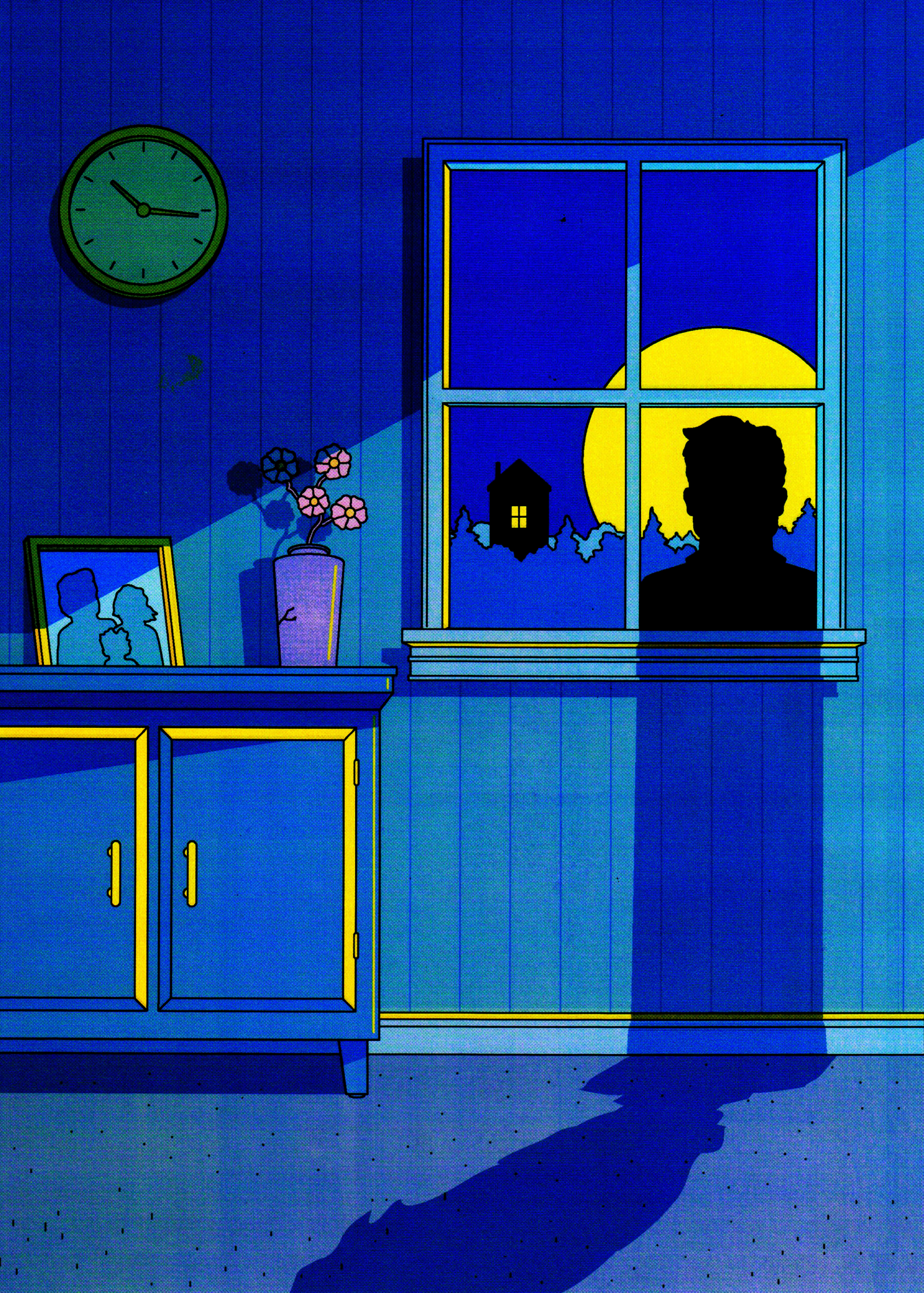
The first thing I noticed was that the house didn’t have Ring cameras. I climbed the stairs to the front door. I walked over to the side yard. I checked the garage. It was a family of four that lived there now. The husband drove a silver Subaru with roof racks and a Thule roof box—most likely for skis. The wife drove an Audi four-door. They had two kids—an older daughter and a younger son—no pets, and the wife had a normal office job, more of a nine-to-five, while the husband had some flexibility in that he owned his own chiropractic practice—Dr. David Demonteverde, I learned from searching their mail. They looked like a nice family. I had no problems with them per se. It wasn’t that I was watching them. I was watching the house.
It was my house. It was my family’s house. It used to be our house, and no longer was.
I got ahold of city records from the city clerk’s office. Originally at 848 Alcott Street there stood a gabled wooden home. The house was moved from a nearby city, date of moving operation unknown. A second floor was added in 1936, but the whole house was razed in 1979. Our house was built the following year. In fact, two houses were built on the same plot of land—two tall-skinnies, three stories each, with a garage and storage room on the first floor, living room and two bedrooms and full bath on the second, and on the third was the kitchen, another living room with fireplace, the dining room, a half bath, followed by the master bedroom and bath. The house didn’t have a front yard, just a driveway with two planters on either side, one shared with the sibling tall-skinny. Then, there was a fenced side yard, and a small back yard. The house was made of wooden shingles in a tight-looking weave. The original paint job was cherry red. Looking up at the house from the street, the house had the countenance of a garish glare. When we had the house painted a light blue, the house still looked alert but more welcoming.
Now the house had gone gray. Now it just looked sad. The fascia was beginning to rot, the wooden shingles loosening, buckling. The new family wasn’t taking care of the house like they should have been. They were letting it go.
I lived not far—half a mile, to be exact. My wife and I were renting; we didn’t own. We had plans to own, to put a down payment on something. We had one son, and we had plans to have another. We lived in a four-on-a-lot, about a thousand square feet. It was tight with the three of us. If we wanted to grow our family, we needed a bigger place. And it didn’t make sense to rent a bigger place from a cost perspective. That money was better spent on a mortgage. But after I got laid off, we had to reassess. My wife practiced law with her father. They owned the practice together. It was his practice, to be exact, and she started working for him, with him, after law school. Her father and I got along just fine for the most part.
I took care of James. We got rid of the nanny, kept the cleaning lady Daphne. We were still building our empire—we could still build off of my wife’s sole income. All I had to do was take care of James. Then he started going to school, and I had time on my hands. He started kindergarten. I packed his lunch, brushed his teeth for him. I walked him to school each day. Then I had the whole day to myself. I was supposed to be looking for work. I was trying to figure things out—what I wanted to do. I had worked in sales, but I no longer wanted to do that.
I started driving by the house more. I started going there every day.
The color of my wife’s suit jacket was heather gray. She wore matching pants and black heels with closed toes. I watched her grind the beans directly into the espresso portafilter. I liked to grind intermittently, use the tamper in between. She didn’t have time for that. She pulled the walnut handle away from the burr grinder, and the tiny mountaintop of ground espresso had a mini landslide onto our kitchen counter, the one that needed regrouting. I held my tongue as I watched her fingers naked of polish grab ahold of the tamper and press the grounds down into the portafilter. Her phone pinged. My wife was in trial that morning.
Did you sleep okay?
Sorry, what? She fit the filter into the espresso machine, pressed for a double shot. It was a quick draw—there weren’t enough grounds or they were too coarsely ground or both.
I repeated my question as her phone chirped again.
Dad! James said from the bathroom. He needed wiping.
Sorry, I can’t talk, my wife said to me, downing the double shot. She put on her backpack, grabbed an Uncrustable from the freezer. She unwrapped it, stuck it in her mouth, held it between her teeth, grabbed her tote.
Those are supposed to be for James.
Sorry, I know.
She pulled the Uncrustable away from her mouth, pecked my lips with hers.
Love you, James, she called as her heels scampered on our hardwood. Our front door yawned open and shut.
Love you, James said, but she was gone, her electric car dinging in reverse.
I went in there and wiped with the flushables.
Ow, he said. Too rough.
Sorry, I said.
I washed my hands and ate one of his Uncrustables too. Then I walked him to school.
When I arrived at the house, I parked around the corner, by the old shack. There was a 30-foot pine that had always been there, never left, on the front lawn. I heard a dog bark, far off.
The driveway of the house was empty. I walked up its slope. An Amazon delivery truck swooshed by. I went to the base of the stairs between the two tall-skinnies. I stood in between the neighbor’s and my own. What used to be my own. When I looked up, there was a sliver of blue sky. I took a deep breath. I smelled rosemary from the planter, the damp residue leftover from the marine layer that had come and gone—wet soil, wet wood, wet cement. I smelled my childhood, and I felt a sudden sense of awe when regarding the sky again, a stillness within. I didn’t want to let this feeling go.
But the feeling did go. I couldn’t hold on to it.
I needed more.
The hard soles of my rubber boots mounted the stairs loudly—there was empty space underneath, a crawl area underneath with leaves and debris. The whole thing hummed metallic, vibrated as I climbed.
The doormat was wet. It said welcome on it. I lifted its edges, looked underneath. No key. I ran my fingers around the planter saucer of a tiny olive tree near the entryway. My fingers touched water, dirt.
When I found the gate to the back yard, I reached over, tried to lift the latch. It was padlocked in gold.
I couldn’t get in.
The man wore thick-framed square eyeglasses in the style of a 1960s politician. He had shoulder length, slightly curly hair. He wore a long-sleeve dry-fit shirt, tech workout pants—they each fit him snugly. He was in shape and it was possible that he’d just come from the gym. He was standing cross-armed, watching his son kick the soccer ball to him. Then he’d kick it back leisurely, arms still crossed.
I recognized him right away. His face. In the photo on his website he was in a white doctor’s coat. That was the only difference.
It was Dr. Demonteverde. David. It was him.
His son was maybe a year older than James. James was on a bench with his Pokémon cards. They didn’t go to the same schools, my son and his son. I had checked. We were zoned differently than them.
Hey James, I said. He didn’t hear me, had undiagnosed ADHD already.
James, I repeated.
What?
Don’t you want to play, make friends?
I don’t see anyone from my school Dad.
Well, maybe you can meet someone new.
My son liked this park, even though he was on the bench with his cards. This park had spongy black astroturf underneath the playground instead of sand. My son didn’t like sand. There was a basketball court, a grass area that doubled as a makeshift soccer field if you brought your own goals. There were two tennis courts.
What about that boy there? I said to my son. He looked up.
I don’t know him.
I heard him talking about Pokémon with his dad.
When?
Just now.
No you didn’t. You’re lying.
No I’m not, I swear! He’s got a huge collection. Maybe he’ll want to trade.
Well, he’s playing soccer, Dad.
Just go ask him, I said.
No, Dad. I don’t want to.
If you go ask him, I’ll take you to the comic book store later.
Fine, he said. He left his cards there in a messy stack, and I followed behind him.
Hey! James said, running over. Want to play Pokémon with me?
The boy had brown hair, a mushroom cut. His hair was straighter than his father’s. He wore a soccer jersey and knee-highs but no cleats—just Velcros. He looked over his shoulder at my son suspiciously, and I detected a whiff of the same vibe from his father the doctor who squinted at me. I returned a calm smile, no teeth.
I don’t have my cards with me, the boy said, with the black-checkered soccer ball stopped underneath him.
That’s okay, James said. You can play with mine.
Go ahead, the good doctor said to his son. We can take a break.
He gave me a tight-lipped smile, and we followed the two boys together to the bench where the cards were waiting.
The son’s name was David too. David Junior. James was going on about the HP of one of his cards, said it was close to 300. David Jr. looked bored. He looked up at his father often.
They play well together, I said to the father. He didn’t respond, swiped the screen of his phone with his meaty thumb. He had strong-looking hands—the hands of a chiropractor.
So where do you guys live?
We live around the corner from here, he said. I knew that. That’s why I selected the park.
What street? I said. I wanted to hear how he said it, if he took ownership of it, if I’d hold him in contempt or give him grace.
We live over on Alcott Street. His feet were clad in black cross-trainers with gum bottoms, and with his left toe, he swept over a rock on the sidewalk.
I hear it’s a nice street.
We like it, he said. He checked the face of his big chronograph.
David, we should head out soon. Almost time for lunch.
On cue, his son stood up, ready to leave.
James, what do you say to David.
Thank you for playing Pokémon with me, James said. I patted his head softly, proudly.
I thought of the house.
We should get the boys together again, I said to the father. Maybe a playdate.
The corner of the doctor’s lips turned up in amusement. His face was freshly shaved, slightly red with vigor. There was a rustle in the trees overhead, a chase of squirrels underway. I felt a cool breeze on my neck. I waited for his response.
I’m sure we’ll see you around, he said. And just as quickly, he turned away, the son kicking the ball to himself all the way to the bike rack.
When we got in the car and started driving, I found myself behind them. They were in the bike path of the tree-lined road, and David pedaled the bicycle while his son sat in a trailer hooked in the back. David Sr. and David Jr. did not wear helmets.
I felt a sense of indignation, of rage. I couldn’t place it at first—the man, he’d said nothing wrong.
I drove slowly. There were no cars behind, and James wasn’t paying attention, looking out the opposite side with an iced oatmeal bar in his mouth. A fog bank had rolled in.
It wasn’t what he said, I decided. It wasn’t even how he’d said it, I decided. It was because of who he was.
They slipped in and out of a cloud as I stayed steady behind, a steady incline.
The superior doctor, the chiropractor with his wise worn eyes, his condescending lower lip.
I slowed at the red light and they did too, then it turned green. I lost them in a sweep of marine layer. I could no longer see ahead.
He lifted the toilet seat and took a piss in my house. He took a shit in my house. He walked barefoot in my house. He fucked in my house. He threw his dirty sweaty clothes in my house. It was my house before it was his. He didn’t know this, of course, but he should. He should walk the earth with a softer step. He should wear a fucking helmet.
Sometimes, when I cook something on the stove, I won’t notice the smoke right away. I have to open the window by the sink, and then I can see again.
There was a break in the fog, and my car almost swiped the side mirror of a parked pickup truck. I swerved away, and when I looked ahead, the bike with the little trailer and David Jr.’s bobbing head was before me.
Dad! James said.
I braked hard, the car screeched, and I pulled the wheel to the left just in time.
I didn’t hit the bike, but the good doctor jerked the handles, looked right at me as they were alongside me. I kept driving.
In the rearview, they had toppled over, the father mainly, but they were fine. The good doctor was righting the bicycle, and the boy, he was fine, they were good.
Good, I thought.
He had fallen down.
Good.
I drove into another cloud, lost them.
Then I made a right, and headed home.
I was on the opposite side of the street. I was on foot when I saw the woman. I walked fast—she didn’t see me. But I recognized her. She was in a big jacket, spandex, running shoes that squeaked. She had her hair tied up. Her face was wet and slick from sweat. She carried bags. It wasn’t the wife, no. She mounted the stairs—I heard her footsteps echo as I slowed. I heard the jangle of keys, the door unlock—open.
It was Daphne, my cleaning lady. She was cleaning their house. She was their cleaning lady too.
The neighbor had referred her to them. Carol was her name. Her husband had used Daphne, and when he died, Carol remained in the house. She didn’t remember me, Carol. I hadn’t seen her in years.
Daphne told me this when I questioned her the next day, when she was in my kitchen. I tried to be discreet.
Do you still clean the old house? I asked her as she ironed a dress shirt of mine. Our place was small—she was done with it in half a day, but she stuck around. Maybe out of concern for me.
She didn’t need to iron any of my shirts. I asked her why.
In case you have an interview, she said.
We call her Daphne, but I don’t know her real name. She came to our family when I was young, when we lived in the original house. She came to us from Sri Lanka.
I watched her spritz the surfaces of the house. I waited until she disappeared into James’s room, with a pile of his clean clothes ready to fold.
I found her key chain with the blue pom-pom sticking out of a side pocket belonging to one of her bags.
Be right back! I said from the front door.
There was a locksmith around the corner from us.
When the soft taps of the rain began on our roof, I was putting James to bed. He was tucked in, and I cut him short after one sentence of reading, of sounding out. He was stuck on the word lost. I found my wife in the dining room on her laptop. She still had work to do.
I heated up the kettle, made myself a cup of chamomile. I mixed it with honey. I stirred it slowly. I stirred some more, looked out the window.
I walked over to the sink and dumped it, found the Old Forester in a cabinet, brought it out. I cut a lemon, squeezed it into a glass, heated up a little water, poured it all together with the whiskey. I drank it all in one hot sip. I poured a little more whiskey. Then I cleaned it all up before heading out the door.
Where are you going?
A walk.
Isn’t it raining outside? The patter sounded like knuckles. They were knocking all over. I could feel it inside my head.
Well, then, I’ll go for a drive.
Okay, she said defensively, like I was yelling.
Earlier that day, their garage had been open, and the Thule box atop the Subaru was also open. It was empty, like a shucked clam—but I knew skis were going inside. I knew the doctor and his family were headed to the mountains. I had heard the forecast on the radio in inches of snow.
When I arrived at the house, I parked the car two blocks away for good measure. The Audi was still there, but the other car was gone. They kept the night light on, the oldest trick in the book.
When the bald locksmith with the walrus mustache questioned which key I wanted copied, I told him all of them. He gave me a long look, but he did what I paid him to do.
The key that worked had dimples on it, and when I opened the door, I was greeted by warm air. It felt like a hug. I locked the door behind me, kept the lights off.
I took off my shoes. I took off my socks. I grounded my bare feet for a moment on the oak floors and let my eyes adjust to the dark. Upstairs was the living room with the vaulted ceiling. I went up there, and through the big picture windows, I saw the outlines of trees and hills, the whole city beyond. Somewhere out there was my son and my wife. I could see everything.
In the kitchen, I placed my hand on the cool marble island. I’d sat at that marble waiting for breakfast my whole life.
Things were orderly in the white cabinet kitchen. The drying rack was empty. The countertop was bare except for the usual appliances. The succulent plants on the windowsill near the sink were well maintained, clipped.
In the refrigerator, I opened the lids of square and circular glass containers—these weren’t the cheap plastic kind that stained. There were cubes of beef bourguignon leftovers. There was a bottle of bordeaux with a five-inch stopper. In the liquor cabinet I found a collection of Japanese whiskey bottles.
Help yourself, I said to myself.
I helped myself.
In the freezer I found pints of ice cream. They were all dairy-free. I had some anyway. I put the used spoon back in the bamboo utensil tray.
In the office I pulled a heavy leather-bound volume from the stacks. I spread it open across the desk and ran my finger along its gutter. I sniffed it. The book was nice and clean.
I walked down the hallways with baseboard and beadboard.
In the master bedroom, I found his side and her side.
Suddenly, I felt hot. I undressed until I was in my underwear. My stomach made a noise.
In the bathroom, I closed the door, flicked on a light. Then I saw it. The mustard-yellow floral wallpaper. This wasn’t there before. It was eye-catching, but not in a good way. It was upsetting. I scratched at it with a fingernail, hoping I could find what was underneath. I punched the wall, then pissed into the sink. Some of it splashed onto the quartz.
I sat down on the toilet.
I thought to myself and wondered.
I tried to go back all the way to the very beginning, but all I could remember was my mother clipping my fingernails over the porcelain sink—how she cut too close to the cuticle—or my father polishing the dining room table with a screw-top metal tin can of Howard’s, and the sound of kitchen knives being sharpened against a steel rod.
I took a shit.
After, I spent some time in the little boy’s bedroom. I thought some more. I sat at the edge of his bed with the bumpers.
Then I went home.
The next morning, my wife left early. My son was still sleeping, and when he came down the stairs, he found the binder next to his cereal bowl on the Formica table.
The binder was black and it had a lightning bolt down its center. My son opened it and began flipping the pages of plastic sleeves filled with cards. There were hundreds of cards—the ones he always wanted.
Dad, where did you get this?
The comic book store, I said.
My son’s cereal went untouched.
The binder was his now. He owned it.
A week later, we went to the park with the duck pond and the ducks, but the pond was drained and the ducks were gone. Sitting under the shade of a tree was a homeless person with half-full jugs of milk scattered around him. People kept their distance.
My son sat on the edge of the concrete skating rink with his binder next to him. He was eating some Pirate’s Booty, licking his fingers, as boys and girls scootered and skated by.
A boy in a blue shark helmet with a flip visor rounded past, and the second time he edged even closer on his scooter. When he stepped on the back brakes, the scooter screeched, like something about to die.
I recognized the boy right away.
Hey, the boy said to my son, not looking at my son. That’s my Pokémon binder!
A woman in a baseball cap and a man’s dress shirt and jeans approached on foot on the periphery of the sunken rink. I recognized her too.
What’s wrong, honey? she said to David Jr.
Mom, that’s my Pokémon binder!
My son now held it against his chest, protecting it.
Honey, there are many Pokémon binders like the one you had. Remember, you lost yours at school during Share Day.
Turning to me, the wife said, I’m so sorry. She smiled and I noticed that her bottom front teeth were a little crooked.
Hey, don’t I know you? the boy said to my son.
Yeah, we played together at Sutherland Park.
Oh how funny, the woman said. We go there all the time.
Same with us, I said. The woman, she was nice. She stood close to me like we were friends. And maybe David Jr. picked up on this, because he leaned his scooter against the steps and sat down next to James.
My hand was in my pocket, my fingers fingering the key.
You guys live close by? I said to her—Stacy. She hadn’t told me her name, but I knew it already.
We actually live closer to the other park.
Same with us. We’re on Herrington.
Oh, that’s right around the corner from us!
I felt the grooves of the key, the dimples.
What street are you on?
The sun hung over my right shoulder, and her eyes were the color of blue Listerine as she answered.
I took a step closer, sending my shadow across her face.
Then, the shouts started happening over by the nearby tree. We all turned. It was the homeless man. He was standing, looking up at the inhabitants. He shouted unintelligibly, and then he shouted again—this time I understood:
Fuck outta here! he said. This is my tree!
He lobbed something into the air—a rock, or a piece of bark, or a big rusty bolt nut—and it bounced off a branch. Birds scattered but the squirrels above remained, their claws deep in the wood, rooted.
Who to side with? I asked myself.
It made me reconsider my position—but just for a second.
Eventually this other man gave up.
I, however, proceeded according to plan.
James opened the binder on his lap, revealing a page of cards studded in flecks of gold and silver—they shined like jewels, like a book of light. He turned the page, the other boy silent. James named each of the cards one by one. It was his now. The binder was his. He owned it. I taught him that.
So, I said, turning back to Stacy. Is this a starter home for you guys—the house on Alcott? But before she could answer, we were interrupted yet again.
Hey! That’s my Charizard right there! David Jr. was pointing at an orange dragon with flames coming out of his mouth.
And that one too! David Jr. said, his finger poking the image of a yellow duck with three weak strands of hair.
David! Stacy said. What did I just finish telling you?
There was a click, and then another as my son opened the binder. He lifted a plastic sleeve filled with nine cards, the ones in question, and handed it to the other boy. Then, he handed another.
James, I said.
No, Dad, he said. It’s okay.
It wasn’t okay.
James, I said again, but he didn’t listen. He kept giving and giving instead of taking.
This is when my disappointment began in the man he would become. 
Ashton Politanoff is a frequent contributor to NOON. He is a former Division I tennis player, and his childhood coach was Robert Lansdorp, who is credited with coaching Pete Sampras, Tracy Austin, and Maria Sharapova. Politanoff’s first novel, You’ll Like It Here, was published by Dalkey Archive.
Illustration: George Wylesol
