I was living with my parents again. All of us were old, including the dogs. We spent our days lying down in separate beds. Sometimes the smaller dog would push his diapered body into the bed of the bigger dog and try to curl up with her. She’d groan and go lie down underneath my father’s desk. Sometimes my father would fall asleep sitting up at the desk, frozen in front of the computer screen with his mouth hanging open.
I was getting around on a walker by this point. The walker was a small one built from a kit. The wheels had been cast crooked in what looked to be a manufacturing error. I kept running over my own feet. Whenever I’d wheel into the kitchen, the dogs would plop down on the tile, waiting for me to drop some food, and I wouldn’t be able to maneuver around them. They soon found they enjoyed sitting around my feet, joining me in the open space inside the walker, behind bars.
Mornings in the kitchen, my parents and I would observe each other to see which one of us had the strength to take the trash out. We started tying up trash bags when they were still only half full to keep them from getting any heavier, but then we had to take them out more often. We kept trying to come up with little schemes and workarounds. We paid a neighbor to move a bed into what used to be the dining room. We put a seat in the shower. Because the government had once compelled my father to serve as a marine in the Quang Tri province of Vietnam, the VA agreed to pay for the installation of a motorized stairlift. The lift ran on a track joined together by big metal knots that’d been drilled directly into the steps. Whenever we rode up, the chair would wobble over each knot and make a sound like the drop of a coin.
My father had just had another knee replaced, and my mother was monitoring a clogged artery. He liked to say she worked hard herself enough to keep the blood pushing through her heart whether it liked it or not. I was still young at being old. I cried all the time and I was afraid to leave the house. They were about to take me to go get x-rays of all my lower joints when my aunt Tessy called to tell my father that his job for the day was to keep her from dying. She was on new pills and had been hallucinating for days.
“Timmy. Take me home right now.”
Ever since they were little she’d called him Timmy, which had never been his name. She would tell people they were twins and threaten to dress him in bow ties.
“You called me from your landline, Tessy. You are home.”
“I will concede that this looks like my home. But it is not my home.”
“Where do you think you are? Where’s Steve?”
“They made all this look like my condo and they made him look like my husband so that I’d get too comfortable and then they’d be able to kill me in my sleep. Don’t tell the girls none of this. This can’t be how they remember me. Hunted down like a dog.”
“Don’t think like that. You know the girls love you.”
“Am I on speaker?”
“I don’t know what you’re talking about.”
Whenever Tessy called like this, I’d try to imagine her as her happiest self, hold a picture of her in my mind to make real like a spell, and what I always saw was her wearing sunglasses and driving to the mall.
“Here’s what we’ll do,” my father said to me. “Your mom’ll take you to the doctor by herself and I’ll go check on Tessy.”
“I can just go another time,” I said.
“You know, you could go by yourself if you had to,” he said. “It’s not like you’re paralyzed.”
“Honey,” my mother said, “what if she ends up paralyzed?”
“Either way, you’re going,” my father said, pointing his cane at me.
“We are going downhill,” said Tessy from the phone. “You know that, Timmy? It’s all downhill.”
My mother was anxious about driving. She’d hold on to the steering wheel saying, “Thank you, Jesus, for being in this truck with us this morning.” She’d fiddle with the radio trying to find the silliest possible song to distract us, eventually landing on the music of the 1940s, songs with three-part harmonies and words like boogie in the title. I sat in the back seat with the walker laid across my lap, and my bones were sore. We rode past the ship channel and out the windows were all the plants and refineries, tall metal tubes puffing clouds of gray smoke. When I was a child, I’d asked my teacher why there was always so much pollen where we lived no matter the season, and he said it wasn’t pollen, it was sulfur dust. “They say sulfur smells like rotten eggs,” he said, “but in this town we say”—here he closed his eyes and tipped up his nose a little, as if in a delicate reverie—”smells like money.” Our school sat between two of the refineries, and whenever there had been a spill or a leak or some kind of accident, we would hear a siren and then be told to stay inside for the day; no one could leave.
“You will be so glad you got this done today,” my mother said. “The clinic is nice and clean.”
“Hope I don’t slip and fall on my ass,” I said.
“Honey, even if you do, there’s medical professionals in there.”
“I don’t want to have that moment of lying there on the floor waiting for them. Or the moment of seeing them run up to me. I just don’t want any of it to happen.”
“I don’t think it will. Let’s pray that they take good care of you today, and if they don’t, next time we’ll bring your dad and he’ll scare them into acting right.”
My father used to scare people. He was built like a bear and he had a big black mustache. Everybody thought he was a cop, or otherwise some kind of mobster. The first time we had to evacuate from a hurricane, we were stuck in traffic for hours, and whenever any cars tried to inch into our lane and cut in front of us, he’d roll down a window and say, “Hey, I have a gun.” Then he’d hold it up and show it to them, all its angles and sides, like a casual object of interest. But my father grew old. He lost weight. His mustache turned white. He had various Agent Orange diseases, and more than one pain doctor had banned him for life for yelling at the office staff. “Let me get this straight: They aren’t going to give me the pills I’m addicted to even though I’m addicted to them because they gave them to me in the first place. Makes sense to me I’d be a shitbird, but they all act surprised I’m not being a little Timmy about it.”
The entrance of the clinic had a cover like a carport. Save for the little shadow space underneath the cover, everything was pale concrete and bright sun. Ahead of us in the drop-off line was a paratransit bus, the kind I used to take until I moved back home. The driver was escorting a woman with a unicorn backpack and a fresh cut bleeding down her arm. The woman was screaming and the driver had no reaction to her cries. He pressed the handicapped button to open the clinic door for her and then returned to his seat.
“You’re up,” my mother said.
I strained myself leaning halfway out my seat setting the walker up on the concrete, and the device waited for me there as I tried to hoist and slide my body out of the car. When I stood, I could feel the weight of myself pressing down into every joint, all through my legs and feet and into the concrete. I held on to the walker so tight I thought something might snap. I had no stride. I could only rock myself back and forth in a kind of waddle. Past the glass door of the entrance there was something like a cove, a room before the real room, with only a hard bench and a busted dispenser for hand sanitizer. I stayed there while my mother parked, and I was still there looking out at the parking lot when she returned. There were no trees in the lot and the dispenser was empty.
“I could just wait here instead of going to the waiting room,” I said.
“You’re going,” she said.
I kept my eyes on my feet and wheels and tried not to look up. The clinic was big and open with shining floors reflecting panels of fluorescent lights. The light distorted everything. Even when I lifted my head and looked right at the front desk, I couldn’t tell if I was about to run into it or if I still had a long way left to go. I could hear the unicorn woman from the bus screaming again from behind a few walls.
“What’s going on with Tessy?” I said when we sat down. “Tell me something.”
My mother put her reading glasses low on her nose and typed away on her phone. It made several quick sounds in succession, all of a choir singing the single word hallelujah. This was her default noise for any notifications.
“He says he’s keeping her distracted,” she said.
“Keeping her distracted” meant flipping the channel to the Home Shopping Network, then letting out a low whistle and saying under his breath, “Now those are some butt-ugly shoes.” Tessy would cut her eyes over and say, “Couldn’t pay me to wear them.” Or he’d say, “You need a coat? This one got all kinds of fur on it. Winter’s comin’ soon,” and then she’d say, “Timmy. Don’t offend my sensibilities.”
Children ran around our chairs. Colors from a muted television in the corner flashed and mixed with the reflected light on the ground. We must’ve waited the better part of an hour. It hurt to sit, but it also hurt to stand, but it also hurt to walk. There was nowhere to lie down. I made myself pace slowly back and forth in front of my mother’s seat, shuffling my heavy legs and rolling past her.
A nurse stepped out, calling my name. Seeing I was moving slow, she came over and put her hand on my back to push me through the door and into a hallway even brighter and whiter than where we’d been. There were no shadows to keep the floor, the walls, the ceiling from all flattening into each other. My throat closed up and I tried to talk, and when I couldn’t talk, I tried to move away from the nurse’s hand.
“Tell me about your dog,” she said, pushing me harder. “We got a whole litter of kittens at my house right now. Our cat is a sweet little mama! You wanna see a picture? As soon as we get into that room down at the end of the hall, I’ll show you a picture.”
My walker wheels got caught and then turned off to one side. I stopped to readjust and the nurse, confused, took her hand off my back and looked down. I seized the opportunity and zipped away into the nearest exam room with a window. I turned off the overhead light and I was there in darkness, save for the light coming through from the hallway and the sun glowing from behind the stiff white curtain.
“Honey, we already got this other room for you down there,” the nurse said.
I sat down and shook my head, not looking up at her.
“Okay, well, maybe we could just use this room. You need some water? I’ll get you some water and you tell me about your dog.”
My mother caught up to us and walked in saying, “How did you know we have dogs?”
“Well, you brought them along with you,” the nurse said, pointing to the clumps of dog hair stuck to the bottom of my walker.
“Oh, that’s embarrassing,” my mother said.
“Please, I am covered in fur at all hours,” the nurse said, handing me a paper cone of water. “These little kittens get into everything. They climbed right up into the dryer! Must be nice and warm in there. I’ll show you my babies and you show me yours.”
She took out her phone and showed us several patchy, scrawny-looking kittens crawling in and out of the open door of an empty clothes dryer. In other, calmer pictures they were curled up asleep on a fluffy blanket, their bodies all blending together.
I showed the nurse a younger picture of Lou, the bigger dog, running free and happy in the backyard with her tongue hanging out. I didn’t tell her that Lou didn’t run anymore because she’d been gaining weight and had developed arthritis. After any brief exertion or even light activity she’d go lick her paws and legs in distress. I showed the nurse a younger picture of Fred, the little dog, looking clean and smart in a turtleneck sweater for Christmas. I didn’t tell her that Fred had been losing weight. His hips and spine looked all knotted up inside, and he moved slow and bowlegged, like an old cowboy. There were tear stains running down his face and deep indentions and scars on his head from where a few large cysts had been removed. I showed her a picture of both dogs posing together on the couch in better days. I didn’t tell her that in more recent days, Fred would seem to forget where he was and just stand there blocking Lou’s path for too long, and she’d lunge at him and make desperate, wild sounds to move him out of the way. I was afraid every time because I knew I’d be too weak to hold her back by the collar if she ever snapped.
“Precious!” said the nurse. “Okay, you drink your water in here for a while and Dr. Purdy will be with you in a moment. I think he’ll be a good fit. He used to be a pediatrician.”
“I’m sorry,” I said.
“I don’t need to understand it,” she said as she left.
“That girl is tough,” my mother said. “I could see her flexing her muscles pushing you through that door.”
We sat in the dark, quiet exam room. I coughed and cleared my throat to remind myself that I could breathe. My mother pulled some rough brown paper towels from a dispenser on the wall and wet them in the metal sink. She handed the clump of wet paper off to me and lifted and angled the walker so I could wipe it down. The wet dog hair stuck to my hands.
“So gross,” my mother said, getting more paper towels to dry everything off. “I hope Fred hasn’t been secretly peeing on it too.”
Before we started keeping Fred diapered, he’d pee wherever he pleased. He looked cross about it, as if peeing were his way of registering a complaint. He’d come see me in my makeshift bedroom in the dining room and he’d stand there with his head held low, ears fanned out to the sides, listening to me say, “Hello, little man, hello, buddy boy,” and then finally he’d just blink at me and lift his leg. He seemed to like peeing in front of me best, and so in that way, it was good that I lived in the dining room, where there was no carpet. When I moved in there, I remembered that in junior high school my friend Shayna Zapalac had an uncle in a wheelchair and he lived in what had been her parents’ dining room. I never saw him. Whenever I was over there, I only knew he was in that room, behind the door. They’d take me out for supper and they’d say, “Oh, we’ll bring something back for George,” but there was never any rush to get home. I never knew if he was hungry and waiting. Their kitchen wasn’t built for wheelchairs; none of the rooms were. I don’t know how well he could get around in the house because I never saw him get around.
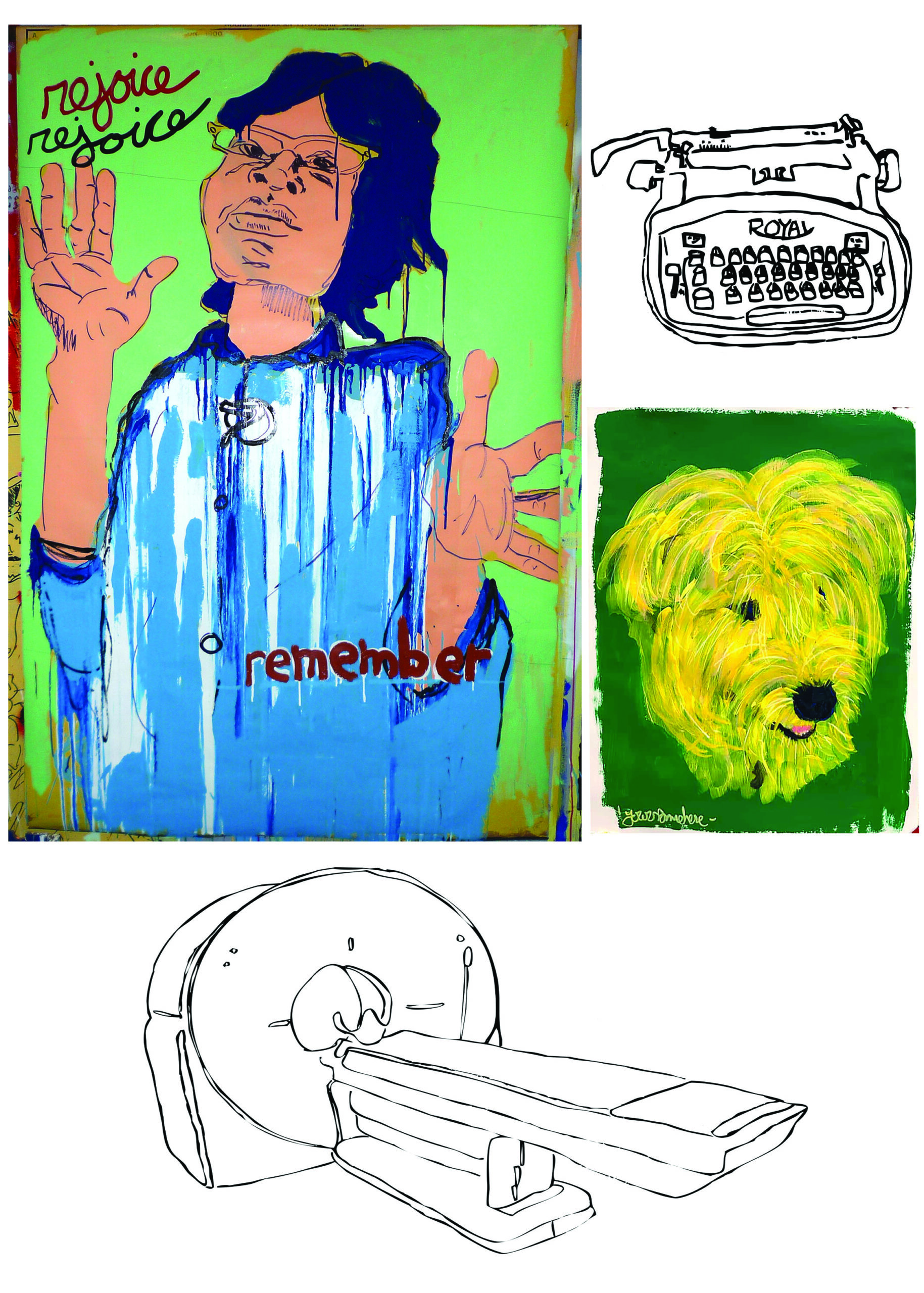
Dr. Purdy came in carrying a tiny laptop. He sat on a rolling stool and set the laptop down on a stool of its own. He had to hunch over the machine and I watched its screen rattle as he typed. The keyboard was too small for his hands and he had to peck at it with his pointer fingers.
“I hate this damn thing,” he said. “If I’m typing, it don’t mean I ain’t listening. Now tell me what brings you in here today.”
I told the doctor about my pain, and the walker, and how I’d tried just using a cane but I fell. He asked what I’d venture was the origin of the pain, and I said I’d started noticing that when I stood in the kitchen a while, whether cooking or cleaning, I couldn’t hold myself up. I felt like my own bones were too heavy for me now, especially with them all stacked on top of each other like they were. I told him I knew what that sounded like, that I was just depressed, but everything really did hurt from head to toe and I really couldn’t walk or even stand up without the walker. The doctor nodded and pecked at his keyboard.
“Real quick,” he said, “do you know what you want?”
“Pardon?”
“What do you want? Gimme a few hopes and dreams.”
“Well, I want to walk. Be able to take care of myself better and help out around the house. I live with my parents.”
Dr. Purdy kept pecking away. “That’s good. One more. Big picture. Sky’s the limit.”
“I don’t know. You mean like health goals?”
“Anything. Writing a letter to Santa Claus.”
“I think I’d have to be a whole new person to do something big like move out or get married.”
“I see all kinds of people with all kinds of things going on, and lo and behold, many of them are married,” he said, looking at us over his glasses. “All right, thank you for humoring an old man. Now let’s see you walk without this.”
The doctor rolled backward on his stool, pulling my walker along with him and offering it out to me like I was a baby. I shook my head. He rolled in a little and pushed the walker closer.
“Two steps,” he said. “That’s all I need. I’ll come around to the side and you hold on to me to help yourself up, and I’ll be right here the whole time.”
I put both hands on the doctor’s shoulder to steady myself. I tried to yank one foot forward but the joints in my hips could only wobble from side to side. I felt like a set of poorly stacked dishes. I yanked the other foot forward and grabbed on to the walker. Dr. Purdy pushed my chair back under me to make me sit and went back to typing.
“All right, we’re going to send you down to Imaging and get a few pictures of your bones and joints and all, and I’ll make a lab order too so we can be real nosy and take a look at your blood. Fasting. Return at your convenience. Any questions I can answer for you?”
“Dr. Purdy,” I said. “Am I faking it?”
“That’s not a question I can answer,” said Dr. Purdy.
The doctor left and we sat silent in the dark room. My mother’s phone started singing hallelujah again and she answered my father’s call.
“How’s everything going with Tessy?”
“Oh, she’s been rowdy this time. Locked Steve out of his own house and kept saying she was going to end it all, so we got her over to the ER, but then she threw a trash can at a nurse.”
“She did not,” my mother said.
“They got into some kind of tussle because they tried to touch her to get the IV in. I guess she just jumped up and threw the biggest thing she could find. Then they all come running in and restrained her in the bed. Put those straps on her arms and legs. She was fighting it. Puffing out her chest and wiggling around like something pitiful. Terrible. But at least then they could give her the IV. Anyway, Timmy is officially off Tessy duty. Steve can handle her from here. I can’t wait to go take a pill and lie down. Did you do the x-rays?”
“Not yet,” I said.
“You better do the x-rays and you better do what the doctor tells you to do. Your mom and I aren’t going to be around much longer, so you better get your shit together or else you’re going to be alone and living in some kind of poorhouse mental hospital.”
“I’m trying. I’m just in a lot of pain.”
“You’re in a lot of pain? This is the least amount of pain you’ll ever be in.”
To get to Imaging we had to go through a door and then cram together into a space meant for only one person, a room just the size for one body to stand in. In front of us was another door with a sign instructing us to press a code into the panel of numbered buttons on the doorknob. Once that door was open, we were in a long, empty hall, with big windows on one side looking out onto the parking lot. At the end of the hall there was a room with only darkness inside. All around the room were warning signs with symbols and the word DANGER. A technician waved to us from across the distance while she helped an old man also using walker roll out of the empty darkness with her.
“So I’m supposed to go in there willingly,” I said.
“They really put that room as far away as they could,” my mother said.
“It’s like when they lead a cow down a long path so they can trick it into getting its head cut off,” I said.
“Honey, it’s just x-rays,” my mother said.
“I can’t walk that far,” I said.
“I’ll walk on one side and you keep your other side directly up against those windows,” she said. “You won’t fall.”
We walked slowly up to the edge of the room, coming at the darkness not straight ahead but sideways, from a corner. The technician was checking her laptop in a hidden cove behind a shield wall. Her desk had a little low-light lamp and an even smaller fake plant.
“Come on in, the water’s fine!” she said. “You doing all right?”
“It’s just that everything hurts,” I said.
“Well, you’ve come to the right place, my dear. All you’ll be doing here is lying down on this table and taking a rest in the dark.”
“That sounds nice,” my mother said, entering the room with us, still walking next to me. “I’m jealous. Can I get x-rayed too?”
Once we were in there, the dark was not so dark. Something about it glowed from the inside and took on a kind of mineral quality. The technician guided me to a long white table. She helped me sit on top of it, and then we looked up to find that my mother had disappeared.
“I didn’t even hear her leave,” the technician said. “She must’ve slipped out like a mouse.”
“She’s like that,” I said. “If it was my dad, you would’ve heard him. He would’ve announced it and slammed the door.”
“I bet that’s what makes them a good match,” the technician said. “Let’s get set up here.”
She helped me swing my legs around onto the table, and she placed my foot on top of a metal square, positioning it in the crosshairs of the aiming device, red lines being projected down from the machine. Even with the hard surface of the table underneath me I was so happy to rest my legs I could’ve cried. The technician placed a lead apron like a heavy blanket over me and I was knocked into lying flat. I couldn’t move. When I was child, my mother would stand at the side of my bed and tuck me in at night. I would reach up, arms stretched wide above my head, and she’d bend and let me hug her. I’d wrap my arms around her back, but then, as if possessed, I’d use all my strength to pull her down and knock her to her side. We would both laugh. I knew all along it was a kind of game, one we never planned or discussed, but still it took me years to realize she had fallen on purpose, that she had been letting me play at being strong.
The technician ran back behind her shield wall, into her little cove away from the radiation. I could see the light being projected from the machine and I heard a click. She kept running back and forth, positioning and repositioning each one of my joints to capture all the different angles.
“Try to keep still for each one. Like you’re taking an old-time photograph,” the technician said. “Get some rest! We’ve got a lot more left to do.”
“You know,” my mother said when we were back in the car, “when I was younger, I used to think getting old would be boring. Like you were just sitting around waiting to die. I didn’t think older folks were still taking care of people. But I’m finding now that I wish it were boring.”
“Or at least peaceful,” I said.
“I’ve got to tell you,” she said. “I can’t believe I didn’t already. Last night, I woke up and I went to the bathroom, and there was pee on the floor, just in front of the commode. It couldn’t have been Fred because the door was closed, and so I thought, well, your dad must’ve missed the toilet. So then—”
My mother started laughing so hard that she started coughing, and then she coughed so hard that she started tearing up. She pulled the truck off to the side of the road and dug into her purse for a tissue.
“I’ll try to get together,” she said, wiping her eyes. “So then—I was half asleep, mind you—I sprayed something all over it, just the first bottle of cleanser I could find. But there was this horrible smell, and even a gas, like what they call noxious fumes. I was panicking. I opened a window but the fumes were still going. I sopped it all up with a wet towel and I threw the towel out the window. I mean, I didn’t know what was going on. I was searching all over the internet, and turns out the cleanser had bleach in it, and there’s some kind of combustible reaction because of the ammonia in pee. Or only in fresh pee, anyway, excuse me. I woke up your dad to ask him what we should do, and he just couldn’t stop laughing. I said, ‘Let’s call poison control, they could at least calm me down,’ and he said, ‘Oh no, you do that and you’ll just need to calm them down, they’ll be laughing so hard.’ He said, ‘I can just see it. We’ll turn on the local news and they’ll have these green slimy letters saying TOXIC PISS with the big thud sound effects’—you know, like Marvin Zindler used to do?”
“Slime! In the ice machine!” I said, laughing. “Houston! Eyewitness News.”
“All these cameras and reporters on our front lawn. Some guys would be dragging your dad out of the house with hazmat suits on, and I’d be standing out there saying: Thank you so much, you all saved my life—I’ve been trapped in here breathing the fumes of his toxic piss for nigh on sixty years!”
We both couldn’t stop laughing. My mother started coughing and crying again.
“He said, ‘Yeah, I’ll be yelling into the camera: I was framed! There was no problem with my piss until she went and sprayed bleach on it—I wasn’t toxic on my own, not until she came along.’ And I said, ‘Yeah, that’s right! That’s love.’” 
Cathryn Rose has an MFA in literary arts from Brown University. She’s originally from Pasadena, Texas, and lives in Mississippi.
Illustration: Tim Kerr
