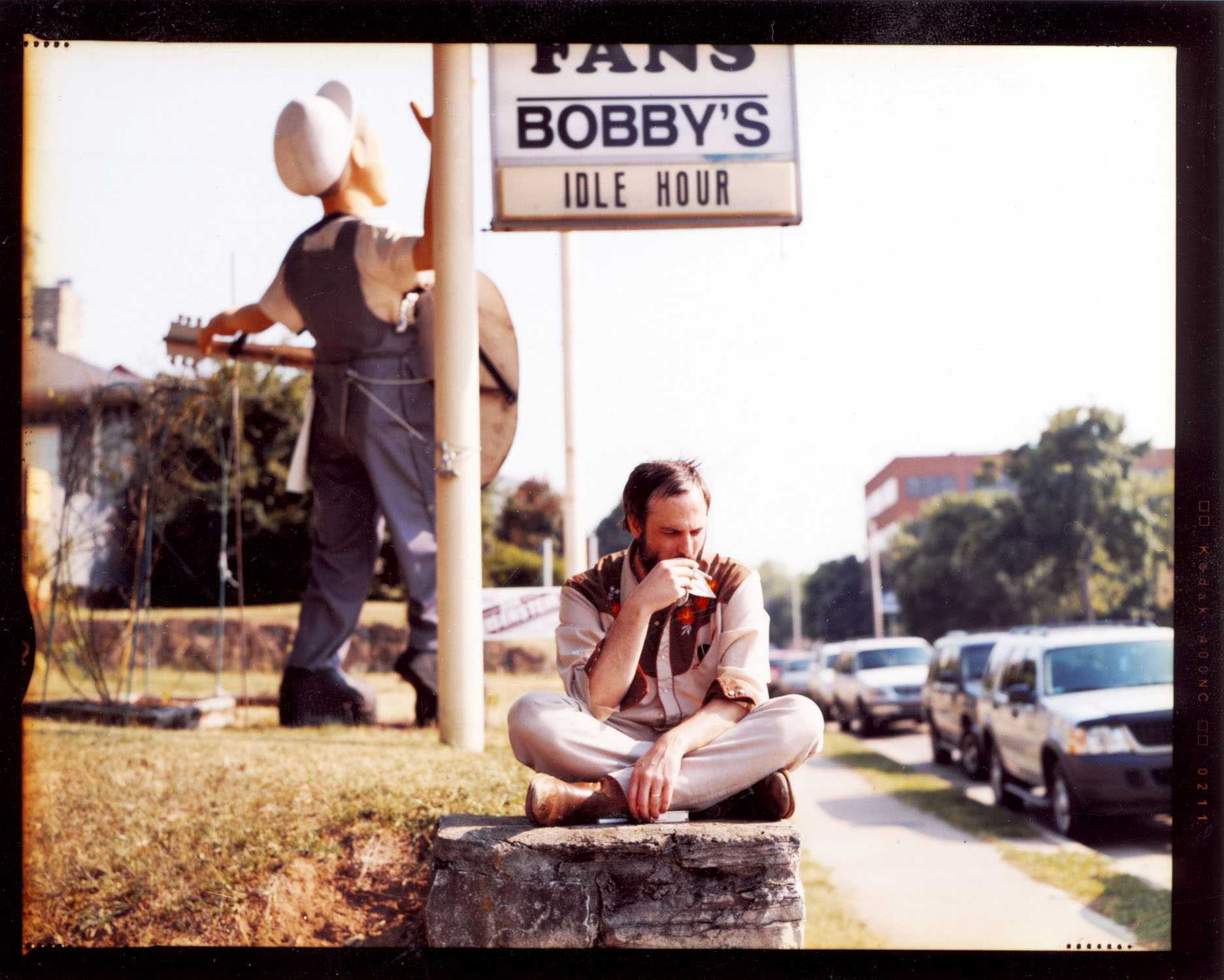
The last time I saw David Berman alive was on July 12, 2019, the day Purple Mountains was released. We’d hosted an art opening that night at Surface Noise, but it was close to ten p.m. and things were wrapping up—maybe one other person had lingered. I was putting away the booze and food when David walked into the store, unannounced. He asked right away if I had on hand a copy of his new record. They had arrived the day before, but I’d neglected to put any out as I prepared for the event. “Where are they?” David wanted to know. “Let’s see how it sounds.”
David had driven down from Chicago (he’d been staying for some time at the Drag City compound) and was on his way to Tennessee, where his wife, Cassie, and their dog, Gittel, were living in East Nashville. He said he’d stopped in Louisville to visit me and Will Oldham. In retrospect, it seems like a farewell tour—like he knew where this all was headed—but that never occurred to me then. As Purple Mountains played through, David leaned back in a blue chair across from me and closed his eyes.
People say it’s a difficult listen because it addresses so nakedly the psychic pain that anticipated his passing. Listening to it makes me feel good, however—mainly because it’s so good, but also because he’d aspired to such unfettered honesty for as long as I had known him. He considered the wry one-liners and sci-fi moves that characterized his writing to be “tricks”—tricks he seemed disdainful of even as they set his poems apart from our classmates’ at the University of Massachusetts and, ultimately, with the publication of Actual Air in 1999, from any other poet’s of our generation.
We’d met in the MFA program at UMass during the fall of ’92. David’s first year was my final one, so we didn’t overlap for long. We never had a class together, and we would hang out only a handful of times before I left Massachusetts. After graduation, when I accepted a position teaching in Missouri, David and I began to correspond, and that is how our friendship grew. When I told him I was getting divorced, he supposed that maybe I needed “time alone in the wilderness to write the poems [I was] meant to write.” One letter he sent included a copy of The Natural Bridge, the second full-length album by Silver Jews, a band he’d formed with Stephen Malkmus and Bob Nastanovich soon after they’d left Charlottesville. David had refused to give me a copy of The Arizona Record, dismissing it as “juvenilia,” but I’d liked its follow-up, Starlite Walker, a lot. I can’t say it had prepared me, though, for songs as timeless as “Pretty Eyes,” “Dallas,” or “Black and Brown Blues.” I called David to let him know how much I’d been enjoying it. He thanked me and said, “I know that it’s a great record, Brett—but there’s no way the world can love it as much as I need them to.”
While David and I exchanged letters, we were also exchanging poetry. I saw in manuscript every poem in Actual Air, and he could say the same about my work in Black Sabbatical. David was a painstaking editor who rarely sought feedback, but our strengths were stark inversions: My early drafts were woefully straightforward, and I revised weirdness into them by omitting transitions, weeding out the prosaic in favor of more and more audacious language; David, on the other hand, had an innately wondrous vision, fraught with unprecedented metaphors, chilling observations; yet he craved the kind of gutbucket emotionalism that came naturally to me. One poem I sent him, “Flowering Judas,” concludes with a telephone ringing over and over, heard by a stranger through an open window. Upon writing me back, David had said, “The difference between you and me is that I’d climb inside that window and answer it.” I couldn’t help but take this as criticism—illustrating how David was willing, always, to take things further than the rest of us.
This tendency could prove problematic outside the realm of art. There were tales of drinks thrown in David’s face by elderly restaurant patrons to whom he’d complained about their perfume. And the story of bikers in Barcelona who’d left tread marks on his forehead, running him down for some rank remark that could not be lost in translation. One time I picked David up in Nashville to see the premier of Be Here to Love Me, our friend Margaret Brown’s film about Townes Van Zandt. I was drug-free in that era, and while David had gone through rehab the year before, he remained on “marijuana maintenance.” His depression was too crippling, too profound, ever to be left unmediated. As soon as he’d climbed into my truck, he pulled out a one-hitter and fired it up. “Sure, David, go ahead, smoke pot in my car,” I’d snapped. “Never mind the fact that I’m sober and weed is my drug of choice.” “You—” he said, blowing smoke out the window, “you’re one person I never worry about.” It was a blindsiding affirmation, one that encapsulates David Cloud Berman—who could burn through your most sacrosanct boundary and then somehow, with a handful of words, turn that transgression into benediction, revealing just how perfectly he’d seen and understood you.
David would come to see me another time, at Vanderbilt as I recovered from surgery. I’d had a herniated disc so massive that I could not sit or ride in a car; I’d been transported to Nashville by ambulance from my mother’s home in Western Kentucky. David was the first of my friends to visit, and as he was walking into the room, he shouted, “Heads up!” I looked down to discover a football in my hands. Our mutual love of the NFL was a constant point of reference, particularly since I’d joined the fantasy league he’d begun with Malkmus and Nastanovich. I had grown up playing football, all the way into college, which is how I’d happened to wreck my spine. “Who knows?” David wondered. “Maybe you’ll come back from this twice as powerful as before.” “God, I hope not,” I said, laughing. David started laughing, too. “Yeah,” he added, taking his leave, “that’s not something I think the world could handle.”
Near the tail end of the twentieth century, before either of us had published a book, David called me up in the middle of the night. He wanted to read aloud to me a poem he’d just that moment finished writing. The poem was titled “Now II,” and it began like this:
I am not in the parlor of a federal brownstone.
I am not a cub scout seduced by Iron Maiden’s mirror worlds.
I’m on a floor unrecognized by the elevator,
fucked beyond understanding
like a hacked up police tree
on the outskirts of town.
“Man, fuck you for using Iron Maiden in a poem before I did,” I said as soon as he’d finished reading. Then I told him how much I liked it—that I rated it among the best poems he’d ever written. It reflected his attempt to employ, he told me, “the Brett Ralph confessional mode.” He went on to discuss the poem’s final stanzas, which include the lines “I don’t think I can change anymore” and “I am all dressed up to go away.” David explained that he’d been stockpiling pills, so that when he decided to kill himself, he would have the means to do it. He imagined himself driving all day long until he felt too tired to continue, at which point he’d pull off the interstate at the next hotel. There he would shower, put on his best suit, and lie down on top of the still-made bed. That is how the world would find him. This conversation took place five years before his first suicide attempt—which, minus the daylong drive, played out in strikingly similar fashion. He would imagine a different ending sixteen years later, when he finally circled back.
David Berman’s passing has taught me many things. I learned early on, for instance, that you can get dehydrated from crying. I’d suffered losses before, but David’s death disturbed me in ways that were shocking and without precedent. As much as I loved him and missed him, certainly, something more was going on. My response seemed outsized and embarrassing. It didn’t take me long to figure out I wasn’t just mourning David—I was mourning others in advance. Both of my parents were well into their eighties and already in decline; Darby, my fourteen-year-old border collie, was also beginning to break down physically. These would be monumental losses, and if I’d been laid so low by David’s death, how would I endure theirs? It seemed impossible, insurmountable. Within five years, they’d all be gone; I didn’t know this yet, but I had seen it coming. Somehow I’d shepherd them each to the other side and remain here to tell the story—thanks, as much as anything, to the heads-up I got from David. It’s the most meaningful gift he’s given me, and that includes the football, the poetry and songs, the superlative hangs and harrowing scenarios I’ll hold dear for as long as I live.
The first time David and I hung out together outside the UMASS campus, I went by the house on Elizabeth Street he shared with some other writers. We’d be going to a show that night in Northampton—maybe we were seeing Sebadoh, maybe it was that time Crain played the Bay State. We pregamed for a good long while, drinking and smoking and listening to records. Just as we were about to walk out the door, David said, “Wait! Hold on—we have to listen to ‘Sweet Virginia!’” We fidgeted as he found the record and put it on the turntable. Some of us stood, some sat down on kitchen chairs, some left their coats and toboggans on and others pulled them off. David stood, grinning, in that hunched-over way of his, looking back and forth from the hi-fi, searching our faces for the requisite ecstasy. No one said a word, as I recall, for the duration of the song. Then he lifted the needle and played it again.
I pitched an interview to David Berman in the summer of 2003. Initially, I invited him up to Western Kentucky, thinking we could talk all night and let the tape roll. David confided to me, “These days, my most honest communications seem to occur through e-mail.” He suggested I interview him over the course of an entire year via e-mail, culling the results to a manageable length. We began just after July Fourth and continued into mid-September, when the interview was broken off due to a mutually enforced period of mourning.
Brett Eugene Ralph: You often reference civic and federal observances in your poems. How did you celebrate the Fourth of July, and what does Independence Day mean to you?
David Cloud Berman: I spent it at my in-laws’ home in Prospect, Kentucky. We ate Owensboro-style barbecue. I was glad there was no mutton. I have to break it to my mother-in-law soon, my feelings about mutton.
We watched fireworks. I love the blue and pink ones, the same color combination as the Reynolds aluminum foil box. Aren’t you always cutting your hands on those little saws on the lip of the box? These little sufferings, going unspoken of. Independence Day doesn’t mean much to me. It means so much to so many people that there’s no meaning left over for me.
BER: Once you claimed to me that the only four things you cared about were reading, drinking, pro football, and country music. Since the connection between alcohol and literary life has been covered exhaustively, let’s discuss the other three. First off, are you merely a fan of the genre, or do you see an affinity between your poems and the lyrics of country songs? What does a serious poet stand to learn from country music?
DCB: People sometimes ask me (not as often as in the past for some reason) when I’m going to write a novel. A lot of times people refer to the novel they intend to write as “my novel,” except crackheads, who are always threatening to write a memoir. I like short forms. I like every word to count for something. A line to score something, even if just a safety against the preceding stanza. Recently “He Stopped Loving Her Today” by Bobby Braddock and Claude Putnam, Jr. [and as recorded by George Jones] was named the number two country song of all time by a team of jackasses. Not surprisingly, each word in that song is the only possible word in the only place possible: underlined in red, a terrifying detail. “Saginaw, Michigan,” made popular by Lefty Frizzell, is a story told so well and economically, my heart spins like a bicycle wheel when I hear it. Charlie Rich’s songs about monogamy. Name a rock song concerning monogamy. It’s just the greatest. Country music makes me so happy.
BER: You mention a number of classic country artists from the 1960s and ’70s. Do you find contemporary country music equally fulfilling?
DCB: I recognize that country music is at once an expression of the mob and a directive to the mob. I think the “countrypolitan” sound—which now sounds so pleasing to the ear—in retrospect might have offended the same educated ear when it was the common currency. Any discussion of C & W must begin with this admission: For the most part, country albums are vehicles for singles. Beginning with Rubber Soul or Revolver, rock albums were otherwise. With that in mind, some modern country artists put out the occasional killer single. Even [Kenny] Chesney, the lowest of the low. “A Lot of Things Different” [written by Bill Anderson and Dean Dillon] is a masterpiece. Tim McGraw has done a handful of classics, especially Bruce Robison’s “Angry All the Time.” The Dixie Chicks are way more important than the Cars. George Strait will have to be accounted for by future musicologists.
BER: I know that professional football is the only sport you actively follow. What is it about football that has captured your imagination above all other forms of sport? How has the game, and your relationship with it, changed from your days as a young Dallas Cowboys fan to your current status as a Titans diehard?
 DCB: I don’t know what it is about football. It lies somewhere in this statistic, which I find to be the most amazing stat in all of sports, all of life: Bill Parcells is 48–0 going into the fourth quarter with a lead. The will to hold on is shocking here. In football, concentrated will makes things happen. Little by little they march down the field. At the perfect pace. And that part of it, too—how the teams only need to get to the other side of the field to score. That hits something deep.
The Cowboys in a way represented the good life for me. I lived half with my mother, poor and on food stamps in Ohio, and half with my dad in glitzy Dallas, eating out every night. Eventually I moved there permanently. I saw the Cowboys–Broncos Super Bowl in ’78 at the Superdome. I had just turned eleven. My father lifted me onto his shoulders on Bourbon Street so I could see a naked lady dancing beyond those hanging saloon-style doors. Her tits had silver pasties on with tassels.
With the Titans, I saw I had a chance to be an original fan, as I moved to Nashville the first year they were called the Titans. It didn’t hurt that that year they performed heroically and went to the Super Bowl with no bigmouth superstars. They have the best record of any team over the last four years. I feel part of that statistic. I’ve done my share of yelling, and I’ve shed a few tears along the way, too.
BER: If Silver Jews was a football team, what position would each of your records play—and why?
DCB: The Arizona Record: TE. Tight end is slang for “beginning.” Both ends of a thing are ends. Even the beginning. And this is the first record so tight end.
Starlite Walker: RB. Starlite Walker is like a rookie back. A little flash, a little half cocked, needs to gain some weight and improve ballhandling skills.
The Natural Bridge: DEF. This one was decided in the trenches. In the bleak Hartford light of the old NFL, where on foggy days the referees would block for the home team.
American Water: WR. Quick, runs nice patterns. Cocky on and off the field. Adept at the flea flicker.
Bright Flight: K. The kicker doesn’t work too hard. He does his thing and then he goes and sits down.
Tanglewood Numbers: QB. The heart of a champion!
BER: Moving on to reading habits, it seems to me that you read way more fiction than poetry. Why is that?
DCB: The blunt answer is there are more (many more) great novels than great volumes of poetry in my way of thinking. Revolutionary Road, Fat City, The Jungle, Outerbridge Reach—off the top of my head—are the real “planets on the table.” Plus, I avoid an immersion in poetry to better culture a private art, as novice-y as that may sound. Although I do like Kenneth Koch immensely.
BER: What else have you read recently that’s impressed you, poetry or otherwise?
DCB: Albert Goldman’s book about John Lennon, which convinced me that Yoko Ono is the most evil person who ever lived. Attack all Ono apologists!
I also just read Johnny Rotten’s autobiography, No Irish, No Blacks, No Dogs. You know what? I think the Sex Pistols really are/were the first punk band. Spare me your objections for a sec. I know the Ramones recorded earlier, but the Ramones were essentially lovable dummies. Not based on, but not so different from the Troggs. The Ramones could not have existed without Ringo Starr or the lummox from Of Mice and Men. But the Sex Pistols really did change the world—more than Nirvana, Dan Quayle, and Roseanne Barr combined. I actually think I got a hard-on the first time I heard “Anarchy in the UK.” I didn’t, but I thought I did before I remembered I didn’t.
John Lydon—what can I say? He sprung fully formed out of John Bull’s forehead (UK’s counterpart to Uncle Sam). His yeller teabag piehole slayed God, church, school, and government, like Evelyn Waugh and Philip Larkin born poor, vindictive, and determined to make Bowie unthought-of for a while. Lydon, he’s so uncharming for the last eighteen years or so. I remember in the early to mid-’80s people used to wear black PiL T-shirts at every show. You never see them anymore.
Furthermore, I love Neil Young way more than Johnny Rotten, but if God made me choose which one to remove from history retroactively, I’d have to extinguish Neil. It would be hard to lose him, but the Band, the Byrds, and Tim Hardin would still be around—we’d piece a Neil together. But Johnny Rotten? He is as unforgettable and as important to how we think today as John Lennon, John Adams, and Johnny Carson ever were.
Lists of three, what would I do without thee. I mean, rhetoric-wise.
BER: Speaking of rhetoric, your poems have a conversational tone—it almost seems purposely flat at times. Given that you don’t make much use of a lot of stock poetic strategies like enjambment or even occasional rhyme (internal or otherwise), and given that you rarely read other poets, why do you think you’re drawn to write poems? I mean, you’ve written prose—wouldn’t it be just as easy (not to mention potentially more lucrative) to write fiction? Why are you a poet?
DCB: As I’ve said, I like the short forms, songs and stories. I guess I’m a Fragmentarian. It takes a lot of concentration to write a novel. I suppose you’d have to turn down the noise of the outside world to get it down. I’m hesitant to play with the volume dial that way.
BER: Do you think this Fragmentarian approach has anything to do with having grown up listening to punk rock?
DCB: No, just the acceleration of culture in general. Art like the Germs or Henry Miller just slowed things down, so I could concentrate on what one mind had to say and tune out the Burger King come-ons for a second.
BER: I’ve heard you say in interviews that your poetry is built around the phrase rather than the line or stanza or sentence. Can you talk about the various ways you go about composing a poem?
DCB: I gave this interview to the college radio station at Barnard College, the female Columbia. It was weird because I found myself talking to this imaginary population of attractive, intelligent yet horny young women with long hair in cable-knit sweaters and thick turtlenecks. Slowly over the interview, I found myself giving away all my tricks and secrets. After all, what I do is based on some simple maneuvers overrided by good taste. I should have balked. Now what profit is there in me doing the same right here?
BER: More than one reviewer has compared the vocal interplay between you and Cassie on Tanglewood Numbers to Johnny and June Carter Cash. What were your thoughts on their deaths?
DCB: Since I’ve lived in Nashville, there’ve been some big deaths. Hank Snow went. Chet Atkins, Waylon. Johnny Cash’s was such a to-do. Some people I know were talking to these girls crying at a party. “I don’t cry for celebrities,” I said. Then one of the girls said they were crying for themselves, not Johnny. That made sense. Plus I was lying. I had cried when Charlie Rich died. I heard it on the radio. Had to pull the car over ’cause I couldn’t see.
I hung out one night with Johnny’s personal chef. He was like an alt-rocker. He showed me the caller ID on his cellphone; it rang and flashed “Johnny Cash.” He didn’t pick up, because he was partying at the Gold Rush. I was like, “He could be dying for a glass of water.” Then he scanned back on the caller ID a couple of spaces to, no lie, “Dr. Phil” and Dr. Phil’s home number. He’d been giving Johnny private grief lessons since June died. This is true.
BER: You’ve used an increasing number of Nashville pickers and singers on your last two records. Is this just the convenience of proximity, or do you feel yourself a part of the local music scene after having lived in Nashville for six years?
DCB: Maybe in Nashville, since anyone will play for you if you will pay them now or can be semi-trusted to pay later, you don’t really have to “earn” your way into the community. This friendly/professional, and tacitly businesslike, type of recording is shorn of many of the sinister, void-approximate energies most people consider an integral part of emotionally hard music. And it accounts for a lot of lite music. But I think if you’re tough-minded about it, and carry enough of the sorrowful mysteries in your heart and in the songs themselves, you can still make heavy music here. 
David Cloud Berman’s poetry collection, Actual Air, sold over twenty thousand copies and influenced a generation of writers. His band Silver Jews released six full-length albums between 1994 and 2008, including American Water and The Natural Bridge. After withdrawing from public life for nearly a decade, Berman returned in 2019 with the self-titled debut by Purple Mountains. A month later, on the eve of the band’s first tour, he took his own life in New York City.
Brett Eugene Ralph is the author of Black Sabbatical, a collection of poetry published by Sarabande Books. He owns and operates Surface Noise, a record store/bookstore/art gallery/intimate venue located in Louisville, Kentucky. He is at work on an autobiography.
Photos: Bobby Fabian
