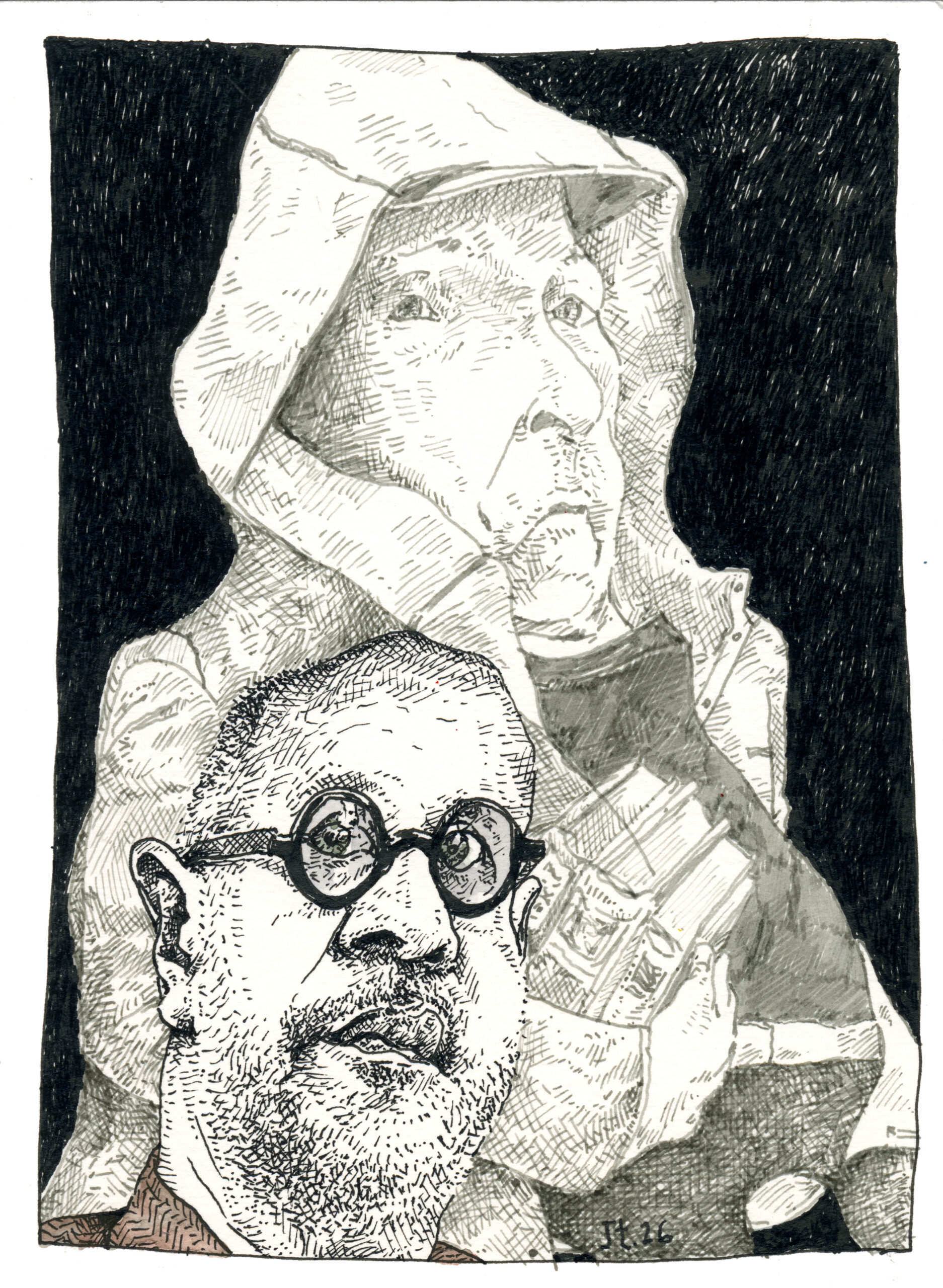
How to begin the never ending? Like that Bob Dylan song, one of my favorites, “Tangled Up in Blue”? “Early one mornin’, the sun was shinin’ / I was layin’ in bed . . .”? Oh, it is and would be, no doubt, a good beginning from a narrative perspective, I think, as I fill the cup my friend, the writer Patricio Pron, brought me as a gift from the Bob Dylan Center in Tulsa, with the coffee of a new morning. To begin singing, yes. But, in my case, it wouldn’t be true or accurate: I’m not layin’ in bed, I’m sitting at my desk. And I don’t sing well (and Dylan, no matter what they say, sings very well, and is a master of tone and phrasing [1]).
No, yes: The beginning of my relationship with Dylan doesn’t have a single and exact and definitive moment. There’s no clear or discernible Big Bang. Hard to mark on a calendar the date my private Bob Dylan Center opened. And my introduction to him—the impossible-to-pin-down subject—was slow and took an alternative and aleatory path.
To begin with: My parents (intellectuals of the exceedingly cosmopolitan Buenos Aires of the ’60s) didn’t listen to him. There were no Dylan albums in my childhood home. The Beatles [2], Pink Floyd, the Rolling Stones were all there, for sure. And, when it came to singer-songwriters, Cat Stevens and Simon & Garfunkel and, again, the Beatles, now as solo acts. Nothing by Dylan. The only trace of Dylan (my first real perception of him, I would’ve been around seven or eight) was that illustration/poster originally included with his first greatest-hits album, in 1967, which also graced the cover of a compilation of the work of one of my father’s heroes, the graphic designer Milton Glaser. I’m sure you’ve seen and remember and won’t forget it: Dylan’s profile in black, like the shadow of an eagle; his hair a mushroom more atomic than magic bursting into lysergic and acidic colors. The illustration already representing to perfection the inscrutable yet luminous opacity (even back then the ungraspable legend of Dylan was all that was available, because his reality was only for internal consumption by family and those closest to him) of a man who’d pronounced that the times were changing with the certainty of one who knows he’ll be the one to change them.
All this to say that, in a way, I see Dylan before I hear him. And that symptom has persisted for a long time. Before I listen to Dylan, I read him. I’m seventeen, 1979, and a devout follower of the work of Jack Kerouac & Co. And, in a volume on the Beat generation, I come across a postcard of Bob Dylan with Allen “Appears-In-Every-Picture” Ginsberg. There, the two of them, sitting almost atop Kerouac’s tomb, in 1975, during a pause in the tour/filming of the Rolling Thunder Revue. Then, there, I buy my first Bob Dylan biography/discography penned by the Spaniard Jordi Sierra i Fabra[3]. And that’s how I learn about Dylan’s life and work. And it was accompanied by a pair of bilingual songbooks—also made in Spain, translating verses that included, for me, extraterrestrial words like chaval or pitillo—by Jesús Ordovás and Mariano Antolín Rato, in the at-the-time-famous Los Juglares collection. And I studied his lyrics without the music. And I imagined how “Blowin’ in the Wind” and “Like a Rolling Stone” and “Knockin’ on Heaven’s Door” and so many other songs might sound.
Only later—feeling that I know all there is to know, already intuiting that my relationship with Dylan will be important and powerful and enduring, and that many of my best friends will be Dylan fans or maybe, end up among my best friends because they’re Dylan fans[4]—do I decide to go out and buy my first Bob Dylan album.
And off we go, to find out, indeed, how does it feel?
And, sure, my first selection is anything but obvious: neither of his two up-to-that-point best-of compilations; neither of his multiple (again, at that point) more highlights than hits; nor, either, the album that was playing all the time in those days: the equally celebrated/condemned and disconcerting Slow Train Coming, wherein the Jewish rambler reinvents himself before the eyes of his followers as a born-again Christian, singing with the malice of a nursery rhyme that in the beginning, man gave names to all the animals, but also that the Apocalypse is just around the corner.
No, what I choose is—perhaps due to familial deformation, because my father devoted a good part of his life to designing book covers and books and so many other things—a vinyl album with a cover photo that I find fascinating.
I choose Street-Legal.
1978. Eighteenth studio album in a sixteen-year stretch and, when released, not particularly well received by critics or the public. But on it—in what with perspective could be considered the closing of his divorce tetralogy that begins in 1974 with Planet Waves and continues with Blood on the Tracks and Desire[5]—Dylan sounds like never before. Tucked inside a big orchestra, decked out in getups à la Neil Diamond for the occasion, heavy production (that would be corrected and remastered in 1999, the year Street-Legal would be justly rediscovered as a fundamental piece of the puzzle), and amid angelic and diabolical feminine choirs. The whole thing gets denounced as reeking of a Las Vegas show. And, if you add to all of that the fact that, at live shows, Dylan plays his classics in dis/arrangements that many (not me) find demented, the truth is that Street-Legal sends the suddenly illegal songwriter back to the same gallows where they attempted to hang him in the ’60s when he decided to stop protesting and go electric.
I don’t care about any of that.
What I care about, as I said, is the cover: there, Dylan, standing in a doorway, peering out and possibly hiding, the obvious absence on his left hand (which the Dylanoide detectives of the time take no time at all to point out) of the wedding band.[6] On the album, of course, visionary songs, Mephistophelian blues, sensitive machista apologies and brokenhearted reproaches, Armageddonist landscapes, and, oh, that voice.
I listen to it, collect all the money I have, and go out to buy The Freewheelin’ Bob Dylan and Blood on the Tracks. Ecstasy and hallelujah. I work and save. And next comes—all on the same day to process them on that same night—Bringing It All Back Home, Highway 61 Revisited, and Blonde on Blonde. And there, in the darkness, while everyone else is asleep, I hear for the first time those lines that go “She’s got everything she needs / She’s an artist, she don’t look back,” “You’re invisible now, you got no secrets to conceeeeeeeeeal,” and “The ghost of ’lectricity howls in the bones of her face.”[7]
And, ever since, almost fifty years later, I’m still out here on my own, with no direction home: like a complete unknown who wants to know everything about that man everybody knows but nobody comprehends.
Don’t wait up for me.
Which brings me to the day when I’m writing all of this and looking back and remembering the unforgettable: that I saw Dylan live for the first time (three nights in a row) in Buenos Aires, in 1991; that my first book, Historia argentina, had just come out; and that I couldn’t help but see his arrival as a miracle and astral conjunction and part of the celebration of my debut as a writer. That during those same days I saw Dylan in his underwear and washing his jeans in a hotel-room bathtub. That a few years later I ran into him on the street, in Manhattan, handing out tickets to dumbfounded passersby for a concert the following week (his now-mythical recordings at the Supper Club, on the 16th and 17th of November 1993) when I would, oh, no longer be in the city. That I saw him again on another stage, in Davenport, Iowa, 1996, on a leg of his eternal Never Ending Tour, and that I ended up going up onstage to sing with him and the gigantic son of an Indian chief named Rolling Thunder amid a sea of ecstatic fans.[8] That I saw him again in Buenos Aires with the Rolling Stones. That I’ve seen him multiple times since—several in Barcelona, in San Sebastián, at Cap Roig. That I was even granted the wish of having him on the cover of one of my novels.[9] That I own his entire official discography and multiple (not too many) carefully selected bootlegs. And that (as I said) I love reading about him. Over and over, one book after another. The same story as always, more the legend of an Arthurian wizard than a Grimmian fairy tale.
Because, yes, I must confess: I’m a Dylanite.[10]
But first and foremost and when all is said and done, a reasonable and realistic Dylanite.
And I have neither time nor space nor means to follow the man the world over on his never-ending tour. For now . . .[11]
In short: Bob Dylan is always the answer whenever anyone asks me what famous person I would most like to have a long conversation with (fearing that, if it were to happen, he might not say a single word to me). And, on insomniac nights, I even fantasize that the exact coordinates and good omens align for me to get to interview him; and to show up at one of those highway motel rooms where the man appears and—almost compelled—hurls at you a handful of brilliant ideas, and then vanishes into thin air, according to those who’ve had the luck of that and him happening to them.[12]
Right, more details: Every time some “New Dylan” is postulated, I feel a certain curiosity to find out what and whom they’re talking about. That was how—beyond Bruce Springsteen—I discovered talented people like Willie Nile and David Gray and Steve Forbert and John Prine and Micah P. Hinson and Warren Zevon and Townes Van Zandt and Freedy Johnston and . . . Likewise, it was the old Dylan who sent me back to uncover venerable relics like the Mississippi Sheiks or Blind Willie McTell or Charley Patton or Woody Guthrie.[13] And, yes, I confess it: I tend to buy (I continue buying with adolescent fervor) nostalgic music magazines like Mojo or Uncut whenever one of the many Bob Dylans who were Bob Dylan (from that young folkie to the present pale horseman, with stops at electric messiah, country husband, fierce divorcee, mad preacher, and directionless captain in the now-defunct MTV Era) graces their cover.[14] And, okay, every so often I go on specialized sites like Expecting Rain to find out what’s up, Doc. But I haven’t found—and I hope not to find—the fine line that separates the turned-on fan from the raging fanatic.
A whole book has been dedicated to the latter. An indispensable title in the subsection of Dylanistic studies and, at the same time, one of the most fun and chilling ever written on the radiation and influence of the artist born Robert Allen Zimmerman, in 1941, in Duluth, Minnesota.
The book in question is called The Dylanologists: Adventures in the Land of Bob (Simon & Schuster, 2014) and is written by David Kinney. And it can be read as a Wes Anderson film (sympathetic and adorable), a Coen brothers film (hilarious and cruel), a David Lynch film (nightmarish and terrifying), or a Paul Thomas Anderson film (all of the above).
What does Kinney do in it? Simple: interview Dylan’s most adoring adorers.[15] People of all sexes and varying ages (from the adolescent to the senescent) devoted to following their guru; to knowing everything about him and what they don’t know, they invent; to deciphering the mysteries of his trash (the case of the already famous and enervating “garbologist” A. J. Weberman); to compulsively collecting every last Dylanian artifact or tape (there’s one who’s the proud owner of baby Bob’s high chair); to convincing themselves that Lady Di’s imminent death was predicted on Time Out of Mind; to lining up the day before his shows to get the best spot in the house, right in front, to stare at him unblinking and with ears wide open and lips moving, analyzing any variation in the verses and every inflection of that voice that seems to have risen from the depths of the earth. “An underground nation of unreformed obsessives,” Kinney diagnoses.
But, come on, there are more grievous offenses: It’s worse—more naive and more painful—to believe in politicians than to believe in Dylan, right? Dylan is less disappointing and deceitful. And—unlike what happens with almost any statesman—when Dylan is wrong, time inevitably shows us that Dylan was right all along.
But what’s interesting about Kinney’s essay/account is that it also deals with the fan that Dylan himself was and still is. Imitating the patriarch and author of “This Land Is Your Land” and feeding vampirically off the folk legends of Greenwich Village on his first incursion, during that frozen 1961 Manhattan winter.[16] Or amassing one of the most important and valuable and vintage shellac record collections. Or collecting everything he can about the Civil War: one/another of his obsessions. Or buying houses and castles the world over. Or “stealing” lines from books and films and songs with gazza-ladra guile, the studious dedication of the wisest archivists or librarians, and with his present look wherein the crepuscular and righteous cowboy converges with the elegant saloon card shark à la Lucky Luke, always on the verge of being ejected from the piano, tarred and feathered, and ridden out of town on a rail, and on to the next stop and the next round.
But the most “useful” (albeit not the most revealing) part of Kinney’s research is a predominant feeling that was there from the beginning: the consistency and discipline with which Dylan always scorned and increasingly scorns his most devout followers. He always mocked them, recommending more than once—like William “Captain Kirk” Shatner to the Trekkies—that they “get a life,” calling them “ridiculous and comical and sad,” and concluding, “Why is it when people talk about me they have to go crazy? What the fuck is the matter with them? . . . May the Lord have mercy on them. They are lost souls.”
And Dylan reserved a special scorn for his contemporaries. The ones who’ve been following and chasing him for over half a century. Kinney says Dylan gets nervous having all those old folks at his feet during shows. And that sometimes Dylan tells his managers to hide them in the back, that he just wants pretty girls up front, that he doesn’t want to see the old folks howling his songs like, yes, “lost souls.” And (Kinney comments at the end of the book) Dylan even has a terrible idea: putting up huge mirrors onstage so his veteran fans could see their own reflections, see what he sees every night, and retreat to the back rows, like vampires or Dorian Grays frightened by their own portraits.[17] Or so they would get it through their heads once and for all: “I don’t have the answers.”
But I’m afraid it doesn’t work.
There they are and there they’ll remain.
Right up front and staring straight ahead.
And, of course, there are times when one longs to be released. To feel as if the spell has been broken. To be able to devote oneself to other artists and even other things. But no. Bob Dylan is still there, above everyone and everything, even the Beatles (because the Beatles are no more and Bob Dylan is more Bob Dylan all the time). Albums for a new cataclysmic millennium, like the disturbing and disturbed yet also euphoric and hilarious Love and Theft[18] and Tempest[19] that demonstrate that the best could/should come with the release of his next new songs. Revisions of his prehistoric past on the recent bootleg box set.[20] Through the Open Window, 1956–1963; as well as the rediscoveries/vindications of Another Self Portrait or the definitive access to The Basement Tapes Complete or the backstage to one of his indisputable pinnacles in More Blood, More Tracks or Fragments; or the backstages of his ever-better and at-the-time-vilified period in the ’80s or his evangelical self-possessions following the conquest of the Budokan theater in Japan, remember that his most transcendent stuff always came when least expected. And so it was that we got and will always have—among the most elevated and expansive of his albums—the magnificent Rough and Rowdy Ways during the ides of COVID.[21] And—also an indispensable part of the enigma, and of the unpredictability—de-luxe whims. Like his approximation to the Sinatraesque Shadows in the Night/Fallen Angels/Triplicate. Or his charity recording of Christmas in the Heart (the best and most demented album of Christmas carols in all History). Or his radio incursions as midnight DJ (Theme Time Radio Hour). Or his bourbon brand (Heaven’s Door). Or his paintings and drawings and photographs and wrought-iron sculptures. All this and much more as evidence that he’ll always be simultaneously unpredictable and thrilling. And, oh, so funny. Like that anecdote about the time a policeman mistakes him for a menacing homeless man and takes him down to the station because “yes, he told me who he was; but he didn’t look like the guy from the pictures to me.” Or showing up without warning at his grandchildren’s kindergarten and serenading them with the exceedingly vintage “Froggie Went a-Courtin’.” Or being spotted among the tourists on a John Lennon bus tour in Liverpool.[22]
Or delivering that surprising and wild and emotive thank-you speech to ailing musician-protection organization MusiCares—which had selected him as Person of the Year—days before the 2015 installment of the Grammys. There, again, the renewed miracle of proving that Dylan is outside time and space, that he’s more ancient than old and, for that reason, a classic. And that he now resembles one of the phantasmal musicians he admired in his youth. There with a shark’s smile and sharp as a razor, Dylan looked back on his long journey, thanked his elders, and mocked (“Why me, Lord?” he lamented, laughing) those who consider him an expert in “confounding expectations.” There, after half an hour of speaking without hurry or pause, Dylan signed off with an “I’m going to get out of here now . . . I probably left out a lot of people and said too much about some. But that’s OK. Like the spiritual song, ‘I’m still just crossing over Jordan too.’ Let’s hope we meet again. Sometime. And we will, if, like Hank Williams said, ‘the good Lord willing and the creek don’t rise.’”
And, of course, one can’t help but hope that it won’t be too long and a long time before the final farewell.
And he knows, for good or ill, like it or not: He wouldn’t be Bob Dylan without Dylanites.
Why him, Lord?
Why us?
Because—as Dylan himself once told a fan who came up to thank him for everything and tell him how important he was in the fan’s life: “Well, son, we all have our heroes.”
And—unlike the unfortunate and pursued and constantly decoded Bob Dylan—we’ve got something he could never have.
We’ve got the unbeatable luck of having Bob Dylan as a hero.
How to end the never ending? “Tomorrow is a long time . . . ,” Bob Dylan sang so many yesterdays ago. So, better for me to refocus on the here and now.
On today.
On this morning and on my new and thoughtfully gifted coffee cup courtesy of Patricio Pron and the Bob Dylan Center in Tulsa.
Another sign that—again—rock is now a museum piece, prey of archeology, something to be stored in a glass display and even taken on the road, like those mega nomadic exhibitions dedicated to David Bowie and to Pink Floyd courtesy of London’s Victoria and Albert Museum, or like the multitude of documentaries to which now is added—in the wake of Get Back—the corrected and expanded version of the Fab Four’s Anthology.
And, oh, I wonder if I’ll ever make it to the Bob Dylan Center. If it’ll be something like my Shangri-La or my Manderley or my Xanadu or my Promised Land.
Who knows.
For the moment—it’s a start, better than nothing—I have my souvenir coffee cup from its gift shop.
The cup is black, and, when you fill it with hot coffee, as if by the art of magic, a photograph of Dylan begins to appear. One taken of him in 1965 by the photographer Jerry Schatzberg. One of the many (compiled in a coffee-table book that I also own) from which the out-of-focus-yet-so-precise portrait that ended up gracing the cover of Blonde on Blonde was selected.
Pron told me (somewhat distressed) that one of the final rooms in the Bob Dylan Center is dedicated to the recent and exceedingly successful film A Complete Unknown and to its wardrobe and props.[23] And that (to Pron’s surprise) visitors preferred to take selfies beside the props in that section and not by the sacred and authentic relics of the man himself. And so, apparently, actor over author and so (multifaceted sign of the times) the times they are a-changin’ not for the better, I guess.
And, accordingly, that delightful anecdote: Before tackling the project, James Mangold—the film’s director who, in 2005, had already had his way with Johnny Cash in the also somewhat synthetic Walk the Line—requested an audience with Dylan to receive his blessing before telling and singing his life. Then—in a Los Angeles bar specially closed for the occasion—Dylan raised a Dylanian eyebrow, smiled a Dylanesque smile, and, Dylanistically, asked: “What’s this movie about?”
Good question.
Meanwhile and until so many possible answers, one more cup of coffee for the road, one more cup of coffee ’fore I go, to the valley below.
Here I am with my cup.
Another piece for my own private Bob Dylan Center, for one of the most important wings in the museum of my life.
PLEASE, DON’T TOUCH. 
[1] The admirers of his technique included none other than Frank Sinatra.
[2] My parents separated many times and split up their records; and so I never heard the Beatles’ double White Album until I was eighteen, when I bought my own copy. The Beatles: that kind of retro-prophetic and leviathan pop Moby-Dick that—like Herman Melville’s likewise white magnum opus—fed off of everything that came before to subsequently spout out the stream of everything yet to come.
[3] On Amazon, there are around five thousand titles on Dylan’s life and work, including children’s, religious, and even financial self-help books (see Forget About Today: Bob Dylan’s Genius for (Re)invention, Shunning the Naysayers, and Creating a Personal Revolution by Jon Friedman). Here and now, Dylan already occupies more than three shelves in my library (nearly a hundred titles; I’m awaiting the arrival of the one recently written by Ron Rosenbaum) with successive quasi-Biblical retellings of his life, interview compilations, essays by experts and high-profile admirers, documentary DVDs, even his own masterful yet disorienting version in the bestselling and very selective memoir, Chronicles: Volume One. A 2004 book with which—before winning the (for me) well-deserved Nobel Prize in Literature in 2016—he conquered the bestseller lists and, at the same time, generated a veritable flood of autobiographies from his fellow musicians (Patti Smith’s also quite successful Just Kids from 2010 is worth highlighting). We’re still waiting for volume 2. And volume 3.
[4] To be more precise: I have many great friends who’re not interested in Dylan. That’s all good. But it’s also true that, with them, I have one less thing—one very important thing—to stay up talking about until three in the morning.
[5] People are really awful and they call the whole move the Alimony Tour.
[6] The picture was taken by the filmmaker Howard Alk, at the entrance to the somewhat disgraced and little-used Rundown Studios in Santa Monica, California—purchased by Dylan in 1977—where Street-Legal was recorded. People who were there claim that “it wasn’t the best place to record.” Five years later, Alk’s lifeless body was found inside those same studios. Some say he died of an accidental heroin overdose, others that he died by suicide.
[7] That last line is one that, years later, I find a way to insert into each and every one of my books and correction: Yes, let this/that night be my Dylanite Big Bang.
[8] Will you allow me the self-reference? Yes? I told part of all of this in a column and reinvented it for my novel The Invented Part.
[9] The latest Spanish edition of my Esperanto (from Mondadori, 2011), a photograph by Daniel Kramer or Barry Feinstein, I’m not sure anymore: Dylan looking down, flipping through a newspaper.
[10] How to recognize a Dylanite? It’s not easy, luckily. They come in all ages, nationalities, and colors. There are no masonic handshakes or magic words that reveal us. Just the private happiness of spending time with Dylan and experiencing the feeling of being Shakespeare’s contemporary; with the difference being that the majority of Shakespeare’s contemporaries had no clue who Shakespeare was, while we, with respect to Dylan, know many things about his life and work and, yes, know ourselves to be Dylanites.
[11] And yes: Yesterday I bought, as I do every week, my EuroMillions lottery ticket. The truth is I’ve seen Dylan live around thirty times and had even decided, in 2015, to retire from the endeavor after seeing him at Jardines de Pedralbes, in Barcelona. I attended the show with my son, Daniel, who was nine at the time. And it struck me that, symbolically, it was a good occasion to retire: to pass the baton to a new generation and let Dylan go on without me, with no direction home, to die, probably, in a hotel bed or on a foreign stage or during intensive therapy far from the land where he was born, after singing, again, that song that goes “It’s not dark yet, but it’s getting there.” Yes: this “Father of Night” taking “Like a Rolling Son” by the hand and, please, “Bob, Protect My Child.” And yet, my son wasn’t all that impressed by what he saw and heard (though he did appreciate sharing something so important to me, just as I appreciated going with him to so many DC/Marvel movies). But, oh, later, another writer friend, Juan Ignacio Boido, gave me—to celebrate my sixtieth birthday—a ticket to see Dylan on tour for Rough and Rowdy Ways in 2023 at the Gran Teatre del Liceu in the same city where I’m writing all of this. And it was a really amazing show. So . . .
[12] In one of his essays included in Listen to This, the musicologist Alex Ross diagnoses: “If you look through what has been written about Bob Dylan in the past 30-odd years, you notice a desire for him to die off, so that his younger self can assume its mythic place.” It’s almost true, yes. Or, at least, an interesting theory. But it doesn’t apply to me. I guess that is a perception and need for those who see him every so often and visit him like a museum piece. But for those of us who have followed him closely and for as long as we can remember, Dylan is forever young as only someone ageless can be, someone who was born vintage. The same thing happens to us, when we’re kids, with our parents. With those to whom we owe our lives or a very important part of our lives. A part we never stop giving back to them.
[13] And to take better advantage of the trip: In Tulsa the Woody Guthrie Center is basically next door to the Bob Dylan Center.
[14] Publications specially designed now for the nostalgic-museological veteran with covers where the artist to be commemorated appears fresh and young while on the inside pages he’s photographed crepuscular if not almost mummified. The strategy, I guess, is to deceive readers, already somewhere between the autumn and the winter of their discontents, with a quasi-pornographic “forever young . . . ” photograph that, with just opening the publication, makes obvious the brutal trap-trick of a magic Snow White mirror that’s malfunctioning.
[15] It’s not the first—compilations of anonymous and famous encounters with the man collected in Encounters with Bob Dylan: If You See Him, Say Hello by Tracy Johnson or Touched by the Hand of Bob by Dave Henderson—but it is the smartest and funniest and most revealing in my library.
[16] See him arrive, out of focus, in the background at the end of the glorious Inside Llewyn Davis from the already mentioned Joel & Ethan Coen.
[17] For now, he does something that’s far worse for many: He confiscates all iPhones at the entrance because he hates seeing them held aloft, and there’s a YouTube video where Dylan interrupts his concert, walks up to the edge of the stage, and booms, “We can either play or we can pose. Okay?”
[18] Where (attention, Dylanites hunting hidden meanings and the confirmation of B. D.’s superpowers) he sings, on “Mississippi,” about a “Sky full of fire, pain pourin’ down” and that album went on sale the morning of September 11, 2001, when the planes hit the towers.
[19] Where he included a fourteen-minute, forty-five-verse song about the sinking of the Titanic without ever uttering the word iceberg but not missing the opportunity to allude to a certain “Leo.”
[20] The Bootleg series, like official communiques, is now a kind of genre unto itself within Dylan’s discography, Dylan being the one who initiated this self-revisionist (and quite commercially successful) impulse with Biograph in the supposedly barren lands of his 1985. And this has also been copied by every dead rock star or rock nova or rock black hole. All those euphoric-nostalgic box sets. Crosses between pharaonic sarcophaguses and treasurable treasure chests. Products that rise up like cathedrals dedicated to rock’n’pop. That once-upon-a-time more-than-revolutionary musical genre and, also, the one that aged most rapidly: because today its thing is, inevitably, the twilight age of its original listeners, who are starting to disappear, like the ever-diminishing number of veterans of the world wars. Thus, anything new that it generates (with the exception of work by Bob Dylan) has nothing all that novel about it and the old now falls into the category not of attic relic but of well-presented and sometimes-astronomically-priced museum piece. Solid ghosts of Christmases past (because they tend to appear toward the end of the year) ideal for decorating little trees of royal magic.
[21] And it leaves you trembling with perverse anticipation to think about what’ll surface from Dylan’s vaults when he is no longer among the living yet living on long after we’ve all disappeared.
[22] Before the assassination of Lennon by his “admirer” Mark David Chapman, Dylan told Sam Shepard that “fans are more dangerous than a man with a weapon because they’re after something invisible. Some imagined ‘something.’ At least with a gun, you know what you’re facing.”
[23] And, yes, Dylan turned out to be a total revelation for the kids when he starred in a biopic with Timothée Chalamet’s face. And yes, there and from there, another symptom of the twilight: If rockers—it’s been said before, spurred on by the success and prestige garnered by the memoirs of Patti Smith and Dylan himself at the turn of the millennium—threw themselves into a desperate race to write their own pasts (the latest and very interesting one is that of Yusuf/Cat Stevens), what they want now is a movie (to make themselves the movie, indeed) about their comings and goings. And these, inevitably, are overly simple and innocent: because they’re targeting a more or less soft and inexpert audience, a new market for an aged product. And these are all pretty homogeneous and hygienic. And, as someone once said, too close to superproduced and hypertrophied fan fiction: Queen and Elton John and Robbie Williams (as a chimpanzee) and Springsteen in the days of Nebraska (depressed and long before sitting down to converse collegially with Obama for an embarrassing book titled, ay, Renegades) and Elvis & Priscilla and Amy Winehouse and Bob Marley. And already underway are the ones for Madonna, Ronnie Spector (& Phil, of course), Linda Rondstadt, Carole King, Michael Jackson, and the multiproject of Sam “American Beauty” Mendes, who will dedicate a feature film apiece to each of the Beatles, telling that old, now quasi-Arthurian myth from four points of view. And, in a way, all of this will function as a new version of the past being rewritten for the future. Thus, if Todd Haynes’s multifaceted and polymorphous and perverse I’m Not There (2007) overflowed with complicit winks and code words for connoisseurs, James Mangold’s A Complete Unknown (2024) is pretty much a Dylan 101 for Dummies.
Rodrigo Fresán is the author of fifteen books of fiction. His latest novel to appear in English, Melvill, won the Republic of Consciousness Prize and the Big Other Book Award for translation. In 2018, the French government awarded Fresán the Prix Roger Caillois for his entire body of work.
Will Vanderhyden has translated more than a dozen books from Spanish. His work has appeared in Granta, The Paris Review, and elsewhere. His translation of Rodrigo Fresán’s Mantra will be published in 2027 by Open Letter Books.
Illustration: Jonathan Twingley
