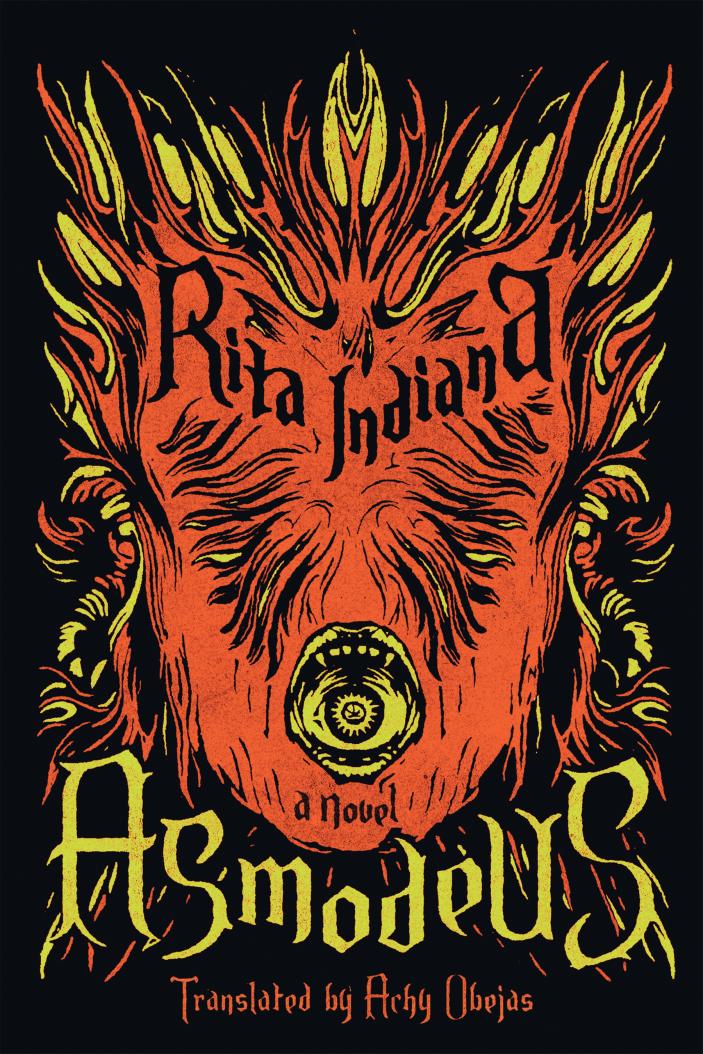
When the powerful witch Mireya is just a child, the demon Asmodeus encounters her, trusts her immediately, and takes up residence in the Goofy doll she carries past the store window, where he has been inhabiting a mannequin. Mireya helps him find a host, as she does for all the good demons.
Later, Asmodeus, having spent many years hosted by Rudy Caraquita, a heavy metal musician in stasis mode, seeks a new and younger host. But the adult Mireya has her own plans to relieve herself of her powers, imbuing a knife with her spiritual gift as well as imbuing it with poor Asmodeus, who must ensure that the knife stays within the proximity of young Sayuri until the transfer of power is complete. As Asmodeus abandons Rudy and Rudy abandons the cocaine that gave Asmodeus fuller control, something comes back: Rudy’s urge for artistic creation. He begins a play, taking inspiration from the Greeks, events that have happened, people he knows, and things he knows only through Asmodeus, who whispers to Rudy lines of songs and of the tragedy he is writing. Rita Indiana includes passages from Rudy’s play in Asmodeus (Graywolf, 2026), translated by Achy Obejas. As Asmodeus follows the knife, we get to know the people in Rudy’s and Mireya’s milieus.
“Greek tragic heroes were always screwed in the myths before those bastards wrote their plays,” Rudy says. He is speaking to Iphigenia, a nun and his former teacher, about his hesitancy to kill off characters. The line calls to our attention the relation between fiction and reality. It’s not because of the tragedian’s bent that the characters are screwed, it’s because that’s how they are; the tragedian merely records the despair of the already condemned humans. In this book, the characters are beleaguered. Mentions of Balaguer and Trujillo pepper the personal histories and conflicts of 1992 Santo Domingo. The sociopolitical despair provides a fitting backdrop to the interwoven narratives of each character the demon comes to know over the course of a week. Within the text, Indiana describes how Rudy once wrote the “darkest of all his songs” for his former teacher. “Iphigenia’s Gift” is a song about the knife he used to stab her in the back. The death in the song is a metaphor for an actual slight. The song exorcises Rudy’s guilt over how she once gifted him a book that he, in shame and in front of his peers, threw directly into the trash. Retrieving the book from the trash can later, he learns that Iphigenia has left the school permanently; he assumes she is dead. The scene reminds the reader that an artist’s account isn’t literally true, even if based on actual events. The world between fiction and reality is connected through a similarity in theme and feeling, and even using the same names, the same characters (Iphigenia) from the “real” world, but there’s got to be another word for what happens when an artist represents something real—it’s neither “accurate” nor “inaccurate,” but some other thing.
That’s where the demons get in. When Indiana is describing how Asmodeus helps Rudy with his projects, she has the demon giving him lines of text, representations of things that Rudy himself can’t remember or wouldn’t know, and she watches Rudy accept or reject these insertions into the text he produces. If we assume an analogy between how the represented artist functions and how the writer of this particular book, Indiana, functions, then the spaces that the demon fills are the fictional elements. But fictions are not just deceptions. By rearranging reality in accordance with another logic, the artist is able to capture aspects of life that aren’t apparent in any old reporting of events. The point of Iphigenia’s song isn’t to report accurately a series of events that affected Rudy. The characters, scenes, plots and other represented objects of fiction are there for how suited they are to being arranged in a manner that, in combination, allows for the expression of something else. Rudy himself describes what he is writing about, and it’s not people or places or things:
“The devil doesn’t believe in coincidences,” he said to himself as he read the verses he’d just written. That phrase, the last verse of the chorus from his best blues, summed up the ideas expressed in all his songs. He wrote about chance, about the embezzlement of fate. He wrote about the random forces that had peeled layers off him, the macabre lottery of divine providence.
Asmodeus is thus working on three levels: (1) that of the book itself, in which characters are possessed by the demon Asmodeus; (2) a level within, where Rudy and his demon collaborate on a tragic play; and (3) a level without that serves as a precondition of the book’s existence and through which we gain insight into the writer’s process as it is transcribed into the fictional account of that process (Indiana writing Rudy writing his tragedy). As Asmodeus discovers Rudy’s writings, we wonder whether Rudy doesn’t reflect something of Indiana, a singer turned writer, and how strong the influence of the Greeks is:
These were not songs, nor loose verses: They were, apparently, part of a play. Rudy had infused his best music with a power he said he’d learned from the Greeks. His lyrics brought to life the characters that swarmed through the Dominican night to the cruel rhythm of fate. In his adolescence in Santiago, Rudy had dreamed of being a playwright, of writing a tragedy.
The book that Rudy throws in the trash is a hardcover edition of the works of Sophocles, best known for relating the story of Oedipus, who, in attempting to avoid the result of a prophecy foretelling that he would kill his father and marry his mother, kills his father and marries his mother. There are obvious parallels between the characteristics of Greek tragedy and those of Asmodeus, such as the assumed existence of otherworldly beings with their own motivations, their intervention in the actions of individual humans; and I also like to think that the references to heavy metal songs and artists stand in for the Greek chorus. In order to write Asmodeus at all, Indiana would need an intimate knowledge of Greek tragedies, and to have the motivation to write as she does about the tragedies, we can also infer her interest is not neutral, not simply a matter of research. She makes explicit reference to the concept of catharsis, which undergirds Aristotle’s theoretical analysis of tragedy in his Poetics.
Aristotle defines tragedy as “the imitation of an action that is serious and also, as having magnitude, complete in itself.” He describes how the incidents that the writer focuses on in tragedy elicit pity and fear, and how the aim of tragedy is to achieve a catharsis of negative emotions. Aristotle writes of how tragedy is composed in “language with pleasurable accessories,” by which he means rhythm and harmony. The play that Rudy is composing is written in décimas—ten-line stanzas with a traditional number of syllables (which I’m sure were extremely difficult for Obejas to translate, maintaining both the form and the content). Finally, Aristotle describes the tragic alternation where “some portions are worked out with verse only, and others in turn with song.” This alternation is apparent in Indiana’s text as well, where Rudy’s décimas stand in for songs that punctuate Indiana’s novel (the novel would be the equivalent of what Aristotle is calling “the verse”).
The meat of the book, however, is not its form but its content—what it is that we are purging through tragedy, the events that elicit pity and fear, what forms of suffering we induce. Rudy says that his tragedy is about Dominican capitalism. Indiana’s tragedy is recursive, moving through sufferings induced at the political level to the harms people inflict on others, the sufferings that Rudy refers to when he talks about chance and the embezzlement of fate—spiritual suffering, the type that seems inevitable, beyond the control of humans both as individuals and as a species, the suffering we like to think is invoked in the service of a greater purpose, precisely because it does not feel that way.
What’s interesting about Indiana’s take on suffering is that it’s not only for humanity; she has characters discussing how demons also suffer, as here demons also have human characteristics, wants that aren’t necessarily fulfilled, dependencies on the natural realm that mean their fates are also outside of their control.
“Do you think demons suffer or cause others to suffer?” Claudio asked Sayuri.
“Why do you want to know?” she replied.
He said: “My father said they suffered a lot.”
“I think they suffer and cause others to suffer, just like us,” she said, avoiding his gaze because Claudio’s voice trembled.
He added: “My father suffered like a demon, and he was a good man.”
The capacity of demons to suffer is fascinating for its implications about how they exist, especially within a framework so heavily influenced by Greek concepts. The whole idea of “suffering” is tied to passivity. Suffering, like emotion and experience (all translations of pathos), is something an individual undergoes. The capacity to suffer is then conceived of as an inverse measure of a being’s divinity, because divine forces, as purely active, are impassive; they have no capacity to undergo anything. Thus Indiana is implying that the demons she is representing really are the furthest thing from the divine. Weaker than the humans they inhabit, they are only able to control something using whispers and suggestions. The demons don’t have authority enough to be able to directly control a human’s movements, limbs, even thoughts. The demon does not take over so much as it exists alongside its host. The body is an important consideration. Whereas our material existence is usually equated with our capacity to suffer (it is the thing that takes in the outside world, makes us vulnerable to its changes, its vicissitudes), the body is also the locus of our activity. We suffer when we can’t accomplish what we want with the bodily form available to us. As Asmodeus inhabits a knife, a mannequin, a cockroach, we see how the demon’s capacities are not increased because he can move between bodies, but decreased because he has no body of his own, and can only ever accomplish what can be accomplished with a body of the type belonging to the being he temporarily inhabits.
With the demon’s powers limited to what it can convince a human to do, we have also a slightly revised version of artistic inspiration implied by Indiana. The concept of artistic creation that includes inspiration (from the Latin for “breath”) admits that the artist’s work is either catalyzed or guided by something external, something that appears suddenly and with force. It’s this lack of inspiration that has left Rudy so unproductive during the latter years of Asmodeus’s possession. The demon appears as working against Rudy’s productivity, even as Indiana presents how Asmodeus has contributed to Rudy’s works. As an embodiment of passivity, Asmodeus reduces Rudy’s activity while they are entwined, even as he whispers lines in Rudy’s ear.
I would be remiss not to mention the hilarious relationship between Asmodeus and the archangel Rocío. One of the funny aspects of the book is how Asmodeus and Rocío are forced together because of a longtime friendship between Rudy and Niurka, a woman the archangel inhabits. Rocío is a derogatory nickname for the archangel, given to her by Asmodeus. Rocío, railing against Asmodeus, spits venom at him, saying things like, “Your presence is a cage full of parrots.” That they must exist in proximity because of the accidental relationship between two puny humans adds moments of levity to the text, as the gods are rendered powerless by two humans’ decision to hang out.
Remarkable about Indiana’s writing is how she flows between characters like her demon moves between bodies. The reader is so invested in the little stories of this novel’s denizens that we barely notice that they’re the abstractions of a much larger perspective, like how a hallucinogen can make us so invested in the plight of a raindrop that we forgot and then are irrevocably reminded of its place within an immense forest. This is a hallucinatory work whose potential for analysis is as great as its unrelenting draw to the eviscerated human condition. Just when I thought I had a grasp on its movement, its trajectory, its boundaries, Indiana forced me to look it in the eye as its guts fell off a makeshift operating table. I would not be surprised if she were to reveal that a demon helped her write it. The measure in which she allows the gore to penetrate the veil of the narrative, plus the control she exerts over the words and phrases, combine to express how the beauty of language functions to both conceal and express the writhing maelstrom just below—the significance of the phrase jabbing through the refined syllabic structure, threatening to drown us in its blood. We should be the better for it.
Charlene Elsby is a philosophy doctor and former professor whose books include The Devil Thinks I’m Pretty, Violent Faculties, and Poor Damned Souls. Her essays and interviews have appeared on Bustle Books and in the Chicago Review of Books, The Millions, and the Los Angeles Review of Books.
