You’re Allowed to Laugh
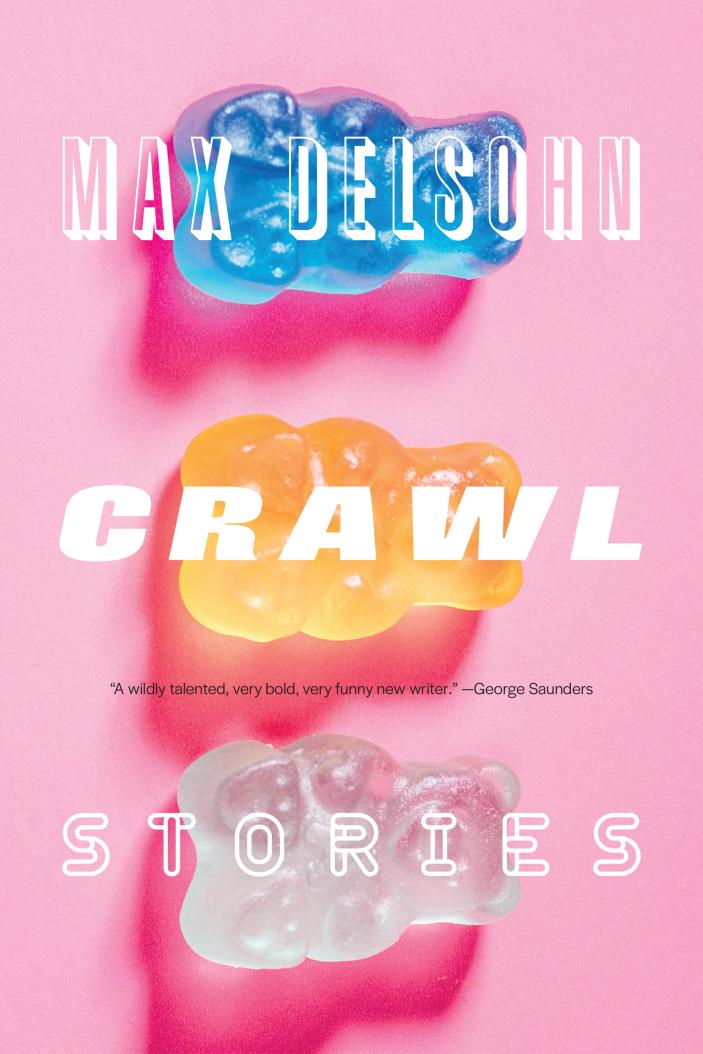
Max Delsohn’s debut short story collection is hilarious. You’re allowed to laugh. It is also masterfully written, deeply felt, and at times painfully sad. Crawl is a sweeping pointillistic landscape of Seattle in the 2010s and a rousing toast to trans men, the main characters of these deceptively readable stories.
Delsohn is a king of craft. Imagine if Mary Gaitskill had written Bad Behavior about the characters from Alison Bechdel’s comic strip Dykes to Watch Out For after doing a close reading of Andrea Long Chu’s “On Liking Women” with an earmarked copy of Leslie Feinberg’s Stone Butch Blues in a back pocket. And, in this scenario, Gaitskill has a sense of humor, truly loves her characters, is a millennial trans guy—and Madwimmin Books is in Seattle. There’s no one book like it. That’s Crawl.
Apart from three drug dealers operating under the moniker the “Furniture Guy,” the city of Seattle is the only throughline character of the collection. “On the first sunny day of the season, the city of Seattle went to Cal Anderson Park. It wore shorts, tank tops, bikinis, flip-flops, sun hats, and cutoff overalls,” begins the third story. It continues: “I’d seen most of the queers there before, but that was to be expected. We weren’t a small community but there were only so many protests, so many independent bookstores and gay bars.” It’s funny because it’s true; the delight is in the details.
A city, like a subculture, cannot be seen accurately from a single perspective. There are brief moments of unity—namely “one glorious, glistening moment” in a story titled “Moon over Denny-Blaine” when all the queers share “the same freak-show moment” of mooning a straight couple until they retreat from the unofficially gay public-lake beach. And there are many instances of individuals in the queer community betraying each other and themselves. There’s the trans man who makes fun of an ex for coming out as nonbinary, the dude who accidentally deadnames himself while nervous, and the college chick who insists she’s straight while hooking up with another woman (and says, “Ew,” at the idea of her paramour transitioning), to name a few. Also included in this large cast of characters are a few obvious bigots and some well-meaning straights who might mean well but cause pain with their invasive questions and callous ignorance.
This book had me thinking about all the times I’ve found myself with tears of laughter on my face while unloading an emotional diatribe to a dear friend. That guffaw in the middle of a snotty cry is Delsohn’s sweet spot. In “Sex Is a Leisure Activity,” the self-conscious narrator—a short trans man who is “new to stand-up and new to men”—is in a polyamorous relationship with April (“a trans woman who was tall and black-haired and having more sex than I was”). When he texts April to let her know that he’s made plans with a fellow comic (and gay cis man) named Gene, she responds enthusiastically with “a string of eggplant emojis with some black hearts peppered in, followed by Get fucked, sweetheart!” The first half of the story is devoted to the narrator’s nervous internal monologue as he prepares for the big date. He shaves his pubic hair after great deliberation and texts Gene while trying to imagine their sexual encounter (“Technically—arguably—in some circles—I was about to lose my virginity”). When they’re finally hooking up, it’s nothing like he pictured; what ensues is one of the funniest scenes in the collection. Without giving it away, suffice to say that Gene’s “fuck playlist” includes both “Rack City” by Tyga and “Electric Feel” by MGMT.
These scenes take place in dorm rooms, in messy apartments, in the park, on the street, at work. Mundane locations, snapshots of life. For a collection riddled with sex and drugs, I also find it difficult not to use the word wholesome to describe it. Perhaps it’s the coming-of-age of it all. Trying to keep up with the ever-changing world around you while simultaneously trying to keep up with yourself is relatable for anyone who deigns to honestly reflect on the very human experience of being young. One character, nervously watching two of their college friends drunkenly make out, declines an invitation to join: “I lit a cigarette in an attempt to reset myself emotionally. Everything was cool. Everything was gay and cool.” In another story, someone describes burlesque poly people as being “the proudest of the sex nerds” before tripping at The National concert.
The final scene of the final story carries forward the emotional weight of the whole collection. Simon, the narrator of “Same Old,” is, at thirtysomething, the oldest perspective in the book. He has more or less settled into himself and is less concerned than other characters with what everyone else is doing or thinking; he’s more mature. Simon encounters Harold, a depressed young person who recently began transitioning. Simon, aware that Harold needs a friend, struggles to decide whether or not he “owes” him anything. What does the notion of “community” entail, and how much should we contribute? It’s one of the more serious, less playful moments in the book. At a breaking point, Harold asks Simon, “And how should I go about moving forward? . . . When no one will fucking let me?” Simon responds: “I can help you, Harold. Let me help you. There are things we can do. Therapy, health care, some new trans friends. I’ve been where you are, Harold. It’s slow, too slow, but you can crawl out of this.” Simon imagines a “stretch of happy future memories” in a gesture that retrospectively grounds the entire book.
“Seattle was still Seattle,” one character muses from the sidelines of a game of bubble soccer, “and we were never, ever, ever going to stop talking about shit that didn’t matter.” In Crawl, Delsohn makes a convincing case for just how much everything—all of it—matters and deserves to be handled with care. “Yes, the whole city of Seattle was outside today, but we were the main attractions, the stars of the show, hot for disruption and cruising for newness.” The we is key here—you are invited.
Riley Rennhack lives in Dallas, TX.

More Reviews