If You Care to Go, I Will Follow
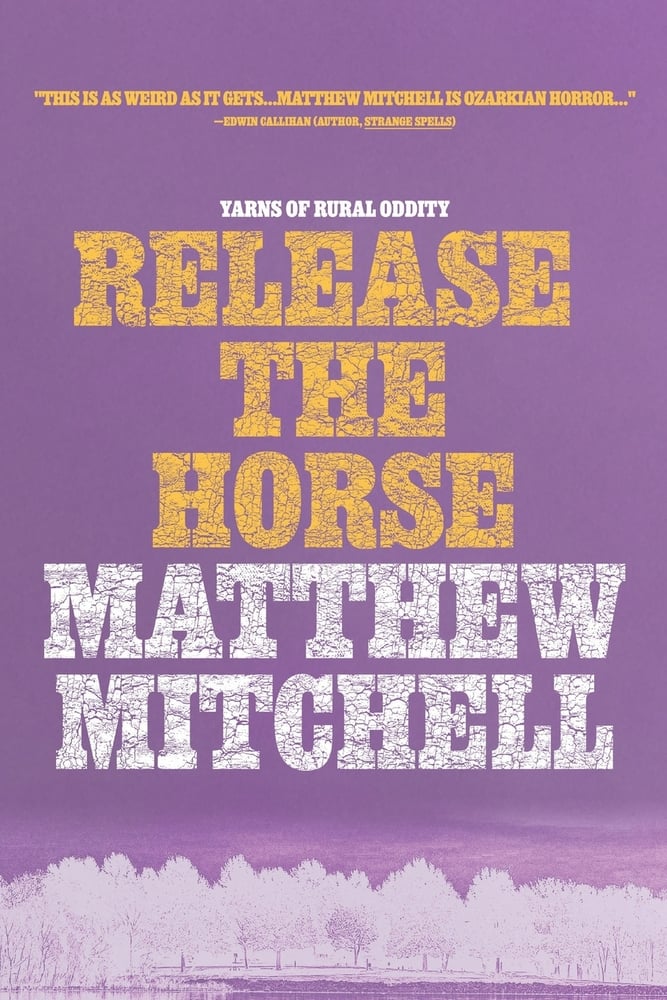
Release the Horse by Matthew Mitchell’s got me thinking about the Ozarks.
Specifically, Dogpatch USA.
We went there when I was a kid, before the place went belly-up for the final time. It had been on the skids forever—money problems, weather problems, legal suits. By the early ’90s, admission was free. Decrepit buildings and the creep of wood rot in the high water slide. Al Capp’s mustachioed adipose Shmoo shambling around for Polaroids with the tourists, squeezed between Daisy Mae and Abner Yokum like a dollop of the unspeakable. I don’t remember rides or food, just a wide paved avenue over which the mountain woods were already looming, a grist mill already creaking, an incline railroad already rusting. This bizarre backwoods carnival, born out of a holler and an American obsession with hillbillies. It was a place in the active process of being forgotten, an entrepreneurial dream turned nightmare right off the Scenic 7 Byway. A lost world peopled and eventually haunted by a weird mythos, at once accessible and ultimately, like the Lovecraftian universe itself, unknowable. Had there been a Big Baby lurking in the tangles of kudzu, I wouldn’t have known what to call it, but it would have been right at home, slathered in stink bait and munching some tourist’s head. Had Daisy Mae abandoned her photo op to shed her top and sneak off to ride the lightbulb in an outhouse with some scabby hick in boxer shorts, who would have been surprised? Had a troop of naked men fallen from the woods hunting Old Scratch, their peckers up, somebody might have cried out, Hey, they’re headed for that church up there, right up the hill, that’s the Church of Daniel! Daniel’s caged in there. Pretty soon, he’ll be out and about his Father’s business, I reckon. Anyway, I’m hungry—they got kettle corn here?
It’s like that, reading Matthew Mitchell. Wondrously weird and utterly familiar and of a world that’s doomed.
A collection of fiction and one poem, Release the Horse (Filthy Loot, 2025) situates itself squarely in the space between Appalachian folklore and gonzo cosmic horror. Told in a voice both literary and down-to-earth, it’s an assemblage of “yarns of rural oddity”—some complete, some just getting started—of a fictional Ozark realm in decline. For me, as an Arkansas-born writer, it conjures up summer trips north beyond even Dogpatch, winding through narrow passes and sharp hairpin turns and looking out from a backseat window into the reaching valleys of sunlight and shadow and cloud-laced peaks, Mitchell’s highway winding through them all, “a highway to questions without answers and dreams with shining eyes.”
Such dreams as a horse made of earth and clay in the title story, shaped with hands unwitting of their own ends, nothing at stake in the horse’s running but beauty for beauty’s sake—right away, a tale of grace afforded to the graceless. Or the dreamlike rhythms of “Muscular Devotion,” preoccupied with the horrors of faith, as the sacred and profane intersect in ways that are both sublime and monstrous. There are “truth” stories, too, like “Big Baby,” told by a fisherman whose notion of “conservation” is “we protect our own,” meaning the magic and the mystery of the world around them. All of which is lost in “Bulendor County,” wherein the narrator exhorts us to be prepared for a mythical quest if we expect to traverse his land, only to realize, in the final moments, that there’s a new freeway bypassing all the wonder. (Which reminds me: There’s a newish freeway down south, too, in Fouke, Arkansas, where a monster generations old is known to wander, though it’s harder to see him these days, I imagine, flying by at 80 on your way to a Shreveport casino). These and more—tales of children and perverts and pervert children and alien homunculi found dead in the mountain woods, where the land and the hardscrabble lives of the people make for an easy coexistence with such beauty and terror.
In the end, all magic, like most amusement parks, fades away.
“We are losing time . . .” says the narrator of “Bulendor County.” “Soon all magnificence will be gone from our world . . .”
When they finally auctioned off Dogpatch in 1994, it changed hands a few times until it was seized in 2002 by the bank. The owner died before he could stand trial for tax evasion. By 2005, no one had bought the place; no one wanted it. A seventeen-year-old kid rode his ATV onto the property and was almost decapitated by a wire strung between two trees. He and his family were awarded hundreds of thousands of dollars for damages, and when the owner didn’t pay, the kid whose head was nearly cut off got the deed to the park itself. Could they have given him a better prize? In 2015, one of the subsequent owners planned to open the park as an ecotourism village, but there was a fire. Suspicious circumstances. Last I heard, Bass Pro Shops bought the land, was trying to restore it to state of natural grace. Maybe not quite a freeway yet. Anyway, there’s a Matthew Mitchell story somewhere in all of this. If he cares to write it, you can bet I’ll follow.
Andy Davidson is the Bram Stoker Award-nominated author of In the Valley of the Sun, The Boatman’s Daughter, and The Hollow Kind. His novels have been listed among NPR’s Best Books, the New York Public Library’s Best Adult Books of the Year, and Esquire’s Best Horror of the Year. His short stories have appeared online and in print journals, as well as numerous anthologies, among them Ellen Datlow’s Best Horror of the Year. Born and raised in Arkansas, Andy makes his home in Georgia, where he teaches creative writing at Middle Georgia State University. He lives with his partner, Crystal, and a bunch of cats.

More Reviews