Way, Way Above the Rim
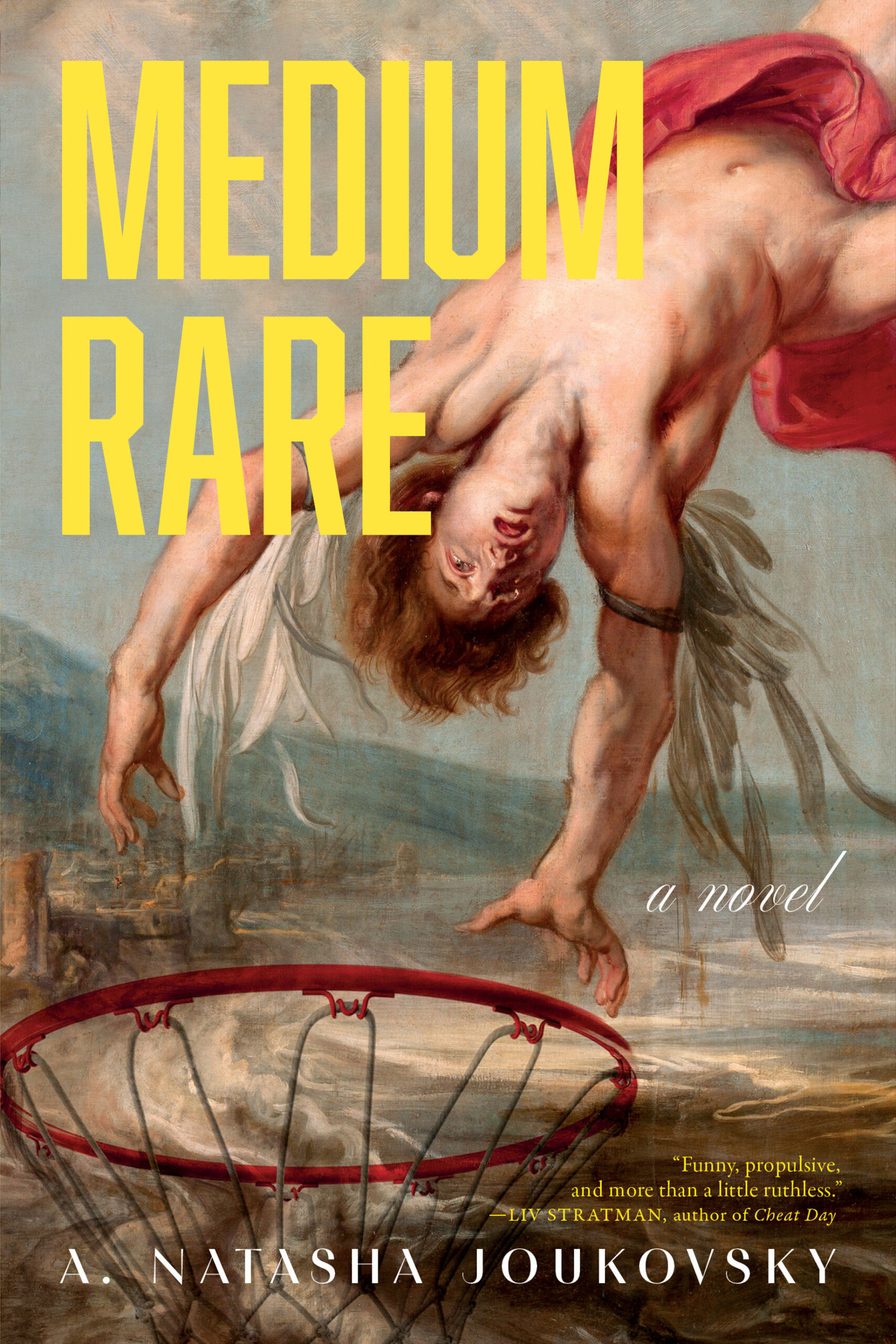
Is it actually possible to fly too close to the sun? Like, we know air gets colder at higher altitudes—picture ice crystals forming on a plane window. Picture snowcapped mountain peaks. If you want to take the conceit to impossible extremes, it’s colder still once you leave the bounds of Earth’s gravity. So what does that mean for Icarus? Did he fly past Venus? Mercury? What temperature do wax wings melt at? Can wings, wax or otherwise, even flap in space?
Fortunately, myths, legends, stories (and often novels, at least good ones) aren’t especially concerned with questions of literal possibility, or as Cassandra, the narrator of A. Natasha Joukovsky’s new novel, Medium Rare, puts it, “fiction is where the incredible finds credibility. Glory, even.” Stories endure for their echoes of life, not their exact reproduction of it, in part because life itself is so very unlikely. The odds that you were conceived (so many spermatozoa!), or that your parents met, or that your grandparents survived their births, or that your great-grandparents survived their particular great famine/war/purge, and so on and so on, on a planet that happens to biologically support multicellular organisms who haven’t exterminated that same planet (yet!) are so infinitesimal as to be essentially zero. Mathematically speaking, you don’t exist. You’re a miracle.
Or, depending on your level of solipsism, maybe you call it fate.
Medium Rare confronts this paradox via a conceit that’s, on its surface, far less lofty. In 2018, Phil Fayeton—a small-time DC lobbyist for the American Association of Stone, Sand, and Shale (or AASSS, per Cassandra)—fills out a mistake-free NCAA tournament bracket, beating odds that we’re told are either around one in two billion (in years with reasonably chalky outcomes) or substantially worse, depending on your personal application of the ideas of luck and/or randomness to your figuring. In the tournament’s first round, in a depiction of a courtside interview, a Georgetown statistician helps us visualize the unlikeliness of Phil’s (not-yet-accomplished but inevitable) feat, telling a television audience that “when the championship buzzer sounds, you’re less likely to fill out a perfect bracket than you are to be one of the five winning players on the court.”
The book’s first half takes us through the tournament round by round as Phil’s bracket edges closer to perfection—and a billion-dollar prize provided by a Google-esque tech company—with little pretense that one of his picks will miss. Phil seems at first like an unlikely conduit for this predestined miracle; he’s a former frat boy turned low-on-the-totem-pole Reagan Republican. He’d previously been the subject of a prophetic warning from Cassandra when Raleigh, her sorority sister at the University of Virginia, began dating him. “I see inconstancy and fitfulness,” Cassandra tells her. “Success portending pain.” But this mundane predictability, shown through Phil’s buglike responses to social stimuli and his unwillingness to see his success as the result of anything other than his own agency, is in fact a type of superpower; Phil is superlatively, exceptionally generic, which makes him, Cassandra claims, “something amazing and something ordinary. A world and a grain of sand.”
If this seems like elevated language to talk about an attendee of a Kappa Rho Epsilon “snow pants or no pants” mixer, that’s by design. Cassandra is either a descendant or reincarnation of her mythological namesake, blessed with the gift of prophecy and the curse of never being believed—see Raleigh and Phil’s eventual marriage—and the references, parallels, and allusions to Greek myth, not to mention the incongruously grand diction of Cassandra’s first-person narration, undergird both the novel’s metaphysics and its plot, grounding the book in both Aeschylus and Dick Vitale. There’s never a question that Phil will achieve the impossible. The suspense and thrills of the book come, in part, from seeing how close to the sun he’s going to get and how (not if) he’ll suffer for his hubris.
Of course, we need to see Phil’s ascension first. By the Sweet 16, Phil has one of just two perfect brackets in the country, and is being interviewed by minor media outlets and sent to Louisville via a Buick sponsorship to watch his championship pick (his alma mater UVA, naturally) play Oregon in the tournament’s third round. As one after another of his picks hits, his profile grows. He becomes omnipresent in cutaway in-game interviews. Jim Nantz and Sir Charles Barkley refer to him by name. (Joukovsky, referring to Barkley’s nominal knighthood while avoiding the better-known but more pejorative nickname the Round Mound of Rebound, redoubles on a theme of notoriety bestowing social ascension.) And Phil’s place in the status-obsessed Washington, DC, milieu that both he and Cassandra occupy grows accordingly, as politicians who’d previously scarcely given Phil the time of day now jockey to sit next to him in catered luxury boxes, so long as his bracket stays perfect.
Oh yeah, there’s also the matter of that billion dollars.
Joukovsky is clearly concerned with hierarchies both explicit and implicit, but the book thankfully turns away from easy correlations with any one aspect of social order and the divide between gods and mortals. Instead we see a more labyrinthine interplay of fame, wealth, success, race, physical attractiveness, and even stranger, less quantifiable personal demarcations, all fractally reflecting one another. Every conversation—even those between friends or spouses—is a triangulation of one’s own status vis-à-vis another’s, whether among the ever-shifting social rankings of DC politicos, staffers, and lobbyists, or in the echoes of Greek (Yurman, not Lattimore) cliques resounding in the narcissism-of-small-differences divides of Beltway yuppies. A first-term Trump himself makes an appearance as a particularly unctuous example of the god-mortal binary’s fuzziness, his ignorance and inattention godlike only for his position, the vulgar manna he distributes a souvenir box of “presidential” M&Ms notable only for their branding.
In fact, it’s Arun Patil, the founder of Daedalus, the novel’s omnivorous, Google-like tech company, who most approaches some semblance of the human form of the divine. By providing paths through the Internet’s maze and a means of comprehending the unfathomably large, Patil gains an unfathomably large fortune, and he offers the billion-dollar perfect-bracket prize with the hubris of a god, assuming that with the odds ever in his favor, the contest is a false one, a simple matter of publicity, a form of engineered tribute. So when Phil’s success sends Patil’s intentions for the contest sideways, it’s not so much the prospect of losing money that Patil is upset about, but the idea that he’s about to be bested by someone so clearly his inferior. Cash greases every gear in the Washington machine, but it’s only Patil, by virtue of having so much of it, for whom it’s of secondary importance. In sponsoring the bracket contest, Patil makes the mistake of voluntarily descending from his unquantifiable, too-big-to-fail perch back into the earthly swamp he’s previously risen above.
Though they’re both minor characters, the divide between Patel and Trump may hold a key to the book’s metaphysics’ practical application. Patel has tamed the infinity of the Internet, and transcended—for all intents and purposes—the theoretically limited supply of money. For all his personal flaws, he’s ascended to the realm of the unquantifiable. But the presidency, like the NCAA tournament, is a closed system. Someone’s got to win it, and doing so is often a matter of a series of flukes and small coincidences—butterflies flapping their wings in Rio—as much as talent or will. What offers transcendence within a closed system is something more ephemeral, a consciousness of mortality even as one strives to achieve its opposite. The Virginia Cavaliers squad that wins the 2018 tournament achieves mortal divinity less for their eventual victory, but because of their previous failures (a humbling loss to a 16 seed the previous year), their individuality-subsuming teamwork, and their probability-defying comebacks. They’re not gods, but they’re godlike, and it’s because of, not in spite of, their humanity. Tournament hero Kyle Guy is, as Joukovsky points out, just a guy. Like Phil, Trump takes his ascendancy as inevitable for the simple fact that it happened, a mark of predestination rather than dumb luck. This is a fatal flaw, a damning, hubristic mark of unavoidable, bestial humanity. When Phil compulsively eats his Trump-branded M&Ms, he discovers they just taste like regular M&Ms. What else would you expect?
So as the friendship between Cassandra and Phil’s wife, Raleigh, begins to dominate the concerns of the book’s second half, it’s in part because their relationship evolves away from the vulgar striving that guides the fates (and the downfalls) of so many. Besides the fact that her prophecies are never believed, Cassandra’s work as an event planner for political fundraisers shows her in a contradictory place in the social milieu of the Washington insiders she works for—she’s essentially an underling, but one with poorly understood powers that seem to affect the behavior (or at least the purse strings) of her nominal betters. (She’s also a novelist herself, meaning she produces something without much material utility or relevance lol.) Phil’s prophetic ability in filling out a perfect bracket is objective, recognized, and believed, but Cassandra’s clairvoyance (as is so often the case for women’s predictions, she points out) rarely is—no one even bothers to ask if she’s filled out a bracket. Meanwhile, though Raleigh is depicted at first as the type of generically attractive sorority girl who’s predestined for a generically attractive life, her own hidden depths serve as both counterpoint and harmony to Cassandra’s. While Cassandra is consumed by the future, Raleigh is a savant of the present, her own star turn as Phil’s relatable wife morphing the inherent artifices of elaborate makeup and television’s aura into something truer than truth.
Raleigh’s deep-South, genteel doublespeak is itself emblematic of this paradox; her politeness is a “fortress,” the literal and subtextual meanings of her words having little to no relation to each other, and this comfort in duality makes her capable of giving an insightful (and ultimately tragic) exegesis of a sign depicting a cutesy saying in a fake-script typeface that she bought off of HGTV. And as Phil is consumed by his ascension (Multiple houses! Yachts! A run for the U.S. Senate as a “centrist,” switching parties to undercut the Democrats’ progressive wing!), Raleigh becomes further anchored in a family that’s more hers than his, which allows for the closest thing to a moral perspective offered in a book that (thankfully) avoids didacticism: In the indictment of Cassandra’s initial judgment on Raleigh’s normality, there’s also a judgment of the knee-jerk urge from those who think they know it all to reject the possibility of the sacred within the mundane. This capability for surprise, and the rare joy it can bring, may be why Cassandra refers to Raleigh as “the love of my life.”
In basing a story on the older stories we all know (whether through cultural osmosis or through dim memories of D’Aulaires’ Book of Greek Myths), and one that has to do with the ideas of predictability and predestination themselves, the novel gives itself a difficult task, one that unsurprisingly becomes most vibrant when it threatens to spin out of control. It helps that the writing about basketball unambiguously sings in its clear affection for the game. The description of Virginia’s “pack-line” defense is wonderful in both its clarity and lyricism, and a scene in which Charles Barkley quotes William Blake (claiming his Auburn Tigers are about to unload “fearful symmetry” on an opponent) is genuinely funny and rings truer because of, not despite, its absurdity. And despite all the implicit criticism of egotistical aspiration, the metaphysical elements of the basketball writing show that this isn’t an earthly world in which the sacred doesn’t exist, but rather that it’s to be found within beauty and art, the offensive possessions that unspool “like paragraphs of Proust,” the boys who play like gods, the men who can actually fly. These are the true miracles, the ones untold in box scores and brackets, the ones that fate has little to do with.
According to a 2013 paper in The Journal of Interdisciplinary Science Topics, Icarus’s wax wings wouldn’t actually melt until he reached the thermosphere—technically in space, some fifty to 440 miles above the Earth’s surface, where unfiltered sunlight enables temperatures as high as 4500 degrees Fahrenheit. Nonetheless, since this layer contains so few air molecules to carry heat, Icarus may have been able to still ascend for an hour or so before solar radiation, not heat, melted his wings.
As in love, politics, stories, and miracles, facts and truth aren’t always the same things.
Liam Baranauskas is a writer from Philadelphia.

More Reviews