Courting Disaster
Of all the games men and women play, tennis is the closest to solitary confinement.
—Andre Agassi
You may have heard that something is wrong with American men. They are lonely. Their lifespans are shortening. They’re not going to college. Worst of all, they’re not reading fiction anymore. It seems that every columnist, podcaster, and Substacker has an opinion to offer on the origins of the male malaise (male-aise?) and how to break out of it. Some say it’s economics—because the number of jobs that rely on physical strength are dwindling, we should bring back more domestic manufacturing. Others argue that schools have been unfairly designed to reward female-coded attributes like the ability to sit still for long periods of time, and that we need to reform our education system to better suit more-active learners. And then there are those who claim that the problem is with the framing of the entire conversation. Before we can decide what men need, we must reevaluate—and revise—the concept of masculinity itself, excising characteristics like aggression, emotional detachment, and recklessness as if they were toxins from a suffering body.
Being a man myself, as well as a father of two boys, I am necessarily implicated in this conversation and its outcomes. And yet I am exhausted by it all the same—not because the problems of men aren’t real, but because, to my mind, they’re much more complicated and have much less to do with masculinity per se than we are being led to believe. Men are no more of a monolith than women are. The sources of the underlying problems for, say, an unemployed factory worker in Northeastern Ohio and a Fortnite-addicted tween in Denver are very different and are hardly related to how each’s masculinity is being either suffocated or misdirected. Sometimes I think the widespread panic about men is due mostly to the need of national media figures to paint in broad strokes.
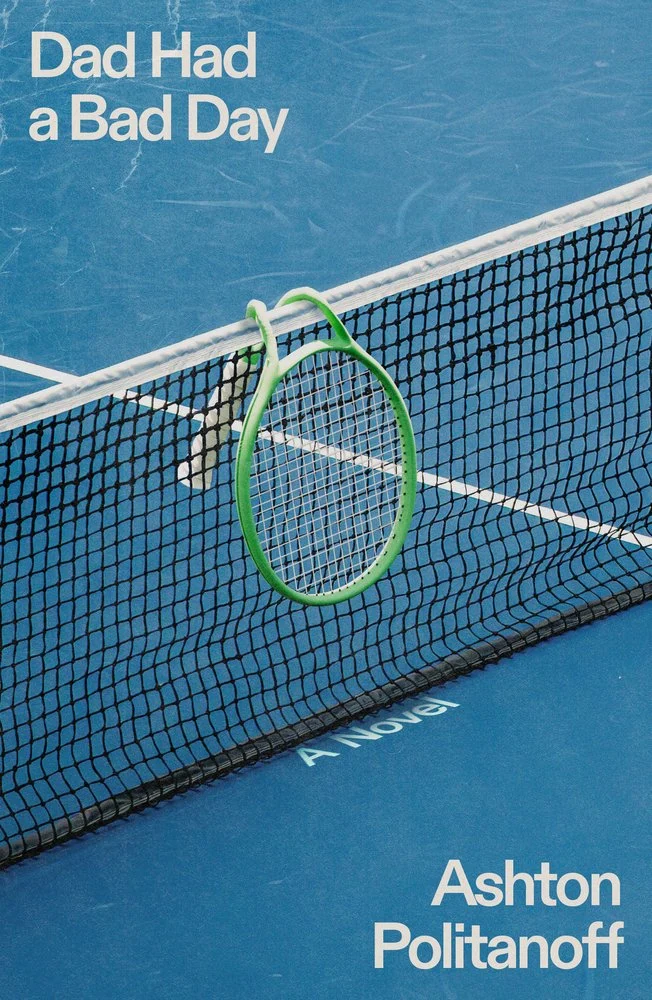
For better or for worse, Ashton Politanoff’s new novel, Dad Had a Bad Day, will likely figure into these conversations about masculinity, or else those conversations will impinge upon how it’s read and ultimately received. In a way you could say this fate is deserved, if not asked for—with that title, and that (admittedly brilliant) cover art, the book is practically begging to be welcomed as an entry in the current Discourse About Men. But that’s a shame, I think, because this book is much more interesting when you view it as a window into a particular kind of a man suffering from a particular kind of problem. What the novel lacks in universal touchstones it more than makes up for in setting down the specific joys and miseries attendant to lives led in a certain kind of way.
While Dad Had a Bad Day should not be used to draw any broad conclusions about men, you can’t say the same thing about its relationship to the sport of tennis. Politanoff, as the jacket copy boasts, is a former Division I tennis player. He describes the sport with an obsessive’s eye, and, while they are not professionals, the tennis players in this book are not the kind of ringers you would meet hitting balls on the court attached to your public park. Tennis in this book is sophisticated, brutal, and life-or-death. The characters in this book have been playing tennis for most of their lives—like alcohol to Homer Simpson, it is both the cause of and the solution to all of life’s problems.
When the novel begins, the narrator and titular Dad, Ned, has just been laid off from his job and has taken on the task of parenting his preschool-age son, Freddie, full time while his wife, Lorraine, works a white-collar job. A former competitive tennis player as an adolescent and in college, Ned hasn’t played in years. But one day at the park he sees two people hitting balls, and a desire to return to the game runs through him like a “vibration.” Next thing we know, Ned has secured a credit card without his wife’s knowledge and joined a private tennis club—the same club where he first learned to play the game. As Ned stretches the club’s childcare to its limits, promising to supply Freddie with toys and treats as long as he keeps Lorraine in the dark about this new habit, he rediscovers his love for tennis and rekindles a sense of manhood that had been lost when he was fired. But Ned’s secret tennis life soon becomes about more than having fun on the court and getting in some cardio. Soon Ned learns that one of his old pals from youth tennis, Roland, is playing again; then Ned becomes captain of the team the club is fielding for a local summer league. Suddenly, whatever had initially led Ned back to tennis becomes subsumed by two desires: getting Roland to join the team and leading the team to victory.
The elusive, volatile Roland lies at the heart of the novel. A star player as a youth who quit the game end after his mother died, he is the object of Ned’s fascination and desire, and he fits a type familiar to many sports movies—the mythic savior, à la Jimmy Chitwood from Hoosiers, who has to be dragged out of early retirement or forced obscurity in order to save the day. As with many of the other players in the book, Roland’s warped relationship with tennis stems from the fact that he was raised by a father who never understood the difference between bullying and coaching. Such fulminating monster dads appear throughout the novel, stalking the sidelines and hurling insults at their beleaguered offspring as well as their confused opponents in equal portion. Anyone who knows anything about tennis knows that the trend of belligerent parents is hardly an exaggeration; in his memoir, Open, Andre Agassi writes at length about the fear instilled in him by his tennis-obsessed father, who regularly pulled him out of school to practice and created a custom-built ball machine, nicknamed “the dragon,” that could fire serves at 110 miles an hour. No wonder, then, that Agassi has famously ambivalent feelings about the sport, writing, “I play tennis for a living, even though I hate tennis, hate it with a dark and secret passion, and always have.”
Ned is also a survivor of early parental pressures. In a flashback to his childhood, he describes playing in a tournament against the son of his one of his stepfather’s rivals and being aware that he was shouldering a strange, competitive burden: “When match day came, I knew this. I knew that I couldn’t miss. I knew that my old man hated his life, his job, and viewed me as a way out. He viewed these matches as a way out, a fantasy, a dream.” All Ned wanted was affection, but he never received it. Meanwhile, he is robbed of his ability to enjoy tennis as the game that it is. At another moment, he invokes the strain exerted on his younger self by imagining the regular interrogation from adults who are nominally supporting and coaching him:
Did you break his serve?
Did you break a racquet?
Did you bleed?
Did you hit him?
Every week they ask these questions, but they never ask one—
Did you have fun?
Dad Had a Bad Day is blunt about what happens when you browbeat children into becoming robotic, tennis-playing savants: they grow into immature, unbalanced adults, prone to mid-game tantrums, sneering trash talk, and blatant cheating. Supposedly teammates, the players on Ned’s team seem to care more about their own ranking than the club’s reputation. Even Ned and Roland struggle to have anything close to a normal conversation. Here is Ned attempting to check up on his friend:
I said, Everything okay?
He nodded.
I’m here if you want to talk, okay?
He nodded again.
Do you want me to get you a water?
He shook his head.
I’m okay, he said.
As much as Ned may want to see his tennis outings as a means of forming connections and seeking fulfillment, he’s too emotionally stunted to truly get there. The best thing that you can say for him is that he avoids pushing Freddie down the same path, even though is he still a disengaged, neglectful father.

In his last book, You’ll Like It Here, Politanoff created a portrait of the town of Redondo Beach, California, using a fragmentary, polyvocal style composed of fictional news clippings, vignettes, and photographs. While Dad Had a Bad Day has a single point of view and tells a single story, it also relies on a fragmentary style of brief moments and scattered reflections, none longer a than a few pages and most clocking in at two or fewer. This abrupt, laconic style, heavy on white space and understatement, fits the characters perfectly. Interspersed among the vignettes are a handful of letters written by Ned and addressed to Lorraine. Whether he actually delivers these notes to his wife goes undeclared, but the letters, some of which are only a few lines long, provide a sense of interiority largely absent from the narration. In an early entry, he tells Lorraine, “I think I’ve found what I’m looking for.” Later, he explains that he has “found a new species of men in these halls. These are men of ritual, discipline, and refinement. My hope is that over time their good habits will rub off on me.” Some of the letters dispense a brusque, Nietzschean wisdom (“Men are hard to please”) while others catalog his various jealousies and resentments, like the time when they were picnicking at an outdoor concert and Lorraine offended Ned by accepting charcuterie from another man: “You took the plastic tray from him without hesitation to spite me.”
Those who want to see Dad Had a Bad Day as a book about contemporary manhood will inevitably point to these passages. Look how broken and isolated he is! He’s jealous because his wife took deli meat from another man? Yet I would still push back against this tendency. Dad Had a Bad Day is a novel about men, yes, but it is more precisely a novel about men who play tennis. More precisely than that, it is about men who have played tennis since they were boys. To go even further, it is about lonely, isolated men who were forced to play tennis as boys and who have never recovered.
As a longtime pickup basketball player, I’ve always viewed tennis as an inferior athletic pastime, even though I have a racket and play occasionally with my family. The main reason behind my preference is the fact that tennis lacks the sense of camaraderie that comes with playing on a team. Because you have to take every shot, you’re more likely to get in your head and less likely to reach that feeling of unthinking bliss that is to my mind the ideal state of playing a sport. After reading Dad Had a Bad Day, and having gone a few months without playing tennis, these prejudices hardened. Good riddance to this whole silly sport, I thought to myself as I read about Ned’s increasing descent into tennis-derived mania. Then, a couple of days ago, the sun finally penetrated the unending grayness that is the Midwestern spring, and my wife suggested we go hit some balls on our neighborhood court during a morning window between meetings. I agreed, and within minutes of being out there, I was reminded of how much fun tennis can be. It does require more concentration, and there are more opportunities for self-abasement, but I can’t deny the sole-burning excitement of a long rally, the resonant twang of a well-hit return, or the meditative exhalations that lead to an effective serve. All these things feel even better when you’re playing with someone you love.
Wilson McBee lives in Highland Park, Illinois, and is currently at work on a novel.

More Reviews