The Degrading Experience of Learning
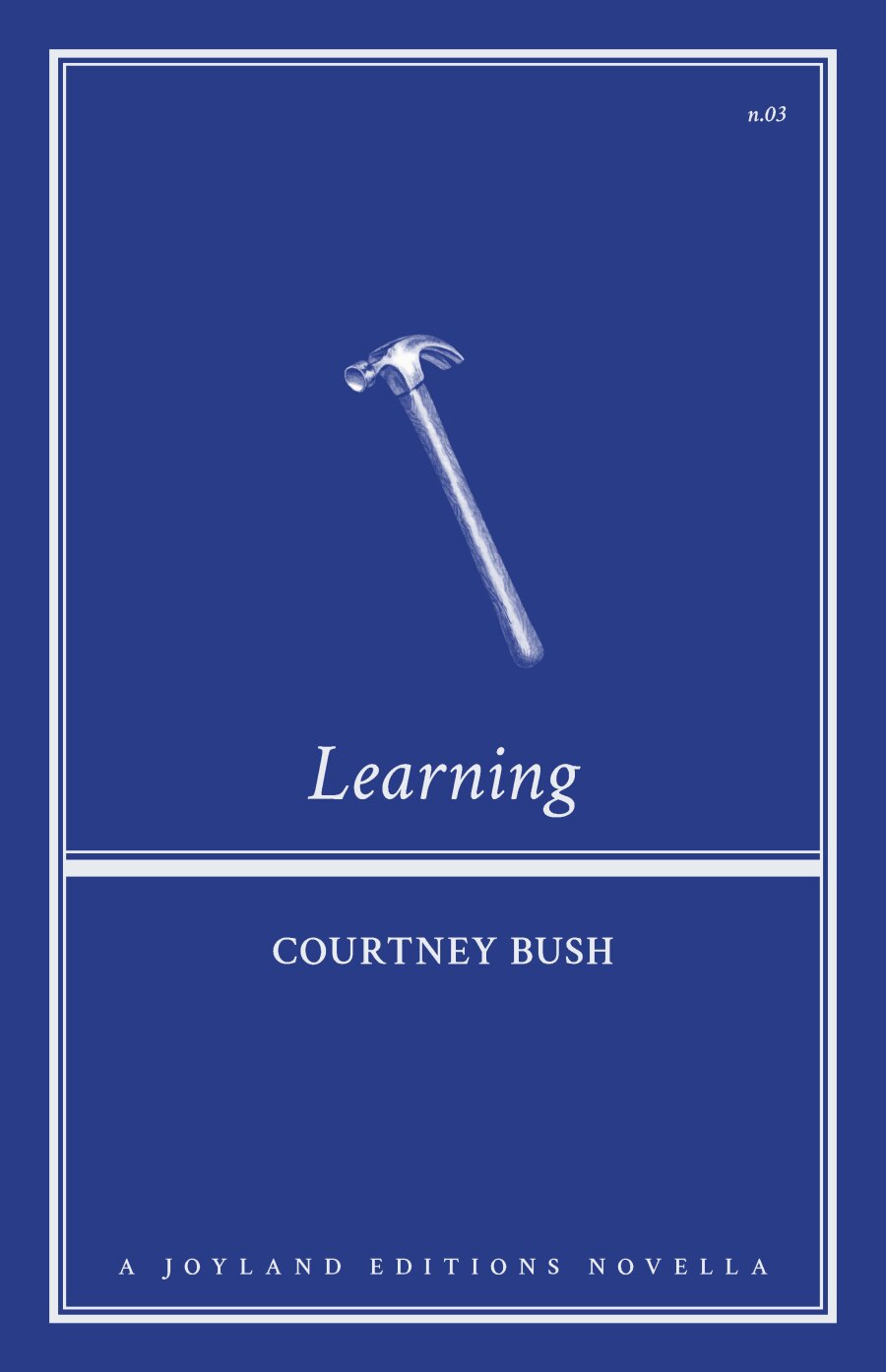
Courtney Bush’s fiction debut, Learning (Joyland Editions), takes place over the course of a single morning and afternoon. The novella’s protagonist, Courtney, wakes up after a trying night comforting her boyfriend, Luke, during a psychedelic meltdown and, without waking him to say goodbye, leaves for work. On the subway, she thinks about the death of her childhood friend Hannah in their home state of Mississippi—it’s now been a year since the funeral—and contemplates her divorce from a man she married and then quickly learned not to love.
At the preschool where she works, Courtney gossips with her head teacher and best friend, an artist named Whitney, about Luke’s mushroom trip, which he’d embarked on in an attempt to cure his crippling OCD. Courtney confesses to Whitney her horror at Luke calling her, while tripping, his “best friend.” He is not her best friend, Courtney confides; Whitney is. While the two teachers set up for the day, the phone keeps ringing in their boss Elena’s office. When Courtney finally answers, the caller says, “Elena, fucking talk to me,” then hangs up the second he realizes he isn’t speaking to Elena. Courtney suspects the caller is Mike Rott, Elena’s toxic and physically violent, criminal ex, whose presence grows more threatening as the day goes on. Internally, when she’s not worrying over him, Courtney meditates on cruelty, her own insecurities about her capacity to love deeply, and, perhaps most important, on learning.
The novella follows several books of Bush’s poetry, and it shows. Rilke references are peppered throughout, along with other mentions of angels. The narrator confesses to thinking she’d been brilliant for connecting the Duino Elegies to Wings of Desire, only to later read on the film’s Wikipedia page that Wim Wenders based it directly on those poems; it wasn’t some hidden insight only she’d picked up on.
Bridging these preoccupations with the narrator’s work, Bush writes:
I considered my work with them [the children] holy. I thought of the children as angels, not in the Renaissance painting sense. There was nothing soft or floaty about their existence, their engagement with the world. They were like armored beings covered in eyeballs, covered in sense organs, spinning innumerable gold and silver wheels around their limbs and tendrils, learning at a rate that is impossible to describe in something as structural as language. Eating information with their entire beings.
This is one of the novella’s clearest statements about the horrors of learning. Bush takes the angel, an image worn smooth by centuries of greeting-card sentimentality, and reanimates it with something closer to Ezekiel’s wheels-within-wheels monstrosity. Children aren’t innocent in the soft sense; they’re terrifyingly absorptive, machines built for taking in the world. The line about language being too “structural” to describe their learning is the giveaway that this is a writer who thinks in poetry first.
Because we see the children through Courtney’s eyes, we fall for them too: their imagination, their purity, their unashamed wanting. Other people’s children cling to Courtney throughout the day: Martin, who smells inexplicably of pizza; Pia, who makes beautiful paintings; Sammy, who hoards uncooked pasta; Theo, the boy genius, who reads about cycles (the water cycle, the life cycle of a chicken) and avoids the other kids, who don’t understand his fascinations. As a group, they hold a funeral for their classmate Anne-Louise, who is only playing dead from an imaginary snakebite. Even the kids who misbehave, Courtney sees with real grace, knowing that just because someone does something bad doesn’t mean they are bad. That extends to Quinn, the child who haunts Courtney’s work-stress dreams, who in waking life will inexplicably yell “MERT” and refuse to stop. As guilt pervades the narrative, readers are left wondering what would happen if Courtney could extend such grace to herself.
One of my favorite scenes comes when Elena, Courtney’s hypocritical boss who once had beautiful ideals and has since become obsessed only with bad men, takes the children outside to teach a lesson on symmetry. She dumps a pile of pinecones onto a white bedsheet and tells them to arrange a mandala, something photogenic for the school’s Instagram. Instead, the kids arrange the pinecones “to their liking, in strange intuitive formations, every now and then glancing up at Elena, wondering why she seemed to be growing more and more angry.” The kids aren’t being defiant; contrived order simply doesn’t translate. The logic of the adult world cannot be transposed onto a four-year-old’s intuitive play. Elena wants a picture of order, and what she gets is the truth, which she has no use for in her composition.
That tension sharpens into something genuinely devastating later, when the kids are confused by something terrible happening in the adult world, involving Mike Rott. When Courtney asks Elena what she should tell them, Elena responds in kind: “Are you stupid? Tell them whatever you want, she basically spat at me. They’re four years old. They don’t know anything and they don’t care. I looked to see if they’d heard her. Of course, they had. I’d think about this moment forever.” The cruelty here isn’t even really directed at the children; it’s collateral damage from Elena’s own exhaustion and self-loathing, which makes it worse, not better. Courtney isn’t traumatized on the children’s behalf so much as she’s recognizing, in real time, the kind of adult she does not want to become, and isn’t entirely sure she can avoid becoming.
Courtney turns that same unsparing eye on her own capacity for cruelty. As a kid, she once ran a bath as hot as it would go and called her little sister, a trusting toddler, in to get in it. The result was horrifying: a toddler twisting on the bathmat, writhing with skin scorched red. She confesses to repeating the exact same cruelty as an adult, in the middle of fights with her ex-husband. Bush doesn’t soften this or explain it away. It just sits there, ugly and specific, the way real self-knowledge usually does.
That unsparingness turns outward, too, when a parent makes a joke at his own son’s expense by asking the boy, who he knows can’t read, to explain the day’s printed curriculum to him:
Sure, Tomás can’t read, I wanted to say. You can read, sir, isn’t that wonderful? But would you be willing to sing a song with us? Do you tell people what you are afraid of? When did you stop learning? When did you say you’d had enough of what Tomás is experiencing, the degrading experience of learning, which is an experience of submission and humility and constantly admitting to yourself that you don’t know what the fuck is going on? Do you reach out for help when you need it? Or love? Then get out of my classroom, I wanted to say.
This is among the book’s angriest passages, and it’s also where its title cracks open into its full meaning. Learning isn’t some innocent process reserved for the young; it’s reframed as an ongoing humiliation, a “submission” most adults have opted out of because it’s easier to mock a four-year-old than to admit you don’t know what’s going on either. The question “Do you reach out for help when you need it? Or love?” is the real accusation, aimed less at this one bad dad than at the adult condition generally, at everyone, including Courtney, who has built defenses precisely so they don’t have to keep learning, keep submitting, keep being humiliated by their own ignorance.
That idea is stated as plainly as a thesis about forty pages later: “Maybe becoming an adult is learning there’s a distinction between the self and the world, an unbreachable boundary. But it is more than possible to learn the wrong thing. To learn something doesn’t make it true. It just means you learned it.” Here, Bush points out that growing up is not synonymous with growing wise, and that most of adulthood is just defending conclusions one has arrived at by accident.
If there is one adult in Learning who rejects the calcification of adulthood, it’s Luke. While Courtney is initially turned off and annoyed by his macrodose the night before, sobbing on a yoga mat in her closet, marveling at his own penis, she comes around to respect both him and the act itself: “He made an extreme attempt at learning where most adults make none.” Earlier in the book, she’s even more direct: “I looked up to Luke. He’s the first person I dated who I’ve been able to say that about. He was the only one who took such an active role in trying to take care of himself, in being good, in learning.”
What Learning ultimately argues is that vulnerability and earnest attempts at change compose the only path toward growth. Courtney spends the day surrounded by children still doing the actual work of being alive—absorbing, failing, trying again—while many of the novella’s adults have stopped. Elena has hardened into cruelty because softness caused her pain. Rott circles the edges of the novella as proof of what happens when a person stops growing and concretizes into pure threat. Courtney’s own past cruelty, confessed without flinching, is the book’s clearest evidence that knowing better and doing better are not the same skill, and that growing up doesn’t make you safe from the worst version of yourself; it just gives you better excuses. By the end, Learning has redefined its own title. It isn’t a children’s word at all. It’s the thing almost everyone in this book has given up on, and the thing Bush seems to be asking us, as readers, to start doing again, badly, humiliatingly, on our unrequited best friend’s yoga mat, if that’s what it takes.
Shy Watson is a PhD candidate in Creative Writing & Literature at the University of Southern California. Her short stories can be found in places like Joyland, Southwest Review, Volume 0, and elsewhere. Monson Arts and the Lighthouse Works have been instrumental in their support.

More Reviews