The Past Is a Hunting Dog
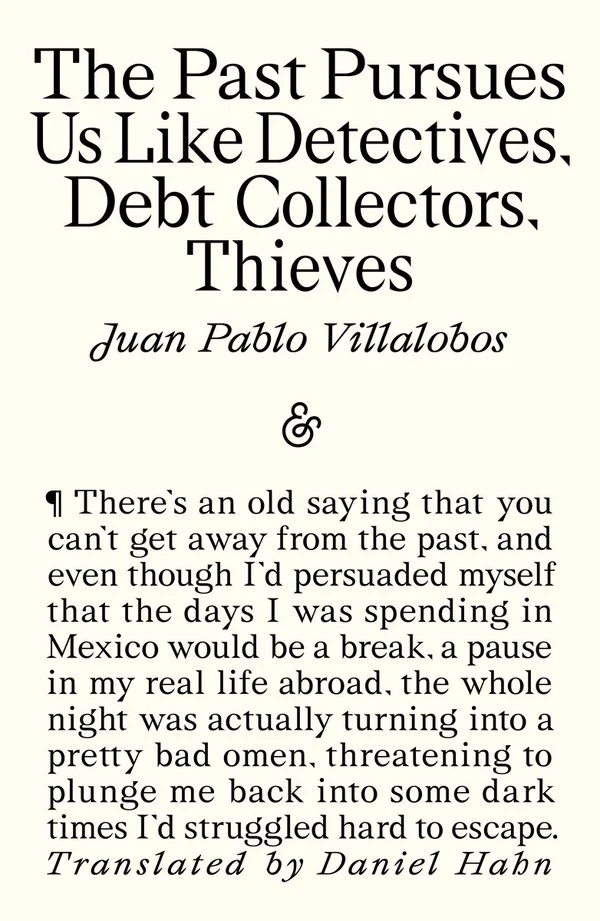
A man returns to his hometown of Lagos de Moreno, Mexico, and leaves behind the comfortable life he built for himself so he can take care of his sick mother. He has to play the role of son once again—not that of a child who is cared for, but of someone expected to take care of others, a duty he has avoided in spite of the guilt that comes with that avoidance. In Lagos, his parents are not the only ones waiting for him, and soon he has to deal with troubling memories and old resentments.
Juan Pablo Villalobos’s The Past Pursues Us Like Detectives, Debt Collectors, Thieves (And Other Stories, 2026, trans. Daniel Hahn) is told by an unnamed narrator, a man whose identity seems to emerge only through his fears, his paranoias, his small and belated acts of revenge, his everyday defeats, his failures. He tells himself the plan is simple: Take care of his mother, take her to the doctor, fix what can still be fixed. And if he follows it exactly, everything will be fine. But if human beings were logical, they would not be human beings.
The story begins with a literal punch, one fueled by ancient anger. It lands on the face of Everardo, the narrator’s childhood nemesis and the target of a long-postponed revenge, the face onto which he projects all his frustrations and helplessness. It’s a punch meant to strike down the past, but it explodes—and hurts—in the present.
Because what the narrator truly wants is not only to fulfill his duties as a son, but to settle accounts with himself, to stop running from everything that came before and finally confront it. And that confrontation has a name: Everardo, the man who bullied him as a boy, who through fists and humiliation planted inside him a ghost that still pursues him—even from the other side of the ocean, even after he has built a family of his own and seems to have everything that should be enough. But it’s not enough, because the past is also a hunting dog.
This is a man whose past is too burdensome, and whose present is not enough because everything he has done has been left unfinished; that incompleteness makes him more visible than if he had done nothing at all. It is a kind of visibility that feels less like recognition than exposure, as if the town were constantly rearranging him into a version of himself he cannot fully escape. In his beloved Lagos, identity is something interpreted for you, often against your will. Even his attempts to explain or justify himself only deepen the sense that he no longer belongs anywhere, that every gesture is read as evidence of guilt or betrayal.
The novel is built around what for the narrator is a series of recurring foundational moments, such as the night of the punch thrown at Everardo, which dismantles that present and which he returns to again and again, trying to understand (or perhaps to find the exact moment when everything went to hell) as well as visual elements that echo throughout the novel, such as photographs of hands holding a rifle casing or a pill, images that reveal new meaning every time they return. And through that chaotic architecture—one resembling the architecture of dreams—the narrator tries to uncover what happened, what is happening. He tries to impose order on a narrative shaped by memory while attempting to escape the trap of his own recollections. After all, memory does not simply preserve what happened; it distorts, rearranges, constantly rewrites it. The narrator, then, becomes someone searching for his own shadow in a dark room.
The novel has a Lynchian sense of place, as if the narrator reached for the wrong blister pack before stopping at a cantina in a pueblo mágico, where the ominous is replaced by something darker: the gaze of everyone else in town, where gossip becomes its own kind of punishment: “In reality it wasn’t just chance, because chance and coincidence are big-city phenomena, not something you get in small towns; what you mostly get in towns is historic cause and effect, the logic of routine and repetition.” And that gaze feeds into whispers and a vox populi hungry for spectacle, a craving that grows stronger when the man who is no longer one of them punches one of their own—a wayward son, perhaps, but still one of theirs. And before there is time to process the ensuing gossip, Everardo turns up dead. Which of course arouses suspicion even though it is officially ruled a heart attack. There has to be more to the story. Death sanctifies the wayward son and places the narrator in front of the town’s eye—an eye that watches everything and forgets nothing.
With the narrator’s cards dealt, Villalobos plunges the reader into a tragicomic marathon where drugs, cops, and gravediggers begin to appear. But these are people who simply want to be paid; the story unfolds from the everyday, without resorting to the most visible (and expected) imagery of narcoviolence. A mountain of debts comes up for collection while the narrator tries to settle the debt that matters most—not with his family, but with himself.
While dealing with old and new troubles, the narrator must focus on what brought him to Lagos—taking his mother to the doctor—as if that could restore a missing order. On the way to the clinic, he discovers that the money meant to pay for the treatment has disappeared from his bank account. It’s as though the material proof of his role had been erased. Paying for the treatment is his way to keep being a son—the responsible one, the one capable of providing what the others cannot. He seems condemned to the impossibility of belonging, and everyone insists on reminding him. “You don’t know what things are like here these days, honestly,” he is bluntly told, recognizing that he will leave, but they are the ones who stay.
The harsh, classic truth is that one can return, but never go back. As the narrator learns to let go of the ghosts of his past, shaking them off one by one, he must also keep from becoming one himself: the ghost of the man he could have become. To do that, he must finally stop running.
Nicolás Ferraro, born in Buenos Aires, is the author of several books, including Cruz, his first novel translated into English, and My Favorite Scar, which won the Dashiell Hammett Prize and was nominated for the Edgar Award for Best Novel. His work has been translated and published in several countries.

More Reviews