The Guest List | Sam Sodomsky
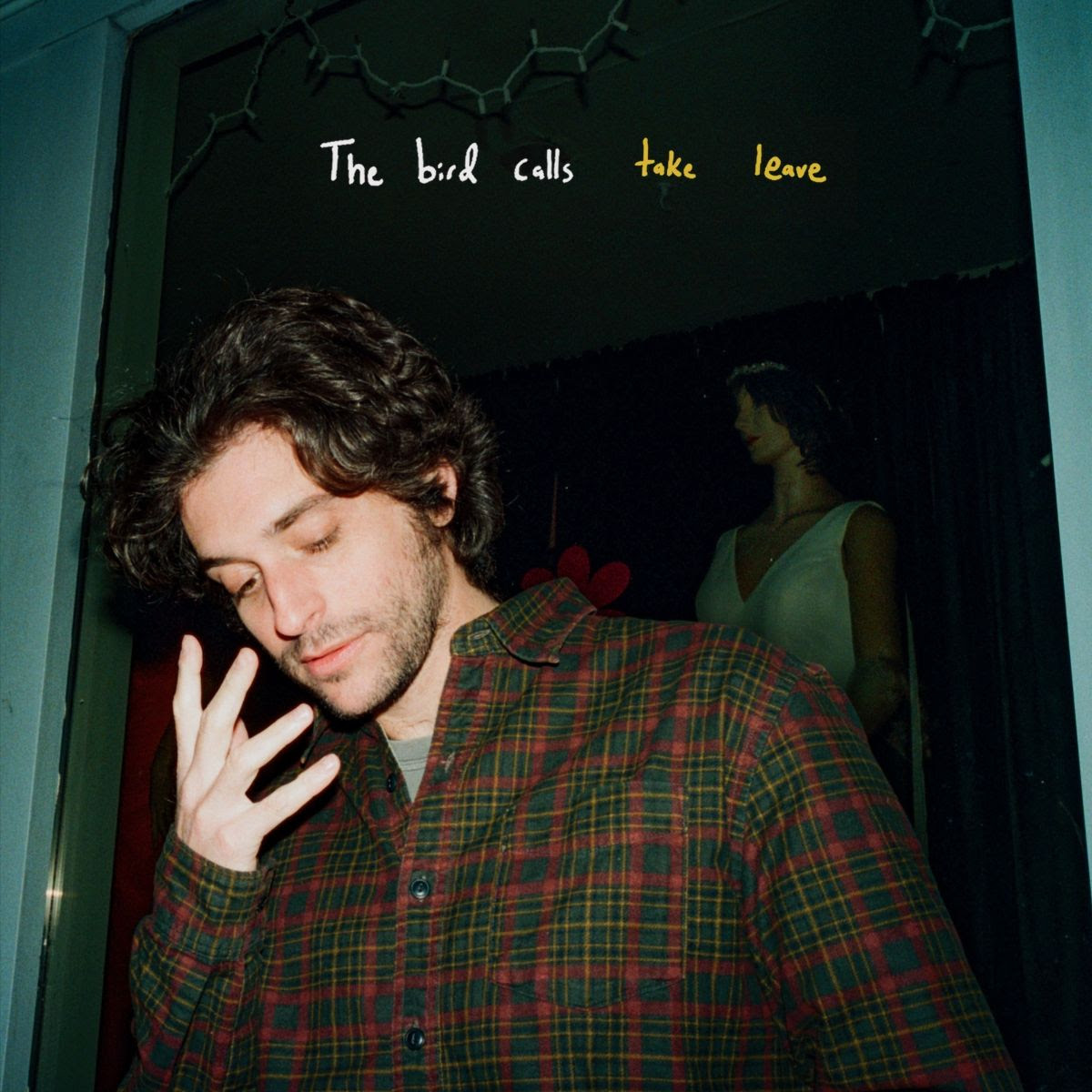
In the newest edition of The Guest List, decorated songwriter and journalist Sam Sodomsky discusses John Prine, Joan Didion, Garielle Lutz, Kiss, Russell Edson, and the countless other inspirations for his marvelous new LP Take Leave, credited to Sodomsky’s alter ego, The Bird Calls—12 songs over 35 minutes that mine new tunnels of love and call into question the very nature of human potential on tracks like the inarguable “To Everything There Is a Ceiling.” Read this, and then head over and dive into the voluminous catalog of one of our best under-the-radar songwriters.
Elizabeth Nelson: Congratulations on Take Leave. I think it’s beautiful. It’s a very sad record—a record about human dislocations, messages sent and not received, messages received and not understood—and yet it makes me laugh a lot. There’s a lot of funny lines about pretty tragic situations. It kind of zooms in and out from a personal narrative and then a larger perspective on the whole human problem, the way John Prine used to do. I’m curious about how conscious you are of using humor in your songs, and how you balance sad songs with funny asides.
 Sam Sodomsky: First off, thanks. I mean, that’s a huge compliment. And also a really astute reading on the album. I personally thought it was really sad when I made it. I thought it was borderline goth in how bleak it was. But the funny thing is, a lot of people have said they find it kind of hopeful or they think it’s more upbeat than my others, which I love when people interpret stuff differently than me. But it’s nice to hear that someone else hears there’s a lot of pain on it. But, yeah, humor, I think about a lot. I mean, it’s hard to be funny in a song in a way that’s not cloying. I attended an MFA program, and in the MFA, there’s MFA writing. And I feel like every form of art has that, where it’s the accepted way to say things that people will think is good or what people will register as a joke in a song.
I actually got into John Prine while I was making this record. I knew the big songs, and I always knew what he represented. But I hadn’t heard some of the deeper cuts until early last year. And I was moved by his way with humor, because obviously he’s known for the folksy, idiomatic, passerby-commenting-on-the-profundity-of-life stuff. But I also thought his ideas for songs were really funny. Like “Jesus the Missing Years” was probably the song that influenced me most on this, where it was taking a heavy subject, the years of Jesus’s life that aren’t in the Bible, and coming at it from an angle where you don’t see the scaffolding of the prompt of the song. I don’t like writing that feels too workshopped, or that feels too self-conscious. It sort of needs to have the spark of a bad idea, or a good idea, but mostly bad ideas in order for the listener, I think, to feel the excitement, or feel like they’re in your brain when you were coming up with it.
EN: You have a song on the record called “Ethan Frome,” which, going into it, I’m like, okay, Ethan Frome, one of the least fun books about sledding. It’s no Cool Runnings. But tell me, what’s going on here? I assume it was inspired in some part by the Edith Wharton novel. There are thematic overlaps in the lyric writing, at least in my reading of it. And, man, that book is so bleak. And this song is equally kind of sad. But I wanted you to tell me a little bit about it. What about Ethan Frome inspired you? In what ways did the novel come into your mind? Why did you pick it? Just please tell me everything that you can about the song.
SS: Well, I was reading the book, and I was really invested. I love the landscape. I’ve also written a lot of songs that are about emotional paralysis. I like writing songs where someone’s kind of pep-talking themselves to do something or say something. And then it cuts, it ends before that happens. Which is maybe a Springsteen thing. He has all these songs about jump in my car and let’s go. And then it ends before they actually get to go. I just like that as subject matter. And then you can really complicate stories like that with the music, whether it sounds triumphant or whether it sounds doomed. I find myself writing songs like that all the time. And I felt like this was maybe the best or most literal book about that. I mean, there’s actual physical paralysis in it too. But so much of the tension comes from making plans and not doing them. Like you said, the song’s not really about the book. I went back and forth giving it that title.
EN: It’s ambitious, you know? You’re taking inspiration from a book from 1911. So let me ask you this, and I’m sure that you get this question a lot, but you’re a music critic in addition to being a singer-songwriter, which is something we share in common. So who are some of your favorite critics, and do you have a work of rock journalism or rock criticism or musical biography or memoir that you really enjoy when you’re thinking about your job as a critic?
SS: I’m a writer, but I’m also an editor. So I’m constantly reading music journalism. I still love it, but I feel like I’m a lot less likely to read it for fun now. I definitely read a lot of rock memoirs. I’m always switching between wanting to read adventurous, experimental prose and, when my brain wears out, just wanting to read a memoir. Anytime a guitarist from a rock band puts out a memoir, the dumber, the better. I’ve read so many books about Kiss, and anytime there’s a new book like that, I get really excited. But I grew up on the blog era of music journalism, in the 2000s. That’s what made me want to be a music writer. I don’t have a ton of reverence for the old seventies guys. Although, I mean, obviously Ellen Willis is amazing, especially as a Dylan fan. I love reading her as a Springsteen fan. I love reading Dave Marsh and Jon Landau from back in the day, but I don’t know. I have that book, the Lou Reed one, My Week Beats Your Year, that has all his collected interviews. I read it and I feel bad for Lou Reed because he’s talking to all these journalists who so clearly are not paying attention to what he’s doing now. And they’re so confrontational and aggressive with him. By the end, when he finally talks to Amanda Petrusich, it’s like a happy ending—finally, someone who understands what he’s doing and isn’t there in a combative way. So I don’t know if there are music journalists specifically I would say as inspo at this point, but I wonder how you feel about this. Something I do feel is that making art can be a form of criticism sometimes.
EN: That’s a really interesting way of thinking about it. My whole approach has always been like, the best way, in my opinion, to critique an album is to make what I think is a better record and vice versa. So we talked about who you may or may not read in terms of critics. I love, by the way, that you read about Kiss a lot. I think about Kiss constantly.
SS: To me, if there were only one, Kiss would be the perfect band in an epic novel about music. That they actually put out records is completely tangential to how fascinating Kiss is as an institution.
EN: Absolutely. Okay. So we talked about what you were reading while you were doing the record, what kind of criticism you might turn to, and what inspires you as a critic. Do you have favorite works of literature that are non–Edith Wharton variety, non–rock criticism variety, that you turn to for inspiration as a songwriter or as a prose writer? And then a follow-up question to that that I want to ask you is, do you find prose writing and songwriting to be overlapping skills, or something distinct from one another?
SS: Yeah, definitely. I came late in life to the whole literary world. I mean, not that late, but I was in college, almost through with my music business major, when I decided I was more interested in the English program. I was at Syracuse, which was an exciting place to be and I imagine still is. They have a great faculty. It was when George Saunders was just putting out Tenth of December. I was studying with Sarah Harwell, who’s a great poet and who encouraged me and introduced me to a lot of the stuff I still love, and Chris Kennedy, who’s another great writer. He’s putting out his first novel next year, I think.
EN: Oh, cool. Saunders, and where Lou had got taught by Delmore Schwartz.
SS: I got to go to that release event and meet Saunders and have him sign my book, which really changed my life. And made me want to do an MFA. At the time, I wanted to do an MFA in poetry because that was what I was really excited by, and it also felt the most like songwriting. I was always drawn to art that left a lot of space for the reader or the audience to fill in the blanks. Music is obviously that way. You hear a good song about heartbreak, and suddenly it’s about your heartbreak. The first time I read Raymond Carver in high school, I felt that way. I imagine a lot of songwriters mention him in these interviews because there’s something very songwriter-y about his style. I didn’t know writing could do that until I read his books. With so few words, suddenly I have this whole picture in my head. It was how I felt about Springsteen, but it was my life. It was magic to me.
EN: The kind of literary rescission that Carver and Gordon Lish arrived at was truly radical, and I would tend to agree that it impacted songwriting.
SS: And then I got really into Joan Didion. With her, the feeling was similar to Raymond Carver, but it was—I felt like I was in her head. You read enough Joan Didion, and you feel like you know how she thinks about things, you know how she would phrase something. I got kind of obsessive with it, and that became what I wanted to do in writing—complete control. World-building but entirely internal, in someone’s head as they process the world, culture, and politics. The idea of maintaining control has always been really important to me in writing.
Then the next really big thing that hit me was The Complete Gary Lutz. This was a really important book to me. I had jury duty one time, and I brought this huge collection, and it blew my mind. It introduced me to this way of writing where the language is the point. There’s so much playfulness and inventiveness with language, so the plot is secondary, and meaning is almost secondary. Then I got into other writers who reminded me of Lutz, or who Lutz would reference, like Christine Schutt. I read a lot of her and still turn to her writing a lot. She’s a little more plot-centric, narrative-centric, and writes about really devastating, brutal things, which I like.
And then—in my head I’m trying to chronologize—one writer who sent me on a tear was the prose poet Russell Edson. I got into him when I was mostly done making Old Faithful, which was my sad first-person album. Russell Edson writes these prose poems that are like fables, and some are accompanied by his woodblock art. They’re all really short, the length of a paragraph, and they twist in all these directions. I loved it so much that I started imitating it and writing my own prose poems, which I still do. That’s still one of the things I like doing, and it’s indebted to his voice and structure, and it also affects my songwriting.
EN: It’s amazing to talk this through and hear a fellow songwriter sound off on all of the psychological, backstage stuff that comes along with making such a fine record as Take Leave. It brings me back to the first thing I asked you, about humor in the songs. Whimsy.
SS: In terms of the question about humor, I think it allowed more nonsense into the songs and more childlike imagery and language. It reminded me that when I was a kid, I loved any children’s books that were self-aware. Like someone breaking through the page, or references to other books. And The Phantom Tollbooth was kind of that. And Russell Edson made me feel that way, but as an adult. I’ve been on this poetry tear the last few years. I also got really into Jorie Graham. I love her writing. It’s very conceptual and similar to Russell Edson. The space that takes up the page becomes part of the poem. Stuff like that has been useful to me, and a lot of it is because I have a really short attention span. For a poem to work, it can’t have any part where you want to stop reading. Right now I’m reading this book, John’s Table by Lesle Lewis, and I’m loving it. I’m reading every poem really slowly because they’re short, and they’re good. It forces you to slow down a little so you can be invested in them, which I like.
EN: Do you like slowing down?
SS: I like the idea of it.
Elizabeth Nelson is a DC-based journalist and singer-songwriter in the band the Paranoid Style. She also hosts the New Pony/Southwest Review podcast Known Associates, where she speaks to fellow writers, artists, and musicians. Her new album—also titled Known Associates—was released on Bar/None Records in February 2026.
