Accented Darkness
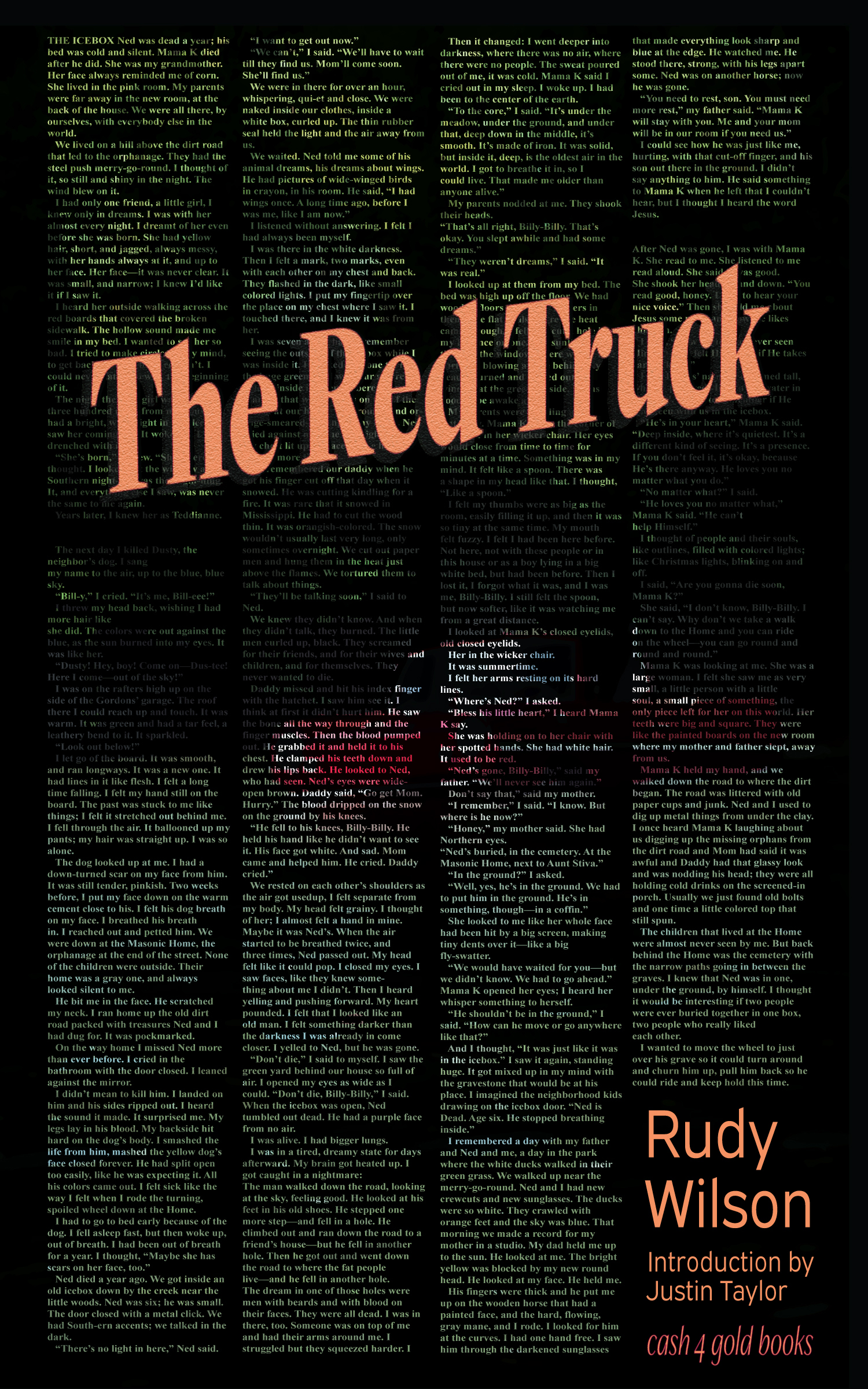
We got inside an old icebox down by the creek near the little woods. . . . The door closed with a metal click. We had Southern accents; we talked in the dark.
—Rudy Wilson, The Red Truck
I promised a boozy consecutionist whom I met at Sewanee that I wouldn’t begin this review with the mention of Gordon Lish. I promised, then (back home) I unpromised. Forgive me, reader—I did try.
The move, as it was conceived while drinking beers outside of a graveyard at the university’s edge, was to willfully ignore the influence of Alfred A. Knopf’s most infamous knifeman in hopes of celebrating the reissue of The Red Truck on its own terms. Lish’s shadow is, even now, a long one; and it shouldn’t distract from the essential point—that Rudy Wilson’s novel is a neglected masterpiece; and that the literary gods who were napping at their desks during its 1987 launch should treat Cash 4 Gold’s 2026 resurrection as a second chance to give this gem its luminous due. Also, though, because I actually (not just “officially”) enjoyed The Red Truck, I had hoped to spare it the privileged-but-problematic stature of books like Raymond Carver’s What We Talk About When We Talk About Love and Barry Hannah’s Ray; classics which, despite their self-authenticating greatness, have come to be understood as collaborations produced with Lish rather than projects edited by Lish. Thus, the idea, there in Sewanee, was to shout a simple truth from the rooftops—that The Red Truck is the best book you’ve never heard of; a marginalized triumph; a sunken treasure; an outsider’s Bible; the fever dream you wish you’d written; the literary equivalent of Jason Molina; and (like Molina’s best work) a poem too pure for a world weaned on trends. Consider it shouted.
But here’s the truth (critically speaking)—if half the joy of reading The Red Truck stems from the language left on the page (a thrill owing to Wilson), then the other half correlates to the language excised from the page (which is all Lish). And it’s this editorial cocktail—Wilson’s Deep South maximalism swishing, sentence by unctuous sentence, against Lish’s New York minimalism—that makes for such a heady style. For a sense of how the two approaches muddle into their signature tinge, take the novel’s opening, which maps the familial ties of Billy-Billy Jump, the story’s twelve-year-old protagonist:
Ned was dead a year; his bed was cold and silent. Mama K died after he did. She was my grandmother. Her face always reminded me of corn. She lived in the pink room. My parents were far away in the new room, at the back of the house. We were all there, by ourselves, with everybody else in the world.
The linguistic buzz—that unfazed and mud-tongued staccato—is all Wilson’s. As is the deadpan-elegiac tone and the heart-on-sleeve existentialism. (Cue the D. Lynch comps.) But the compressed violence (two deaths in three sentences) and the elliptical (if not withholding) narration arises from what Doris Grumbach, in her memoir The Pleasure of Their Company, called Lish’s “slashing hand.” Barry Hannah remarked on said “slashing” in two different interviews from the 1990s. Talking to Don Swaim in 1993, Hannah said of his longtime friend and editor: “Gordon always went for . . . the more assaultive, the quickest stop. . . . He’s big on the blue pencil and hates unnecessary rhetoric.” Four years later, in a talk with Rob Trucks, Hannah further explained, “Lish . . . loves the echo. . . . He went more for tone, more toward poetry, the unresolved.”
That’s what makes for the best moments in The Red Truck—those inimitable poetic echoes. Wilson’s writing consistently delivers resonance even as it often resists resolution (a seductive and sometimes mystical effect that Publishers Weekly misread as “teasing”). But none of this gushing over the lyricism should lead you to believe The Red Truck is some kind of plotless “language novel.” It’s not. In what amounts to a hallucinatory bildungsroman, its narrative traces Billy-Billy’s journey through the Christ-haunted South in search of Teddianne Sayers, a messianic blonde teenager whom he has already met in dreams and (depending on how you read the novel) already loved in past lives. Billy-Billy and Teddianne are estranged (geographically speaking) for the early chapters of the novel, and each takes a turn as narrator to unpack the traumatic and transcendent parts of their childhoods. Eventually their paths converge, and Billy-Billy and Teddianne partner up (spiritually and sexually), and the narrative switches gears from coming-of-age to lovers-on-the-run. The book’s later chapters feature some of the best (and weirdest) sex writing this side of Kathy Acker, including a scene in which Billy-Billy and Teddianne consummate their passion alongside a can of yellow paint:
I touched the surface of the paint, its face, with my fingertip. I pulled it out, dripping. I stuck it into my mouth. The paint can had said it wasn’t a poison; it was made for children. I sucked the yellow color. I put some down on me, between my legs. I put a lot down there. I put the paint on my face, just some, and then all over my mouth. It tasted yellow. It dripped out of my mouth and on my lips and down my chin. I was naked. Billy-Billy was sleeping.
But as wonderful as The Red Truck is as a love story, what sticks most stubbornly in my memories of it are its vivid scenes of seemingly predestined violence. Like this passage from the novel’s second page, which features Billy-Billy jumping off a roof and breaking his fall on Dusty, the neighbor’s dog:
I landed on him and his sides ripped out. I heard the sound it made. It surprised me. My legs lay in his blood. My backside hit hard on the dog’s body. I smashed the life from him, mashed the yellow dog’s face closed forever. He had split open too easily, like he was expecting it. All his colors came out.
Or this one, which narrates another fall that results in a death (a conscious refrain in a book made up of conscious refrains), this one from Teddianne’s childhood:
When she was twelve, her brother, Charles, was killed when he fell to earth from fifty feet of tree—floating as he fell with his arms stretched wide and a towel flapping behind him. He hit with a heavy sound, and the sound made a place like a spoon shape in Teddianne’s heart.
And then, of course, there is the novel’s most famous violent image—the suffocation of Ned (Billy-Billy’s younger brother) inside of an abandoned refrigerator:
When the icebox was open, Ned tumbled out dead. He had a purple face from no air.
I was alive. I had bigger lungs.
Wooed by the sheer miracle of compression on display in these paragraphs, one thinks again of Lish, and just how much language he had to slash away from the original manuscript to produce these lithe and dreamish vignettes. The answer: exactly 262 pages. In a phone conversation which, incidentally, also took place during my stay in Sewanee, I spoke with Rudy Wilson, and he told me how Lish took the original 440-page manuscript to France and returned one month later with a 178-page version that felt (in some ways) inevitable and (in others) unrecognizable. Not only had Lish cut the book by more than half, he had committed the (for some) unpardonable sin of relocating language.
“He took a sentence from the middle of the book,” Wilson shared, “and he moved it to the very end.” (The line in question here is “Sometimes, I raised my head to look out the window at the sea.”) “He also wanted the title to be Cartoon,” Wilson confided. “I couldn’t have that.” (Titles were apparently a thing with Lish. During this same phone call, Wilson shared an anecdote about the time Lish offered to publish one of his short stories in The Quarterly but only if Wilson changed the story’s title from “Horse-Child of Mine” to “Cake.”)
But the most critically significant takeaway from this phone call came when Wilson discussed how, after Lish cut and rearranged the 440-page version of the book, Wilson then made cuts to Lish’s cuts and rearrangements to Lish’s rearrangements, giving the already-purified prose a kind of triply distilled quality. “It was important to know,” Wilson said, “that every single word in the book came from me.”
Every single word in the book did come from Wilson, and once those words were put between covers for the 1987 release, Lish famously said, “I wish I could put my name on it.” Wilson has since gone on record as saying, “He [Lish] wants to get to the meat of the work and display it in its honest reality, and I believe he is a genius at it.”
Lish (the genius) and Wilson (the generator) worked with (and against) each other to make an “honest reality.” And lest the excerpts quoted above give the impression that the “honest reality” of The Red Truck is one dominated by violence and sex, think again. Where brutality and carnality appear, so do tenderness and (not infrequently) faith. In fact, the title derives from a one-page chapter (named “Christ”) in the book’s middle where Teddianne experiences a spiritual vision:
Teddianne ran out of the house from the back door and up over the front yard hill. Parked on the street was Christ. It looked like a red truck.
It sat, facing down the hill.
“It’s too big!” she cried. “I can’t get it in. It hurts; the truck, it’s too big for my heart.”
She pressed her hand to her chest.
But then Teddianne fit it in. She got it in. She opened up and got it in.
The world of The Red Truck, which is both recognizably Southern and unapologetically surreal, supports a theophany such as this because, as Justin Taylor astutely points out in the book’s introduction, this is a world where “the uncanny and inexplicable are structural conditions of the real itself.” There’s no question that Wilson’s characters are “uncanny and inexplicable,” but they are also earnest, and (insofar as there’s nothing more human than the braided urge to love and be loved) they are also unbearably sympathetic. Like the comps mentioned thus far—Barry Hannah, and Jason Molina—Rudy Wilson champions large-hearted outcasts who, though scarred by their violent pasts, continue their search for, if not a happy future, some kind of romantic salvation amidst the ruins.
Maybe my favorite passage in the book, especially after Wilson told me over the phone that the novel’s original, pre-Lishian title was Samskara (a Sanskrit word meaning “scars on the soul”) is one in which Teddianne prays for Billy-Billy and envisions a shared journey that is in turns corporeal and spiritual:
Billy-Billy drove the car straight out of town onto a quiet road, straight toward the morning sun. We headed toward its huge yellowness, and through it, purified and scarred by it, too. It left a permanent impression of Billy-Billy and me together inside, on our souls where only the deepest scars remain.
The Red Truck will, if you let it, deliver this transcendence to any reader who is tired of books with no scars and books with no soul—it will, I promise, leave a “permanent impression.”
Dan Leach has published work in The Southern Review, Copper Nickel, and The Sun. Junah at the End of the World, his debut novel, was released by Hub City in 2025. He lives in the low country of South Carolina and teaches writing at Charleston Southern University.

More Reviews