Hobo Fever Dream
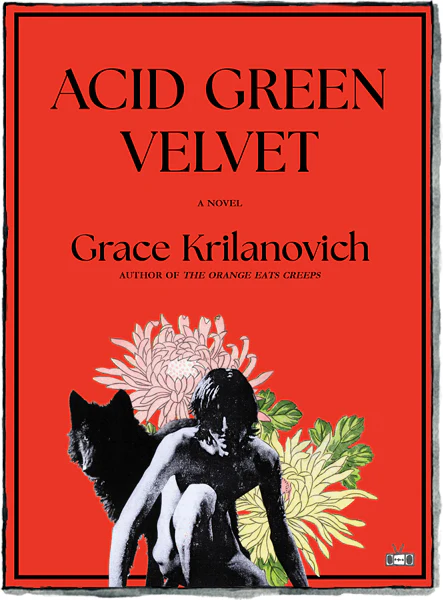
“For years rambling men had sheltered in the trees along the roadways,” Grace Krilanovich writes toward the end of her sly and exuberantly bizarre new novel, Acid Green Velvet, out this fall from Two Dollar Radio, “sipping java or whatever from rusted cans, biding their time in the jungles till the revolution when everything that was hiding would come out and the elites would be banished. But afterward, in a cruel twist the men too had disappeared.”
In context with the novel’s plot—which centers what can best be described as a love triangle of misbegotten voluptuaries living in a fictitious late-Victorian California boomtown overrun by “tramps” and “’boes” (contemporaneous slang for hobos!), who wage a failed revolution against its ruling elites—the above quote seems to serve as a coda of sorts. At the risk of spoilers (a relative term when it comes to Krilanovich): Although the “yeggs, vagrants, aging sports, and minor thieves” who infiltrate the town cause quite a ruckus over the course of Acid Green Velvet’s outwardly breezy, yet inwardly dense two-hundred-some pages, all their jousting and hollering comes to naught. The town of Anzar remains more or less the dominion of its feudal overlords; the voluptuaries scatter, or disappear underground. Inequity falters but never lets go.
If your allegorical antennae are already going crazy here after reading even a very basic plot summary, rest at ease—you’re not mistaken. Krilanovich’s “cavorting” legions of late nineteenth-century rail riders and wandering itinerants do recall the sorrowful epidemic of houselessness overspreading modern-day West Coast cities like Los Angeles and Portland; her opium-addicted, deliquescent elites in Anzar’s Hasley Manor, high upon its hill, do recall those of our own broken world (Tom Cruise or Gwyneth Paltrow somehow both come to mind, if you were to take the land grabbing and opium and add Scientology and vagina-scented candles); and her nineteenth-century immersion in Spiritualism and anarcho-matriarchal communities—not to mention vampires, werewolves, and the occult more generally—does recall the twenty-first-century “California freakiness” of Transhumanism and anti-vaxxer mommy bloggers.
Yet for all the parallels that exist between Krilanovich’s carnivalesque, pseudo-historical send-up of the modern West Coast and the place itself, the novel’s illumination of those parallels ultimately presents nothing so much as a sort of closed circuit, one of Acid Green Velvet’s slyest tricks. Which isn’t to say there is no meaning; Krilanovich is too smart for that. Only that this is a book that gleefully sidesteps our compulsion to understand it, seducing us in that very process.
Acid Green Velvet is the long-awaited follow-up to Krilanovich’s highly intoxicated and otherworldly 2010 debut, The Orange Eats Creeps, a high-minded gutter-punk road epic of “hobo vampire junkies” rampaging across the wastes of the Pacific Northwest, fueled by cough syrup and existential dread, now generally considered to be a cult classic and currently undergoing cinematic adaptation by American Psycho’s Mary Harron. Lucky for us, Acid Green Velvet is not only a somewhat better second novel, but also a more purposeful and controlled one. It’s also more rigorous, lyrical, and challenging, in the very best way—the absinthe-infused Gobstoppper to The Orange Eats Creeps’ sizzurp-spiked Fun Dip, rewarding the attentive reader.
For the briefest of plot rundowns, back to that love triangle: Quintessential woman-with-a-shadowy-past Paulette Eligon and pseudo-intellectual, paregoric-sipping enfant terrible Johnny Hasley, whose family has ruled the town of Anzar (its name like some Byronic B-side) for generations, lie abed all day in Hasley Manor, slurring fond aphorisms and getting real high between very occasional bouts of screwing. Cue the entrance of Paulette’s former lover, the enticingly lumpy-bodied Kenneth, who we learn at the beginning of the novel was an accomplice some years before in the seaside murder of Paulette’s slimy, mercurial father, Rodney. Yet no sooner has Kenneth re-arrived on the scene—comically foretokened by “little gentleman bootprints all over the [herb] beds, right under the kitchen window,” hoping to win back Paulette—than we discover that Paulette’s father is not, in fact, dead after all, but has now become a silver-braided, shamanic leader to the “yeggs” and “’boes” and “tramps” (Krilanovich, clearly obsessed with various states of nomadism and transience, gives the reader more period-specific words for unhoused person in Acid Green Velvet than they might ever have use for) turning the town into their campground. But the “yeggs” are plotting revolution, a usurpation of the Hasleys and the ill-gotten summit upon which they stand.
“By summer the occupation had outgrown the park to encompass every public crevice and street-side nook downtown,” Krilanovich writes of Anzar’s unhoused visitors,
claiming scores of vacant buildings for the people. . . . The Main Stem was a pageant, a gathering of the tribes: vagrants as sailors, vagrants as concrete men, sandwich counter girls, field-workers, baby handlers, food tasters, range salesmen. Vagrants as sporting girls, stoat farmers, and rat trappers. A generation from now people would pretend to know what happened here, would insist on the idea that some authoritative entity was present. Digging up the bones of our community they would pretend to comprehend the story of alien ancestors, whose skeletons lay scattered in party positions in graves dug by drunkards and sleepwalkers.
One need only imagine the result of shaking up such an unstable mix of personalities and agendas to get some sense of the gothic outlandishness that follows—though in the end, well, that’s not really the point. Not from this reader’s vantage, anyway. Making my way through Acid Green Velvet and its reflexively telescopic examination of history, I got the creeping sense that Krilavonich isn’t, in fact, attempting to reinvent the manner in which we view ourselves as a society, but rather attempting (with resounding success, as in The Orange Eats Creeps) to reinvent storytelling, language, and world-building, completely. Where most writers endeavor the typical coup, seducing the reader with immersive language and atmospheric world-building to present an allegorical or politicized meaning, Krilanovich, still the clear-eyed iconoclast after sixteen years, takes the opposite tack, drawing us in with allegory, then demolishing our minds with words.
“We repaired to the busted cantina,” she writes in one instance, where
occupying the tables inside were elderly women half dozing with their necks bundled in scarves, large raucous groups of shopworkers, gutter wizards tapping their long nails on streaky beer mugs, and bearded train hoppers bantering with serious-faced youths in multiple coats.
Further still:
When the storm cleared some of the familiar faces showed up at camp, a few from Hasley Manor, girls from town, but there was a temporary air to the way they lounged. They came with stolen goods and town food. They lit the perforated shacks with oil lamps, and over flames burned herbs and hair clippings to bless the journey ahead. Kindling was laid in the sun to dry in hashed aura cascading down the embankment. Later they lit bonfires, scattered flares chittering right in the mud of the commons. By night they had spiced wine warming in a kettle, bread toasting, and stolen ham chunked on skewers, sizzing over orange coals. On the morning they’d chosen for their departure, they tied sodden blankets up in the branches, steam lifting in the sharp sunlight. They were adamant about having a good time.
Or, gloriously:
Errant sensations of recent weeks slipped back to me—his whimper in my ear, his grip on my neck, how he tantalized me, stretched across the sofa like a feral cat or a tray of dangerous vegetables. The honeyed air of his kisses at night. I alternated him with sips of wine. He let me drink but wouldn’t touch it himself. I bowed low to kiss him again and again, to taste what poison I alone was permitted, partaking of his mouth, that deathly serious begonia.
Oh, what heedless and refreshing joy! The Orange Eats Creeps is a cult classic, sure. But Acid Green Velvet is a cult.
Adrian Van Young is the author of four books of fiction—most recently, Rough Beast. His writing has been published in Granta, McSweeney’s, and The New Yorker online. He is a freelance editor and splits his time between Paris, where he lives with his family, and New Orleans.

More Reviews