Running Is a Road to Nowhere
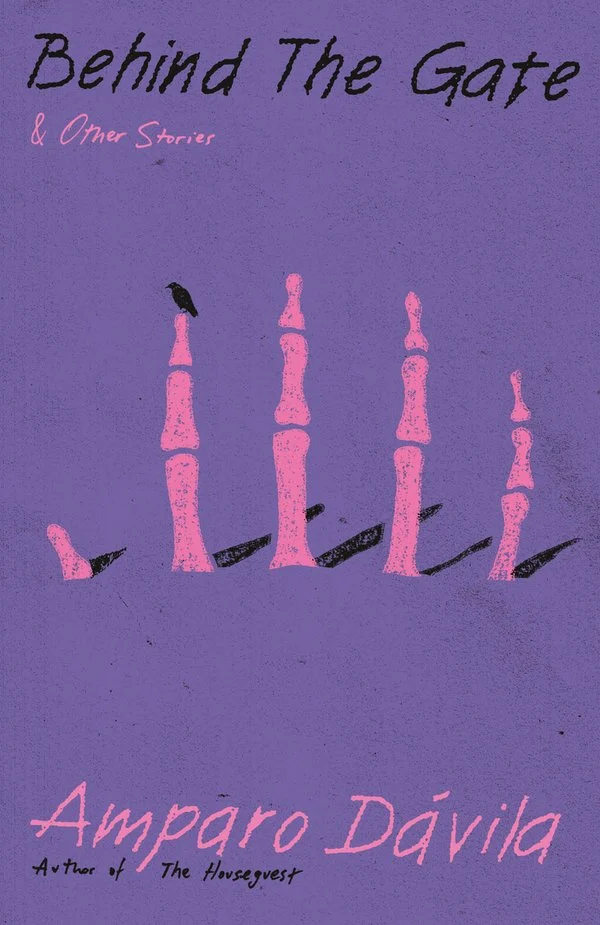
Mexican author Amparo Dávila, who died in 2020 at the age of ninety-two, is one of those rare writers known solely for their achievement in a single strain of literature—in her case, three collections of unsettling short stories portraying the frantic delusion and psychological turmoil that can develop out of nothing more sinister than, say, being alone in the dark, conversing with a stranger, or growing up a woman in the world. But Dávila actually began her career as a poet, publishing several slim volumes of verse in the decade before her debut story collection.
Her first chapbook, Salmos bajo la luna (1950), was written when Dávila was only in her early twenties, but it reveals an artist who already seemed to sense the direction she was headed, introducing themes of absence, insomnia, paranoia, terror, silence, and solitude, all subjects that would preoccupy her for the rest of her life. While she almost certainly didn’t intend it at the time, the book’s opening poem, “Aquí bajo la luna,” can even be read as a blueprint for how she would conduct her career. Dávila’s poetry has never been translated into English, so my amateur rendition follows the original below.
AQUÍ BAJO LA LUNA
Aquí bajo la luna transparente; entre el río melancólico de las aguas lunares,
deshojaré mis salmos; salmos color violeta como la flor del crepúsculo,
dichos a media voz mientras dura la luna.
HERE BENEATH THE MOON
Here beneath the transparent moon; midst the melancholy river of lunar waters,
I will bare my psalms; psalms violet-colored like the twilit flower,
whispered while the moon endures.
Dávila’s work was not accessible to Anglophones until 2018, when New Directions published The Houseguest, a selection of twelve stories, translated by Audrey Harris and Matthew Gleeson, that drew heavily on Dávila’s early work, with half coming from Tiempo destrozado (1959), four from Música concreta (1961), and just two from her third and final collection, Árboles petrificados (1977). The title was warmly received, and now Harris, Gleeson, and New Directions are back with Behind the Gate, a collection of ten stories that shifts the balance toward the latter part of Dávila’s career, taking four stories from her 1977 collection and three from each of her first two books. It’s not clear what criteria dictated the contents of the two New Directions volumes, and while The Houseguest is maybe a bit more uniformly satisfying, there’s not a significant drop in the quality of stories in Behind the Gate. (Fifteen stories remain untranslated at this point—three from Tiempo, one from Música, six from Árboles, and five published only in Dávila’s collected works, Cuentos reunidos (2009)—and I really hope that Gleeson and Harris are given the opportunity to put out a third volume that would complete their project and enable English speakers to read Dávila’s work in the way she originally published it.)
It can be difficult to isolate a unifying theme for stories that were never intended to be considered together, but reading The Houseguest, I often found my imagination supplying the specifics of a particular menace, filling in details or making assumptions about things Dávila intentionally left unsaid or vague. The stories in Behind the Gate are generally less enigmatic, and yet several times they upend your perspective so completely at their conclusion that you have to reassess what you thought you knew happened. Take Marcos, the protagonist of “The Tomb Garden,” which opens the collection. Now forty, he’s returned to an abandoned monastery where his family vacationed when he was growing up. The story alternates between teenaged Marcos’s diary entries and adult Marcos’s impressions of his youth, a time when he began sneaking out to avoid the specter he sensed at the foot of his bed in the monastery. As an adult, he’s never been able to shake the “double life” he developed, the nights drinking in bars and picking up women solely so he would not be alone. He’s nostalgic “for that time of life when he had been so innocent of literary concerns and life’s complications,” but an epilogue raises the possibility that it’s all a twisted fantasy conjured by his adolescent mind.
“The Tomb Garden” is one of just two stories in Behind the Gate that feature a male protagonist. Both have elements of genuine darkness, but their overall vibe is more aggrieved aggression or angsty disenchantment than anything. For the women centered in the collection’s eight other stories, the stakes are much higher and the prospects for finding fulfillment are much lower. This idea is neatly stated partway through “The Square Patio,” the most surreal story in Behind the Gate, which sees a woman experiencing a succession of nightmares or hallucinations—her partner leaps to his death, a dead girlfriend (possibly a model, possibly one photographed in explicit scenes) calls to her from among thousands of outfits, a librarian informs her that her “mental purity” doesn’t merit the book she wants to read. Just before she strips down and throws her clothes on a bonfire being used to vanquish childhood memories, one of the men who started the fire tells her: “We try to flee ourselves but there’s no escape; the chaos inside always projects itself outward; running is a road to nowhere.”
Women trying and failing to find their way out, often trying to escape the consequences of being a woman, is familiar territory for Dávila. Several stories in The Houseguest deal with variations on this conceit, notably the harrowing “Tina Reyes,” where a woman is confronted by a man who won’t take no for an answer. Dávila takes up the theme throughout Behind the Gate as well, but never with the verve that she does in the collection’s standout title story. The twenty-three-year-old narrator lives with her aunt Paulina, who raised her, and her grandmother Dorotea, who spends her days sitting by the window. Paulina, a spinster at forty because she never got over being jilted by her first love, shares a bedroom with her niece, and shortly after the story begins, the two also share an attraction to Dario, newly returned to town from school in the north. When Paulina is away on business, her niece starts sleeping with Dario. The story overtly acknowledges sex with a frankness that is rare for Dávila, with the narrator saying at one point, “I watched [my aunt and Dario] dance with great distaste, even though afterward I would have him in a way she never could.” In another rarity for Dávila, the story’s narrative pits the women against each other, destroying their relationship—“we were like two starving beasts fighting over the same prey”—and making readers question who will prove to be “too clever, too cruel.”
The relationship of women to each other again comes to the fore in “The Mirror,” though this time it’s a mother and daughter who seem set up to be at odds with each other after the daughter places her mother in a sanatorium to recover from a broken leg. Yet the daughter refuses to abandon her mother after the older woman’s condition deteriorates, leaving her “pale, emaciated . . . her restless, trembling hands [betraying] the state of her nerves.” The threat is seemingly supernatural, but modern audiences will also see malice in Dávila’s depiction of the medical attitudes of 1959, as when a doctor explains: “There are many cases of serene, self-controlled women who, when they reach a certain age, become excitable and demonstrate symptoms of hysteria . . .”
Two other stories see women driven to desperation because of marriages, though in distinctly different ways. In “Griselda,” the fifty-something title character bonds with the young Martha over their shared sense of loss, the former for her husband, who died many years back, the latter for her father, whose death was much more recent. As the air grows soporific with the “smell of the jasmine and the honeysuckle,” Griselda reveals the truly horrifying intensity of her grief. “Matilde Espejo” is also mourning, though in her case the losses are many, including her parents, sister, two brothers, and three husbands. For the story’s narrator, Matilde remains “the kindest person in the world,” but the truth is much more sinister.
In “The Night of Broken Guitars,” Dávila powerfully demonstrates how a woman can lose herself, either to her own vanity or to a partner with violent tendencies. A shopkeeper, looking like “an authentic doll from the 1920s,” discusses herbs, lotions, tonics, and creams with Shábada whose daughters wander through the store touching everything like kids do until the doll’s “corpulent” husband (or possibly her father, boss, or owner, as it’s not explicitly stated) starts shouting at them, convulsing with “rage, grotesquely gesticulating and tearing at [his] hair.” Shábada and her girls flee, leaving the doll “lost in the gloomy tunnels of fear and disillusionment,” conditions that characterize so many abusive relationships.
Along with the social issues still recognizable to twenty first–century readers, Dávila’s stories in Behind the Gate also highlight contemporary concerns, like consumerism. In “Death in the Forest,” a man has fallen out of love with his wife as she’s aged, a feeling devastatingly expressed in the line “Sometimes he stood there watching her with great pain and a kind of tenderness, the way you might contemplate the grave of a loved one.” For her part, the wife is sick of all her husband’s crap, telling him to either find another place to store it or move out. Though the story was published in 1959, his rant could have been posted on social media yesterday: “Anywhere you go, it’s the same . . . Collecting trash loading up on useless things in case they come in handy someday, this desperate amassing of things and more things, until one day you die suffocated by them.”
Another story that would be totally at home on the pages of a present-day literary magazine is “Señorita Julia,” also taken from Dávila’s 1959 collection. Julia’s life starts falling apart the first night she’s kept awake by “a strange noise, like the light racing and kicking of little feet.” More than a month later, she still can’t sleep. And even though Julia was a woman of “impeccable conduct and everyone knew it,” her coworkers start gossiping about her, conjuring “the most shameful and humiliating explanations for her behavior.” Eventually, her sisters and fiancé start to buy into the rumors too, causing Julia to despair. “The baseness and lack of sympathy most people were capable of shattered and depressed her completely.” (Oh, just you wait till they can hide behind online anonymity!)
Left to her own devices, Julia’s deterioration accelerates: “She couldn’t find her bearings; she’d been left in the abyss, spinning blindly in the dark; she wanted to let herself go, lose herself in sleep; forget it all.” The story ends with a succession of ellipses and clauses breathlessly hurtling the reader down the page. It’s a stylistic flourish that Harris and Gleeson deftly handle in various guises throughout Behind the Gate, and one that’s tremendously effective at making you feel as if you’re rushing headlong into something troubling, something unavoidable, something from which you will never escape. Given the prescience of Dávila’s disquieting tales from fifty, sixty, sixty-five years ago, you can almost hear the footsteps of fate chasing you, until you run out of room and find yourself trapped, alone, in the dark.
Cory Oldweiler is an itinerant writer who focuses on literature in translation. In 2022, he served on the long-list committee for the National Book Critics Circle’s inaugural Gregg Barrios Book in Translation Prize. His work has appeared in the Boston Globe, Minnesota Star Tribune, Los Angeles Review of Books, Washington Post, and other publications.

More Reviews