Sapphic Magic
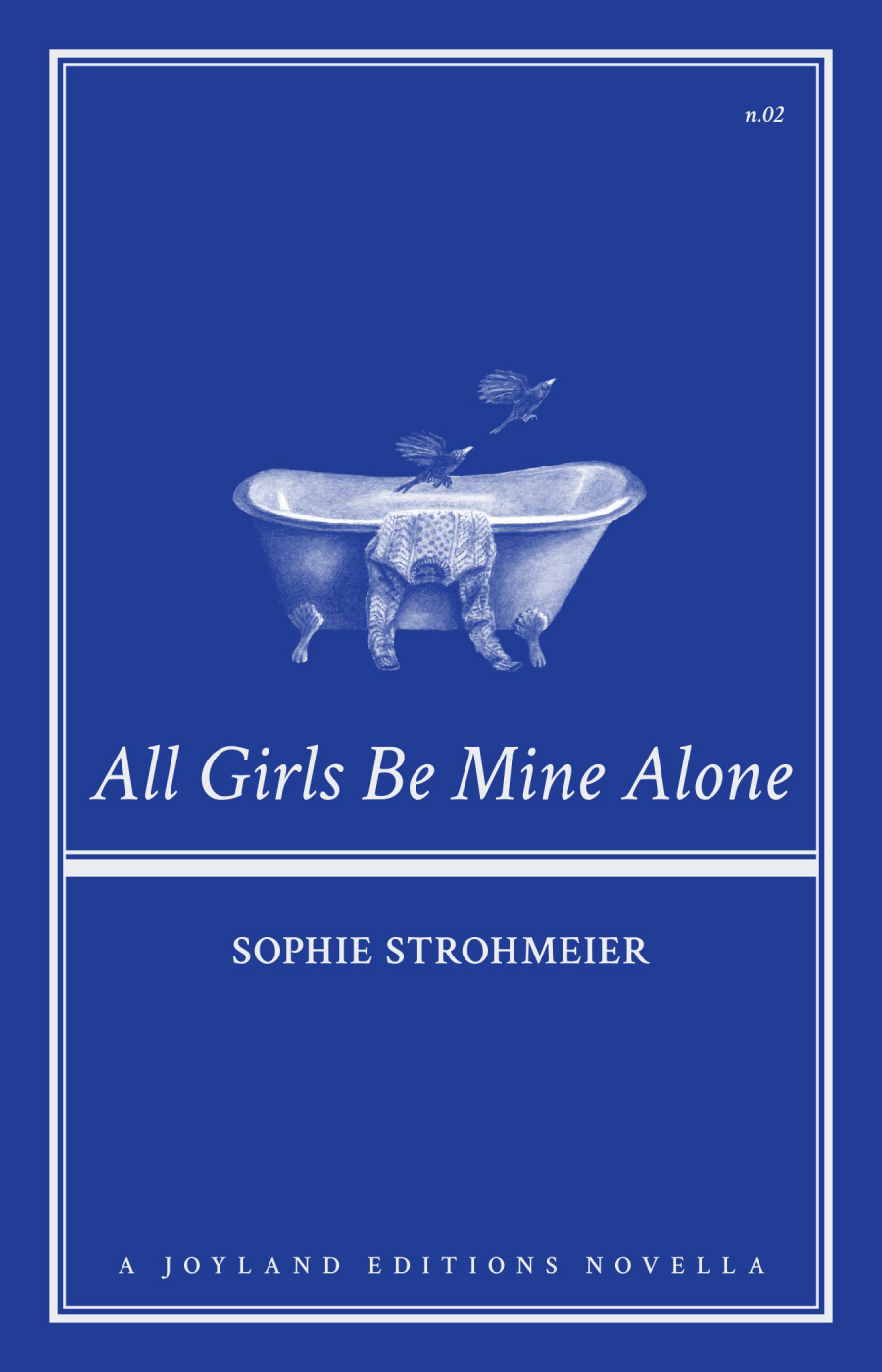
Lesbians, opera singers, and birch trees? Yes. Mulholland Drive, monsters, and Mozart’s Magic Flute? Absolutely. The bilingual writer and translator Sophie Strohmeier strikes all the right dissonant chords in All Girls Be Mine Alone (Joyland Editions, 2025). Where else might high school music students fight and flirt over orchestras and operas but in the City of Music: Vienna. Strohmeier has spun an irresistibly gorgeous and ghoulish novella of mythic gossip and heartfelt coming of age. The richness of her novella comes not only from her skillful storytelling, but from her uninhibited character portrayals and textured world-building, twisting a two-part tale into one raveled narrative of obsession and possession.
All Girls Be Mine Alone is as much a story of passion and magic as it is an ode to the act of storytelling—legends, fairy tales, myths, operas, and of course ghost stories. Strohmeier’s unnamed narrator reminds us repeatedly of the intimate relationship between storytelling, confession, and testimony, as she looks back on her cloistered days as a Gymnasiastin. She recounts the series of events leading up to a night that leaves her changed, pricked by the metallic blows of winter and spellbinding desire, the kind that shows up without a plan and slips its spindly fingers through the moth-eaten hole of a wool sweater. She hadn’t planned to go to Wolfie’s party that night, lounging about listening to Brahms in her pj’s, but when her deskmate, Joachim, texts with such desperation for her to “please come,” she nearly feels needed, significant, possibly even seen. She goes, bringing along Brahms’s violin concerto, and wearing a pair of “undies with brown bloodstains in the crotch area.” (You either do or don’t shamefully own one or two yourself and wear them on nights you think no one will be coming close to you and your waistband.) Curious to put a face to the name of who has caught Joachim’s attention via a sequence of coquettish Belle-and-Sebastian-riddled texts, she meets Lea, Wolfie’s childhood friend, a student at the other Musikgymnasium; Lea, the woman to whom, years later the unnamed narrator “will dedicate this whole story to.”
But back to the party. What better way to get to know someone than by swapping neighborhood legends of mythical creatures, gates to hell, and badass nuns? Maybe a cobblestone stroll in the soft November rain? The warm, earthy smell wafting from a bag of roasted chestnuts to share under the moon? The only problem is Joachim, Lea’s boyfriend, the “cartoon goblin” who’s annoyingly able to distinguish Haydn from Salieri on the radio. And lest we forget, where there is opera, there must be drama, the spectacle of conflict, the looming threat of competition in the halls of high school, and the freaky psychic lengths to which a lovestruck protagonist will go to get what she wants.
It’s no coincidence that Strohmeier chose an unnamed narrator to usher us through the torments of a triangulated love story—a winter love story at that, one that echoes the plight and delight of Dostoyevsky’s unnamed protagonist in “White Nights” (which, of course, she fantasizes gifting to Lea). But the lexicon of All Girls Be Mine Alone doesn’t limit its allusions to literature and music; it’s also haunted by lore. The Basilisk appears throughout the first section (and its title, “Under the Basilisk”) as a landmark that conjures Vienna’s legend, a cultural inheritance that colors and shapes the air of the city through the eyes of the unnamed narrator. Part of a legend’s longevity comes from its ever-threatening possibility of recurring: a monster’s return, a creature reawakened, a spell recast. The Basilisk might just be the stucco façade above an antique bookstore, or it might be the part-rooster, part-serpent monster at the bottom of the well, or the aches we try to bury, the obsessions we wish to flood out with white noise, distraction, and denial.
It’s only natural (or supernatural) for Strohmeier’s novella to straddle time, to drift between the past and present weightless; or perhaps more so, to pull these portals into greater proximity. This is what music can do. Music can repeat a phrase, a melody composed, performed, and listened to in one place and time, and replay it in an entirely different context wherein the past is carried into the future. An incantation of sorts. It sounds simple, but really, isn’t this a kind of teleportation, time travel, or collision of the space-time continuum? Clearly I’m not a physicist, but I was once a girl caught between adolescence and young adulthood. I was a girl kissing another girl in secret, hiding from my classmates and friends, falling in love one winter night so quickly that it wouldn’t have taken much to convince me of desire’s supernatural constitution. I, too, wove my hand in and out of her pocket, flinching at the sight of an approaching classmate, someone who would ask and accuse me in the same breath, “You’re a lesbian, aren’t you?”
Here, I’m compelled to ask the obvious: Am I projecting? Am I entirely enmeshing my life, my desires, worries, and memories, exchanging imagination for a mirror simply because my grandmother sang opera? Because I know the eyes of the birch trees from visiting my family in the Baltics? (No one else looking to astral project these days?) But then again, perhaps to get lost in a story is not so different from the questions of possession that Strohmeier’s novella poses and invites us into by way of séance, rituals, body swapping, and some pretty steamy sex. In many ways, crafting a protagonist and first-person narrator your reader can project her likeness onto is a testament to good writing, to the ability to transcribe the unlit corridors of emotional and psychological interiority with enough detail and strangeness that a reader can slip into the page without knowing she’s even done so and is suddenly sipping herbal schnapps in a city she’s never been to, reading Rilke in the original German, standing at the window counting snowflakes as they dance into the mouth of midnight.
What’s so captivating about Strohmeier’s unnamed narrator is that she emits a particular glow of confidence that comes from an unwavering self-consciousness and a shameless attitude that gives no fucks at all. I thought this novella would be an investigation of artistic passion among friends, a coming-of-age coming-out sexploration story, and it is. But what it becomes in the harmony formed between the two sections is much more. Strohmeier continues to pull back one velvet curtain after another to reveal deeply complex questions of gender and sexuality in relation to performance with such utter frankness that, at times, I found myself unsure whether to laugh or sigh. That sly matter-of-factness comes from a fluency in fairy-tale logic, landing brightly lit moments of criticality with precision, offering us the obvious in the cape of absurdity, a symbol defamiliarized to become a “phantom thing.”
Strohmeier dials up the weird in the novella’s second section, “The Birch Trees,” as the narrative thread of infatuation and romance grows ever more fevered and frenzied. The narrator remembers a different night, summer, in which Stasi, the Russian “mother and housewife and most importantly a trained singer,” invites her, Nat, Nadya, and Larissa for a post–opera season Mulholland Drive movie night. But the night doesn’t end when the movie does. More wine and apricot cake lead the friends to talking about (what else) centaur sightings and dead bodies possessed by spirits. In no time, Stasi takes the storyteller’s mic: “There was a story I had known as a little girl about the origin of birch trees: how they had been girls once too, princesses, and they had been trapped by an evil spell.” The fairy tale becomes a threshold through which Stasi pulls the room of friends back into her days at Mikhail Glinka Conservatory as a vocal student, into the realm of winter’s music and the late-night dorm-room game she once played—a ritual that summons the spirit of an excommunicated monk and sends the student singers into a spiraling fear that one of them has been possessed by his “lecherous, brain-bending puddle of vileness.” How else could Stasi explain her vivid dreams or the magnetic tug in her gut, her need to know green-eyed Tanya, who seems to fear nothing and spins jam like a spell into every cup of tea? The world of Stasi’s memory is brimming with allegory: fairy-tale emblems and Biblical imagery alike. Emotions are expressed through allusion and songs are a measurement of their intensity—a mirror that reflects not the surface of the image, the bodily form, but the damp, mossy inner thoughts and desires, however lewd or lustful. And while the students remain under the spell of winter, its snow-packed pressure, every flush of the skin is electric, dizzying. Well-paced and methodic, we move deftly between duets, doubles, dusty sheet music, wind-chapped lips, trouser roles, and the prismatic shapes of passion. Performance and its malleability, its requirements, become yet another study in everyday possession.
I can’t help but think of the opening sentences from “On the Problem of Form,” written in 1912 by the Russian artist and theorist Wassily Kandinsky:
At the appointed time, necessities become ripe. That is, the creative spirit (which one can designate as the abstract spirit) finds an avenue to the soul, later to other souls, and causes a yearning, an inner urge. When the conditions necessary for the ripening of a precise form are fulfilled, the yearning, the inner urge acquires the power to create in the human spirit a new value which, consciously or unconsciously, begins to live in the human being. From this moment on, consciously or unconsciously, the human being seeks to find a material form for the new value which lives in him in spiritual form (trans. Kenneth Lindsay).
What I love most about Strohmeier’s characters is that they choose to believe in the creative spirit. They wholeheartedly leap into the bottomless lake of the uncanny, of art, of the chance to love and be loved with operatic force. And these leaps don’t always land. Even in those moments of failure or grief, these characters might regret choices they did or didn’t make, but never at the cost of neglecting the memory. “But I never forgot about this story, never stopped wanting to somehow recreate it, inhabit it, stay in it,” the narrator begins the novella’s penultimate paragraph. For me, this feels so true, and so European, so not American—that to linger in memory or in story is not always indulgent, but at times quite necessary and meaningful, and perhaps a resistance to the rush of erasure that stands in the way of time required to locate deep feeling.
Which brings us back to art. Time and choice become the guardians of memory, protecting and reshaping where the narrator sees fit in order to preserve a different, more precious wing of truth. Despite heartache or because of it, she leaves us in the possibility of ongoingness, the present tense, seeking, reenvisioning, creating a different ending, an invitation: “let’s call it a memory.”
Amanda Maret Scharf is the author of To Make a Bell Ring Back, winner of the 2025 Four Way Books Levis Prize in Poetry (forthcoming, spring 2027) and coauthor of the collaborative chapbook, Metal House of Cards (Finishing Line Press). Her poems can be found in Narrative, Poetry Northwest, Iowa Review, Gulf Coast, and elsewhere. She lives in Los Angeles with her wife and their dog, Silver.

More Reviews