The Guest List | Lord Huron
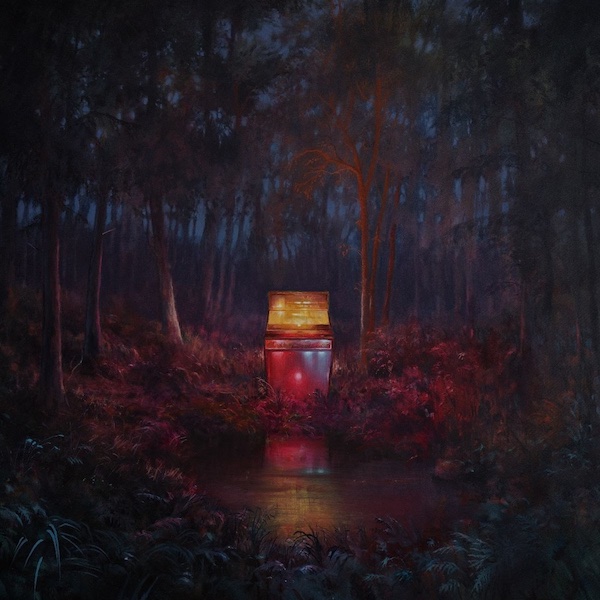
The Guest List is a regular book column that surveys the reading habits of our favorite musicians. In this edition, Jimmy Cajoleas talks with Ben Schneider of the Los Angeles–based indie rockers Lord Huron. Lord Huron’s latest album, The Cosmic Selector Vol. 1, is out now.
Jimmy Cajoleas: What are you reading right now?
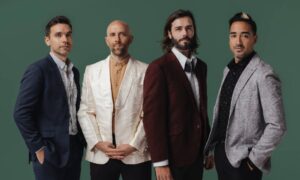 Ben Schneider: This has been one of my least literate years so far, just because I was so busy putting the record together. But I’ve got kind of a weird stack on my nightstand right now. I took a trip to Japan earlier this year and realized I didn’t know much about Japanese mythology or folklore, so I’m reading a book of Japanese folktales right now, which is a nice send-me-off-to-sleep sort of thing that I read before bed. And I’m also reading Emily Wilson’s translation of The Odyssey. It’s the most recent translation of one of my favorite books.
JC: How are you finding Wilson’s translation?
BS: I like it. It was really interesting to read her introduction, to learn about the choices she made. It’s funny, because I think of that book as like a big song, you know, which I guess it kind of is. One of the things I love about it is the repetition, and Wilson took an approach where she wanted to do away with the repetition and make it a little more novelistic, I guess, a little less repetitive. I think she’s probably being in some ways really truer to the original Greek, from what I can tell—I don’t know Greek, but from what I could glean about how she approached it. But I missed some of those poetic turns of phrase that previous translations had in them. The one I know the best is the Robert Fagles one. It calls Odysseus “the man of twist and turns,” which is such a cool phrase. I think Wilson just calls him a “complicated man,” which is just plainer language and probably closer to what it was in the original. But I’m loving it too, because it’s always nice to revisit those stories in a new translation. It’s like reading a new book, you know?
JC: Translation can be so strange. I read a lot of older Chinese poetry, specifically Tang Dynasty stuff. I first found them from Arthur Waley, a British translator who helped popularize Eastern poetry in English in the early twentieth century. And then later I read some newer translations, and they are radically different. To the degree that I felt like what I had been reading was more Arthur Waley than the original poet. But I also still have a soft spot for those translations. They’re almost a cultural interpretation as well.
BS: I guess it’s kind of hard to parse in some ways, but I like when a translator inserts some of their own artistry into it. It’s interesting. I think it’s good to know that they’re doing that, to have something to compare it to that’s maybe truer to the original, which is why I always wished I could read ancient Greek just to see if I could get a feel for what it was actually like in the original form. But that’s why it’s fun reading all these different ones over the years. I would always go back to The Odyssey. I think I’ve read four or five different translations of it over the years.
JC: To step back a bit, can you tell me more about that book of Japanese folktales?
BS: It’s literally just called Japanese Folktales. It’s a little red book. I don’t know who put it out. My wife had it in her collection. It’s got some of the classic stories, like Kintarō and some of those. I’ve definitely seen some of those stories trickle down into other stuff I really like. Miyazaki movies, comic books, but I never knew the source material that well. So it’s been fun to dig into some of that. And like I said, it’s like a nice way to end the day.
JC: Are there any books that inspired the writing on the new record?
BS: I have my wife to thank for getting me into Thomas Hardy over the last couple of years. She’s a huge fan, Tess of the d’Urbervilles in particular. She also got me this beautiful edition of his poetry that has illustrations by Stanley Donwood, who’s known for working with Radiohead, doing a lot of their visuals, which I think is just such a cool pairing. I really love Hardy’s poetry too.
I like all his novels I’ve read, honestly, but Tess has become one of my top three books. Hardy does such a good job of smuggling philosophy into these deceptively simple pastoral tragedies, you know? I always think about the conversation Tess has with her little brother, Abe, where she says that we live on a blighted star. And the climax is set at Stonehenge. There are these choices that give these little pastoral stories a cosmic dimension. It seems so contemporary reading it now. And I love that. It’s the type of subject matter I’ve dealt a lot with in the past. Finding new ways to present these big, sometimes daunting ideas in condensed, easy-to-digest forms. I was really inspired by his writing in that way. There’s so much in there that’s still applicable today. It’s a beautiful thing.
JC: I agree too about Hardy’s poetry. I feel he’s super underrated as a poet. Like, that poem “Drummer Hodge”? That was always my favorite.
BS: It’s such an incredible poem. The first time I read that, I was in Australia on tour. And obviously, it’s a different kind of drummer in the poem, but a musician who’s traveling in a faraway land and dies and his uncoffined body grows into a tree. I can’t remember the exact phrase, but his brain and lungs grow into a tree and “strange-eyed constellations reign his stars eternally.”
JC: Talk about one of the all-time great last lines.
BS: Yeah, it really is such a beautiful poem. I’m so glad you said that. One of his best.
JC: It was an important poem for me, especially when I was younger. “Strange-eyed constellations” was one of the first phrases that got stuck in my mouth, in that good way where I had to say it over and over again.
BS: It’s such a great phrase because it makes sense on first reading, but then you think about what it actually means and it gets more complicated. I mean, it’s like cosmic horror. It’s almost Lovecraftian. I get the same feeling from that stuff in Tess. The sense of scale that’s distilled into these little human interactions. It’s so complex in a really poetic way.
JC: What are some of your all-time favorite books?
BS: I guess there’s stuff I find myself returning to. There’s a Somerset Maugham novel The Razor’s Edge that I first read in high school. Basically, it’s about a guy who leaves the conventional world behind and becomes a monk. I’ve read it probably six times over the years, and I just love it. If I ever feel like I’m confused about where my life’s going or feeling a little unmoored, it’s been a very solid anchor.
I love Raymond Chandler. Farewell, My Lovely, I’ve read that probably twenty times. If I’m ever bored on tour, I can stay up all night and read Farewell, My Lovely.
JC: Why is that your favorite Chandler?
BS: I don’t know. I love all the little tableaus, like the gambling ship. I love the dangerous, very vibey of-the-time setting. I love the cult, and there’s a psychic, and it’s all very L.A., which is where I live now. Reading books that are set here back in that time period really lights up the city for me. A lot of the same landmarks are still here. Though the neighborhoods have changed, Chandler mentions things you know and plays the streets you know.
Another Raymond I love is Raymond Carver. I love his short stories. I’ve reread those countless times over the years. I’ve got the collection Where I’m Calling From, which has new stuff plus selections from Cathedral and the other collections. Those stories too seem so simple, but there’s so much in there. So much that they suggest. The smallest gesture can paint this whole complex world of emotion.
Did you ever get into Ross Macdonald? Zebra-Striped Hearse? Great tour books. What else? There’s this Michael Ondaatje book called The Collected Works of Billy the Kid: Left-Handed Poems. A fragmentary novel with such a cool form. I get a lot of inspiration from books that make you think about how a series of impressionistic fragments can hang together and tell a complete story.
I love comics too. Charles Burns’s Black Hole is a great one that I read a lot. The horrors of adolescence, I guess, is what this book is about. Burns puts it in a frightening visual context with disgusting but beautiful drawings.
I’ve read Dostoevsky’s The Idiot probably three or four times. I love that book. The Gambler too. I don’t know how to describe what I like about The Idiot exactly. It’s incredible that a writer can weave so much philosophy into a story. Did you happen to read that George Saunders book about Russian short stories, A Swim in a Pond? I’ve read that probably four times too. I mean, who knows if he’s right, but it’s so cool the way he breaks down how those stories were made. There’s something special about that period of writing in Russia, and it’s right up my alley in terms of existential philosophy being embedded in tragic stories.
JC: There’s also a boldness to those books. In Brothers Karamazov, or in Tolstoy, Anna Karenina. The ability to write from so many different perspectives with absolute authority and then make it all cosmic.
BS: The scope of those books is crazy. Like in War and Peace. Writing about war with such authority and what seems like firsthand experience, and then also writing young girls’ thoughts and having it feel totally real. Those are some of my favorite books.
JC: Do you read many books about music or musicians?
BS: Overall I’m not that interested in, like, how the sausage is made or behind-the-scenes stuff about music. It’s just never interested me that much. There are a few exceptions, though. Maybe because it feels to me halfway between autobiography and fiction, I love Bob Dylan’s Chronicles: Volume One. Usually I’m not that interested in musicians, as people, but with him, I am. He’s one of the best living examples we have of a dedicated artist. I think that’s inspiring, and also kind of scary. The person he’s become is just a one-off, a complete one of a kind where his experience has warped him in a really interesting way. I love that book.
JC: Are there any other books you’d like to mention?
BS: One of my favorite books of the past few years was Daniel Clowes’s last graphic novel, Monica. One of my favorites ever. Very original when it comes to storytelling. It’s a great example of how that medium is its own beautiful art form. The colors of the pages are different depending on whose head you’re in or what timeline you’re following. I’ve thought about it so much since I read it, and I think about it a lot still.
JC: I heard you got Karl Ove Knausgård to write something for your new record.
BS: So this has been my year of reaching out to people. I’m not like “on the scene” in any way. It started with us recording a song with my wife doing narration over it, and we just kept hearing Kristen Stewart’s voice, which is really random. But then I got in touch with her, and turns out she’s a fan and wants to record the song. It’s amazing. Then I had another song that needed a female vocalist. I went and saw a Blonde Redhead show here in L.A. and I thought, I’ve loved this band for twenty years, I’m going to ask Kazu Makino. She was down. I mean, like wow.
So then it comes time to write the bio for the band, which is a very small bit of copy. But I’ve always struggled with it because I’m pretty private, and I don’t really want anything to be about me necessarily or my biography—I want it to be about the music. It’s like that thing David Lynch said: I don’t want to talk about what I did. The thing I did is what I wanted to say, you know? So I’ve always struggled with bios. And I thought maybe we can just ask a writer who I admire to do it. I thought Knausgård would be interesting, just because biography is obviously such an important part of his writing. But since he wrote My Struggle, he’s written all these strange novels that have supernatural elements. Weird cosmic sort of stuff. So I thought I’d see what he’s up to. We didn’t hear back for a while. I thought, Yeah, that’s kind of what I figured. Then one day he’s like, Yeah, I’m a fan of the band, I’d love to talk to Ben. So we talked for like an hour. And he totally got what I was saying. He hasn’t turned it in yet, so we’ll see. But again, just the power of just reaching out and asking is a pretty shocking thing to me this year.
Jimmy Cajoleas was born in Jackson, Mississippi. He lives in New York.
